How to Build an Inbound Marketing Automation Funnel That Actually Works
Why Your Inbound Marketing Automation Funnel Is the Growth Engine You're Missing
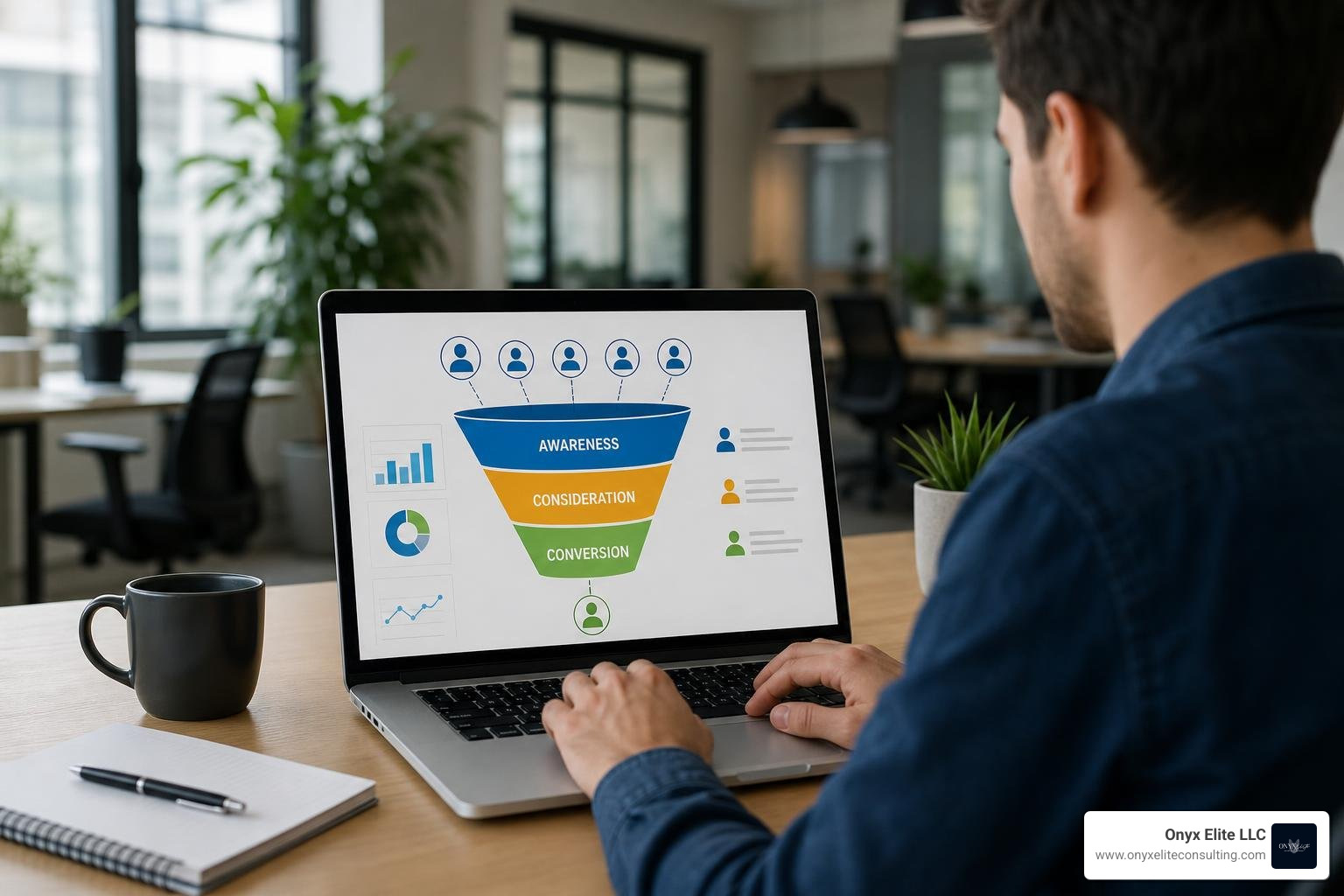
An inbound marketing automation funnel is a system that attracts potential customers through valuable content, captures their information, nurtures them with personalized follow-ups, and converts them into loyal buyers — all with minimal manual effort.
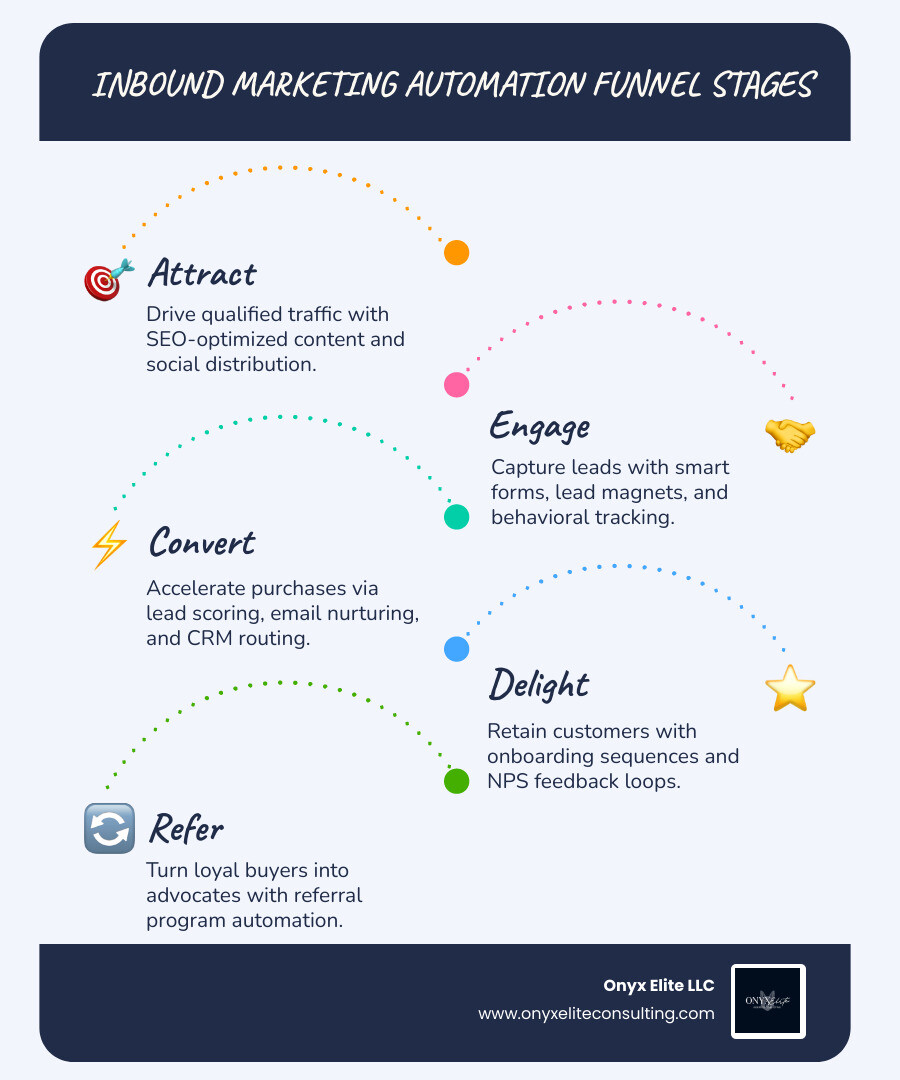
Here's the core structure at a glance:
| Stage | Goal | How Automation Helps |
|---|---|---|
| Attract | Drive qualified traffic | SEO, content scheduling, social distribution |
| Engage | Capture and qualify leads | Smart forms, lead magnets, behavioral tracking |
| Convert | Accelerate purchase decisions | Lead scoring, email nurturing, CRM routing |
| Delight | Retain customers and grow referrals | Onboarding sequences, NPS surveys, feedback loops |
Most businesses don't have a lead generation problem. They have a leaky funnel problem. They're spending time and money driving traffic to a system that isn't built to convert — or to keep customers once they arrive.
The good news? Inbound marketing is 54% more effective than traditional outbound methods at generating leads. And with the right automation in place, that system works around the clock without you.
Think of it this way: automation is a digital clone of your best salesperson — one that never sleeps, never misses a follow-up, and always delivers the right message at the right moment.
I'm Doru Angelo, Founder and CEO of Onyx Elite LLC, and over more than a decade of helping organizations build scalable growth systems, I've seen how a well-engineered inbound marketing automation funnel transforms inconsistent pipelines into predictable revenue engines. In this guide, I'll walk you through exactly how to build one that works.
What is an Inbound Marketing Automation Funnel?
To build a funnel that works in July 2026, we first have to understand what it actually represents. An inbound marketing automation funnel is not just a collection of landing pages and emails. It is a structured, human-centric system that aligns your business’s digital assets with the natural decision-making process of your buyers.
Unlike traditional outbound marketing, which relies on interruptive "push" tactics (think cold calling, unsolicited emails, and disruptive print ads), inbound marketing is entirely permission-based. It is designed to "pull" highly qualified prospects to your brand by solving their problems first. By wrapping this philosophy in modern automation software, we create a "digital clone" of our best sales and marketing strategies, running 24/7/365.
The modern buyer is in complete control. They do not want to be sold to; they want to be educated. In fact, research shows that up to 80% of all search traffic consists of informational queries where users are looking for solutions to their challenges, not looking for specific brands. When you build an automated inbound funnel, you build an educational path that meets prospects exactly where they are, guiding them from anonymous website visitors to brand advocates without any manual friction.
Inbound vs. Traditional Sales Funnels
Traditional sales funnels are built on a "push" mentality. They assume a linear, rigid path where marketing dumps a high volume of raw contacts into the top, and sales aggressively pushes them down to the bottom. This legacy approach is not only incredibly expensive to maintain due to rising ad costs, but it also ignores how modern buyers interact with brands online.
An inbound automation funnel, on the other hand, is customer-centric and highly dynamic. It focuses on attracting high-quality, qualified traffic rather than raw quantity, and it values the post-purchase relationship just as much as the initial sale.
| Feature | Traditional Sales Funnel | Inbound Marketing Automation Funnel |
|---|---|---|
| Core Philosophy | Push messages out; disrupt to get attention | Pull prospects in; provide value-first content |
| Buyer Journey | Linear and rigid | Dynamic, multi-channel, and looping |
| Marketing Role | Hand off raw leads and stop | Nurture and build context across the entire lifecycle |
| Automation Use | Blast generic email campaigns | Deliver highly personalized, behavioral-triggered content |
| Post-Purchase | Neglected; focus is entirely on the next new deal | Prioritized; automated retention, onboarding, and expansion |
The Shift to AI-Powered Loop Marketing in 2026
As we navigate 2026, the digital landscape is experiencing its biggest disruption in over two decades, primarily driven by the rapid rise of Artificial Intelligence (AI). Traditional search engines are evolving into answer engines. This shift means that Answer Engine Optimization (AEO) is now just as critical as traditional Search Engine Optimization (SEO). AI search engines are directly synthesizing answers for buyers, which requires brands to focus heavily on creating highly authoritative, cite-worthy content.
Furthermore, growth no longer happens in straight lines; it happens in dynamic loops. This has led to the rise of "Loop Marketing," an AI-powered framework that builds directly on top of the traditional inbound foundation. Instead of linear paths, Loop Marketing relies on autonomous multi-agent AI systems that continuously express brand identity, personalize interactions in real-time based on subtle behavioral cues, amplify content across highly fragmented channels (like Reddit, podcasts, and AI chat interfaces), and evolve strategies based on real-time data.
To win in this environment, businesses must design their Marketing Automation Integration to support multi-channel buyer journeys, ensuring that their brand remains visible and unignorable wherever their target audience chooses to research.
The Core Stages of the Inbound Funnel
A successful automated funnel is built around four core stages: Attract, Engage, Convert, and Delight. The ultimate goal of this framework is to maximize customer lifetime value (CLV) by treating the customer journey as a continuous flywheel rather than a one-way street.
Attract: Building Awareness with Value-First Content
The goal of the Attract stage is to turn strangers into website visitors by providing genuine value without demanding anything in return. To do this effectively, we must align our content strategy with our target audience's specific buyer personas.
Rather than writing isolated, disparate blog posts, we focus on building "content clusters." This involves creating a comprehensive "pillar" page centered on a broad topic and linking it to multiple, highly specific sub-topic articles. This structure builds deep domain authority and helps search engines understand our expertise.
Since 80% of search queries are informational, your top-of-funnel (TOFU) content should focus entirely on identifying and solving your prospects' major challenges. For example, a local service firm in West Hartford, CT, shouldn't start by pitching their consulting services; they should publish articles answering specific local business operational questions. To understand this dynamic deeper, explore how Visibility Is Your Growth Engine: How to Become Unignorable Online can transform your brand's digital reach.
Engage: Converting Visitors into Qualified Leads
Once a visitor lands on your site, the goal of the Engage stage is to capture their contact information and convert them into a lead. The most effective way to do this is by offering premium "lead magnets"—such as eBooks, whitepapers, templates, or interactive calculators—that directly address a middle-of-funnel (MOFU) pain point.
To minimize user friction, we must optimize our landing pages and forms. A common mistake is using long, intimidating forms that scare prospects away. Instead, we use "progressive profiling" on smart forms. This technology allows us to gather lead data incrementally over multiple visits. On their first visit, we might only ask for a name and email. On their second visit, the form dynamically adapts to ask for their company size or primary business challenge.
By stripping distracting navigation menus and footers off our landing pages and keeping forms short, we can significantly increase lead conversion rates. For a step-by-step breakdown on designing these automated engagement paths, refer to our Marketing Automation Workflow Guide 2026.
Convert: Accelerating Deal Velocity with Automation
In the Convert stage, we guide qualified leads toward a purchase decision by delivering highly personalized, context-rich content. This is where automation truly shines. Instead of sending generic email blasts on a fixed time schedule, we build behavioral-triggered email nurture sequences.
For example, if a lead downloads a guide on operational efficiency, our automation engine can instantly enroll them in a tailored three-part email sequence. If that same lead subsequently visits our pricing page twice, the system recognizes this high-intent behavior and immediately triggers a notification to our sales team.
To do this successfully, we must establish a robust lead scoring system that combines demographic data with real-time behavioral intent signals. This ensures that sales reps only spend their valuable time talking to highly qualified, sales-ready prospects. Implementing this level of automation requires a seamless bridge between your marketing tools and your central database, which you can learn to build in our CRM Marketing Automation Integration Guide.
Delight: Driving Retention and Brand Advocacy
Most businesses stop optimizing their funnel once a sale is made, missing out on the compounding profits of customer retention. The Delight stage is focused on turning new customers into lifelong brand advocates.
We use automation to deliver seamless, post-purchase customer onboarding sequences that guide new clients through their first 90 days, accelerating their time-to-value and reducing early churn. Additionally, we set up automated feedback loops, triggering Net Promoter Score (NPS) and customer satisfaction surveys at key milestones. Positive feedback can automatically route customers into review-generation or referral campaigns, while negative feedback instantly escalates to our customer support team for rapid resolution.
This post-sale infrastructure is one of the 5 Internal Systems That Drive Scalable Growth for Service-Based Businesses, turning transactional sales into a self-sustaining referral engine.
How to Build and Optimize Your Inbound Automation Funnel
Designing Your Inbound Marketing Automation Funnel Architecture
Building a high-converting inbound marketing automation funnel is fundamentally a systems engineering problem. Before you touch any software, you must map out your entire workflow logic on paper.
Your CRM must serve as the single, authoritative source of truth for all customer-facing activity. When designing your architecture, map your lifecycle stages and lead routing rules against your CRM data model first. Ensure you have clear progression triggers (e.g., when a lead requests a demo, their status automatically updates to SQL) as well as regression logic (e.g., if a lead goes cold, their score decays, and they are routed back to a long-term marketing nurture sequence).
To keep your database clean, implement automated duplicate management and data validation rules on all form submissions. For organizations looking to implement a world-class system, we highly recommend following our structured approach to HubSpot Marketing Automation Setup to establish a flawless technical foundation.
Aligning Sales and Marketing for Seamless Handoffs
One of the most common points of failure in any inbound funnel is a messy handoff between marketing and sales. If marketing passes unqualified leads to sales, sales will quickly stop trust-testing and acting on marketing-generated opportunities. Conversely, if sales is too slow to follow up on high-intent leads, those valuable opportunities will go cold.
To prevent this, both teams must align on shared, data-driven definitions of a Marketing Qualified Lead (MQL) and a Sales Qualified Lead (SQL). This alignment should be formalized in a joint Service Level Agreement (SLA). The SLA must outline explicit response-time targets based on lead intent.
For instance, a high-intent action like a demo request or pricing inquiry must trigger an instant internal notification (such as a Slack alert) and be routed to a sales representative within five minutes. Research shows that responding to an inbound lead within five minutes yields a conversion likelihood roughly nine times higher than waiting 30 minutes. When the handoff occurs, the automation system must pass the full behavioral context—such as which articles the prospect read and which resources they downloaded—giving the sales rep the exact insights needed to conduct a highly personalized outreach.
Key Metrics to Track Across the Inbound Marketing Automation Funnel
A funnel without data is just a collection of digital assets. To turn it into a predictable revenue engine, you must measure and optimize the metrics that actually matter. Rather than focusing solely on vanity metrics like raw website traffic, revenue teams must track stage-to-stage conversion rates and financial efficiency.
- Top of Funnel (Attract): Track organic search traffic growth, keyword rankings (and AI search citations), and target account website engagement.
- Middle of Funnel (Engage): Monitor visitor-to-lead conversion rates (a healthy B2B benchmark is 2% to 5%) and content download volumes.
- Bottom of Funnel (Convert): Measure your MQL-to-SQL conversion rate, average lead response time, sales pipeline velocity, and Customer Acquisition Cost (CAC).
- Post-Purchase (Delight): Track customer retention rates, Net Promoter Score (NPS), and account expansion revenue.
One of the most critical metrics to monitor is the Inbound Efficiency Ratio (total inbound pipeline value divided by total inbound marketing spend). A healthy, mature inbound engine should see this ratio compound over time, improving from a 1:1 ratio in year one to a highly profitable 3:1 or 5:1 ratio by year three. For a comprehensive breakdown of how to build real-time executive dashboards to track these metrics, consult our Marketing Automation Services Guide 2026.
Common Funnel Leaks and How to Fix Them
Even the most carefully designed funnels will develop leaks over time. The key is knowing how to diagnose and repair them before they drain your marketing budget.
- The "False MQL" Leak: This occurs when your lead scoring model over-indexes on raw activity (like a student downloading five educational whitepapers) rather than actual commercial intent (like a decision-maker visiting your pricing page). The Fix: Adjust your scoring system to weight high-intent actions significantly higher than informational downloads, and implement negative scoring for non-ICP (Ideal Customer Profile) indicators.
- The Form Friction Leak: High drop-off rates on your landing pages usually point to forms that ask for too much information too early. The Fix: Shorten your forms to just name and email for early-stage offers, and leverage progressive profiling to capture deeper company data later in the journey.
- The Slow Response Leak: High-intent leads go cold because sales takes hours or days to follow up. The Fix: Deploy real-time automated scheduling tools (like calendar booking links) directly on your conversion confirmation pages, allowing hot prospects to book a meeting instantly.
- The Static Content Leak: Sending the exact same email sequence to every contact regardless of their industry or role. The Fix: Utilize dynamic content blocks within your marketing automation platform to automatically tailor email copy and case studies based on the recipient's industry.
To explore the modern technology stack required to eliminate these common points of friction, check out our guide on the best Lead Nurturing Automation Tools.
Frequently Asked Questions about Inbound Marketing Automation
What is the difference between inbound marketing and Loop Marketing?
While traditional inbound marketing relies on a structured, linear flywheel (Attract, Engage, Delight) to pull customers in, Loop Marketing is an advanced, AI-powered evolution designed for the highly fragmented buyer journeys of 2026. Loop Marketing focuses on continuous, multi-channel touchpoints and uses real-time AI personalization to adapt your brand's messaging instantly across diverse platforms like AI search engines, messaging apps, and community forums, creating a continuous loop of customer acquisition and expansion.
How does lead scoring work in an automated inbound funnel?
Lead scoring is a methodology used to rank prospects against a scale that represents their perceived value to the organization. It combines demographic/firmographic fit (e.g., job title, company size, location) with real-time behavioral data (e.g., website visits, email opens, content downloads). Advanced systems also incorporate negative scoring (deducting points for inactivity or non-ICP indicators) and score decay to ensure that sales teams only focus on hot, active opportunities.
How long does it take to see a return on an inbound automation funnel?
While you can set up the core components of your funnel and begin capturing early leads within the first 90 days, the true power of an inbound marketing automation funnel lies in its compounding ROI. Unlike paid advertising, where traffic stops the moment you turn off the budget, organic inbound content and automated nurture sequences continue to attract and qualify leads indefinitely. Most businesses experience a significant reduction in average Cost Per Lead (CPL) and a measurable boost in pipeline predictability within six to nine months of launch.
Conclusion
Building an inbound marketing automation funnel that actually works is not about chasing the latest technical gimmick or setting up complex, robotic workflows that alienate your prospects. It is about using modern technology to scale genuine, human-centric relationships built on trust, authority, and consistent value.
At Onyx Elite Consulting, we help businesses across Connecticut and beyond translate complex marketing and operational challenges into simple, high-performing growth engines. Whether you are looking to design your automated workflows from scratch, align your sales and marketing teams around a unified CRM, or optimize your existing systems for maximum cost efficiency, we are here to help you achieve operational excellence.
Ready to transform your marketing into a predictable revenue generator? Learn more about our approach to Automation and Process Improvement to see how we can streamline your operations.
Maximize your pipeline, eliminate manual friction, and build a brand that attracts clients automatically.
Optimize your growth engine with Onyx Elite Consulting services today.