CRM and Marketing Automation Integration: Top Tools for Growth
Why CRM and Marketing Automation Integration Is the Growth Engine Your Business Is Missing

CRM and marketing automation integration is the process of connecting your customer relationship management system with your marketing automation platform so both tools share data in real time — eliminating silos between your sales and marketing teams.
Here's a quick snapshot of what integrated systems do:
| Feature | What It Means for Your Business |
|---|---|
| Two-way data sync | Sales and marketing always work from the same customer data |
| Automated lead handoff | Hot leads move from marketing to sales without manual work |
| Lead scoring | Contacts are ranked by engagement so reps focus on the best ones |
| Personalized campaigns | Emails and ads adapt based on real CRM behavior and history |
| End-to-end reporting | See which campaigns actually drive closed deals and revenue |
Most businesses treat their CRM and marketing tools as separate systems. That's a costly mistake.
When your CRM doesn't talk to your marketing platform, leads fall through the cracks. Sales reps follow up on cold contacts. Marketing sends generic messages to people who are ready to buy. The result? Wasted budget, slower growth, and a customer experience that feels disconnected.
The numbers back this up. 87% of customers expect personalized communication — and that kind of personalization is only possible when your marketing tools have access to real CRM data. Meanwhile, 45% of companies say automation is the top feature they want in a CRM, yet many still haven't connected the two systems properly.
I'm Doru Angelo, Founder and CEO of Onyx Elite LLC, and over my decade-plus in business consulting I've helped organizations across industries implement CRM and marketing automation integration strategies that eliminate operational chaos and build the scalable systems that drive sustainable growth. In the sections below, I'll break down the top tools, key benefits, and exactly what to look for so you can make the right choice for your business.
Understanding CRM and Marketing Automation Integration
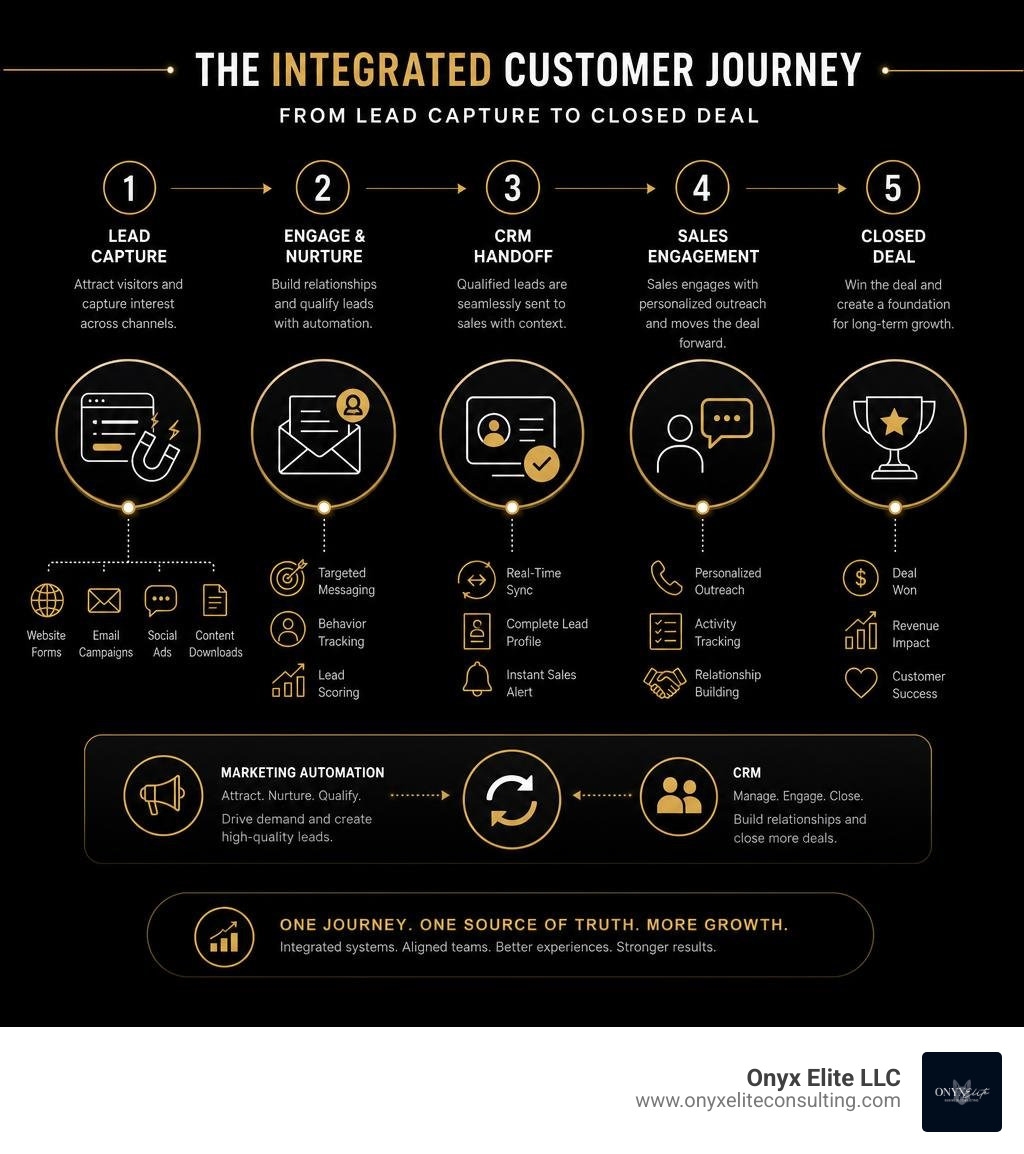
To understand how these systems work together, it helps to use a simple metaphor: marketing automation is the lighthouse, and your CRM is the harbor.
The lighthouse (marketing automation) casts a wide, bright beam across the digital ocean. Its job is to attract passing ships (prospects), guide them through early-stage waters, and signal that there is a safe path forward. It tracks their initial behavior, nurtures them with helpful content, and identifies which ones are ready to dock.
Once those ships enter the harbor (your CRM), they need organization, structural management, and personalized attention. The harbor masters (your sales reps) take over to manage the relationship, secure the cargo (close the deal), and ensure long-term custody.
If your lighthouse doesn't communicate with your harbor, ships will crash on the rocks or sail away to other ports. In technical terms, a true Marketing Automation Integration establishes a continuous, two-way flow of customer data.
Rather than sending data in a one-way, batch-processed stream, modern systems in 2026 rely on real-time synchronization. When a prospect interacts with a marketing campaign, that data instantly enriches their profile in the CRM. Conversely, when a sales representative updates a lead's status in the CRM, the marketing automation engine immediately adjusts the type of content that lead receives.
As detailed in this comprehensive CRM and Marketing Automation Integration Guide |... , connecting these systems ensures that your business operates with a single source of truth. For a deeper look at how these platforms compare side-by-side, you can also explore this guide on How to Use CRM and Marketing Automation Together .
Key Benefits of Connecting Your Sales and Marketing Tech Stack
When we work with businesses in West Hartford, CT and throughout the broader Connecticut region, we find that fragmented technology is one of the biggest drains on team morale and operational efficiency. Connecting your sales and marketing systems yields immediate, compounding returns.

The primary benefits of integrating your tech stack include:
- Radical Efficiency Gains: Instead of manually exporting CSV files and uploading them between platforms, your systems talk to each other automatically. This eliminates human error and frees up hours of administrative time.
- True Personalization at Scale: With 87% of customers demanding personalized experiences, you can no longer rely on generic email blasts. Integration allows you to trigger automated messages based on real-time CRM updates, such as purchase history or specific sales pipeline stages.
- Shorter Sales Cycles: When sales reps have immediate visibility into what marketing materials a prospect has consumed, they can tailor their pitch perfectly. This alignment can lead to a 42% reduction in sales cycle length and a 28% increase in overall close rates.
- In-Depth Revenue Attribution: Instead of guessing which marketing campaigns actually generated revenue, integration allows you to trace closed-won deals directly back to the original lead source and subsequent marketing touchpoints.
To dive deeper into how automating these workflows can systematically scale your operations, review our insights on Automation and Process Improvement.
How CRM and Marketing Automation Integration Drives Lead Scoring
One of the most powerful outcomes of integrating your systems is the ability to implement advanced, behavioral lead scoring.
Lead scoring assigns numerical values to prospects based on their demographic data and digital behavior. For example, a prospect might receive 1 point for opening an email, 5 points for clicking a call-to-action button, and 20 points for visiting your pricing page.
Without integration, these behavioral signals remain locked inside your marketing platform. Your sales reps have no idea who is actively showing buying signals. With a connected tech stack, however, once a lead crosses a specific scoring threshold (say, 50 points), the system instantly flags them as a Marketing Qualified Lead (MQL) and routes them to the appropriate sales representative in the CRM.
This seamless handoff ensures that your sales team only spends time talking to warm, highly engaged prospects, significantly accelerating your sales pipeline velocity. For a step-by-step breakdown of how to map out this handoff, see How to Integrate CRM and Marketing Automation: A Marketer's Guide .
Enhancing Personalization Through CRM and Marketing Automation Integration
Modern personalization goes far beyond adding a "First Name" tag to your email subject lines. True personalization is contextual and behavioral.
When your marketing automation tool has access to your CRM, you can deliver highly targeted dynamic content. If your CRM shows that a contact is an active customer of a specific service, your marketing platform can automatically suppress introductory promotional offers and instead send them advanced user guides, up-sell opportunities, or referral prompts.
For service-oriented businesses, this level of personalization is critical for maximizing customer lifetime value and reducing churn. You can learn more about managing these specialized lifecycles in our guide to CRM for Service Businesses.
Comparing All-in-One Platforms and Best-of-Breed Integrations
When deciding how to build your tech stack, you will face a fundamental choice: Do you adopt an all-in-one platform, or do you integrate best-of-breed systems?

An all-in-one platform (such as HubSpot or Zoho) provides both CRM and marketing automation features natively within a single ecosystem. A best-of-breed setup pairs a specialized CRM (like Pipedrive or Salesforce) with a dedicated marketing automation power-house (like ActiveCampaign, Brevo, or Omnisend) using direct API integrations.
Here is how the top platforms compare in 2026:
- ActiveCampaign: Widely regarded as the best sales and marketing all-rounder. It features an incredibly deep visual workflow builder and boasts an impressive 94.2% inbox placement rate in vendor deliverability studies.
- HubSpot: The gold standard for mid-market B2B organizations needing polished CRM features and multi-touch revenue attribution. However, the price escalates quickly. HubSpot Professional starts at $890/month with a mandatory $3,000 onboarding fee.
- Brevo (formerly Sendinblue): An excellent choice for businesses with large contact lists but lower send frequencies, as they charge based on email send volume rather than contact count.
- Salesforce: The enterprise giant. When paired with its B2B Marketing Automation Platform - Salesforce , it offers unmatched customization, though it requires significant development resources to manage.
To bridge these systems seamlessly, many modern tools now offer deep, native connectivity. For instance, platforms like HubSpot, Salesforce, Dynamics 365, Pipedrive, Cloop is now native in all four, Cloop allow businesses to write directly to native CRM objects without messy middleware.
For companies looking to connect niche industry ERPs with mainstream marketing tools, options like the SYNC Integration for CMiC and HubSpot Marketing Hub Professional - Commercient offer fully managed data bridging. Additionally, businesses looking to optimize their digital ad spend can leverage a Marketing Automation CRM Integration for Ads with AI 2026 to automatically adjust ad bids based on CRM lead status.
If you are a mid-sized business in Connecticut looking for expert guidance on selecting and configuring these tools, you can explore the Best Marketing Automation Agencies for Mid Business in ... to find local partners who specialize in these complex deployments.
Comparison Table: All-in-One vs. Best-of-Breed
| Feature / Criteria | All-in-One Platforms (e.g., HubSpot, Zoho) | Best-of-Breed Integrations (e.g., Pipedrive + ActiveCampaign) |
|---|---|---|
| Ease of Setup | Extremely high; no integration mapping required. | Moderate; requires API mapping or middleware. |
| Feature Depth | Broad, but specialized tools may offer deeper features. | Extremely high; both platforms are built for their specific purpose. |
| Data Consistency | Perfect; native shared database. | High, provided you maintain strict data hygiene. |
| Cost Flexibility | Can become very expensive as you scale up tiers. | Often more cost-effective; you only pay for what you use. |
| Workflow Flexibility | Bound by the platform's native ecosystem. | Highly customizable; can connect to multiple external tools. |
To make sure you choose the right foundational system, read our guide on selecting a Simple CRM Small Business. If you decide to move forward with HubSpot, we have also documented the ideal process in our HubSpot Marketing Automation Setup guide.
Frequently Asked Questions about CRM Automation
What is the main difference between CRM and marketing automation?
A CRM (Customer Relationship Management) system is designed primarily to manage sales processes, track pipelines, and store historical interaction data for active leads and customers. It is built for sales and customer service teams. Marketing automation, on the other hand, is designed to automate top-of-funnel marketing tasks, track early-stage digital behavior, and nurture prospects through automated email, SMS, and ad campaigns.
How long does it take to integrate CRM and marketing automation systems?
For standard native integrations (such as connecting Pipedrive and ActiveCampaign using their built-in API connector), the basic setup can take as little as 20 to 45 minutes. However, for enterprise-grade deployments involving custom field mappings, lead routing rules, and historical data cleaning, a realistic implementation timeline is typically 2 to 6 months.
Can small businesses benefit from integrated CRM and marketing automation?
Absolutely. In fact, small businesses often see the highest relative ROI because they have fewer team members to manage manual tasks. By automating lead scoring, data entry, and follow-up sequences, a small team can operate with the efficiency of a much larger organization without having to hire additional staff.
Conclusion
At Onyx Elite LLC, we believe that technology should serve your business strategy, not complicate it. Achieving sustainable, scalable growth requires aligning your people, processes, and tools into a unified, high-performing system.
Integrating your CRM and marketing automation platforms is one of the most impactful steps you can take to eliminate operational friction and unlock hidden revenue in your sales pipeline.
If you are ready to build a tech stack that drives measurable, long-term growth, explore our guide on the 5 Internal Systems That Drive Scalable Growth for Service-Based Businesses.
To learn how our team of award-winning business consultants in West Hartford, CT can help you design, implement, and optimize your business systems, visit our Onyx Elite Consulting Services page to schedule a strategic consultation.