

8 Essential Marketing Automation Integrations for 2026
Why Marketing Automation Integration Is the Backbone of Modern Business Growth

Marketing automation integration is the process of connecting your marketing platform to other business systems — like your CRM, ERP, email tools, and social media — so data flows automatically between them in real time.
Here's a quick breakdown of what it means and why it matters:
| What it is | Linking marketing tools so they share data automatically |
| What it replaces | Manual data entry, copy-pasting between platforms, delayed follow-ups |
| Core systems involved | CRM, ERP, email, social media, e-commerce, analytics |
| Primary benefit | A single, unified view of every customer across all touchpoints |
| Who needs it | Any business using more than one marketing or sales tool |
| Common methods | Direct APIs, iPaaS platforms, third-party hubs like Zapier |
If your marketing tools don't talk to each other, you're losing time, money, and leads every single day.
Think about it: a prospect fills out a form on your website. Without integration, that lead might sit in a spreadsheet until someone manually uploads it to your CRM — by which time a competitor has already followed up. That gap is where revenue disappears.
Enterprise organizations can run 100 or more tools across their marketing technology stacks. But more tools don't automatically mean better results. When those tools operate in silos, customer data gets fragmented, campaigns become inconsistent, and your sales and marketing teams end up working from different playbooks.
The good news? The right integrations turn that disconnected stack into a unified growth engine. The global marketing automation market is projected to reach $9.5 billion by 2027, reflecting just how critical connected systems have become for competitive businesses.
I'm Doru Angelo, Founder & CEO of Onyx Elite LLC, and over more than a decade of advising founders and business leaders across industries, I've seen how marketing automation integration separates businesses that scale from those that stall. This guide will walk you through the eight integrations that matter most heading into 2026.
The Strategic Value of Marketing Automation Integration
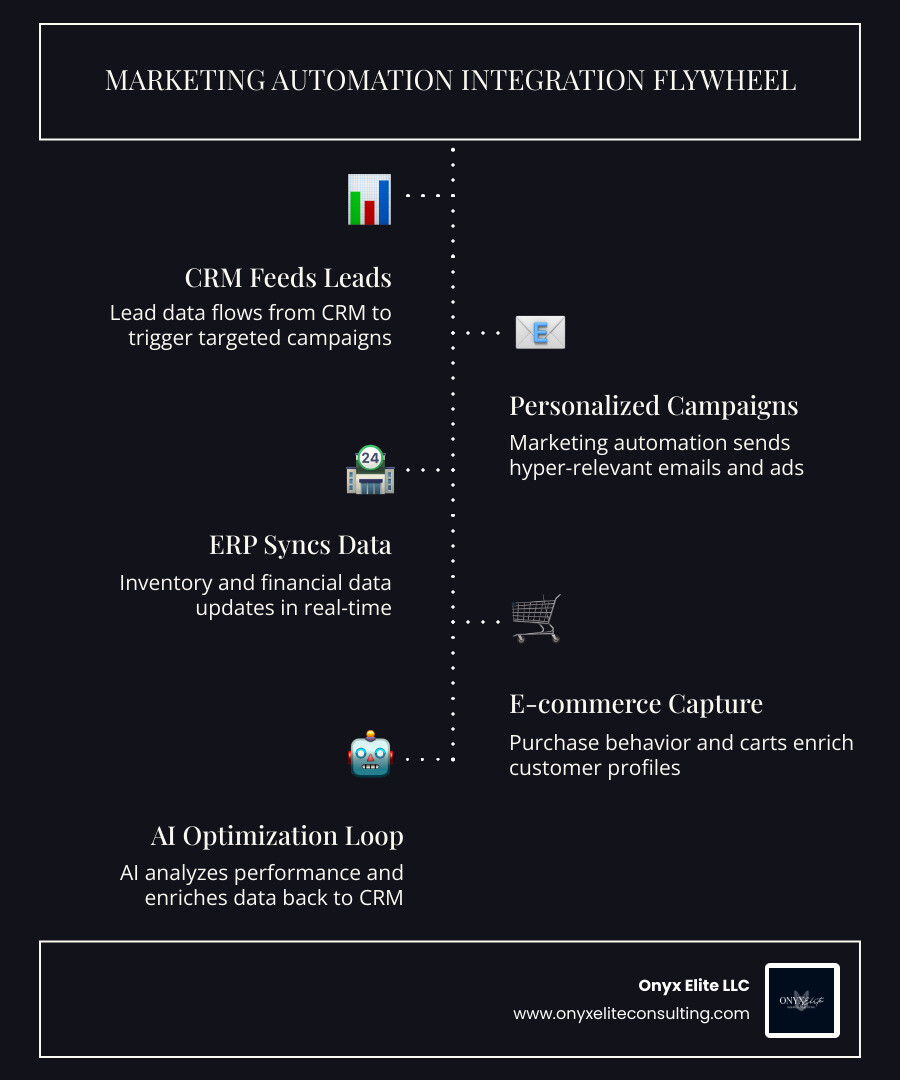
In our work at Onyx Elite Consulting, we often find that the difference between a "busy" marketing department and a "profitable" one is connectivity. When you achieve true marketing automation integration, you aren't just saving a few hours of admin work; you are building a strategic asset.
The primary goal is to create a "single source of truth." When your platforms are integrated, every department—from sales in West Hartford to customer support—sees the same data. This alignment is powerful. In fact, research shows that sales and marketing alignment can improve win rates by 38% and boost revenue growth by 24%.
Integrating your systems allows you to Enhance Operational Efficiency by automating lead scoring and nurturing. Instead of guessing which leads are "hot," your system can automatically calculate a score based on website visits, email opens, and even ERP purchase history, ensuring your sales team focuses only on high-propensity deals.
The Impact of Real-Time Data Synchronization
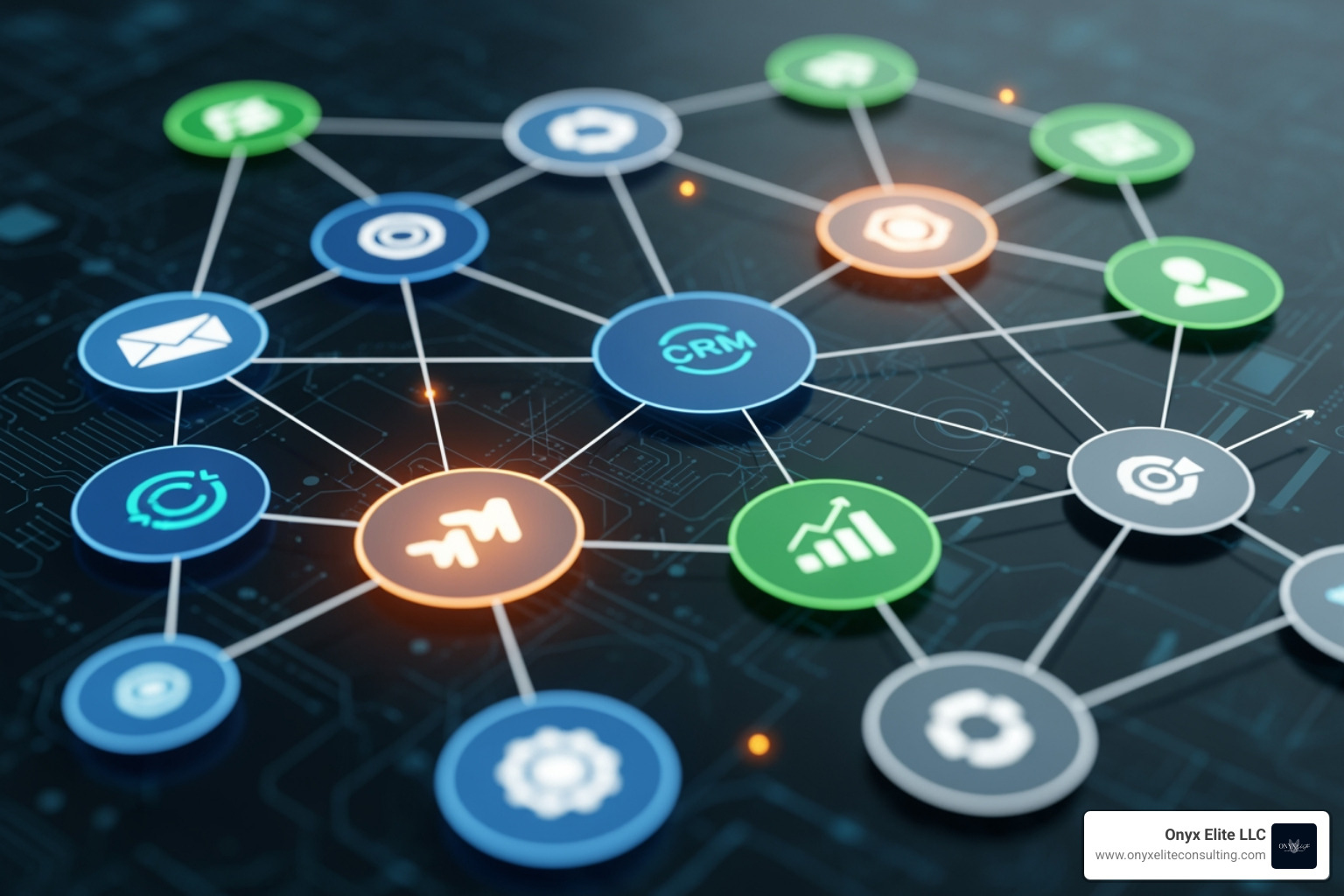
Static data is dead data. For a modern business to thrive, data must flow in a bidirectional stream. This means if a customer changes their email address in a support portal, it should instantly update in the marketing database and the CRM.
Real-time synchronization ensures:
- Data Integrity: No more duplicate records or outdated contact info.
- Proactive Sales Engagement: Your sales reps get an alert the moment a high-value lead engages with a specific piece of content.
- Hyper-Personalization: You can trigger an SMS or email based on immediate actions, such as a user abandoning a cart or downloading a whitepaper.
8 Essential Marketing Automation Integrations for 2026
As we look toward 2026, the complexity of the digital landscape is only increasing. To maintain Lean Operational Excellence, businesses must future-proof their stacks. Here are the eight integrations we consider non-negotiable for the coming years.
1. CRM: The Foundation of Marketing Automation Integration
The Customer Relationship Management (CRM) system is the beating heart of your business. Integrating it with your marketing automation platform is the most critical step you can take.
This connection allows for seamless lead routing. When a prospect hits a specific lead score in your marketing tool, they are automatically handed off to the right sales representative in the CRM. It also provides full pipeline visibility, allowing marketers to see exactly which campaigns generated actual revenue, not just clicks. By syncing lifecycle stages, you ensure that a "Customer" doesn't accidentally receive a "Prospect" discount email, preserving your brand's professional image.
2. ERP for Inventory-Based Promotions
Enterprise Resource Planning (ERP) systems hold the keys to your back-office reality: inventory levels, supply chain status, and financial data. Integrating your ERP with your marketing tools allows for "inventory-aware" marketing.
Imagine your ERP detects excess stock of a specific product. An integrated system can automatically launch a discount email campaign to a targeted segment to clear that inventory. Conversely, if a product is out of stock, the system can pause all active ads for that item, saving you wasted ad spend. This level of financial alignment ensures your marketing is always supporting your bottom-line business needs.
3. AI Agents and Marketing Automation Integration
By 2026, AI won't just be a tool; it will be an active participant in your workflows. Marketing automation integration with AI agents (like those powered by OpenAI or proprietary LLMs) allows for "agentic workflows."
These AI agents can:
- Generate Content: Automatically draft personalized email replies based on a lead's recent behavior.
- Predict Churn: Analyze patterns in customer data to flag accounts that are likely to cancel before they actually do.
- Optimize Campaigns: Dynamically shift ad budgets between channels based on real-time performance forecasts.
4. E-commerce and Payment Gateways
For any business selling online, the link between the storefront and the marketing engine is vital. Integrating tools like Stripe or Shopify with your automation platform enables sophisticated customer retention strategies.
The most common use case is the "abandoned cart" sequence, but it goes deeper. You can trigger personalized "thank you" videos after a first purchase, send automated renewal reminders based on subscription data, and use purchase history to recommend the perfect "next-best" product. This turns a single transaction into a long-term customer relationship.
5. Social Media and Lead Ads
Social media platforms are often where the first touchpoint occurs. Integrating Facebook Lead Ads or LinkedIn Lead Gen Forms directly into your marketing stack eliminates the need for manual CSV downloads—a process that often leads to "cold" leads.
With instant verification, a lead captured on social media can be in your CRM and receiving a welcome email within seconds. This also allows for better audience segmentation; you can automatically add social engagers to retargeting lists, ensuring your brand stays top-of-mind across the entire web.
6. Customer Service and Support Tools
Marketing doesn't end when a sale is made. Integrating support tools (like Zendesk or Service Cloud) into your marketing automation platform creates a truly unified profile.
If a customer has an open "high-priority" support ticket, your marketing system should know to pause all promotional emails to that person until the issue is resolved. This prevents the frustration of receiving a "buy more" email while they are currently dealing with a technical problem. Furthermore, feedback loops from support can trigger automated "check-in" surveys to boost customer satisfaction.
7. Event and Webinar Platforms
Events are high-intent lead generators. Whether it’s an in-person seminar in West Hartford or a global webinar, integrating these platforms (like Zoom or On24) is essential for lead capture.
Automation can handle the entire event lifecycle:
- Sending registration confirmations.
- Triggering "reminder" SMS messages.
- Segmenting attendees vs. no-shows for different follow-up nurture sequences.
- Tracking which sessions a lead attended to better understand their specific interests.
8. Internal Communication and Project Management
Efficiency isn't just about how you talk to customers; it's about how your team talks to each other. Integrating your marketing engine with Slack or Microsoft Teams ensures workflow transparency.
You can set up automated notifications for:
- A new high-value lead entering the system.
- A campaign reaching a specific ROI threshold.
- A customer providing a negative NPS score.
Linking these to project management tools like Asana or Jira means that a new lead can automatically create a "follow-up" task for a sales rep, ensuring nothing ever falls through the cracks.
Choosing Your Method: APIs, iPaaS, and Integration Hubs
When you decide to move forward with marketing automation integration, you’ll need to choose the right technical "plumbing." This is a key part of Business Process Improvement.
| Method | Best For | Pros | Cons |
|---|---|---|---|
| Direct API | Core systems (CRM/Email) | High speed, deep data sync | Requires developer resources |
| iPaaS (e.g., Jitterbit) | Complex enterprises | Scalable, handles many apps | Higher monthly cost |
| Integration Hubs (e.g., Zapier) | Smaller tasks/Quick wins | No-code, thousands of apps | Can get expensive at high volumes |
| Middleware | Legacy/On-premise systems | Total control over data | Very complex to maintain |
Direct API Integrations vs. Third-Party Hubs
A Direct API integration is like a non-stop flight between two cities. It is fast, secure, and built specifically for those two systems to talk. This is usually the best choice for your CRM and primary marketing tool.
Third-party hubs like Zapier are more like a connecting flight. Data moves from App A to the Hub, then to App B. These are fantastic for "quick wins"—like sending a Slack notification when a form is filled—because they require zero coding. However, for deep, bidirectional real-time sync of thousands of records, a more robust iPaaS or Direct API is often necessary.
Overcoming Challenges in Marketing Automation Integration
Implementation isn't always a walk in the park. We see many firms struggle with user adoption and technical debt. However, the cost of doing nothing is much higher. It is estimated that $3 trillion is lost every year due to bad data.
To succeed, you must focus on Automation and Process Improvement by addressing three main areas:
- Data Silos: Break down walls between departments by establishing clear data-governance agreements.
- User Adoption: Train your team on why the integration matters to their specific role. If they don't see the value, they won't use the tools.
- Security: As data flows between more systems, the "attack surface" grows.
Solving Data Silos and Security Concerns
Security should never be an afterthought. In the age of GDPR and CCPA, your marketing automation integration must be built on a zero-trust architecture. This means every system must verify the identity of any other system trying to access its data.
We recommend:
- Encryption: Ensuring data is unreadable both while it's moving (in transit) and while it's stored (at rest).
- Role-Based Access (RBAC): Only giving employees access to the specific data they need for their job.
- Regular Audits: Conducting penetration tests to ensure your connections are secure.
Frequently Asked Questions about Marketing Automation
What is the difference between RPA and marketing automation integration?
Robotic Process Automation (RPA) uses "bots" to mimic human clicks on a screen to handle repetitive tasks (like copy-pasting data). Integration, on the other hand, connects systems at the code level (via APIs) so they share data natively and invisibly. Integration is generally faster and more reliable for long-term growth.
How does integration enable personalized marketing campaigns?
Personalization requires data. Without integration, you might only know a customer's name and email. With integration, you know their name, their last purchase (from ERP), their recent support ticket (from Service tools), and the last webinar they attended. This allows you to send an email that says, "Hey [Name], since you're using [Product] and recently talked to our support team about [Feature], here is a guide to help you get the most out of it."
What should businesses consider when choosing an integration platform?
Focus on three things: Scalability (can it grow with you?), Security (does it meet compliance standards?), and Support (is there a team to help when a 'Zap' breaks?). Also, look for platforms that offer "native" integrations for the tools you already use, as these are often easier to set up.
Conclusion
The future of business isn't just about having the best product; it's about having the most connected customer experience. Marketing automation integration is the bridge that turns a collection of isolated tools into a strategic powerhouse.
By prioritizing these eight essential integrations, you can eliminate manual errors, align your sales and marketing teams, and drive sustainable growth. At Onyx Elite Consulting, we specialize in helping businesses in West Hartford and beyond navigate these complex technical waters to achieve operational excellence.
Ready to turn your tech stack into a growth engine? Achieve growth with our Services Overview and let's build your 2026 roadmap together.