

The Ins and Outs of Business Process Improvement
The Engine of Modern Business Excellence

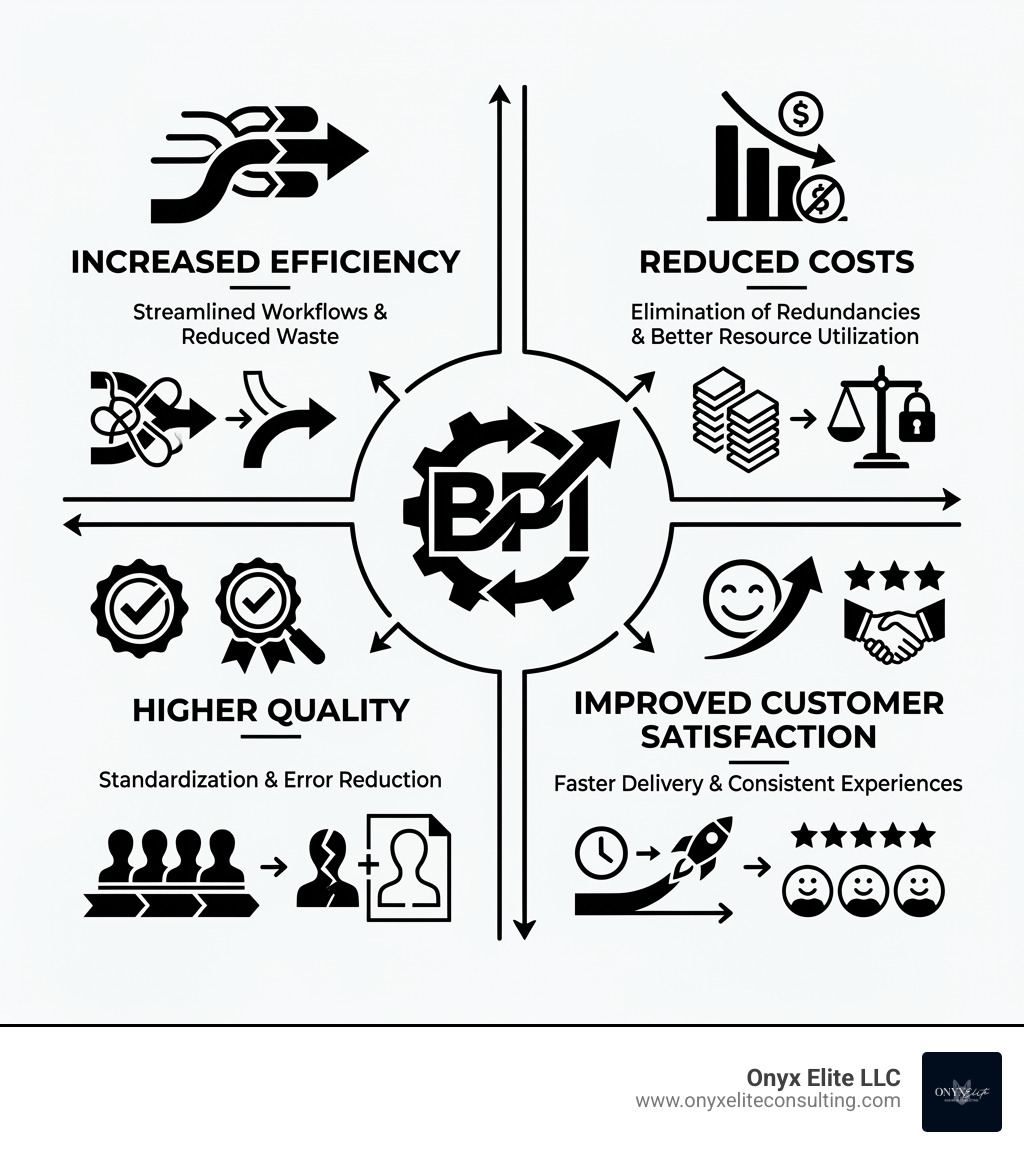
Business process improvement is the systematic practice of analyzing, redesigning, and optimizing an organization's workflows to increase efficiency, reduce costs, improve quality, and deliver better outcomes for both customers and employees.
Key aspects of BPI:
- Definition: A subdiscipline within Business Process Management (BPM) that identifies and eliminates inefficiencies in how work gets done
- Primary Goals: Cut costs, boost productivity, reduce errors, speed up delivery, and improve quality
- Core Approach: Map current processes, analyze bottlenecks, redesign workflows, implement changes, and monitor results
- Common Methodologies: Lean, Six Sigma, Kaizen, Total Quality Management (TQM), PDCA, and Business Process Reengineering (BPR)
- Impact: Organizations can typically achieve 3-4x the results of traditional incremental improvements
In today's business landscape, 83% of business leaders see process optimization as their most effective tool for driving value and rapid change. Yet many organizations struggle to translate technological advances into real productivity gains.
The challenge is that too many companies layer new tools onto outdated workflows, optimizing isolated tasks rather than reimagining entire processes. This results in modest gains or, worse, the automation of existing inefficiencies.
Business process improvement offers a different path. It's not about quick fixes but systematically examining every step of how your organization creates value to identify what's working and what's not, making strategic changes that compound over time. When done right, BPI doesn't just reduce costs—it transforms how your team works, improves customer experiences, and builds the operational foundation for sustainable growth.
The stakes are high. Nearly two-thirds of business leaders report that suboptimal business processes cost their departments time and reduced productivity. In an environment where agility and efficiency determine winners, the ability to continuously improve how work gets done has become a core competitive capability.
I'm Doru Angelo, founder and CEO of Onyx Elite LLC. Over the past decade, I've guided organizations through transformative business process improvement initiatives that have opened up millions in value by aligning operations with strategic objectives. If you're struggling with inefficient workflows, inconsistent quality, or processes that can't scale, the principles in this guide offer a clear roadmap for meaningful change.
The "Why" and "What": Unpacking the Core of Business Process Improvement
This section defines BPI, clarifies its goals, and distinguishes it from related concepts, establishing the fundamental value it brings to an organization.
What Exactly is Business Process Improvement (BPI)?
Business process improvement (BPI) is a methodical approach to identifying, analyzing, and enhancing existing business processes. It involves closely examining how tasks are performed to find smoother, faster, or more effective methods and implementing those changes. As a leading information technology resource puts it, BPI is "a business methodology for efficiency and productivity" that aims to optimize performance, meet best practice standards, and improve the user experience for customers and end-users.
BPI is a subdiscipline of Business Process Management (BPM). While BPM takes a holistic, strategic view of all processes, BPI focuses on refining specific workflows. It's about making current processes better, not creating new ones from scratch. This systematic approach scrutinizes every activity to ensure it contributes maximum value with minimal waste.
To better understand BPI, it's helpful to differentiate it from related concepts that often get intertwined:
| Feature | Business Process Improvement (BPI) | Business Process Management (BPM) | Business Process Automation (BPA) |
|---|---|---|---|
| Primary Goal | Optimize existing processes for efficiency, quality, and cost. | Oversee, manage, and optimize all organizational processes holistically and continuously. | Automate repetitive, rule-based tasks within processes using technology. |
| Focus | Targeted improvements to specific processes. | End-to-end management of the entire process lifecycle (design, execute, monitor, optimize). | Eliminating manual effort for specific steps. |
| Scope | Typically departmental or cross-functional for a particular process. | Organization-wide, strategic, and continuous. | Specific tasks or workflows that can be handled by software/robots. |
| Approach | Analytical, project-based, often iterative. | Strategic, ongoing, comprehensive. | Technological implementation, often one-time setup. |
| Relationship | A subdiscipline of BPM; often a project within a BPM framework. | The overarching discipline that encompasses BPI and BPA. | A tool or technique used within BPI or BPM to achieve automation. |
The Primary Goals: What Does BPI Aim to Achieve?
The primary objective of business process improvement is to drive significant, measurable improvements in organizational effectiveness and performance. This ensures your business runs as smoothly and profitably as possible.
These goals typically include:
- Cost Reduction: By eliminating inefficiencies, redundancies, and waste, BPI directly lowers operational costs. This is crucial during economic instability, where 82% of business leaders use process optimization to cut costs and improve cash flow.
- Increased Productivity: Optimized processes mean less time is wasted and more output is generated, allowing employees to focus on higher-value tasks.
- Improved Quality: Standardizing procedures and reducing variations leads to more consistent, reliable outcomes and improves the quality of products or services.
- Error Reduction: BPI identifies manual steps prone to human error and implements controls or automation to reduce mistakes.
- Faster Turnaround Times: Streamlined processes move quicker, accelerating everything from order processing to customer query resolution.
BPI aligns your daily operations with your broader business goals, ensuring every task contributes to your strategic objectives. To learn more about how we can help align your operations with your vision, explore our strategic planning services.
The Ripple Effect: Benefits Beyond the Bottom Line
While cost reduction and efficiency are immediate drivers for business process improvement, the benefits extend beyond the financial statement. Successful BPI initiatives create a positive ripple effect, fostering a healthier, more productive work environment.
Here are some of the broader benefits:
- Improved Customer Satisfaction: Smooth internal processes benefit customers. Faster service, higher quality, fewer errors, and consistent experiences lead to happier, more loyal customers. We help businesses in West Hartford build stronger relationships by making processes customer-centric.
- Improved Employee Experience and Morale: Inefficient systems are frustrating. BPI improves the employee experience by eliminating bottlenecks, reducing mundane tasks, and providing clearer guidance. This leads to higher job satisfaction, a sense of ownership, and better morale.
- Organizational Agility and Adaptability: In a fast-changing market, businesses must pivot quickly. Optimized processes are more flexible, allowing your organization to respond swiftly to new market conditions, technologies, or customer needs. This agility is key to long-term growth.
- Fostering a Culture of Continuous Improvement: BPI is an ongoing mindset, not a one-time project. Embedding process optimization into your DNA cultivates a culture where everyone seeks better ways of working, driving sustained innovation. As we discuss in our insights, Leadership is the New Currency: The Mindset Shift Every CEO Needs in 2026, this culture starts at the top.
The BPI Playbook: Methodologies and Step-by-Step Implementation
A practical guide to how BPI works, from the general steps involved in any initiative to the specific, proven methodologies that structure the improvement process.
A Universal Framework: The 6 Steps of a BPI Initiative
Most business process improvement initiatives follow a common, logical progression. This roadmap guides you from identifying a problem to implementing a lasting solution. Here are the six typical steps involved:
- Identify the Process for Improvement: Pinpoint which processes are underperforming, causing bottlenecks, or not meeting goals. Start by mapping "as-is" processes to visualize workflows and identify friction. Stakeholder input is crucial, as they often have the best insights into daily frustrations.
- Analyze Pain Points and Root Causes: Deeply analyze the current state of the identified process. Break it down into individual activities to find "pain points" like bottlenecks and inefficiencies. Tools like the 5 Whys analysis help uncover root causes. A fishbone (Ishikawa) diagram can also visualize potential causes.
- Redesign the Process (Develop Solutions): With a clear understanding of root causes, design a "to-be" process. This means fundamentally rethinking how work should be done, which might involve streamlining activities, eliminating unnecessary steps, reskilling employees, or integrating new technology. Evaluate potential solutions and test for unintended consequences.
- Implement the New Process: This is where the rubber meets the road. Implementing the redesigned process requires careful planning, effective change management, and thorough communication. This often includes providing training to employees on new procedures and tools. We typically recommend testing new processes on a small scale or with a pilot group before a full organizational rollout.
- Monitor Performance: Once the new process is in place, continuously monitor its performance against established metrics. This step involves tracking key performance indicators (KPIs) to ensure the improvements are having the desired effect and to catch any new issues that might arise.
- Optimize and Standardize: BPI is an iterative journey. Based on monitoring, continuously look for optimization opportunities. Once the process is performing optimally, standardize and document it as the new official workflow to ensure sustained gains. As TechTarget notes, processes are "never a 'set it and forget it' project." For a deeper dive, their guide on How to develop a business process in 8 steps offers additional insights.
Choosing Your Approach: Common Business Process Improvement Methodologies
While the 6-step framework is a general roadmap, various proven methodologies offer structured approaches for business process improvement. Each has a unique philosophy and toolkit for different challenges.
Here are some of the most common BPI methodologies we leverage:
- Lean Management: Originating from Toyota, Lean focuses on eliminating waste (Muda) to maximize customer value while minimizing resource use. Key principles include identifying value, mapping the value stream, creating flow, establishing pull, and pursuing perfection. The 5S, a related checklist-based approach, is often used to organize workspaces for efficiency.
- Six Sigma: A data-driven methodology from Motorola, Six Sigma aims to minimize variations and defects. The goal is near-perfect quality (no more than 3.4 defects per million opportunities). Its core framework for existing processes is DMAIC:
- Define the problem and project goals.
- Measure key aspects of the current process and collect data.
- Analyze the data to identify root causes of defects.
- Improve the process based on data analysis.
- Control the improved process to prevent recurrence of defects.
- Kaizen (Continuous Improvement): A Japanese philosophy meaning "change for the better," Kaizen emphasizes small, incremental improvements made continuously by everyone in the organization, from top management to front-line employees. It fosters a culture where everyone is looking for ways to get better.
- Total Quality Management (TQM): TQM is a management approach focused on long-term success through customer satisfaction. It involves all members of an organization in improving processes, products, services, and culture. Key principles include customer focus, team involvement, and data-driven decisions.
- PDCA Cycle (Plan-Do-Check-Act): Also known as the Deming Cycle, PDCA is an iterative four-step management method used for the control and continuous improvement of processes and products.
- Plan: Identify an opportunity for change and plan a test or change.
- Do: Implement the change on a small scale.
- Check: Analyze the results of the change and compare them to expectations.
- Act: Standardize the change if it was successful, or go back to the Plan stage if it wasn't.
- Business Process Reengineering (BPR): Unlike incremental methods, BPR involves a radical redesign of core business processes for dramatic improvements in cost, quality, service, and speed. It often means "starting from a blank slate" and can lead to significant organizational change.
Choosing the right methodology depends on the nature of the problem, the desired scale of change, and the organizational culture. Often, we find that a blended approach, drawing tools and philosophies from several methodologies, yields the best results for our clients. For more on building robust internal systems, check out our insights on 5 Internal Systems That Drive Scalable Growth for Service-Based Businesses.
BPI in Action: Technology, Challenges, and Best Practices
This section explores the practical application of BPI, including the technology that powers it, real-world examples, and how to steer common obstacles.
The Role of Technology in Modern BPI
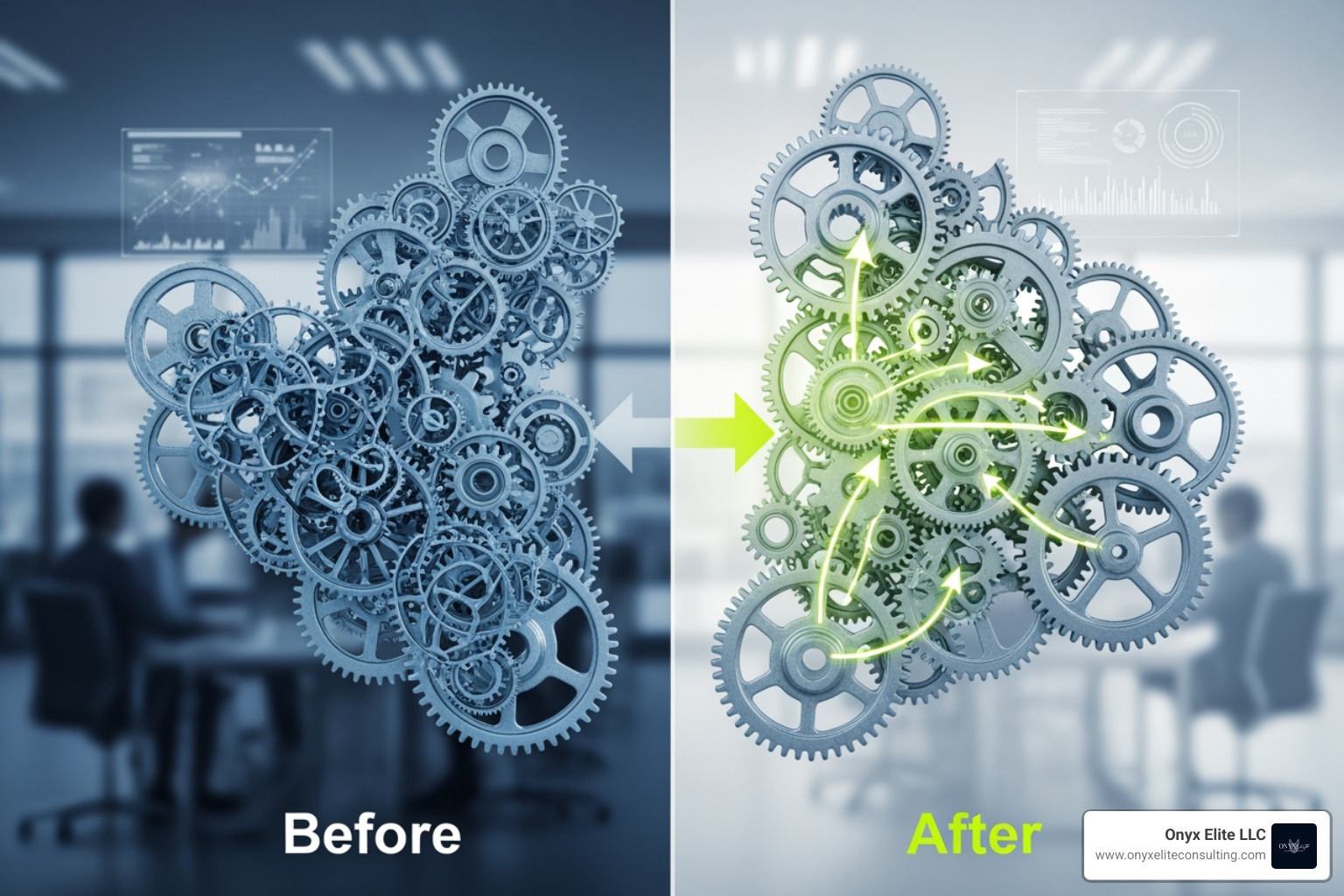
In today's digital-first workplace, technology isn't just a supporting player in business process improvement; it's often the engine driving transformative change. We've seen how modern tools can dramatically accelerate BPI efforts and open up new levels of efficiency and insight.
Key technological enablers include:
- Robotic Process Automation (RPA): RPA uses software robots to automate repetitive, rule-based tasks that typically require human interaction. Imagine a bot handling routine data entry, invoice processing, or customer service inquiries. This frees up your human workforce for more complex, creative, and customer-facing activities.
- Artificial Intelligence (AI) and Machine Learning (ML): AI goes beyond simple automation, bringing intelligence to processes. Machine learning algorithms can analyze vast datasets to identify patterns, predict outcomes, and make decisions, continuously improving processes over time. Generative AI, for example, can automate complex tasks like content creation or personalized marketing. In fact, McKinsey estimates that as much as 30% of hours currently worked in the U.S. economy could be automated by 2030, a trend significantly accelerated by AI.
- Enterprise Resource Planning (ERP) Systems: A robust ERP system integrates and automates core business functions like finance, HR, supply chain, and manufacturing. It provides a unified view of operations, eliminating data silos and creating a foundation for streamlined processes.
- Process Mining and Analytics: These tools use data logs from your existing systems to visualize and analyze actual process flows. They can automatically identify bottlenecks, deviations, and inefficiencies that might be invisible through traditional process mapping. This data-driven insight is invaluable for targeted BPI efforts.
However, it's crucial to remember that technology is an accelerator, not a magic bullet. As recent BCG research underscores, "technology's potential to dramatically improve productivity remains largely untapped." Many companies make the mistake of simply layering new technology onto outdated workflows, which at best yields modest gains, and at worst, automates existing inefficiencies. True impact comes from fundamentally rethinking processes before applying new technology, using it as a catalyst for end-to-end reinvention.
Real-World Wins: Examples of Successful BPI
We've had the privilege of witnessing and facilitating numerous successful business process improvement initiatives across various industries. These examples highlight how applying BPI principles can lead to tangible results:
- Manufacturing Efficiency: In the manufacturing sector, particularly in Connecticut, we've helped clients implement Lean principles to redesign production facilities. By moving to a just-in-time inventory system and optimizing assembly lines, they've seen significant improvements in productivity, product quality, and cost reduction. Imagine IoT sensors collecting machinery data for predictive maintenance, preventing costly downtime before it even happens.
- Retail Inventory Management: A midsize retailer we worked with was struggling with overstocking and inaccurate forecasts, leading to financial losses. Through BPI, they invested in a new inventory management system and reengineered their ordering and stocking processes. This led to reduced carrying costs, better utilization of inventory, and fewer stockouts, directly improving profitability. Think of retailers installing weight sensors on shelves to automatically track inventory levels and trigger proactive restocking.
- Financial Services Fraud Detection: For financial institutions, the speed and accuracy of fraud detection are paramount. We've seen credit card companies leverage AI and machine learning to analyze transaction patterns in real-time, identifying suspicious activities far more quickly and accurately than manual processes ever could. This not only protects customers but also saves the company millions in potential losses.
- Human Resources (HR) Hiring Process: An HR department faced long "time-to-hire" metrics, impacting their ability to attract top talent. By analyzing their recruitment process, they identified bottlenecks in resume screening and interview scheduling. Implementing automation for initial screenings and streamlining communication with candidates drastically reduced their hiring cycle, improving candidate experience and securing talent faster.
These examples, and many more like them, demonstrate that BPI isn't just theory; it's a practical, powerful strategy that delivers measurable results. Our Testimonials / Results page offers further insights into the impact we've made for our clients.
Navigating the Problems: Common Challenges and How to Overcome Them
While the promise of business process improvement is compelling, the path to achieving it isn't always smooth. We often encounter common challenges that can derail even the best-intentioned BPI initiatives. Understanding these problems and planning for them is key to success. As Forbes points out, "There are, however, the following challenges to implementing a successful BPI program: workers' resistance to change; unplanned improvements are not aligned to business goals; and lack of communication across the organization to relevant parties."
Here are some of the most frequent challenges and how we help our clients overcome them:
- Employee Resistance to Change: People are naturally comfortable with the status quo. New processes can feel disruptive, threatening, or simply like more work.
- Solution: Effective change management is paramount. This includes early and transparent communication about why the change is happening, what the benefits are (for them and the organization), and providing adequate training and support. Involving employees in the redesign process (soliciting input and ideas) can also foster a sense of ownership and reduce resistance.
- Lack of Leadership Support and Prioritization: Without clear buy-in and active participation from senior leadership, BPI efforts can quickly lose momentum or be perceived as optional.
- Solution: Secure executive sponsorship from the outset. Leaders must champion the initiative, allocate necessary resources, and visibly commit to the change. This helps align the initiative with overarching business goals and signals its importance to the entire organization.
- Poor Communication Across the Organization: Siloed departments or inadequate information flow can lead to misunderstandings, duplicated efforts, or a lack of coordination, undermining BPI efforts.
- Solution: Establish clear and consistent communication channels throughout the BPI lifecycle. This means regularly updating all relevant stakeholders, explaining progress, and addressing concerns. Cross-functional teams are excellent for fostering collaboration and ensuring everyone is on the same page.
- Improvements Not Aligned with Business Goals: If BPI projects aren't directly tied to strategic objectives, they can become busywork that doesn't deliver meaningful value.
- Solution: Before starting any BPI initiative, clearly define its goals and link them to the organization's strategic priorities. Establish measurable KPIs upfront to track progress and demonstrate ROI. This ensures that every improvement effort contributes to the bigger picture.
- Inadequate Resources: BPI requires time, effort, and sometimes financial investment in new tools or training. Under-resourcing can lead to stalled projects and frustrated teams.
- Solution: Commit adequate resources—human, financial, and technological—to support BPI as an ongoing exercise. This includes dedicating team members, providing necessary training, and investing in supporting software.
By proactively addressing these challenges with careful planning, robust communication, and strong leadership, we help our clients in Connecticut establish and maintain a strong business process improvement discipline that delivers lasting results.
Frequently Asked Questions about Business Process Improvement
What is the difference between BPI and Business Process Reengineering (BPR)?
While both aim to improve processes, the key difference lies in their scope and approach. Business process improvement (BPI) typically focuses on incremental, continuous improvements to existing processes. It's about refining, streamlining, and optimizing what's already there to make it better. Think of it as tuning up a car to make it run more efficiently.
Business Process Reengineering (BPR), on the other hand, involves a radical, fundamental redesign of core business processes. It often means starting from a "clean slate" and completely rethinking how work is done to achieve dramatic improvements in performance. This is more akin to designing a brand new, car rather than just tuning an old one. BPR is usually a larger, riskier undertaking, reserved for situations where existing processes are fundamentally broken or obsolete.
How do you measure the success of a BPI project?
Measuring the success of a business process improvement project is crucial for demonstrating its value and ensuring accountability. We typically measure success using Key Performance Indicators (KPIs) that are directly tied to the project's specific goals. These might include:
- Cost Savings: Reductions in operational expenses, labor costs, or resource consumption.
- Cycle Time Reduction: Decreases in the time it takes to complete a process from start to finish.
- Error Rate Decrease: Lower numbers of defects, mistakes, or rework required.
- Throughput Increase: Higher volume of output or transactions processed within a given timeframe.
- Customer Satisfaction Scores (CSAT) or Net Promoter Score (NPS): Improvements in customer perception and loyalty.
- Employee Satisfaction/Engagement: Positive feedback from employees regarding the new process and their work experience.
Establishing these metrics at the beginning of a project and regularly monitoring them allows us to quantify the impact of the improvements and make data-driven decisions for further optimization.
Can BPI be applied to small businesses?
Absolutely! Business process improvement is not exclusive to large corporations. While the scale and complexity of the methodologies may be adapted, the core principles of identifying waste, improving efficiency, and enhancing customer value are universal and can provide significant benefits to businesses of any size, including small and medium-sized enterprises in West Hartford and across Connecticut.
For a small business, BPI might look like:
- Mapping out the customer onboarding process to reduce manual steps and ensure a consistent experience.
- Streamlining inventory management to reduce carrying costs and avoid stockouts.
- Automating repetitive administrative tasks to free up valuable employee time.
- Improving communication flows between sales and operations teams.
The benefits—cost savings, increased productivity, better customer service—are just as vital, if not more so, for small businesses looking to maximize their resources and achieve sustainable growth.
Your Partner in Operational Excellence
Business process improvement is not a one-time fix but a continuous journey toward operational excellence and sustainable growth. By systematically refining how work gets done, organizations can build a resilient foundation for the future. Onyx Elite Consulting specializes in guiding businesses through this change, tailoring strategies that deliver measurable results. Ready to open up your company's full potential? Explore our Services Overview to learn how we can help.