

The Synergy of Automation and Process Improvement
Why Automation and Process Improvement Are Essential for Business Success

Automation and process improvement are now fundamental requirements for survival and growth. Organizations that refine their processes and leverage automation gain reduced costs, improved quality, faster delivery, and the ability to scale without burning out their teams.
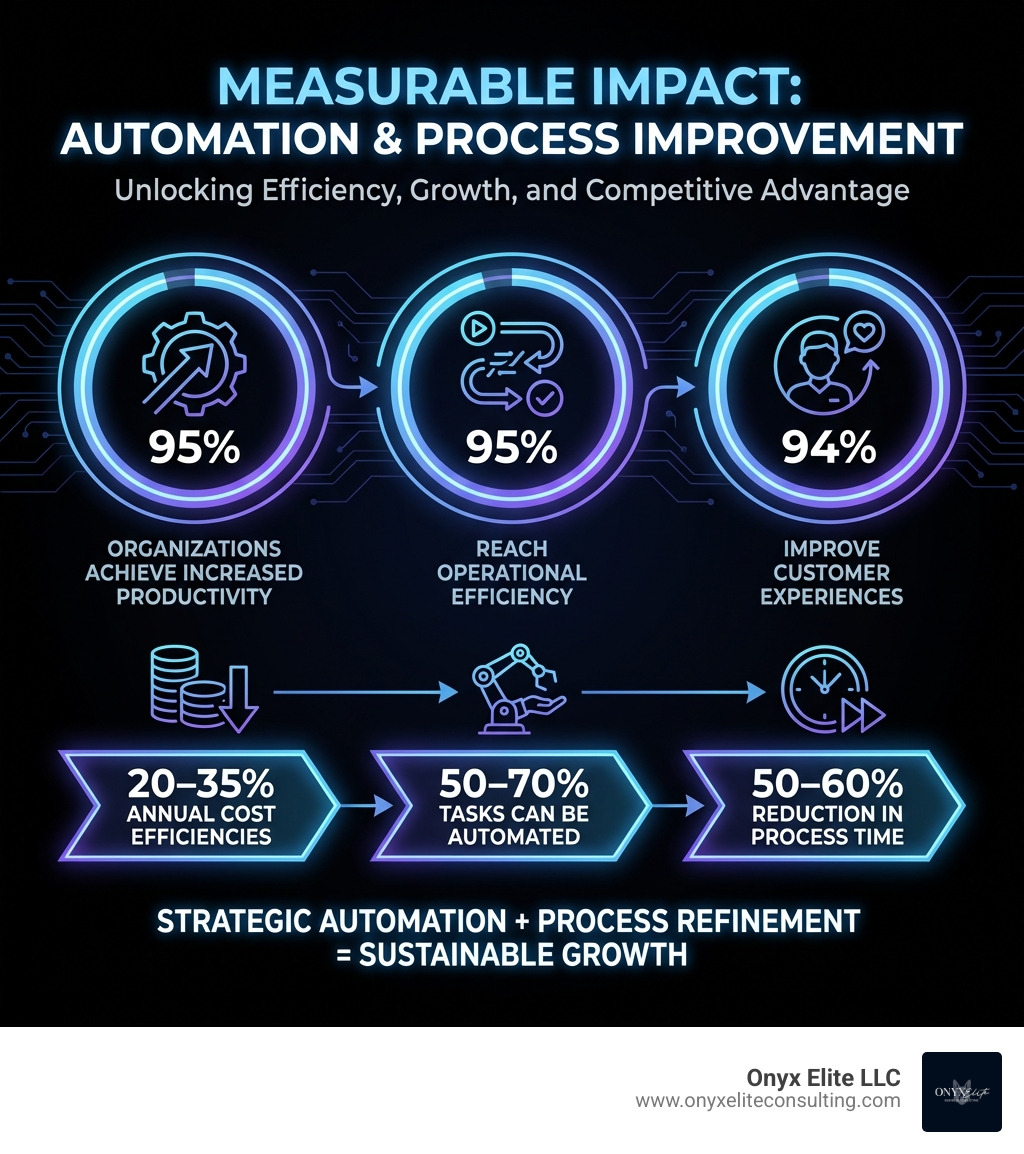
Key Benefits of Automation and Process Improvement:
- 95% of IT decision makers report increased business productivity from automation
- 95% achieve operational efficiency through automated processes
- 94% see improved customer experiences as a result of automation
- 20-35% annual cost savings through process optimization
- 50-70% of tasks can be automated in most organizations
- 50-60% reduction in straight-through process time
Process improvement focuses on finding better ways to work. When combined with automation (using technology to execute those improved processes), businesses can eliminate repetitive tasks, reduce errors, and free teams to focus on strategic growth.
As Doru Angelo, Founder & CEO of Onyx Elite LLC, I have spent over a decade helping organizations transform their operations through strategic automation and process improvement. My approach combines practical consulting with proven methodologies to help leaders build scalable systems that deliver measurable results.
Understanding Process Improvement: The Foundation for Sustainable Growth

At Onyx Elite, we begin with process improvement, or Business Process Improvement (BPI). It is a systematic approach to refining existing processes for better efficiency and effectiveness. BPI is a key part of Business Process Management (BPM), which aims for a holistic understanding and control of an organization's processes.
Minor inefficiencies can accumulate and hinder your entire operation. Process improvement is not just about fixing what is broken; it is about optimizing what already works to make it even better.
The benefits are far-reaching:
- Cost Reduction: Streamlined processes reduce wasted time, materials, and effort, leading to significant cost savings.
- Quality Improvement: Standardized and optimized processes decrease errors, resulting in more consistent, high-quality outputs.
- Agility and Adaptability: Efficient operations allow your organization to respond quickly to market changes and customer demands.
BPM provides the framework for managing and improving repeatable business processes. We help clients in West Hartford, CT, and beyond use structured methods like automation and AI to remove inefficiencies and drive business value.
To learn more about how we can help with your strategic planning, visit our Services Overview.
Methodologies like Lean and Six Sigma are powerful tools. Lean focuses on maximizing customer value while minimizing waste. Six Sigma is a data-driven approach to reduce defects and variations.
Why 'If It Ain't Broke, Don't Fix It' Is Bad for Business
The adage, "If it ain't broke, don't fix it," is a dangerous philosophy for business processes. Even processes that seem to work can have hidden flaws:
- Outdated Processes: What worked years ago may now be a bottleneck in a digital world.
- Hidden Inefficiencies: Processes might take too long, require too much effort, or have unnecessary steps that hurt productivity and profits.
- Customer Experience Impact: Slow or error-prone internal processes lead to poor customer experiences.
- Revenue Loss: Inefficient processes can cause missed sales, delayed invoicing, and higher operational costs.
- Stifled Innovation: When teams are bogged down by manual tasks, they lack the time for strategic thinking and innovation.
The top priorities for process management teams include improving performance, quality, and resource use while reducing costs and boosting revenue. The "if it ain't broke" mentality conflicts with these goals. We encourage you to review a recent survey on process management priorities to see how critical continuous improvement is.
The Core Benefits of a Process Improvement Mindset
Adopting a process improvement mindset builds a healthier, more agile organization. Key benefits include:
- Increased Productivity: Eliminating redundant steps lets teams accomplish more in less time by working smarter, not harder.
- Improved Consistency: Standardized processes lead to reliable outcomes, minimizing errors and improving quality.
- Improved Transparency and Accountability: Clear processes, supported by automation, create a transparent audit trail and clarify responsibilities.
- Risk Mitigation: Optimized processes can include compliance checks and error prevention, reducing operational risks.
- Sustainable Growth: These benefits create a solid foundation for growth, allowing your business to scale efficiently without sacrificing quality.
Embracing this is a mindset shift every CEO needs to thrive in today's market.
A Practical Guide to Automation and Process Improvement

Understanding the "why" of process improvement leads to the "how" of automation and process improvement. Automation is the engine that powers optimized processes, freeing your team from repetitive tasks to focus on high-value work. With 80% of business executives believing automation can be applied to any business decision, the key is to start strategically. The journey begins with identifying suitable candidates, setting clear goals, selecting the right technology, and managing the change.
How to Identify the Right Processes for Automation
Not every process is a good candidate for automation. Automating a flawed process is ineffective. At Onyx Elite, we help clients pinpoint processes that will yield the greatest returns. Look for processes that are:
- Repetitive: Tasks performed repeatedly, like data entry or report generation.
- Rule-Based: Processes following clear "if-then" logic with little human judgment, such as invoice processing.
- High-Volume: Frequent activities that consume significant time.
- Prone to Human Error: Tasks requiring high accuracy where mistakes are common.
- Data-Intensive: Workflows involving gathering, moving, or analyzing large data sets.
Focusing on these processes ensures your automation efforts deliver tangible value. It is about building 5 Internal Systems That Drive Scalable Growth for long-term success.
Common Examples of Business Processes to Automate
Here are some real-world examples of processes that are ideal for automation:
- Customer Invoice Requests: Automate invoice generation, distribution, and tracking to improve cash flow.
- Purchase Order Processing: Streamline procurement from request to payment, reducing paperwork and improving tracking.
- Customer Support and Ticketing: Use automated systems and chatbots to route inquiries and provide instant responses, improving resolution times.
- Inventory Management: Track stock levels in real-time, automate reorder alerts, and improve forecasting.
- Employee Onboarding: Coordinate IT setup, HR paperwork, and training for a smooth new-hire experience.
- Data Entry and Migration: Quickly and accurately handle data input and transfers between systems.
These are just a few examples. For more custom solutions, explore More on our tailored services.
Key Technologies: BPA vs. RPA Explained
When discussing automation and process improvement, two key terms are Business Process Automation (BPA) and Robotic Process Automation (RPA). While related, they have different applications.
Here is a simplified comparison:
Business Process Automation (BPA):
- Scope: End-to-end, holistic process change across departments.
- Integration: Deep integration with core systems (such as ERP or CRM) using APIs.
- Goal: Redesign how work flows through the organization for maximum efficiency and quality.
Robotic Process Automation (RPA):
- Scope: Specific, repetitive tasks within an existing process.
- Integration: Works through the user interface, mimicking human clicks and keystrokes.
- Goal: Make current tasks faster and more accurate without changing underlying systems.
Introduction
Automation and process improvement are no longer optional strategies for businesses. They are fundamental requirements for survival and growth in today's competitive landscape. Organizations that systematically refine their processes while leveraging automation technology gain reduced operational costs, improved quality, faster delivery times, and the ability to scale efficiently.
Key Benefits of Automation and Process Improvement:
- 95% of IT decision makers report increased business productivity from automation
- 95% achieve operational efficiency through automated processes
- 94% see improved customer experiences as a result of automation
- 20-35% annual cost savings through process optimization
- 50-70% of tasks can be automated in most organizations
- 50-60% reduction in straight-through process time
Process improvement examines how work gets done and finds better ways to do it. When combined with automation (using technology to execute those improved processes), businesses can eliminate repetitive manual work, reduce errors, and free their teams to focus on strategic initiatives that drive growth.
As Doru Angelo, Founder & CEO of Onyx Elite LLC, I have spent over a decade helping organizations transform their operations through strategic automation and process improvement initiatives, enabling sustainable growth and competitive advantage across diverse industries. My approach combines practical business consulting with proven methodologies to help leaders build scalable systems that deliver measurable results.
Understanding Process Improvement: The Foundation for Sustainable Growth
At Onyx Elite, we often begin by discussing process improvement, sometimes referred to as Business Process Improvement (BPI). It is a systematic approach to refining existing processes to boost efficiency and effectiveness. Think of it as giving your business a regular tune-up, even when it seems to be running smoothly. BPI is a subdiscipline within Business Process Management (BPM), which aims for a holistic understanding and control of an organization's business processes.
This is important for businesses striving for sustainable growth and operational excellence because even minor inefficiencies can accumulate, acting like invisible anchors dragging down your entire operation. By focusing on process improvement, you are not just fixing what is broken; you are optimizing what works.
The benefits are far-reaching:
- Cost Reduction: Streamlined processes reduce waste in time, materials, and human effort.
- Quality Improvement: When processes are standardized and optimized, the chances of errors decrease, leading to more consistent, higher-quality outputs.
- Agility and Adaptability: Optimized processes allow your organization to respond quickly to market changes, customer demands, and new opportunities.
Business Process Management (BPM) provides the overarching framework. It is a management approach that seeks to understand and control repeatable business processes to introduce efficiency. Within this framework, BPI is the focused effort to make specific processes better. We help our clients in West Hartford, CT, and beyond leverage structured methods and technologies, including automation and AI, to remove inefficiencies, increase quality, and drive business value.
To learn more about how we can help with your strategic planning, visit our Services Overview.
Among the many methodologies, Lean and Six Sigma are particularly popular. Lean focuses on maximizing customer value while minimizing waste, identifying and eliminating any steps that do not add value. Six Sigma is a data-driven approach that aims to reduce defects and variations in processes to achieve near-perfect quality.
Why 'If It Ain't Broke, Don't Fix It' Is Bad for Business
The adage, "If it ain't broke, don't fix it," is risky for business processes. Even if your processes are not technically broken, that does not mean they are without fault.
Consider this:
- Outdated Processes: What worked years ago might now be slow and manual. Relying on spreadsheets or paper-based approvals in a digital age creates bottlenecks.
- Hidden Inefficiencies: Processes may complete, but they take too long, require too much effort, or involve unnecessary steps that reduce productivity and margins.
- Customer Experience Impact: Slow, inconsistent, or error-prone internal processes directly translate to a poor customer experience.
- Revenue Loss: Inefficient processes can lead to missed sales opportunities, delayed invoicing, and increased operational costs.
- Stifled Innovation: When your team is bogged down by manual, repetitive tasks, they have less time for creative problem-solving or strategic thinking.
The top operational priorities for process management teams consistently include improving performance, ensuring quality and consistency, optimizing resource utilization, reducing costs, and boosting revenue. The "if it ain't broke" mentality does not align with these objectives. We encourage you to review a recent survey on process management priorities to see how critical continuous improvement is.
The Core Benefits of a Process Improvement Mindset
Adopting a process improvement mindset is about building a healthier, more agile, and more successful organization. When businesses accept this philosophy, several key benefits emerge:
- Increased Productivity: By eliminating redundant steps and optimizing workflows, teams can accomplish more in less time.
- Improved Consistency: Standardized processes lead to consistent and reliable outcomes, minimizing errors and improving quality.
- Improved Transparency and Accountability: Clearly defined processes, especially when supported by automation, create a transparent trail of activities and clarify roles.
- Risk Mitigation: Optimized processes often incorporate compliance checks and error-prevention mechanisms, reducing operational risks.
- Sustainable Growth: Continuous refinement of how you operate creates a solid foundation for sustainable growth and scalability.
Embracing this mindset is a mindset shift every CEO needs to thrive in today's dynamic business environment.
A Practical Guide to Automation and Process Improvement
Now that we understand the "why" of process improvement, we can look at the "how," particularly for automation and process improvement. Automation is the engine that powers optimized processes, freeing your team from repetitive tasks and allowing them to focus on work that truly moves the business forward.
A recent survey shows that 80% of business executives believe automation can be applied to any business decision. The journey, however, should be strategic: identify suitable candidates for automation, set clear goals, select the right technology, and then implement and manage change carefully.
How to Identify the Right Processes for Automation
Not every process is a good candidate for automation. At Onyx Elite, we guide our clients through a systematic approach to pinpoint the processes that will yield the greatest returns. Look for processes that are:
- Repetitive Tasks: Tasks that follow the same steps over and over again, such as data entry or routine email responses.
- Rule-Based Processes: Processes that follow clear "if-then" rules with little to no human judgment required, such as invoice processing.
- High-Volume Activities: Processes that occur frequently and consume significant cumulative time.
- Prone to Human Error: Tasks that require meticulous attention to detail and are easily susceptible to human mistakes.
- Data-Intensive Workflows: Processes that involve gathering, transferring, or analyzing large amounts of data.
By focusing on these types of processes, you ensure that your automation efforts deliver tangible value. It is about building 5 Internal Systems That Drive Scalable Growth rather than just patching holes.
Common Examples of Business Processes to Automate
Some frequently automated processes across industries include:
- Customer Invoice Requests: Automating the generation, distribution, and tracking of customer invoices standardizes billing, reduces errors, and supports better cash flow.
- Purchase Order Processing: From employee request to vendor payment, automating purchase orders reduces manual paperwork and provides clear tracking.
- Customer Support and Ticketing: Automated ticketing systems can route inquiries, provide instant responses to common questions, and track issues from submission to resolution.
- Inventory Management: Automation can track stock levels in real-time, trigger reorder alerts, and update inventory records based on sales and shipments.
- Employee Onboarding: Automation can coordinate requests for equipment, HR paperwork, training schedules, and system access for new hires.
- Data Entry and Migration: Automation tools can input and update records across systems quickly and accurately.
For more custom solutions, explore More on our tailored services.
Key Technologies: BPA vs. RPA Explained
When discussing automation and process improvement, two terms often come up: Business Process Automation (BPA) and Robotic Process Automation (RPA). They both involve automation but serve different purposes.
Business Process Automation (BPA):
- Scope: Redesigns and automates entire end-to-end business processes.
- Integration: Uses deep, API-driven integration with core systems.
- Goal: Change how work is done to improve efficiency, scalability, and quality.
Robotic Process Automation (RPA):
- Scope: Automates discrete, repetitive tasks.
- Integration: Uses software bots that interact with applications via the user interface.
- Goal: Make existing processes faster and more accurate without changing underlying systems.
Best Practices for a Successful Automation Initiative
Implementing automation and process improvement is not just about picking software and pressing "go." It requires a thoughtful, strategic approach to ensure success and avoid becoming one of the many process automation projects that fail to deliver benefits. Our experience has shown that following a set of best practices is essential.
- Involve Stakeholders from Day One: From the executive suite to the front-line employees who perform the processes, involve everyone. Their insights are invaluable for identifying pain points, designing effective solutions, and fostering buy-in.
- Streamline Before Automating: Never automate a bad process. Analyze and optimize existing workflows first so that you do not simply make inefficient work run faster.
- Set Clear Goals and Measure Impact (KPIs): Define what you hope to achieve, such as reduced processing time, lower error rates, or improved customer satisfaction. Use SMART goals and Key Performance Indicators (KPIs) to track progress.
- Prioritize Security and Compliance: Automated systems often handle sensitive data. Ensure that your automation initiatives comply with relevant regulations and data privacy laws, and include robust security measures from the start.
- Focus on User Training and Change Management: Automation changes how people work. Provide training and support so employees understand how the tools help them and feel confident using them.
- Continuous Monitoring and Optimization: Automation is not a "set it and forget it" solution. Monitor automated workflows regularly, gather feedback, and refine them as business needs evolve.
These best practices help ensure your automation and process improvement efforts are successful and deliver measurable value. You can read more in this report: 95% of IT decision makers see productivity boosts from automation.
The Next Frontier: How AI and Machine Learning Improve Automation and Process Improvement
The world of automation and process improvement is evolving rapidly, driven by Artificial Intelligence (AI) and Machine Learning (ML). These technologies are turning traditional automation into something more intelligent and adaptive, often referred to as Intelligent Process Automation (IPA).
IPA combines process redesign with robotic process automation and machine learning, augmented by technologies like natural language processing (NLP) for decision-making support.
Here are a few ways AI and ML improve process automation:
- Intelligent Process Automation (IPA): Combines RPA with AI technologies so systems can learn from data, adapt, and improve over time.
- Cognitive Agents: AI-powered tools that support employees and customers via phone or chat, understanding context and intent.
- Advanced Analytics: AI and ML can analyze large datasets generated by automated processes to identify patterns, predict outcomes, and highlight improvement opportunities.
- Natural Language Processing (NLP): Allows automation systems to understand and work with unstructured text such as emails, forms, and documents.
- Predictive Decision-Making: ML models can anticipate potential issues and recommend actions, helping you move from reactive to proactive operations.
Navigating Potential Roadblocks and Challenges
While the benefits of automation and process improvement are significant, the path is not always smooth. Common challenges include:
- Automating Flawed Processes: Automating an inefficient process means doing poor work faster. Always improve the process before you automate it.
- Integration Complexity: Many organizations use a mix of legacy and modern systems. Integrating new automation tools requires planning and sometimes a phased approach.
- Employee Resistance: People may worry about job security or feel uncomfortable with change. Strong communication, involvement, and change management can reduce resistance.
- Data Limitations: Successful automation, especially with AI and ML, relies on accurate and accessible data. Poor data quality can limit results.
- Limited Knowledge of Automation Capabilities: Some organizations underestimate what automation can do, while others expect too much too quickly. Education and realistic planning are key.
To overcome these challenges, we advocate for a strategic, people-centric approach. This means making automation a strategic priority, not just a series of isolated tools, and supporting it with a robust Business Process Management (BPM) program as the foundation. For more insights, explore our Blogs & Insights.
Frequently Asked Questions about Automation and Process Improvement
What is the main difference between Business Process Automation (BPA) and Robotic Process Automation (RPA)?
The main difference is scope and integration. BPA is a holistic strategy to redesign and automate end-to-end business processes, often requiring deep system integration. RPA is a technology that uses software "bots" to mimic human actions for specific, repetitive, rule-based tasks within existing applications, typically by interacting with the user interface.
What are the first steps to start with process automation?
You can begin with a phased approach:
- Identify and Map a Process: Choose a repetitive, high-volume, and error-prone process. Document every step.
- Analyze for Inefficiencies: Pinpoint bottlenecks, redundant steps, and common errors.
- Set Clear Goals: Define what you want to achieve, such as reducing processing time or error rates.
- Select Appropriate Technology: Choose the right tool for the job, such as RPA for data entry or workflow automation for approvals.
- Start with a Pilot Project: Implement automation on a small scale to test, gather feedback, and adjust before a full rollout.
How does Business Process Management (BPM) support automation?
BPM is the strategic foundation for successful automation. It provides the framework for continuously finding, modeling, analyzing, and optimizing business processes. Automation is then used within the BPM lifecycle to execute these improvements, ensuring that technology aligns with broader business goals.
Conclusion
The synergy of automation and process improvement is a strategic imperative for any business aiming for sustainable growth and operational excellence. By refining how work gets done and applying technology wisely, organizations can achieve higher efficiency, lower costs, and better customer experiences.
At Onyx Elite Consulting, we believe in a holistic approach that integrates people, processes, and technology. We guide our clients in West Hartford, CT, and beyond to build a culture of continuous improvement, turning operational challenges into growth opportunities.
Are you ready to transform your operations and achieve new levels of efficiency and profitability? Learn how our services can drive your growth and help your business build scalable systems that deliver measurable results.