

Boost Your Business: Simple Ways to Enhance Operational Efficiency
Why Operational Efficiency is the Foundation of Business Growth

Improve operational efficiency and you open up the key to sustainable growth, higher profits, and a competitive edge in your market. At its core, operational efficiency means getting more done with less waste—less time, less cost, and less friction—while maintaining or improving quality.
Quick Answer: To improve operational efficiency, focus on three core areas:
- Streamline your processes - Map workflows, remove bottlenecks, and standardize procedures
- Empower your people - Invest in training, foster open communication, and build a culture of continuous improvement
- Leverage technology - Use automation, AI, and integrated systems to eliminate repetitive tasks and gain real-time insights
According to industry research, companies that invest in operational improvements see up to 25% higher productivity and 20% lower operating costs than their peers. The impact is clear: operational efficiency isn't just about doing more with less—it's about creating a foundation for scalable, profitable growth.
Think of operational efficiency as the difference between a well-oiled machine and one that sputters along. The former runs smoothly, adapts quickly to change, and delivers consistent results. The latter burns resources, frustrates employees, and struggles to keep up with customer demands.
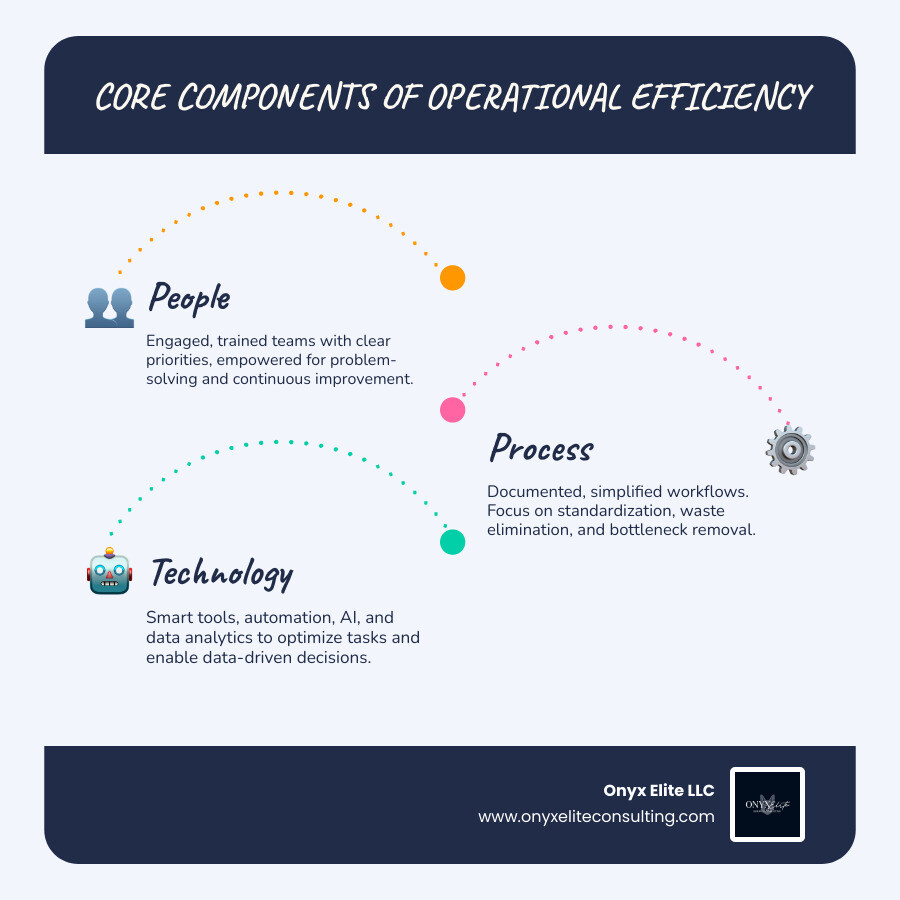
The three pillars that support operational efficiency are:
- People - Trained, engaged teams with clear priorities and the authority to solve problems
- Process - Documented, simplified workflows that eliminate waste and reduce errors
- Technology - Smart tools that automate tasks, provide visibility, and enable better decisions
As Doru Angelo, Founder & CEO of Onyx Elite LLC, I've spent over a decade helping businesses transform their operations through strategic consulting and proven frameworks to improve operational efficiency. My work with clients across industries has shown me that the path to sustainable growth starts with eliminating the friction that holds businesses back.
Understanding and Measuring Operational Efficiency

When we talk about boosting your business, we're really talking about making every part of your operation work smarter, not just harder. This focus on efficiency isn't just a buzzword; it translates directly into tangible benefits like cost savings, increased business agility, improved customer satisfaction, and higher employee engagement. It's why, as mentioned, companies that strategically invest in operational improvements often see impressive gains in productivity and a significant reduction in operating costs.
What is Operational Efficiency (and Why Does It Matter)?
At its core, operational efficiency is about maximizing the benefits of your processes and resources while enhancing production and reducing costs without compromising quality. It's the art of getting the most output from the least input. Think of it as an organization's or a team's ability to get important work done with minimal wasted time, effort, or resources. This means ensuring your people have precisely what they need to do the job right the first time.
We often consider three critical factors when defining operational efficiency:
- Cost: Minimizing how much it costs to operate and produce goods or services.
- Time: Optimizing production timelines and delivering products or services faster.
- Quality: Maintaining or improving the standard of your offerings.
When you improve operational efficiency, you're not just cutting corners; you're refining every process to run smoothly and align with your strategic goals. This leads to increased profit margins, as you're spending less to earn more. It also fosters scalability, allowing your business to grow without disproportionately increasing resources. Without a focus on operational efficiency, even the most innovative ideas can struggle to translate into sustainable success.
How to Measure Your Success
You can't improve what you don't measure, and operational efficiency is no exception. We rely on clear metrics and consistent tracking to understand where we stand and where we need to improve.
One common metric is the Operational Efficiency Ratio. This is calculated by adding your operating expenses and cost of goods sold (COGS), then dividing that sum by your net sales. For example, if a business has $2.5 million in expenses and $7 million in COGS, with $14 million in net sales, their operational efficiency ratio would be 67.9%. Generally, if your operational efficiency is 50 percent or less, you're doing well. Tracking this ratio over time, and comparing it to industry benchmarks, provides a clear picture of your performance.
Beyond this ratio, we use Key Performance Indicators (KPIs) custom to specific aspects of your operations. These might include:
- Cycle Time: The total time it takes to complete a process from start to finish.
- Throughput: The rate at which products or services are processed.
- Quality Yield: The percentage of output that meets quality standards without rework.
- Customer Feedback: Metrics like Net Promoter Score (NPS) or customer retention rates, which indicate how efficiently you meet customer needs.
- Employee Productivity: Output per hour or sales per employee.
It's also crucial to consider both lagging and leading indicators. Lagging indicators, like monthly output, show past results. Leading indicators, such as daily task completion rates, offer insights into where things are headed, allowing for real-time course correction. A blend of both provides a comprehensive view for both strategic planning and day-to-day management. Regularly benchmarking these metrics against industry standards helps us understand our competitive position and identify areas for improvement.
Operational Efficiency vs. Operational Effectiveness
While often used interchangeably, operational efficiency and operational effectiveness are distinct concepts, both vital for business success.
| Feature | Operational Efficiency (Doing Things Right) | Operational Effectiveness (Doing the Right Things) |
|---|---|---|
| Focus | How well tasks and processes are executed. | Whether the tasks and processes align with strategic goals and future plans. |
| Goal | Reduce costs, minimize waste, optimize resource utilization, maintain quality. | Achieve strategic objectives, deliver value, adapt to market changes, innovate. |
| Question Asked | Can we do this faster, cheaper, with fewer errors? | Are we doing the right activities to achieve our long-term vision? |
| Outcome | Higher productivity, lower operating costs, smoother workflows. | Competitive advantage, market relevance, sustainable growth, strategic alignment. |
| Relationship to Profit | Directly impacts profit margins by reducing expenses. | Drives revenue and market position by delivering superior value. |
Operational efficiency measures your organization’s ability to reduce the cost of producing a product while maintaining quality. In contrast, operational effectiveness examines whether the business's functioning aligns with its future plans and goals. We aim for both: doing things right and doing the right things.
Core Strategies to Improve Operational Efficiency
To truly improve operational efficiency, we must look beyond quick fixes and implement systemic changes. This involves a multi-faceted approach, focusing on streamlining processes, empowering our teams, and optimizing how we manage resources and finances. For more insights into building robust internal systems that drive scalable growth, you can explore our detailed article on 5 Internal Systems That Drive Scalable Growth for Service-Based Businesses.
Streamline Processes and Eliminate Bottlenecks

Inefficiency often hides in plain sight within our daily workflows. The first step to open uping significant gains is to carefully examine and refine these processes.
- Process Documentation and Mapping: We start by documenting every step of a process, from initiation to completion. This involves conducting process mapping exercises to visualize workflows and identify every hand-off, decision point, and potential area of friction. By observing how work actually gets done—perhaps even "going undercover boss" to experience frontline operations firsthand—we can spot inefficiencies that managers might miss from a distance.
- Standardization (SOPs): Once processes are mapped, we standardize procedures and best practices through clear Standard Operating Procedures (SOPs). This ensures consistency, reduces variations, and makes training new employees much easier.
- Workflow Simplification: Complex processes are often rife with unnecessary steps. We simplify them by breaking them into manageable tasks, eliminating redundant actions, and removing unnecessary approvals or blockers. For instance, reducing the number of work packages, reports, and meetings can significantly impact efficiency, with a typical potential gain of 5% to 15%.
- Identifying and Removing Bottlenecks: Bottlenecks are points in a process where work accumulates, causing delays and slowing down the entire operation. We use data and team feedback to identify these choke points. Once identified, we can adjust capacity, reallocate resources, or redesign the process to alleviate the blockage. Continuously monitoring and addressing these bottlenecks is crucial for smooth operations.
By systematically documenting, simplifying, and optimizing our workflows, we can significantly improve operational efficiency, leading to reduced delays, lower costs, and improved overall output.
Empower Your People Through Training and Culture
Our people are our greatest asset, and their engagement and capabilities are central to operational efficiency. Investing in them through training and fostering a supportive culture pays dividends.
- Comprehensive Employee Training and Development: We believe in training for the task, not just the role. This means conducting regular training needs assessments to identify skill gaps and providing both technical and soft skills training. Cross-functional training is particularly valuable, as it equips employees with a broader understanding of different roles and allows for greater flexibility within teams. Mentoring and coaching programs further support knowledge transfer and continuous skill development.
- Building a Culture of Continuous Improvement: We accept the philosophy of Kaizen, a Japanese concept that translates to “continuous improvement.” This involves creating a culture where employees are encouraged to identify and implement small, incremental changes that lead to significant efficiency gains over time. It's about making it easy for teams to share ideas, experiment, and celebrate wins, fostering a mindset that constantly seeks better ways of working. You can learn more about this powerful approach by exploring The Kaizen methodology for continuous improvement.
- Breaking Down Silos and Fostering Communication: Organizational silos, where departments operate in isolation, are notorious efficiency killers. As research highlights, individual divisions often have necessary but conflicting priorities, and goals tied to compensation can reinforce silo-oriented behavior. We actively promote cross-departmental collaboration and establish clear communication channels and protocols. Open, transparent communication is vital, especially since 28% of employees cite poor communication as a reason for not delivering work on time. Improving communication ensures smoother information flow and proactive issue resolution.
- Employee Autonomy and Empowerment: Research from MIT Sloan School of Management found that employees with autonomy over their work pace and activity order were twice as productive and produced units at a much lower cost. We empower our frontline teams to act locally, giving them the tools, training, and authority to fix issues on the spot. Building a culture of trust and relationship building among teams, combined with transparency about goals, ensures that employees feel valued and motivated to contribute their best.
By empowering our people and nurturing a culture of continuous learning and collaboration, we significantly improve operational efficiency from the ground up.
Optimize Resource and Financial Management
Smart resource and financial management are crucial for sustained operational efficiency and profitability. This involves making strategic decisions about how we allocate our assets and manage our money.
- Demand Forecasting and Capacity Planning: Accurate demand forecasting allows us to align resources effectively, preventing both over- and underutilization. Coupled with regular capacity planning, we can assess our resource requirements—be it staffing, equipment, or materials—and optimize them to meet anticipated needs without waste.
- Supply Chain Optimization: A streamlined supply chain is a cornerstone of efficiency. We work to minimize lead times, reduce inventory costs, and ensure a smooth flow of goods and services. This often involves collaborating closely with suppliers and leveraging technology for better visibility and coordination.
- Outsourcing Non-Core Activities: Focusing on our core competencies means we sometimes outsource non-core activities to specialized service providers. This can free up internal resources, reduce overhead, and often lead to cost savings and improved service quality. McKinsey's research indicates that consolidating and outsourcing can create an impact of 5% to 10% on efficiency.
- Strategic Financial Management: Beyond general cost-cutting, we focus on strategic financial management. This includes analyzing project profitability to identify which clients, projects, or products contribute most to our bottom line. As David Finkel for Inc.com notes, professional service firms typically have operating profit margins from 25-40 percent, highlighting the impact of diligent financial analysis. For more on optimizing financial flows, particularly in crucial areas like transaction costs, you might find our insights on Credit Card Processing valuable. By wisely managing our financial strategies, we can boost margins and ensure a healthy financial foundation for our operations.
Through these strategies, we ensure that our resources are allocated efficiently, our supply chain runs smoothly, and our financial health supports our efforts to improve operational efficiency.
Leveraging Technology for a Quantum Leap in Efficiency
In today's business world, technology isn't just an advantage; it's a necessity for achieving peak operational efficiency. Tools like automation, Artificial Intelligence (AI), Machine Learning (ML), and robust data analytics are changing how businesses operate, enabling us to do more with less in ways previously unimaginable.
The Power of Automation and AI to Improve Operational Efficiency
Automation and AI are game-changers in the quest to improve operational efficiency. They allow us to offload repetitive, time-consuming tasks, freeing up our human talent for more strategic and value-added activities.
- Robotic Process Automation (RPA) and Intelligent Automation: RPA bots can handle mundane administrative tasks like data entry, account reconciliation, and report generation, drastically reducing human error and speeding up workflows. Intelligent automation, which augments RPA with AI, goes a step further, allowing systems to analyze sentiment, cross-reference details, and even make decisions to resolve issues without rigid, predefined workflows. This can achieve a significant impact, with digitizing operations often leading to a 20% to 50% improvement in efficiency.
- AI-Powered Helpdesks and Chatbots: Imagine an employee needing a password reset. Instead of filing a ticket and waiting, they could chat with a conversational AI assistant that resolves the issue instantly. AI-powered helpdesks can fully automate many tier-one support requests, triaging complex issues and resolving straightforward ones autonomously. This is not just a theoretical benefit; companies have reported remarkable results, such as an 88% autonomous resolution rate with AI assistants, a 96% accuracy rate in routing IT tickets eliminating backlogs, and a 73% ticket deflection rate. This dramatically improves IT efficiency and employee satisfaction.
- Predictive Analytics and Machine Learning: AI and ML excel at analyzing vast datasets to identify patterns and predict future outcomes. This capability is invaluable for:
- Predictive Maintenance: Anticipating equipment failures before they occur, minimizing downtime and costly repairs.
- Demand Forecasting: More accurately predicting customer demand, optimizing inventory, and reducing waste.
- Supply Chain Optimization: Identifying potential disruptions and recommending efficient routes or production sequences.
- Fraud Prevention: Analyzing transaction data in real-time to detect patterns indicative of criminal activity.
- Freeing Up Human Potential: The most exciting aspect of automation and AI is its impact on our workforce. Studies show that nearly 80% of employees report that automation has allowed them to spend more time on valuable activities, such as enhancing customer relationships or engaging in strategic thinking. This shift not only improves efficiency but also boosts employee morale and job satisfaction. For a deeper dive into how these technologies are revolutionizing operations, explore 10 ways artificial intelligence is changing operations management.
With 78% of companies using AI for at least one task, it's clear that these technologies are no longer futuristic concepts but essential tools for any business looking to improve operational efficiency.
Choosing the Right Tools for Your Business
Implementing technology effectively requires selecting the right tools that integrate seamlessly into your existing operations and support your strategic goals.
- Enterprise Resource Planning (ERP) Systems: An ERP system is a single, integrated software solution that manages various business functions, from supply chain and finance to inventory and customer relationship management (CRM). Companies that have adopted robust ERP systems have reported significant improvements in operational efficiency—for example, a remarkable 45% improvement with platforms like Acumatica. ERP systems automate labor-intensive tasks, provide a unified view of data, and enable better forecasting and decision-making.
- Collaboration Tools: Effective communication and collaboration are paramount. Tools like project management software, communication platforms, and shared document systems enable seamless teamwork, regardless of location. They reduce delays, improve information flow, and foster a more connected and productive workforce.
- Data Visualization and Analytics Dashboards: AI-powered analytics platforms can transform raw operational data into intuitive dashboards. These tools provide real-time insights into performance, allowing us to pinpoint recurring issues, identify bottlenecks, and make data-driven decisions swiftly. When teams can visualize performance data clearly, they are better equipped to identify what's working and what's not.
To truly improve operational efficiency, it's not just about acquiring tools, but about strategically integrating them to create a cohesive and powerful operational ecosystem. For a comprehensive look at how to leverage technology for scalable growth, review our insights on 5 Internal Systems That Drive Scalable Growth for Service-Based Businesses.
Real-World Success and Avoiding Common Pitfalls
Learning from both triumphs and missteps is invaluable on the journey to improve operational efficiency. Real-world examples illuminate what's possible, while understanding common pitfalls helps us steer our own improvement efforts more effectively.
Learning from the Best: Operational Efficiency in Action
Many companies have successfully transformed their operations, providing inspiring blueprints for others.
- Manufacturing Sector Innovations:
- Waste Reduction and Safety: A distribution center, for example, implemented improvements in safety behaviors and task execution that led to a significant 54% drop in recordable incidents and a reduction in rework. This demonstrates how efficiency isn't just about speed, but also about quality and safety.
- Just-in-Time (JIT) Inventory: Many manufacturers adopt JIT inventory management, a lean principle aimed at minimizing inventory holding costs by receiving materials and producing goods only as they are needed. This reduces waste and improves cash flow.
- Service Industry Changes:
- Financial Services Automation: Financial services companies frequently leverage Robotic Process Automation (RPA) for tasks like data entry, account reconciliation, and report generation. This frees up human employees to focus on more complex client interactions and strategic analysis, as seen in firms improving throughput with frontline visibility.
- Retail Task Management: A grocery retailer significantly cut task execution time and improved restocking by enabling frontline staff to manage tasks and store execution through mobile interfaces. This highlights the power of empowering frontline workers with accessible technology.
- Airline Operational Excellence: British Airways, for instance, reimagined its Heathrow operation to improve punctuality, baggage handling, and customer experience. This involved moving from large, impersonal groups to smaller, accountable teams and investing in tools and control centers, leading to increased punctuality, customer satisfaction, and employee engagement.
- Insights from Business Leaders: Sometimes, the best insights come from stepping into the shoes of those on the frontline. The concept of "going undercover boss" is more than just a TV show; it's a powerful way for leaders to find inefficiencies firsthand. One business owner, disguised as an employee, found that job specifications for sorting towels were based on incorrect bag weight assumptions, leading to a simple but impactful process redesign.
These examples underscore that operational efficiency is not a theoretical concept but a practical, achievable goal with profound real-world benefits.
Common Mistakes to Avoid on Your Efficiency Journey
While the path to improve operational efficiency is rewarding, it's also fraught with common missteps. Being aware of these can save valuable time and resources.
- Confusing Cost-Cutting with Waste Reduction: A critical distinction we make is between simply cutting costs and genuinely reducing waste. Cutting budgets without addressing underlying issues like broken workflows or unclear priorities can lead to more rework, burnout, and employee turnover. True operational efficiency reduces waste—unnecessary time, effort, or materials—rather than just slashing resources, which often damages quality and morale.
- Ignoring Company Culture: Operational efficiency isn't just about processes and technology; it's deeply intertwined with your company's culture. If leadership hasn't purposefully cultivated a culture of trust, open communication, and continuous improvement, new efficiency initiatives can face significant resistance. As data from MIT Sloan School of Management suggests, a strong culture of trust and relationship-building among teams directly correlates with higher productivity and satisfaction.
- Lack of Clear Goals: Without explicit, measurable goals, it's impossible to track progress or determine success. Vague objectives lead to unfocused efforts and make it difficult to rally employees around a common purpose. We emphasize establishing practical, measurable, and actionable KPIs from the outset.
- Overcomplicating Processes: The irony of seeking efficiency is that some businesses inadvertently overcomplicate their processes in the pursuit of perfection. Adding too many layers of approval, complex reporting requirements, or unnecessary steps can create more bottlenecks than they solve. The goal is simplification and clarity.
- Poor Communication: As highlighted earlier, poor communication is a significant barrier to efficiency. If employees aren't informed about changes, don't understand the "why" behind new initiatives, or lack clear channels to provide feedback, efforts to improve operational efficiency will falter. Transparency, providing context, and explaining the goals of any changes are crucial for gaining employee buy-in and fostering a collaborative environment.
By avoiding these common pitfalls, we can ensure our journey to greater operational efficiency is smoother, more effective, and ultimately more successful.
Conclusion
The journey to improve operational efficiency is a continuous, dynamic process, not a one-time fix. It's about building a robust, adaptive business that can thrive in any environment. As we've explored, the core strategies revolve around the seamless integration of people, processes, and technology.
We've seen how streamlining processes through meticulous documentation, standardization, and bottleneck removal can eliminate waste and accelerate workflows. Empowering your people through comprehensive training, fostering a culture of continuous improvement, and promoting open communication not only boosts productivity but also cultivates a more engaged and satisfied workforce. Finally, leveraging cutting-edge technology—from automation and AI-powered tools to integrated ERP systems—provides the quantum leap needed to automate routine tasks, gain deep insights, and make smarter, faster decisions.
This commitment to ongoing improvement is essential because markets change, competitors advance, technology evolves, and customer expectations shift. By embedding efficiency as a core value, businesses in West Hartford CT, Connecticut, and beyond can maintain a competitive edge, achieve sustainable growth, and ensure long-term profitability.
At Onyx Elite Consulting, we specialize in helping businesses like yours steer this complex landscape. We go beyond traditional solutions, offering strategic planning, brand development, and custom services designed to achieve sustainable growth and operational excellence. If you're ready to transform your operations and open up your full potential, we invite you to learn more about how we can partner with you. Explore our comprehensive offerings and find how our expertise can benefit your business by visiting our Services Overview. Let's build a more efficient and prosperous future together.