

Beyond the Buzzword: Unpacking Lean Operational Excellence
Why Lean Operational Excellence Matters for Your Business

Lean operational excellence is a management philosophy and systematic approach that combines traditional Lean principles of waste elimination with a culture of continuous improvement to deliver maximum value to customers while minimizing costs and inefficiencies. It's about creating a sustainable operating model where every process, person, and decision is aligned toward delivering value efficiently and reliably.
Quick Answer: What is Lean Operational Excellence?
- Core Focus: Eliminate waste (activities that don't add customer value) and create smooth, efficient workflows
- Key Principles: Define value from the customer's perspective, map value streams, create flow, establish pull systems, and pursue perfection through continuous improvement
- Primary Benefits: 25% higher growth and 75% higher productivity compared to competitors, with cost reductions of 15-25%
- Cultural Foundation: Empowers all employees to identify problems and implement solutions, not just a set of tools
- Outcome: Sustainable competitive advantage through operational efficiency, improved quality, and improved customer satisfaction
Many business leaders today struggle with a frustrating paradox. They invest in new systems, hire talented people, and work harder than ever—yet inefficiencies persist, costs remain stubbornly high, and growth feels elusive. The missing piece isn't more effort or investment. It's a structured approach to operational excellence that addresses the root causes of waste and builds a culture where improvement becomes part of your organization's DNA.
The statistics tell a compelling story. Companies with top operational excellence have 25% higher growth and 75% higher productivity than their competitors. Lean programs alone can create cost savings and capacity increases of 15 to 25%. One industrial services company achieved a 34% increase in production performance, a 73% reduction in pending safety actions, and a 33% decrease in employee absenteeism after implementing Lean principles systematically.
But here's the reality that many organizations miss: Lean operational excellence isn't about implementing a few tools or running occasional improvement projects. It's a fundamental change in how you view and manage your operations. As one financial services expert notes, "the most frequent reason for not reaching stated goals is an insufficient understanding of the journey that the organization must take to evolve into a world-class lean institution—a journey that involves driving true cultural change."
The good news? This change is achievable for any organization willing to commit to the journey. Whether you're in manufacturing, services, IT, or even government, the principles of Lean operational excellence can be adapted to your specific context. The path requires leadership commitment, employee empowerment, and a systematic approach—but the results speak for themselves.
I'm Doru Angelo, Founder and CEO of Onyx Elite LLC, where I've spent over a decade helping organizations achieve sustainable growth through strategic operational improvements and Lean operational excellence frameworks. My experience guiding businesses through cultural change and process optimization has shown me that lasting success comes from building systems that work efficiently while empowering people to continuously improve them.
The Foundations: Core Principles and Waste Elimination
At its heart, Lean operational excellence is about delivering maximum value to the customer. This means understanding exactly what the customer values and then systematically working to achieve it with the least possible effort and resources. This philosophy, rooted deeply in the Toyota Production System (TPS), revolutionized manufacturing and has since proven universally applicable across all industries.
Operational excellence, as a management philosophy, creates a workplace that strives for continual improvements and moves forward with the goal of meeting all performance standards and metrics. It entails aligning corporate activities with a single goal, encompassing various approaches to achieve this. To learn more about this overarching concept, explore What is operational excellence?
The 5 Core Principles of Lean Management
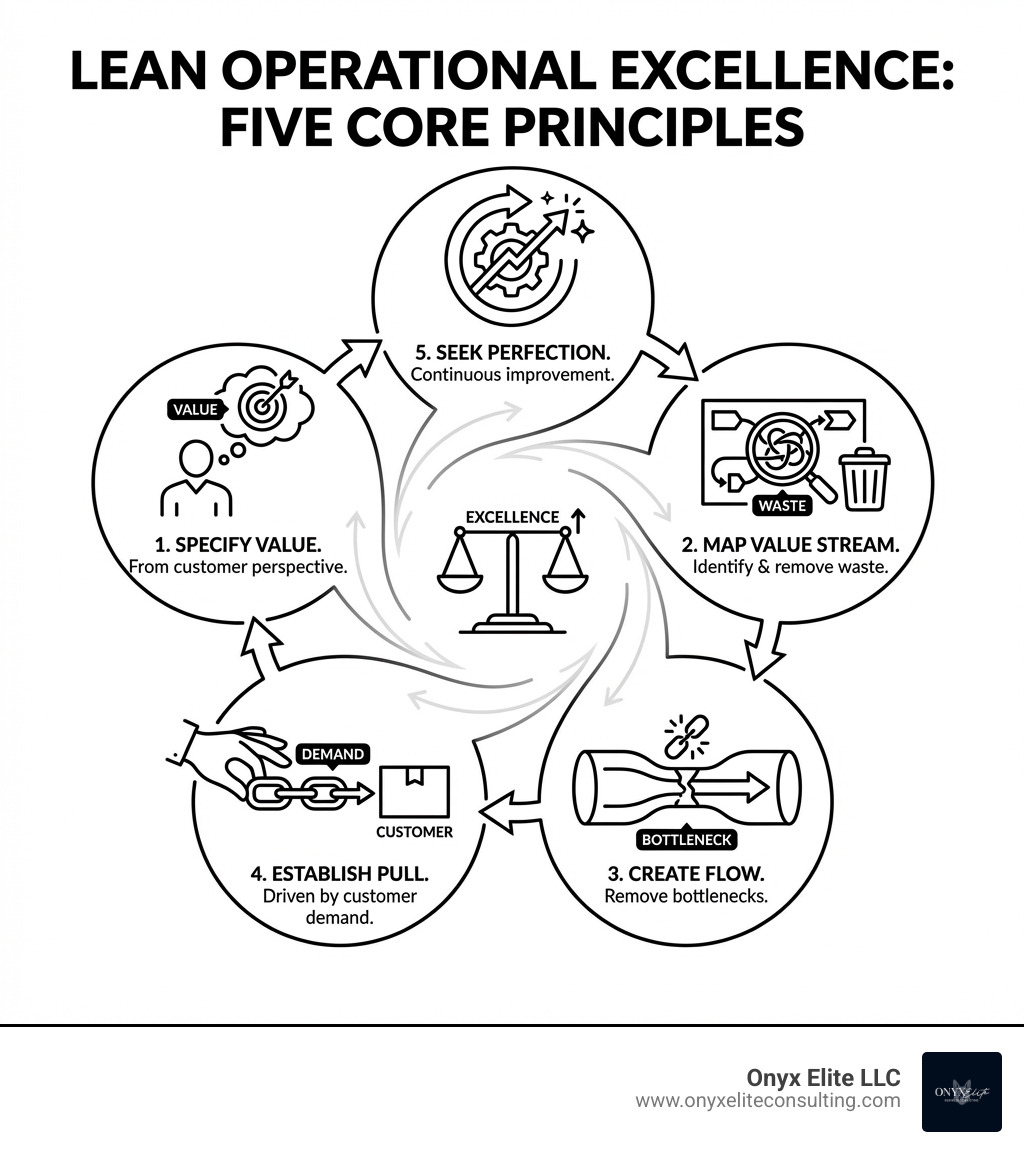
The entire framework of Lean is built upon five interconnected principles, each crucial for guiding our journey toward Lean operational excellence:
- Specify Value: The very first step is to precisely define "value" from the customer's perspective. What is the customer truly willing to pay for? What problem are we solving for them? This isn't about what we think they want, but what they actually need and perceive as valuable. Without this clarity, all subsequent efforts risk being misdirected.
- Map the Value Stream: Once value is defined, we map the entire value stream – all the steps, both value-adding and non-value-adding, that a product or service goes through from conception to delivery. This visualization helps us identify where waste exists and where flow is interrupted.
- Create Flow: After identifying waste, the goal is to eliminate it and ensure that the value-adding steps flow smoothly without interruptions, delays, or bottlenecks. This means optimizing processes so that work moves continuously from one step to the next, like water in a river.
- Establish Pull: Instead of pushing products or services through the system based on forecasts (which often leads to overproduction and inventory waste), we establish a "pull" system. Production is initiated only when the customer signals a need, ensuring that we produce only what is required, when it is required.
- Seek Perfection (Kaizen): Lean is not a one-time project; it's a relentless pursuit of perfection. This principle embodies continuous improvement, known as Kaizen. We constantly look for ways to eliminate more waste, improve flow, and deliver even greater value.
These principles form the backbone of any successful Lean change. They guide not just our actions but also our thinking, helping us foster a mindset of constant improvement. For a deeper dive into how these principles drive systemic change, we encourage you to explore The Lean Transformation Framework. Additionally, understanding how these principles integrate with broader business systems is vital for sustainable growth. Find more insights on More on strategic business systems.
The Enemy of Efficiency: Identifying and Eliminating Waste
The core of Lean thinking is the ruthless identification and elimination of waste. In Lean terminology, waste is anything that does not add value for the customer. The Toyota Production System identified three main types of waste:
- Muda (Waste): This refers to activities that consume resources but do not add value for the customer. This is the most commonly recognized form of waste.
- Mura (Unevenness): This is the waste of inconsistency or fluctuation in production volumes, schedules, or quality. It often leads to Muda and Muri.
- Muri (Overburden): This is the waste of overburdening equipment or people, often resulting from Mura. It can lead to breakdowns, defects, and employee burnout.
By systematically identifying and addressing these three types of waste, we can achieve significant process optimization and cost reduction. In our experience, Lean programs can create cost savings and capacity increases of 15 to 25 percent.
The most common categories of Muda are often summarized by the acronym DOWNTIME:
- Defects: Errors, rework, or anything that doesn't meet quality standards.
- Overproduction: Producing more than is needed, sooner than needed. This is considered the worst waste as it often leads to other wastes.
- Waiting: Delays in processes, people, or materials.
- Non-Used Talent (or Non-Used Talent): Underutilizing the skills, knowledge, and creativity of employees.
- Transportation: Unnecessary movement of materials or products.
- Inventory: Excess raw materials, work-in-progress, or finished goods beyond what is immediately required.
- Motion: Unnecessary movement of people or equipment within a process.
- Extra-Processing: Doing more work than is required by the customer.
The Lean Toolkit: Practical Methods for Achieving Excellence
Achieving Lean operational excellence isn't just about understanding principles; it's about applying practical tools and techniques to drive process improvement, ensure quality management, and make data-driven decisions. These tools empower teams to identify problems, implement solutions, and sustain improvements.
Essential Lean Tools and Techniques
Here are some of the fundamental tools we use to translate Lean principles into action:
- Value Stream Mapping (VSM): This powerful visual tool allows us to map out every step in a process, from customer request to delivery. By visualizing the flow of materials and information, we can easily identify bottlenecks, waste, and opportunities for improvement.
- 5S Methodology (Sort, Set in Order, Shine, Standardize, Sustain): A systematic approach to workplace organization and standardization. It helps create a clean, organized, and safe work environment, reducing waste related to searching for items, improving safety, and making problems visible.
- Gemba Walks: "Gemba" is a Japanese term meaning "the real place" or "where the value is created." Gemba walks involve leaders and managers going to the actual workplace to observe processes, engage with employees, and understand problems firsthand. This hands-on approach provides invaluable insights that cannot be gained from an office.
- Kaizen Events: These are focused, short-term (typically 3-5 days) intense workshops designed to rapidly improve a specific process or area. Teams work together to identify problems, brainstorm solutions, implement changes, and measure results, embodying the "seek perfection" principle.
- Kanban Boards: A visual system for managing work as it moves through a process. Kanban uses cards or visual signals to limit work-in-progress, promote continuous flow, and allow teams to pull work only when they have capacity, directly supporting the "establish pull" principle.
- Poka-Yoke (Error-Proofing): This technique involves designing processes or systems to prevent errors from occurring in the first place or to make them immediately obvious if they do. It removes the possibility of human error, improving quality and consistency.
Lean and Other Improvement Methodologies
While Lean is a powerful methodology on its own, it's important to understand its relationship with other approaches to operational excellence. Lean's primary focus is on speed and waste removal, streamlining how work flows. However, it often complements other frameworks to achieve a more holistic improvement.
Continuous improvement, often synonymous with Kaizen, is a core principle of Lean, emphasizing ongoing, incremental improvements to processes, products, or services. This commitment to never-ending perfection is what drives long-term success.
Many organizations combine Lean with other methodologies that address different aspects of operational excellence:
| Methodology | Primary Goal | Focus | Key Tools/Concepts |
|---|---|---|---|
| Lean | Maximize value, eliminate waste | Speed, efficiency, flow | Value Stream Mapping, 5S, Kanban, Just-In-Time |
| Six Sigma | Reduce defects and variation | Quality, consistency, data | DMAIC (Define, Measure, Analyze, Improve, Control), Statistical Process Control |
| Kaizen | Continuous, incremental improvement | Employee involvement, small changes | Kaizen Events, Daily Kaizen, Standard Work |
| Theory of Constraints (TOC) | Optimize system throughput by addressing bottlenecks | Bottleneck identification & exploitation | Five Focusing Steps, Drum-Buffer-Rope |
Lean and Six Sigma, for example, are often combined into "Lean Six Sigma." While Lean targets speed and waste, Six Sigma reduces variation and defects through measurement and statistical control. Many organizations combine both to improve flow and quality simultaneously. Similarly, the Theory of Constraints often strengthens Lean and Six Sigma efforts by helping to find the single bottleneck limiting throughput, allowing Lean to remove waste around it and Six Sigma to stabilize quality.
These frameworks provide structured methods to improve performance and sustain results. For a comprehensive overview of how these fit together, explore Top operational excellence frameworks explained.
A Roadmap for Implementing Lean Operational Excellence
Implementing Lean operational excellence is not merely a technical undertaking; it's a cultural change that requires a well-defined implementation strategy and effective change management. It's about shifting mindsets, empowering people, and embedding a philosophy of continuous improvement into the organization's DNA.
The Critical Role of Leadership and Employee Empowerment
The success of any Lean initiative hinges on strong leadership commitment. Leaders must provide a clear vision, actively participate in the change, and remove barriers for their teams. Without executive buy-in and consistent support, Lean efforts often falter. Leaders must understand that Lean is a long-term journey, not a quick fix.
Furthermore, employee empowerment is non-negotiable. Lean thrives when everyone, from top management to front-line operators, is involved in identifying waste and implementing solutions. We've seen how engaging employees fosters a sense of ownership and drives innovation. Our case studies show that over 95% of staff can receive training in Lean Thinker methodologies, leading to approximately 30% of teams being certified as Lean Practitioners. This investment in our people empowers them to become problem-solvers.
Leadership's role is to:
- Set Direction and Align Objectives: Translate strategic goals into actionable plans using tools like Objectives, Goals, Strategies, Measures (OGSM).
- Develop Skills and Behaviors: Train leaders and employees in Lean principles, coaching them to adopt a continuous improvement mindset.
- Foster Autonomy: Encourage teams to make decisions and take responsibility for their processes.
For more insights on how effective leadership can drive organizational change, we invite you to read our Read more leadership insights.
Cultivating a Culture of Continuous Improvement
A true Lean change results in a culture where continuous improvement is ingrained in daily operations. This means fostering a mindset where employees are always looking for ways to improve, no matter how small.
Key elements of cultivating this culture include:
- Daily Improvement Habits: Encourage regular, small-scale improvements (Daily KAIZEN™) by teams at their workstations.
- Standard Work: Establish clear, documented best practices for every task, providing a baseline for consistency and future improvement.
- Visual Management: Use visual aids like performance boards, charts, and dashboards to make processes, performance, and problems transparent. This promotes accountability and helps teams track their progress toward goals.
- Celebrating Wins: Acknowledge and celebrate successful improvements to motivate teams and reinforce the value of continuous improvement.
The impact of such a culture is tangible. A significant qualitative result we often observe is a decrease in employee absenteeism rates, sometimes by as much as 33%, as improved well-being and engagement foster a more dynamic, collaborative, and proactive organizational environment.
Overcoming Common Challenges in Your Lean Journey
Implementing Lean operational excellence is a rewarding journey, but it's not without its bumps. We've identified several common challenges and strategies to overcome them:
- Resistance to Change: Employees may be comfortable with existing processes. Overcome this by clearly communicating the "why" behind Lean, involving employees in decision-making, and providing adequate training. Pilot projects can help validate concepts and build advocacy.
- Lack of Leadership Support: As mentioned, without consistent leadership commitment, Lean initiatives often fail. Leaders must visibly champion the effort and allocate necessary resources.
- Focusing on Tools Over Culture: Many organizations mistakenly believe Lean is just a set of tools. True Lean requires a fundamental cultural and mindset shift. We emphasize principles over tools, ensuring a deep understanding of Lean philosophy.
- Insufficient Training: Employees need to be equipped with the knowledge and skills to identify waste and implement solutions. Comprehensive training programs are essential.
- Overcoming Obstacles: Expect challenges and build problem-solving capabilities within teams. Structured problem-solving methodologies like A3 and A6 are invaluable for tackling issues systematically.
By proactively addressing these challenges, we can ensure a smoother and more successful Lean change, changing obstacles into opportunities for growth.
The Measurable Impact of Lean Change
The adoption of Lean operational excellence isn't just about philosophical shifts or improved workflows; it delivers concrete, measurable benefits that directly impact business growth, productivity gains, and financial results.
Quantifiable Business Benefits of Lean Operational Excellence
The statistics speak for themselves, illustrating the profound impact Lean can have across various business aspects:
- Increased Productivity and Growth: Companies with top operational excellence boast 25% higher growth and 75% higher productivity compared to their competitors. This isn't just theory; it's a consistent outcome.
- Significant Cost Reduction: Lean programs can create cost savings of over 15% in direct operational costs. Manufacturers implementing Lean Industry 4.0 can reduce conversion costs by as much as 40%. This is achieved by systematically eliminating waste and optimizing resource utilization.
- Improved Quality and Safety: One industrial services company saw a dramatic 73% reduction in pending safety actions after implementing Lean principles. By focusing on error-proofing (Poka-Yoke) and continuous improvement, organizations improve product and service quality, reducing defects and rework.
- Improved Efficiency: Lean drives efficiency across the board. We've seen production performance increase by 34%, efficiency in product inbound processes jump by 25%, and dispatch and delivery improve by 6%. This translates into faster lead times and better resource allocation.
- Improved Customer Satisfaction: By delivering products and services at the exact moment customers desire them, at the lowest cost, with the slightest effort, and at a price they are willing to pay, Lean operational excellence directly contributes to superior customer value and satisfaction. This focus on customer value, from defining it to delivering it, is what sets Lean apart.
These quantifiable results demonstrate that Lean is not just a theoretical concept but a practical strategy for achieving superior business performance.
The Future of Lean: Integrating with Industry 4.0 for Next-Level Operational Excellence
The world of operations is constantly evolving, and so is Lean. The next frontier in Lean operational excellence lies in its integration with Industry 4.0 technologies, giving rise to "Lean Industry 4.0." This concept combines traditional Lean principles with advanced digital technologies like predictive maintenance, real-time data analytics, and smart factories.
While Lean management alone has been a powerful tool for decades, it's often insufficient to address the increasing complexity of modern operational challenges. Industry 4.0 technologies, which include advanced robotics, big data and analytics, cloud computing, and the Industrial Internet of Things, offer new levels of transparency, predictability, and self-controlled systems.
The synergistic benefits of integrating Lean and Industry 4.0 are remarkable:
- Improved Cost Reduction: While independent Lean or Industry 4.0 initiatives might reduce conversion costs by around 15%, their integrated application can reduce conversion costs by as much as 40%.
- Superior Quality: This integrated approach can reduce costs associated with poor quality by 20% and achieve a 50% to 70% reduction in defects through data-driven quality control and self-inspection.
- Increased Efficiency and Speed: Real-time data from connected systems accelerates production management, allowing for more efficient changeovers and optimized production plans.
- Improved Safety: Sensors and virtual reality training improve working conditions and safety, reducing accident rates.
The key is to avoid "automating waste." Processes must first be optimized using Lean principles before deploying advanced technologies. This ensures that we are automating value-adding activities, not just making inefficient processes faster. Manufacturers that master the ability to apply Lean Industry 4.0 will be the operational excellence champions in the years ahead, driving unprecedented levels of efficiency, quality, and customer satisfaction.
Frequently Asked Questions about Lean Methods
What is the first step in implementing Lean?
The first step is always to clearly define "value" from the customer's perspective. Without understanding what the customer is willing to pay for, you cannot effectively identify and eliminate waste.
Can Lean be applied to service-based businesses?
Absolutely. While originating in manufacturing, Lean principles are universally applicable. In service industries, waste can be found in the form of unnecessary paperwork, long wait times, redundant process steps, and unclear communication.
How long does it take to see results from Lean?
Small, incremental improvements can often be seen within weeks of implementing tools like 5S or running a Kaizen event. However, achieving deep cultural change and realizing the full financial benefits of a comprehensive Lean operational excellence program is a long-term journey that requires sustained commitment.
Conclusion: Your Next Step Towards Sustainable Growth
At Onyx Elite LLC, we understand that achieving Lean operational excellence is more than just a business strategy; it's a cultural journey that reshapes how an organization operates and innovates. It's about empowering your people, optimizing your processes, and relentlessly pursuing perfection to deliver unparalleled customer value.
The journey may present challenges, but the rewards are substantial: from significant cost reductions and efficiency gains to improved quality, improved productivity, and a robust culture of continuous improvement. These benefits translate directly into sustainable growth and a formidable competitive advantage for businesses in West Hartford, CT, and across Connecticut.
We believe that every organization has untapped potential for operational excellence. Our comprehensive suite of custom services goes beyond traditional solutions, guiding you through strategic planning, process optimization, and cultural change. We help you define your unique path to Lean operational excellence, ensuring that every step taken is aligned with your strategic goals and delivers measurable results.
Are you ready to transform your operations and open up your organization's full potential? Learn how our services can drive your operational excellence.