How to Lead Without Losing Your Mind Using Executive Coaching
Why Leadership Coaching for Executives Is the Edge Modern Leaders Can't Afford to Ignore

Leadership coaching for executives is a structured, one-on-one development process that helps senior leaders think more clearly, lead more effectively, and drive real organizational results.
Here's what it covers at a glance:
| What It Is | What It Does | Who It's For |
|---|---|---|
| Personalized coaching with a qualified coach | Builds adaptive thinking and decision-making | C-suite leaders, founders, emerging executives |
| Evidence-based frameworks and assessments | Drives measurable behavior change | Leaders navigating transitions or high-stakes roles |
| Ongoing engagement (months to years) | Increases transformation success by 70%+ | Organizations scaling leadership capacity |
Being a leader today is harder than it used to be. The pace of change is faster. The expectations are higher. And the problems landing on your desk — from team culture to market disruption to operational chaos — don't come with a playbook.
Most leaders were promoted because they were great at doing the work. But leading at the executive level requires something different: the ability to think strategically under pressure, inspire trust, and make confident decisions even when the right answer isn't obvious.
That's a skill set. And like any skill set, it can be developed.
The challenge? You can't get there through a training course alone. Research consistently shows that leaders need ongoing, personalized coaching to build the kind of thinking and self-awareness that transforms how they lead — not just what they know.
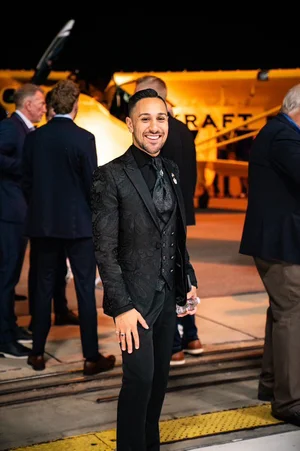
I'm Doru Angelo, Founder & CEO of Onyx Elite LLC, and with over a decade of experience in business consulting, executive strategy, and leadership development, I've seen how leadership coaching for executives can be the turning point between stagnation and sustainable growth. Let's break down exactly how it works — and how to make it work for you.
The Science of Performance: Neuroscience and Evidence-Based Frameworks
Modern leadership is no longer just about "gut feeling." We now have the benefit of behavioral science and neuroscience to explain why some leaders thrive while others burn out. At the executive level, the cognitive load—the amount of information your working memory can hold—is often at its breaking point. When you are hit with disruptive change and emerging technologies, your brain’s "fight or flight" response can hijack your strategic thinking.
High-quality leadership coaching for executives utilizes neuroscience-based approaches to help leaders regulate stress and improve cognitive agility. Instead of reacting impulsively to a market shift, a coached leader learns to pause, access their prefrontal cortex, and make a reasoned decision. This isn't "fluff"; it’s about rewiring the brain for better performance.
Evidence-based frameworks, such as those used in the Strategic Healthcare Leadership Program, emphasize that success in disruption depends more on how a leader thinks than what they know. Research into adult development shows that leaders can actually expand their mental capacity to handle more complexity as they age, provided they have the right support.
The Role of Somatic Coaching in Leadership
You might be wondering: what does my body have to do with my quarterly earnings? As it turns out, everything. Somatic coaching is an advanced technique that focuses on the body's role in leadership. It’s about more than just posture; it’s about physiological regulation.
When an executive is under immense pressure, their body often shows signs of stress before their mind even registers it. Somatic coaching helps leaders develop "presence"—that intangible quality that makes people listen when you walk into a room. By becoming aware of non-verbal communication and physical cues, you can project more confidence and stay grounded during high-stakes negotiations. This physical awareness is a key component of Corporate Strategy Development, as a leader's physical state often dictates the "vibe" and psychological safety of the entire boardroom.
The Strategic Value of Leadership Coaching for Executives
The ROI of coaching is often debated, but the data is becoming harder to ignore. Research shows that coaching senior leaders can increase the likelihood of organizational transformation success by more than 70%. When a leader changes their mindset, the ripple effect moves through the entire company, improving talent retention and organizational agility.
In our view at Onyx Elite LLC, Leadership is the New Currency: The Mindset Shift Every CEO Needs in 2026. In an era where technology is a commodity, the only true competitive advantage is the quality of your leadership.
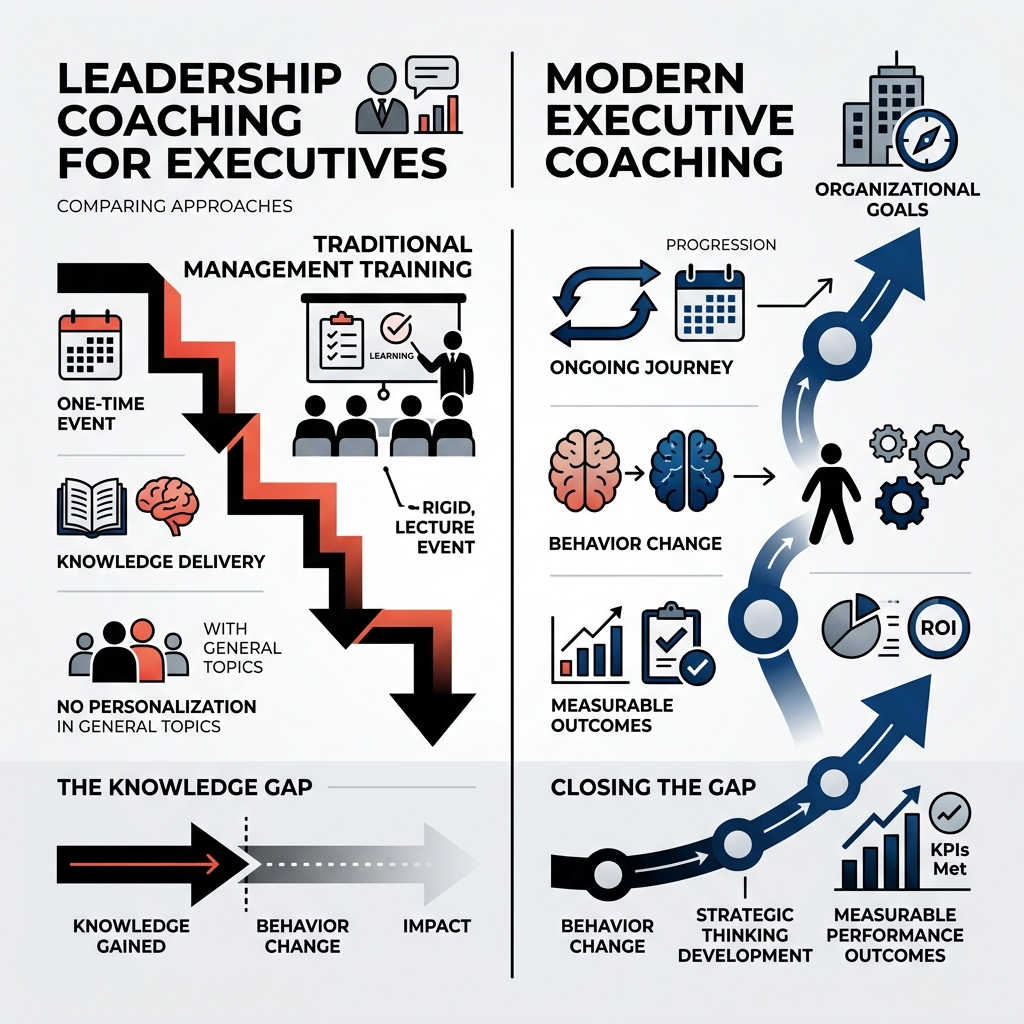
| Feature | Generic Management Training | Executive Leadership Coaching |
|---|---|---|
| Focus | Technical skills & knowledge | Behavior change & mindset |
| Customization | One-size-fits-all | 100% tailored to the individual |
| Duration | Short-term (1-3 days) | Long-term (6 months - 2 years) |
| Outcome | Information retention | Sustained performance & ROI |
| Feedback | General assessments | 360-degree feedback & stakeholders |
Key Skills Developed Through Leadership Coaching for Executives
What does a typical coaching session actually look like? It’s not just a friendly chat. It’s a rigorous process designed to sharpen specific high-level skills:
- Strategic Decision-Making: Learning to filter out the noise and focus on the 2-3 key capabilities that will actually move the needle.
- Executive Presence: Developing the gravitas to lead through uncertainty and inspire teams during transitions.
- Conflict Resolution: Shifting from a directive "boss" who dictates solutions to a facilitative "coach" who asks the right questions.
- Inclusive Leadership: Building a culture where diverse perspectives are leveraged to spark innovation rather than friction.
As you Meet the Founder of Onyx Elite, you’ll see that these aren't just theoretical concepts—they are the pillars of operational excellence.
Who is the Ideal Candidate for Leadership Coaching for Executives?
Coaching is no longer a "remedial" tool for underperformers. Today, it is a perk for the highest achievers. The ideal candidates include:
- C-Suite Executives: Leaders who need a confidential "thinking partner" to navigate high-risk moments.
- Emerging Executives: High-potential leaders preparing to step into roles with significantly higher complexity.
- Leaders in Transition: Those navigating mergers, acquisitions, or rapid scaling.
At Onyx Elite, we understand that every executive is different. About the Firm: our approach is rooted in the belief that leaders aren't born—they are built through intentional, evidence-based development.
Measuring Impact: ROI and the Gold Standard of Coaching
How do you know if the coaching is actually working? You look at the credentials and the data. The gold standard in the industry is accreditation from the International Coaching Federation (ICF). Coaches with Professional Certified Coach (PCC) or Master Certified Coach (MCC) designations have logged thousands of hours (often 2,000+) and passed rigorous examinations.
To measure impact, high-quality programs use:
- 360-Degree Feedback: Gathering anonymous input from peers, direct reports, and supervisors to benchmark progress.
- Stakeholder Engagement: Involving key colleagues in the process to ensure behavior changes are visible and impactful.
- Business Simulations: Testing a leader's new skills in a controlled, high-pressure environment.
Scaling Coaching Across the Organization
While one-on-one coaching is the "platinum" service, many organizations are now looking to scale these benefits. This is often done by building a "coaching culture" where managers at all levels learn to use coaching techniques—listening, questioning, and guiding—rather than just giving orders.
Digital coaching platforms are also making it easier to provide support to entire leadership teams simultaneously. By aligning a group of leaders around a "shared North Star," organizations can ensure that everyone is pulling in the same direction. For a full look at how we support these initiatives, see our Services Overview.
Frequently Asked Questions about Executive Coaching
How long does a typical executive coaching engagement last?
The duration of leadership coaching for executives depends on the goal. Short-term "Pressure Point Development" might last only 6 to 8 weeks to help a leader through a specific transition or "hiccup." However, most executive-level engagements last between 6 months and a year. For C-suite leaders, coaching often becomes a multi-year partnership that evolves as the business grows.
What is the difference between coaching and mentoring?
This is a common point of confusion. Mentoring is typically directive; a mentor is someone who has "been there, done that" and tells you how they did it. Coaching is non-directive. A coach doesn't give you the answers; they ask the powerful questions that allow you to discover the answers yourself. This leads to deeper "aha!" moments and more sustainable behavior change because the solution came from within you, not from a textbook.
How do organizations measure the ROI of coaching?
We look at both "soft" and "hard" metrics. Hard metrics include improved retention rates, faster project completion, and hitting specific KPIs tied to the leader’s department. Soft metrics—which are just as important—include 360-degree assessment scores, improved team morale, and the leader’s own reported sense of clarity and reduced stress. As mentioned earlier, the 70% increase in transformation success is the ultimate benchmark.
Conclusion
Leading a modern organization is a high-wire act. You are expected to be a visionary, a therapist, a strategist, and a crisis manager all at once. It is perfectly normal to feel like the complexity is occasionally overwhelming.
Leadership coaching for executives isn't about fixing what’s broken; it’s about optimizing what’s already working and building the mental "muscle" to handle what’s coming next. Whether you are in West Hartford, CT, or leading a global team from the heart of Connecticut, the goal remains the same: sustainable excellence.
At Onyx Elite LLC, we don't just provide advice; we partner with you to achieve operational growth and strategic clarity. If you're ready to stop reacting to the chaos and start leading with intention, we invite you to Start your journey with a Services Overview. Let’s build the leadership capacity your organization deserves.