
Charting Your Course: The Art of Corporate Strategy Development
Why Your Business Needs a Clear Strategic Roadmap

Corporate strategy development is the process of defining your organization's long-term direction and creating a plan to achieve sustainable growth. An effective strategy provides clear direction, optimizes resources, builds a competitive advantage, and aligns all departments toward common goals.
The stakes are high. The average company lifespan has halved since 1970, and research shows that nearly half of organizations fail to meet even half of their strategic targets. Many businesses struggle because they lack an effective strategic planning process—confusing a plan with a strategy, skipping analysis, or failing to execute.
Strategy is not complex, but it is hard. It requires the discipline to look beyond daily operations and ask fundamental questions: Where is our industry headed? Where do we want to be in five years? How do we create value greater than the sum of our parts? Without a robust corporate strategy, you're navigating without a compass.
I'm Doru Angelo, Founder & CEO of Onyx Elite LLC. Over the past decade, I've guided organizations through corporate strategy development to achieve sustainable growth. I've seen how the right strategic framework transforms businesses from reactive to visionary.
In this guide, we'll walk you through the complete corporate strategy development process—from foundational concepts to execution frameworks—to help you chart a clear course for your organization's future.
Foundations of Corporate Strategy: The 'What' and 'Why'
At its core, corporate strategy development is about ensuring the value of the entire enterprise is more than the sum of its parts. It’s the art of creating synergy, optimizing resource allocation, and driving long-term growth. Without a well-defined corporate strategy, even the most innovative products can falter. As an award-winning business consulting firm, we at Onyx Elite LLC understand the profound impact a well-crafted strategy has on a company's trajectory. More info about our strategic planning services.
What is Corporate Strategy?
Corporate strategy defines the overall scope of the firm, addressing questions like "what businesses should we be in?" and "how do we create value across them?". It's a high-level plan guiding decisions for the entire organization, involving choices about portfolio management, market entry or exit, and capital allocation to achieve sustained success. It's the compass that aligns every major decision with the ultimate vision.
Corporate Strategy vs. Business Unit Strategy
It's easy to confuse corporate strategy with business unit strategy, but they serve distinct, aligned purposes.
| Feature | Corporate Strategy | Business Unit Strategy |
|---|---|---|
| Primary Question | "Where should we compete?" | "How should we win in this particular market?" |
| Focus | Overall portfolio, resource allocation across units | Competitive advantage within a specific market/segment |
| Scope | Entire enterprise, multiple businesses | Single business or product line |
| Goal | Maximize overall shareholder value, synergy | Achieve market leadership, profitability in its niche |
| Key Decisions | M&A, diversification, divestment, capital budgeting | Pricing, product development, marketing, operations |
Corporate strategy sets the overarching direction, while business unit strategies detail how each unit will compete in its market. Without this alignment, business units might pursue conflicting goals, wasting resources.
The Essential Components of a Robust Strategy
A robust corporate strategy development effort hinges on several fundamental components:
- Vision and Mission: The long-term aspiration and the organization's core purpose.
- Core Values: Guiding principles that shape culture and decision-making.
- Strategic Objectives: SMART goals that translate the mission into actionable targets.
- Resource Allocation Plan: A plan for distributing financial, human, and tech resources.
- Key Performance Indicators (KPIs): Metrics to track progress toward objectives.
- Implementation Roadmap: A step-by-step plan detailing actions, timelines, and responsibilities.
These components form the blueprint for the strategic journey, ensuring clarity and accountability.
The Step-by-Step Process for Corporate Strategy Development
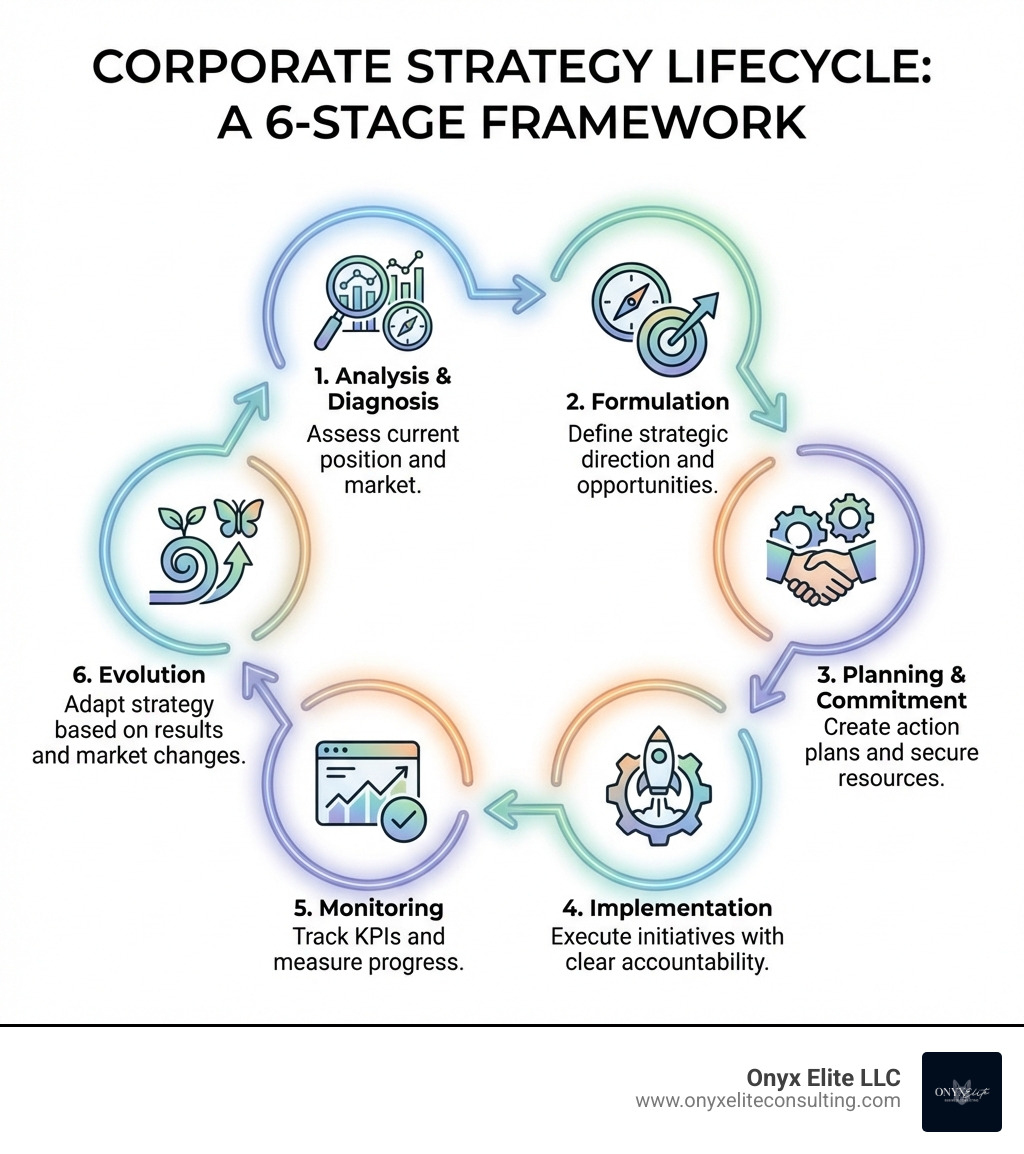
Developing a corporate strategy is an ongoing, iterative process that requires rigorous analysis and continuous adaptation. At Onyx Elite, we emphasize strategic dialogue and stakeholder engagement to foster buy-in and strengthen the strategy's foundation. The core stages remain consistent.

Stage 1: Analysis & Diagnosis (Where are we now?)
Before charting a course forward, we must understand our current position. This diagnostic stage is about asking tough questions to uncover insights about where and why we create value.
- Environmental Scanning: Using tools like PESTLE analysis to understand broad external forces (Political, Economic, Social, Technological, Legal, Environmental).
- Internal Assessment: Evaluating our strengths and weaknesses using frameworks like VRIO to assess internal resources and capabilities.
- Competitive & Market Analysis: Analyzing competitors, market trends, and customer needs to identify opportunities for growth.
Stage 2: Formulation (Where do we want to go?)
With a clear understanding of our current state, we define our desired future and set the strategic direction.
- Setting Strategic Direction: Synthesizing analysis to articulate clear goals, prioritize markets, and define a unique value proposition.
- Identifying Growth Opportunities: Brainstorming and evaluating avenues for growth, such as new products, markets, or customer segments.
- Choosing a Strategic Approach: Matching the strategy to the business context, whether it requires a classical, adaptive, visionary, shaping, or renewal approach.
- Adapting to Time Horizons: We develop plans for the long-term (5+ years), medium-term (3-5 years), and short-term (1 year) to ensure our vision is grounded in actionable steps.
Stage 3: Planning & Commitment (How will we get there?)
This stage translates strategic choices into a concrete action plan that everyone is committed to following.
- Creating an Action Plan: Breaking down objectives into specific initiatives, tasks, responsibilities, and timelines.
- Allocating Budgets and Resources: Distributing the financial, human, and technological resources required for each initiative.
- Building a Support Base: Engaging stakeholders to build ownership and ensure smoother implementation. More info about internal systems for growth.
- Securing Leadership Commitment: Ensuring top management actively champions the strategy, provides visible sponsorship, and removes roadblocks.
Essential Tools and Frameworks for Strategic Analysis
Effective corporate strategy development relies on robust analytical tools to make data-driven decisions. These models help dissect complex situations, identify patterns, and anticipate future scenarios.
Foundational Analysis Tools
These tools help understand internal capabilities and external forces:
- SWOT Analysis: Assesses internal Strengths and Weaknesses alongside external Opportunities and Threats to derive actionable insights.
- PESTLE Analysis: A macro-environmental scan of Political, Economic, Social, Technological, Legal, and Environmental factors influencing your strategy.
- Five Forces Analysis: Analyzes industry attractiveness by examining five competitive forces: the threat of new entrants, buyer power, supplier power, threat of substitutes, and rivalry among existing competitors.
Portfolio and Growth Frameworks
These frameworks guide strategic choices about your portfolio and future growth:
- Growth-Share Matrix: Categorizes business units as "Stars," "Cash Cows," "Question Marks," or "Dogs" based on market share and growth rate to guide investment decisions.
- Market and Product Development Matrix: Identifies growth opportunities through four strategies: market penetration, product development, market development, and diversification.
- Value Innovation Approaches: Focus on creating new market space by simultaneously pursuing differentiation and low cost, making competition irrelevant.
Understanding Value-Based Strategy
Value-based strategy focuses on creating superior value for all stakeholders—customers, employees, and suppliers. This approach uses the perceived value of goods and services to determine pricing and resource allocation. The goal is to maximize the total value created (the gap between a customer's willingness to pay and a supplier's willingness to sell) and distribute it strategically. This includes creating customer value through quality and service, employee value through compensation and culture, and supplier value through fair partnerships. A recent survey found that nearly 75 percent of millennials would take a decrease in salary if it meant working for an environmentally responsible company, underscoring the importance of a holistic value model.
From Plan to Action: Implementation and Measurement
A brilliant strategy is only as good as its execution. Since many companies struggle with implementation, this stage is about translating plans into tangible results, managing change, and monitoring progress.
Best Practices for Successful Implementation
To ensure corporate strategy development leads to results, we follow several best practices:
- Clear Communication: Consistently communicate the "what," "why," and "how" of the strategy to every employee.
- Leadership Alignment: Ensure leaders at all levels are aligned with the strategy and actively sponsor its success.
- Employee Engagement: Make the strategy relevant to employees' daily work to foster buy-in and create champions.
- Adequate Resource Allocation: Back the strategy with the necessary financial, human, and technological resources.
- Supportive Culture: Foster a culture of innovation, collaboration, and adaptability to support implementation.
Measuring Success with Key Performance Indicators (KPIs)
We establish clear KPIs linked to strategic objectives to track progress and make data-driven adjustments.
- Financial Metrics: Revenue growth, profitability (ROI, EBITDA), and cost efficiency.
- Customer Metrics: Customer satisfaction, market share, and retention rates. Research shows that consumers' motivation to buy from sustainable brands is rising, with sales of such products growing significantly faster than others.
- Operational Metrics: Efficiency ratios, productivity gains, and supply chain performance.
- Innovation Metrics: Number of new products launched and time-to-market.
Strategy dashboards help visualize these KPIs for a real-time view of performance. More info about building brand authority.
Overcoming Common Challenges
Implementing a strategy often involves overcoming common problems:
- Resistance to Change: Address skepticism and inertia with effective change management and clear communication.
- Misalignment Between Departments: Ensure cross-functional collaboration with clear, shared objectives.
- Resource Constraints: Plan realistically and allocate resources strategically to avoid implementation stalls.
- External Market Disruptions: Build in adaptability and contingency plans for unforeseen market shifts.
- Lack of Accountability: Define clear ownership for initiatives and link incentives to strategic outcomes.
The Role of Strategic Leadership
Leadership is the heartbeat of corporate strategy development. Without strong strategic leaders, even the most brilliant plans remain aspirations. Leaders are the visionaries, communicators, and champions who guide the organization through its strategic journey, playing an active role in its design and execution. Leadership is the New Currency in today's dynamic business environment.
Key Skills for Strategic Leaders
Effective strategic leaders possess a unique blend of skills to steer complexity and drive change:
- Strategic Thinking: The ability to see the "big picture," anticipate future trends, and define long-term objectives.
- Problem-Solving: Using data-driven analysis to address challenges and make decisive choices.
- Communication: Articulating the vision and the "why" behind the strategy to secure buy-in.
- Business Acumen: A deep understanding of the business, its industry, and financial drivers.
- Adaptability: The capacity to adjust plans in response to changing market conditions.
- Emotional Intelligence: Building trust and motivating teams by understanding and influencing emotions.
Leadership's Responsibility in the Strategy Process
Leaders have critical responsibilities throughout the corporate strategy development lifecycle:
- Defining the Vision: Setting the overarching direction and painting a compelling picture of the future.
- Communicating the "Why": Explaining the strategy's rationale to foster understanding and commitment.
- Driving Execution: Ensuring the strategy is implemented by monitoring progress, removing barriers, and holding teams accountable.
- Empowering Teams: Delegating authority and providing the resources and support needed for execution.
- Monitoring and Adapting: Continuously assessing the strategy's effectiveness and being willing to pivot when necessary.
The role of leadership is to ensure strategy is not just conceived but realized.
The Future of Corporate Strategy Development
The future of corporate strategy development is being shaped by powerful emerging trends. Organizations in Connecticut and beyond must accept agility and resilience to steer these shifts. Today's strategies must be flexible enough to adapt to tomorrow's uncertainties.
Emerging Trends Shaping Strategy
- AI-driven Decision-Making: AI and machine learning are revolutionizing data analysis and forecasting, enabling quicker, more informed strategic choices.
- Sustainability and ESG Integration: Environmental, Social, and Governance (ESG) factors are now central to strategy. Consumers, employees, and investors demand ethical practices, and research shows sales of sustainable products are growing significantly faster. Integrating ESG creates long-term value.
- Ecosystem Partnerships: Building strategic alliances and participating in broader business ecosystems is crucial for innovation, market reach, and competitive advantage.
- Personalization at Scale: Using data and technology to deliver highly personalized customer experiences is becoming a competitive imperative.
- Geopolitical Risk Management: Strategies must account for global uncertainties by building resilience into supply chains and market diversification.
These trends demand a move from rigid plans to more dynamic, "always-on" strategic processes.
Leveraging M&A and Partnerships for Growth
A key part of corporate strategy development is using mergers and acquisitions (M&A) and partnerships to achieve ambitious growth.
- Strategic Acquisitions: M&A can fast-track growth by acquiring companies that fit the long-term vision, whether for new technology, customer bases, or market position.
- Joint Ventures and Alliances: Partnerships allow companies to share risks, pool resources, and leverage complementary strengths without a full acquisition.
- Building a Corporate Development Pipeline: A robust strategy involves continuously scanning the market for M&A targets and partnership opportunities that align with our strategic goals.
The decision to pursue M&A or partnerships must be driven by clear strategic objectives to fill capability gaps and create value.
Frequently Asked Questions about Corporate Strategy
How often should a corporate strategy be reviewed?
The strategic planning process should be continuous. We recommend a review rhythm that matches your industry's pace, often involving different time horizons:
- Long-term (5+ years): Review annually or biennially to assess the overarching vision.
- Medium-term (3-5 years): Review quarterly or semi-annually to track business plans and initiatives.
- Short-term (1 year): Review monthly for tactical adjustments and to accelerate execution.
The key is to maintain a regular strategic dialogue, ensuring continuous adaptation.
What is the difference between a strategic plan and a strategy?
A strategy is the set of integrated choices that position an organization to win—it's the why and the what. A strategic plan is the document that outlines the specific actions, timelines, and resources to execute that strategy—it's the how. A plan is the output of the process, but it is not the strategy itself.
Who should be involved in the corporate strategy development process?
While senior leadership is ultimately accountable, effective corporate strategy development involves a broad range of stakeholders:
- Senior Leadership: To set the vision and make final decisions.
- Mid-level Managers: To translate strategy into action and provide ground-level insights.
- Key Employees: To offer diverse perspectives and build early buy-in.
- External Stakeholders: Customers and suppliers can offer valuable external perspectives and prevent groupthink.
Engaging a diverse group improves the strategy and increases commitment for smoother implementation.
Conclusion
Corporate strategy development is a continuous journey, not a fixed destination. It demands discipline, a willingness to challenge assumptions, and the courage to make decisive choices in an changing market. A robust process, supported by strong leadership and comprehensive tools, is the bedrock upon which sustained growth and operational excellence are built.
At Onyx Elite LLC, we believe that understanding the art and science of corporate strategy is the ultimate competitive advantage. By carefully analyzing your environment, formulating clear objectives, and executing with precision, you can chart a course that not only steers the future but actively shapes it.
Let us help you define your strategic sweet spot, drive value creation, and empower your organization to thrive. Explore our comprehensive suite of strategic services to chart your course for success.