

The Definitive Financial Consulting NAICS Code Resource
Why the Financial Consulting NAICS Code Matters for Your Business

The financial consulting NAICS code is one of the most important classification decisions a consulting firm or financial advisory business will make. It affects everything from tax reporting and government contracting eligibility to SBA loan qualification and industry benchmarking.
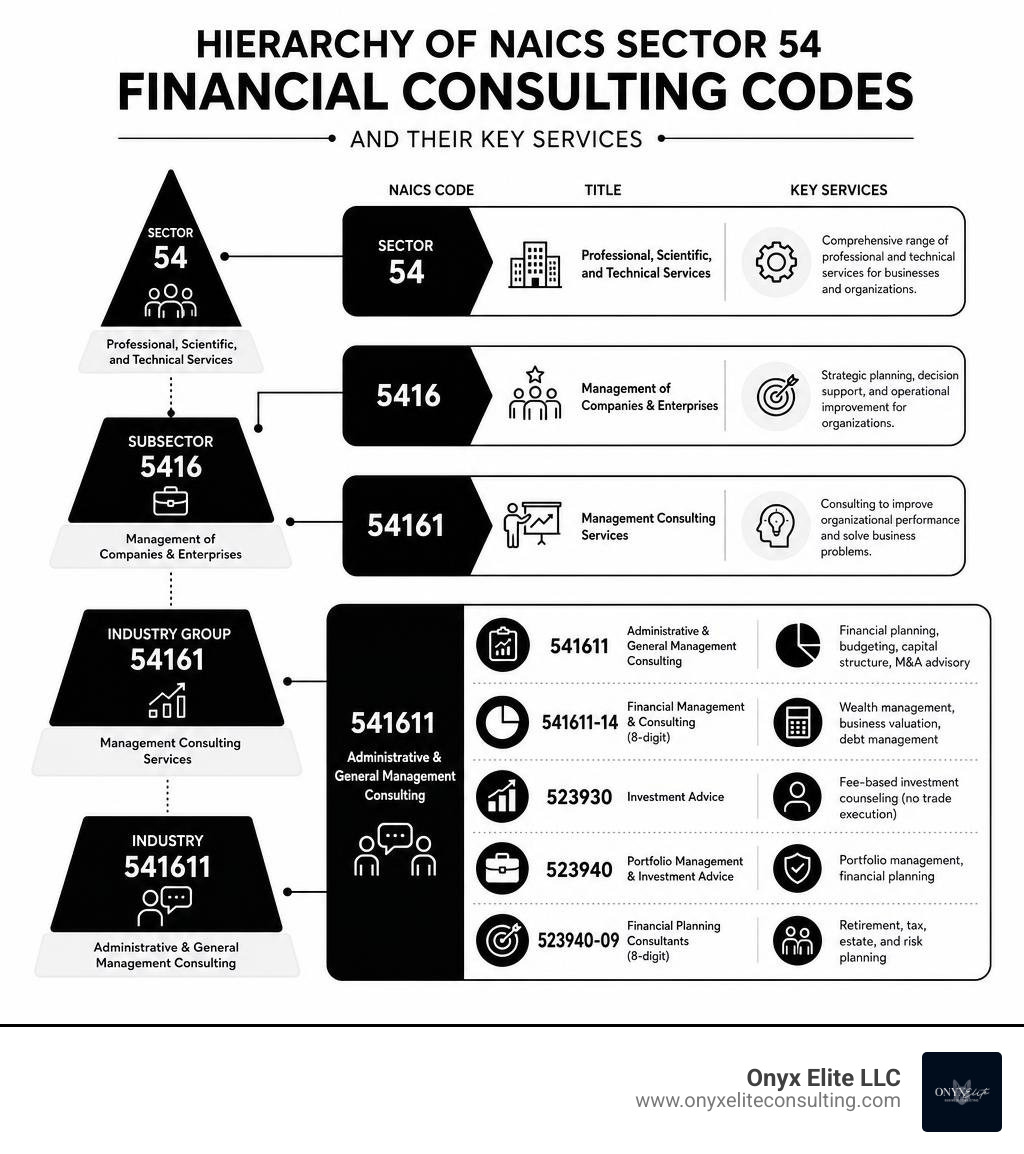
Here is a quick-reference summary of the most relevant NAICS codes for financial consulting:
| NAICS Code | Title | Key Services |
|---|---|---|
| 541611 | Administrative & General Management Consulting | Financial planning, budgeting, capital structure, M&A advisory |
| 541611-14 | Financial Management & Consulting (8-digit) | Wealth management, business valuation, debt management |
| 523930 | Investment Advice | Fee-based investment counseling (no trade execution) |
| 523940 | Portfolio Management & Investment Advice | Portfolio management, financial planning |
| 523940-09 | Financial Planning Consultants (8-digit) | Retirement, tax, estate, and risk planning |
Most financial consulting firms fall under NAICS 541611. This code covers operating advice on financial planning, budgeting, working capital, and strategic management — but not investment advice, which falls under NAICS 523930 or 523940.
The U.S. Management Consulting industry (NAICS 54161) is projected to generate $411.7 billion in revenue in 2026, employing over 1.2 million people. Getting your code right means getting your share of that market — and accessing the contracts and programs that come with proper classification.
I'm Doru Angelo, Founder & CEO of Onyx Elite LLC, and with over a decade of experience in business consulting — including capital markets, strategic planning, and fundraising for a client portfolio exceeding $12.5 billion — I have helped countless business leaders navigate decisions just like the financial consulting NAICS code selection process. Let's break it all down clearly so you can classify your business with confidence.
Understanding the Primary Financial Consulting NAICS Code
Selecting the right code for your business can feel like trying to solve a Rubik's cube in the dark. However, the North American Industry Classification System (NAICS) is highly logical once you understand its hierarchy.
For most professional service firms providing advisory services, the journey begins in Sector 54: Professional, Scientific, and Technical Services. This massive sector covers everything from legal advice and engineering to scientific research and management consulting.
Under Sector 54, the subsector 5416 specifically covers Management, Scientific, and Technical Consulting Services. If your business primarily provides operating advice and assistance to other businesses on administrative, financial, or general management issues, your home is under the 541611 naics code.
This code, officially titled Administrative Management and General Management Consulting Services, is the standard industry classification for general business consultants. It includes consultants who analyze a client's financial situation, organizational structure, or operational workflows and offer expert guidance to improve efficiency. It is the broad umbrella under which corporate financial consulting sits.
How to Apply the Financial Consulting NAICS Code 541611
When we drill down into the specifics of the financial consulting NAICS code 541611, we find that it covers a wide variety of corporate financial advisory activities. If your firm provides operating advice on budgeting, capital structure, working capital management, or mergers and acquisitions (M&A) valuation, this is the correct classification for you.
According to the official NAICS Code 541611 description, this industry comprises establishments primarily engaged in providing operating advice and assistance to businesses on administrative management issues. These issues specifically include:
- Financial planning and budgeting
- Capital structure and equity management
- Working capital and asset management
- Business process improvement
- Strategic and organizational planning
For marketing and highly refined research purposes, industry databases often use extended 8-digit codes. The specific subdivision for deep financial consulting is NAICS Code 541611-14 - Financial Management & Consulting. This 8-digit extension is incredibly helpful if you are trying to segment your business or target specific B2B clients in the financial management niche, as it separates general management consultants from those focused strictly on corporate finance.
Choosing Between Investment Advice and a Financial Consulting NAICS Code
One of the most common points of confusion for professionals in Connecticut is distinguishing between corporate financial consulting and personal investment advice. The line can seem blurry, but the government's classification system draws a very sharp boundary based on what you are advising on and how you are paid.
If your business provides customized, fee-based investment counseling to individuals or institutions without having direct trade execution authority, you do not belong under Sector 54. Instead, you belong in Sector 52 (Finance and Insurance), specifically under NAICS Code 523930 - Investment Advice.
Similarly, if you are a certified financial planner who designs comprehensive personal financial plans covering retirement, tax strategies, and estate planning, you will likely fall under NAICS Code 523940-09 - Financial Planning Consultants.
The key difference lies in the target audience and the nature of the advice:
- NAICS 541611 (Financial Consulting): Focused on businesses. You advise corporate clients on how to manage their internal finances, optimize cash flow, structure their capital, or prepare for a sale. You do not manage their investment portfolios or trade securities.
- NAICS 523930 / 523940 (Investment Advice & Planning): Focused on individuals or portfolios. You advise clients on where to put their money in the market, build retirement portfolios, or manage trust funds.
Comparing NAICS 541611 to Other Management Consulting Sub-Industries
Management consulting is a diverse field. While you might specialize in corporate finance, your neighbors in a West Hartford executive suite might specialize in restructuring HR departments or launching digital marketing campaigns.
To help you see where you fit in the broader consulting ecosystem, let's look at how the primary financial consulting NAICS code compares to other sub-industries within the 54161 hierarchy. This classification is vital when structuring consulting services for small business clients who may need multi-disciplinary support.
| NAICS Code | Industry Title | Primary Focus | Typical Deliverables |
|---|---|---|---|
| 541611 | Administrative & General Management | Financial planning, budgeting, strategic restructuring, site selection | Corporate budgets, cash flow models, strategic plans |
| 541612 | Human Resources Consulting | Employee benefits, HR policies, compensation systems, executive search | Employee handbooks, payroll structures, retention strategies |
| 541613 | Marketing Consulting | Customer acquisition, brand strategy, sales channel development | Market research reports, branding guidelines, launch plans |
| 541614 | Process & Logistics Consulting | Supply chain, inventory management, distribution networks | Logistics mapping, warehouse optimization plans |
Human Resources and Marketing Consulting Classifications
As shown in the comparison, firms classified under NAICS 541612 (Human Resources Consulting) focus entirely on the human capital side of an enterprise. They help businesses design employee benefits packages, craft HR policies, develop performance assessment systems, and advise on organizational development.
Meanwhile, firms under NAICS 541613 (Marketing Consulting) are hired to drive revenue. They specialize in market research, defining target demographics, analyzing sales channels, and building comprehensive marketing strategies.
If your consulting firm in Connecticut provides a mix of these services, you must determine which activity generates the largest share of your revenue. If your primary value proposition is helping a business secure capital, manage its cash flow, or model its financial projections, you should stick with NAICS 541611 as your primary code.
The Evolution and History of Financial Management Consulting
To understand why these codes are structured the way they are today in 2026, it helps to look back at how the industry evolved.
The financial consulting industry began to take shape in the early 20th century, but it experienced its first major modern transformation in the 1950s with the introduction of computerized accounting systems. Suddenly, businesses could track data at a speed and scale previously unimaginable, creating a massive demand for external experts who could interpret these new digital balance sheets.
The 1970s brought another massive wave of expansion. With the creation of Individual Retirement Accounts (IRAs) and 401(k) plans, the line between corporate financial management and individual financial planning began to emerge, prompting the government to refine its classification systems to distinguish between the two.
Following the 2008 financial crisis, the demand for corporate financial consulting skyrocketed. Businesses faced unprecedented regulatory complexity and volatile capital markets. They turned to specialized financial consultants to navigate risk management, restructure debt, and find creative ways to keep their doors open.
More recently, the rise of fintech and advanced data analytics has disrupted the industry once again. Modern financial consultants are no longer just looking at static spreadsheets; they are leveraging artificial intelligence, real-time cash flow forecasting, and predictive modeling to guide their clients. This rapid tech adoption is a major driver of the industry's continued growth.
Industry Trends, Revenue Projections, and Essential Tools for 2026
As we navigate the mid-point of 2026, the management consulting sector in the United States is showing remarkable resilience and steady growth.

Market Growth and Financial Consulting Statistics
The overall U.S. Management Consulting industry (NAICS 54161) is projected to generate an impressive $411.7 billion in revenue in 2026, representing a steady year-over-year growth rate of 0.93%. The sector remains a massive engine of the professional services economy, employing over 1.2 million people with an annual industry payroll exceeding $128 billion. For professionals working in this space, the financial rewards are substantial, with average hourly earnings in the consulting sector hovering around $50.52.
Within this massive industry, financial consulting is a highly active and lucrative niche. The parent NAICS code 541611 includes approximately 6,796 active companies. If we zoom in on the highly specialized Financial Management & Consulting subdivision (NAICS 541611-14), there are 289 verified, highly active corporate consulting firms driving major transactions and helping businesses secure us business funding solutions.
Meanwhile, on the individual and retail side, the Financial Planning Consultants industry (NAICS 523940-09) boasts over 11,700 companies, reflecting a massive and highly active market of advisors helping families and individuals secure their personal wealth.
Software and Technology Driving Modern Financial Consulting
To remain competitive in 2026, a financial consultant cannot rely on basic spreadsheets alone. The day-to-day operations of a modern advisory firm require a sophisticated tech stack to analyze complex data, ensure compliance, and present clear strategies to clients.
The most common tools and software used by leading financial management consultants include:
- Financial Modeling & Forecasting: Tools like Jirav, ProjectionHub, or advanced Excel add-ins that allow consultants to build dynamic, multi-scenario financial models.
- Risk Management Software: Platforms that analyze market volatility, interest rate risks, and cash flow sensitivities to protect businesses from sudden economic shifts.
- Data Visualization & BI: Software like Tableau or Microsoft PowerBI, which transforms complex financial data into interactive, easy-to-understand dashboards for corporate boardrooms.
- Tax Planning & Compliance: Specialized corporate tax software that helps consultants identify tax credits, structure transactions efficiently, and ensure compliance with federal and Connecticut state tax regulations.
- Portfolio & Asset Management: For those operating on the border of investment advice, advanced portfolio tracking systems that monitor asset allocation and performance in real time.
How to Determine and Register the Correct Code for Your Business
Determining your primary NAICS code is not just an academic exercise; it is a critical step in setting up your legal business structure in Connecticut. Whether you are establishing a new practice in West Hartford or expanding an existing firm, you must select the code that represents your primary activity—which is defined as the activity that generates the largest portion of your business revenue.
If you are a business owner registering your entity with the state, you will need to reference this code on your tax documents and state registration forms. For instance, the Connecticut Department of Revenue Services utilizes the form ct-naics to classify businesses for state tax purposes. Ensuring your code on this form matches your federal filings prevents unnecessary audits and classification discrepancies.
If you are unsure how to position your firm's services or are writing a business plan to secure local funding, consulting a specialist can save you months of administrative headaches. You can learn more about structuring your business plan in our business plan consultant ultimate guide 2026 or explore state-specific setup steps in our comprehensive business consultant connecticut guide.
Frequently Asked Questions About Financial Consulting Classifications
What is the difference between NAICS 541611 and NAICS 523930?
The difference comes down to who you are advising, what you are advising them on, and whether you are touching their investments.
- NAICS 541611 is for business-to-business (B2B) consulting. You are providing operating advice to a company's leadership team regarding their internal corporate finances, budgeting, mergers, or strategic growth. You do not manage or invest their capital.
- NAICS 523930 is for investment advice. Under this code, you provide customized, fee-based advice to individuals or institutions on which securities, stocks, bonds, or mutual funds they should purchase.
For a complete breakdown of how the government separates financial transactions from professional technical services, you can refer to the official Ask Kodiak Guide to NAICS, which outlines the boundaries of Sector 52 (Finance and Insurance).
Can a financial planner use NAICS code 523990 or 523940?
Yes. If your primary business activity is managing investment portfolios or providing comprehensive personal wealth management, you should use NAICS 523940 (Portfolio Management) or the catch-all code NAICS 523990 (All Other Financial Investment Activities).
However, keep in mind that these codes fall under Sector 52, which has different regulatory oversight and compliance requirements than Sector 54. Additionally, the Small Business Administration (SBA) sets size standards based on these codes. For example, under NAICS 523990, the SBA small business size standard is typically $16.5 million in average annual receipts, which determines your eligibility for certain federal programs and small business loans.
Why is accurate NAICS classification important for government contracting?
When the federal government or the state of Connecticut puts out a contract for bid, they restrict certain opportunities to "small businesses" to promote economic diversity. The SBA uses your primary NAICS code to determine if your firm qualifies as a small business.
If you register under the wrong code, you could inadvertently disqualify your firm from lucrative government contracts, face tax classification issues, or find yourself locked out of specialized SBA loan programs designed specifically for professional consulting firms.
Conclusion
Navigating the nuances of the financial consulting NAICS code is a foundational step in establishing a compliant, successful, and highly competitive professional services firm. Whether you are advising local businesses in West Hartford or structuring complex corporate transactions across Connecticut, choosing the right classification ensures your business is positioned accurately for tax authorities, financial institutions, and potential clients.
At Onyx Elite LLC, we believe that operational excellence begins with a strong strategic foundation. We help companies achieve sustainable growth and operational excellence through strategic planning, brand development, and a comprehensive suite of tailored services, going beyond traditional solutions.
If you are ready to take your business to the next level, optimize your corporate structure, or secure the strategic guidance your leadership team needs to scale, let's work together. Explore our Tailored Business Consulting Services today to see how we can help you turn complex regulatory and operational challenges into your greatest competitive advantages.