
A Practical Guide to Business Formation
What Is Business Formation and Why It Matters

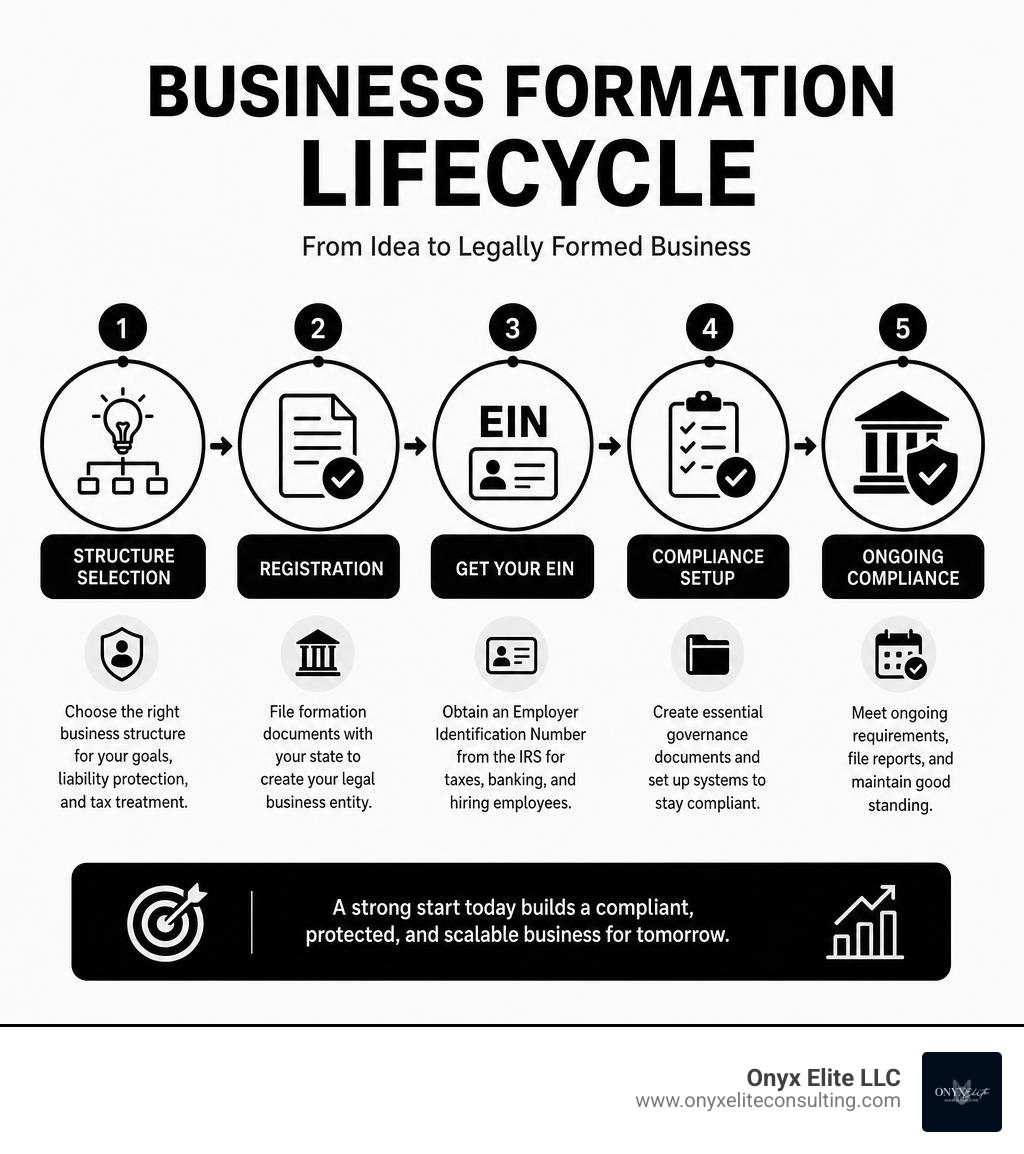
Business formation is the process of legally establishing your company — choosing a structure, registering with the state, and setting up the systems that protect your assets and keep you compliant.
If you're trying to get started quickly, here's what you need to know:
| Question | Quick Answer |
|---|---|
| What is business formation? | The legal process of registering a business entity with your state |
| Which structure should I choose? | LLC for most small businesses; C-Corp for raising investment; S-Corp for tax savings |
| Do I need a registered agent? | Yes — every LLC and corporation requires one |
| What documents do I need? | Articles of Organization (LLC) or Articles of Incorporation (Corporation) |
| Do I need an EIN? | Yes — required for taxes, banking, and hiring employees |
| How long does it take? | A few days to a few weeks, depending on the state |
Getting your business structure right from day one matters more than most founders realize. The structure you choose affects everything — how you pay taxes, whether your personal assets are at risk, and how easy it is to bring on partners or investors later.
Many entrepreneurs skip this step or rush through it, only to face expensive restructuring down the road. Others get tripped up by the difference between forming a legal entity and registering for taxes — two separate steps that are often confused.
This guide walks you through every stage of the process clearly and practically.
I'm Doru Angelo, Founder and CEO of Onyx Elite LLC, with over a decade of experience in business consulting, helping founders and business leaders navigate business formation, strategic growth, and operational setup from the ground up. Everything in this guide reflects real-world experience — not just textbook theory.
Choosing the Right Structure for Your Business Formation
Deciding how to structure your business is the most critical decision you will make during the early stages of your entrepreneurial journey. It dictates your personal liability, how much you pay in taxes, and the level of administrative paperwork you must handle.
To help you visualize the landscape of business formation, we have outlined the core differences between the primary entity types below:
| Business Structure | Personal Liability Protection | Taxation Method | Operational Complexity | Best For |
|---|---|---|---|---|
| Sole Proprietorship | None (Personal assets at risk) | Pass-through (Personal return) | Very Low | Low-risk, single-owner startups testing an idea |
| Partnership | None (Unlimited joint liability) | Pass-through (Personal return) | Low | Multi-owner businesses testing a concept |
| Limited Liability Company (LLC) | Strong (Shields personal assets) | Pass-through (Flexible options) | Moderate | Most small businesses and service providers |
| S Corporation | Strong (Shields personal assets) | Pass-through (Avoids self-employment tax on dividends) | High | Profitable small businesses wanting tax optimization |
| C Corporation | Strong (Shields personal assets) | Double Taxation (Corporate + Shareholder levels) | Very High | Startups seeking venture capital or planning to go public |
Choosing the wrong structure can lead to unexpected tax bills or, worse, expose your personal savings to business debts. If you need personalized guidance to map out your long-term setup, our team at Onyx Elite Consulting can help you align your legal structure with your growth goals through our Business Consulting Services.
Sole Proprietorships and Partnerships
A sole proprietorship is the default structure for anyone who starts doing business without registering a formal entity. If you are a freelancer or a local service provider operating under your own name, you are automatically a sole proprietor. Similarly, if you launch a business with a partner without formal filing, you have established a general partnership.
While these structures require almost no initial paperwork, they carry a massive catch: unlimited personal liability.
In a sole proprietorship or general partnership, there is no legal separation between you and your business. If your business is sued or runs into debt, creditors can go after your personal assets, including your home, car, and personal bank accounts. Furthermore, in a general partnership, you can be held legally responsible for the actions and financial decisions of your partners.
If you choose to operate under a name other than your legal name, you must register a trade name (also known as a DBA) at the local municipal level. For example, in Connecticut, you must file a trade name certificate with the town clerk's office where your business is physically located.
Limited Liability Companies (LLCs)
For the vast majority of small businesses we consult, the Limited Liability Company (LLC) is the ideal structure. An LLC acts as a legal shield, separating your personal assets from your business liabilities. If your business faces a lawsuit, only the assets owned by the LLC are at risk—your personal savings remain protected.
In addition to personal asset protection, LLCs offer incredible management flexibility. Unlike corporations, which require a rigid structure of directors, officers, and shareholder meetings, an LLC can be managed directly by its owners (members) or by appointed managers.
To govern how your LLC operates, you should draft an internal operating agreement. Although Connecticut does not require you to file this document with the state, maintaining one is crucial. It outlines ownership percentages, profit distribution, and what happens if a member decides to leave the company.
If you are currently mapping out your business model and need to document your operational and financial strategy, check out our Business Plan Consultant Ultimate Guide 2026 to ensure your business plan is built for long-term success.
C Corporations vs. S Corporations
If you plan to raise venture capital, issue public stock, or scale rapidly on a global level, a C Corporation is the gold standard. C Corporations are completely separate legal entities owned by shareholders. However, they are subject to "double taxation." This means the corporation pays taxes on its net income at the corporate level, and shareholders pay taxes again on their personal returns when dividends are distributed.
An S Corporation is not a distinct entity type but rather a special tax election that an eligible LLC or C Corporation can file with the IRS using Form 2553. Under an S Corp election, the business enjoys pass-through taxation, meaning profits and losses flow directly to the owners' personal tax returns, bypassing corporate income tax.
The primary benefit of an S Corp election is the potential for significant self-employment tax savings. As an S Corp owner, you can divide your business income into two categories:
- A "reasonable salary" paid to you as a W-2 employee (subject to self-employment and payroll taxes).
- Shareholder distributions (exempt from self-employment taxes).
According to industry tax advisory analyses, electing S Corp status for a business earning $37,000 in net profit can save an estimated $3,240 in self-employment taxes annually. For a real estate agent or consultant generating $50,000 in profit, electing S Corp status can yield identical tax savings of approximately $3,240, which can then be reinvested directly into marketing and business development.
When to Use a DBA (Doing Business As)
A DBA (Doing Business As), sometimes called a fictitious or trade name, allows you to conduct business under a name other than your official legal name. For example, if your legal LLC name is "West Hartford Consulting Group LLC," but you want to market a specific service line as "Onyx Digital Solutions," you can register a DBA for that trade name.
It is vital to understand that a DBA is not a legal entity. Registering a DBA does not provide any personal liability protection. If you are a sole proprietor operating under a DBA, your personal assets are still completely exposed. You should only use a DBA to brand a new product line or service under an already existing, legally protected LLC or corporation.
Step-by-Step Guide to Registering Your Business
Once you have selected the appropriate structure, it is time to make your business official.

To help you visualize the registration flow, here is how the process typically works from name selection to final state approval:
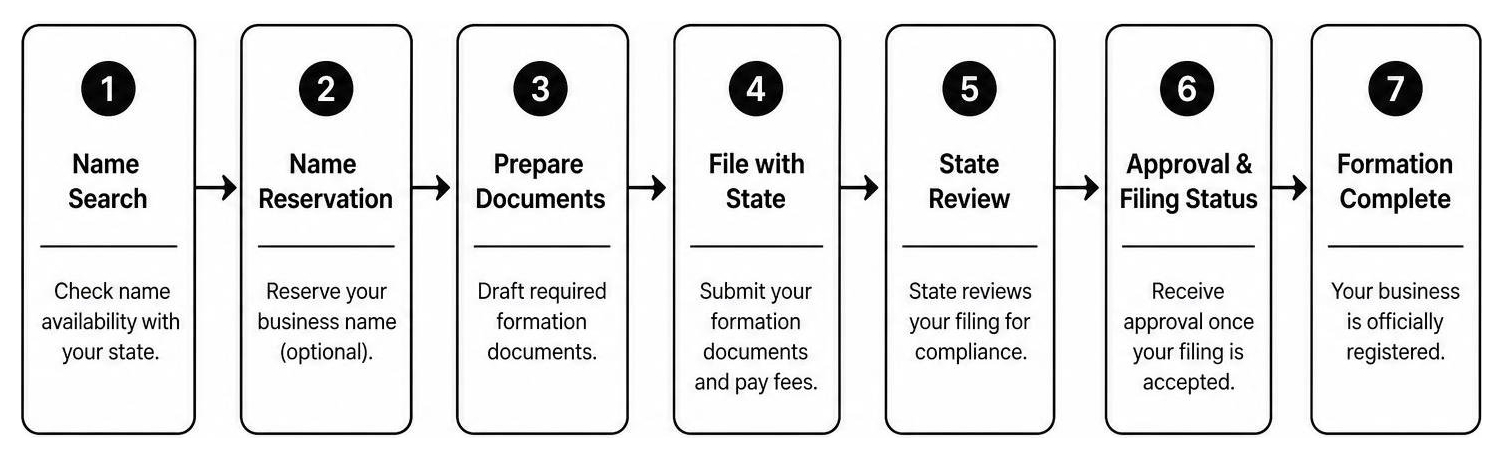
If you are establishing your company in Connecticut, you will complete your state-level registration through the official portal. You can find step-by-step state filing systems at Register Your Connecticut Business - CT.gov.
Selecting and Reserving Your Business Name
Your business name must be entirely unique and distinguishable from any other entity registered in your state. When choosing a name, keep the following rules in mind:
- Designator Suffixes: Your name must include the appropriate legal suffix, such as "LLC," "L.L.C.," "Incorporated," or "Corp."
- Restricted Words: Words associated with regulated industries (like "Bank," "Trust," "Insurance," or "Cooperative") cannot be used without explicit authorization from state regulators.
If you have found the perfect name but are not quite ready to file your formation documents, you can reserve it. For instance, you can review name reservation standards through the How to Form a New Business Entity - Division of Corporations - State of Delaware, which charges a $75 fee to hold a name for 120 days. In Connecticut, you can check name availability and submit reservations directly through the Business Services - Connecticut business - CT.gov portal.
The Role of a Registered Agent in Business Formation
Every registered LLC or corporation is legally required to appoint a Registered Agent. A Registered Agent is an individual or business entity authorized to receive official government correspondence, compliance notifications, and legal documents (such as lawsuits or service of process) on behalf of your business.
Your Registered Agent must meet strict criteria:
- They must have a physical street address in the state where your business is formed (PO Boxes or PMBs are not legally accepted).
- They must be available at that physical address during standard business hours (9:00 AM to 5:00 PM, Monday through Friday).
While you can technically act as your own Registered Agent, doing so publicly exposes your home address on state databases and means you could be served with a lawsuit in front of clients or employees. Appointing a professional Registered Agent service ensures privacy and guarantees you never miss a critical compliance deadline.
Obtaining an EIN and Setting Up Financial Infrastructure
An Employer Identification Number (EIN) is a unique nine-digit number issued by the IRS to identify your business for tax purposes. Think of it as a Social Security number for your company. You will need an EIN to:
- Open a business checking account.
- Hire employees.
- Apply for business licenses and permits.
- Establish business credit.
You can apply for an EIN online directly through the IRS website and receive it instantly. Once you have your EIN, you should immediately open a dedicated business bank account to keep your personal and business finances completely separate—a practice crucial for maintaining your LLC's liability shield.
If you want to start building operational leverage and funding solutions, read our guide on Business Credit Cards EIN Only and check out our Get Business Credit Cards Complete Guide to learn how to secure capital without personal guarantee risks.
Out-of-State Formation: Delaware, Wyoming, and Foreign Qualification
A common question among new founders is whether they should form their business in a tax-friendly state like Delaware or Wyoming instead of their home state.
While Delaware is highly favored by venture capitalists due to its sophisticated corporate laws and dedicated Court of Chancery, and Wyoming is popular for its low fees and strict privacy protections, out-of-state formation is rarely beneficial for local small businesses.
If you register your business in Delaware but physically operate in Connecticut, you must register as a "foreign entity" in Connecticut to legally conduct business here. This means you will pay:
- Formation fees in Delaware.
- Registered agent fees in Delaware.
- Annual franchise taxes in Delaware.
- Foreign qualification and annual report fees in Connecticut.
Unless you are actively seeking venture capital or planning a public offering, it is almost always more cost-effective to register your business in your home state. If you plan to scale across multiple states and want to compare options, you can explore the process using Start Your LLC or Corporation in Any U.S. State.
Ongoing Compliance and Post-Formation Requirements
Completing your initial business formation is only the first step. To keep your business active and in good standing with the state, you must meet ongoing compliance obligations.

Key compliance requirements include:
- Annual Reports: Most states require LLCs and corporations to file an annual report to update the state on their current business address and management structure. In Connecticut, LLCs must file an annual report online between January 1st and May 1st of each year.
- Franchise Taxes: Some states impose an annual tax on the privilege of doing business in the state. For example, Delaware corporations face an annual franchise tax ranging from a minimum of $175 to a maximum of $200,000, while Delaware LLCs pay a flat annual tax of $300.
- Corporate Transparency Act (CTA): Effective January 1, 2024, most small businesses must file a Beneficial Ownership Information (BOI) report with the Financial Crimes Enforcement Network (FinCEN). This federal filing identifies the individuals who ultimately own or control the business and must be updated whenever ownership details change.
Failing to meet these deadlines can result in late fees, interest penalties, and even administrative dissolution, where the state revokes your legal right to do business. To ensure your business finances and administrative filings remain flawless, consider partnering with a local professional for Bookkeeping Services West Hartford CT.
How to Avoid Common Scams During Business Formation
Immediately after your business formation documents are approved by the state, your business address becomes a matter of public record. Unfortunately, this makes you a target for scammers.
New business owners frequently receive official-looking mail solicitations demanding urgent payments for "Certificates of Legal Existence," "Corporate Minutes Records," or "Mandatory Compliance Posters." These letters often feature state seals or threatening language warning of legal penalties if you do not pay.
Do not fall for these scams. Official documents like a Certificate of Legal Existence are rarely required to start your business, and when they are, they can be ordered directly from the state website for a fraction of the cost. Always verify any payment request through the official Business Formation and Registration - Connecticut business portal or consult with your business advisor before sending money.
Frequently Asked Questions about Business Formation
Can I form an LLC in a state where I do not live?
Yes, you can form an LLC in any U.S. state, regardless of where you reside. However, you must maintain a Registered Agent with a physical address in that state to handle legal correspondence. If you plan to operate physically in your home state, you will also need to register your out-of-state LLC as a foreign entity in your home state, which requires additional fees. For an example of how state-level online portals operate, you can view the instructions to Start a Domestic (WA) Limited Liability Company (LLC) Online | WA Secretary of State.
What is the difference between an Entity ID and a Tax ID?
An Entity ID is a public identification number assigned to your business by the state's Secretary of State when you file your formation documents. It is used to track corporate public records. A Tax ID (such as an EIN or a state-specific Tax ID) is a confidential number used strictly for filing taxes and managing payroll. To see how different states manage these IDs, you can look at the guidelines on Register Your Business | Business.NJ.gov, which highlights the operational boundary between public corporate records and confidential tax registrations.
Do I need an attorney to form my business?
While you are not legally required to hire an attorney to form your business, consulting with professionals is highly recommended—especially if you have multiple partners, complex equity structures, or specific tax-saving goals. A professional business consultant can help you navigate the strategic setup of your brand and operations. If you are looking for local support in Connecticut, explore our Business Consultant Connecticut Guide to learn how professional advisory can streamline your launch.
For local accounting and municipal resources in the West Hartford area, we also recommend checking out these helpful guides:
- Review local accounting support at West Hartford, CT Accounting Firm | New Business Formation Page.
- Access local municipal regulations through the Business - Town of West Hartford portal.
- Download a local registration checklist via the West Hartford Chamber of Commerce at Register Your Business.
Conclusion
Successfully launching a business requires a solid foundation. From choosing the correct legal structure to navigating state tax registration and maintaining ongoing compliance, every decision you make during the business formation phase will impact your operational efficiency and financial success for years to come.
At Onyx Elite LLC, we specialize in helping businesses achieve sustainable growth, operational excellence, and seamless strategic planning. We go beyond traditional consulting templates to deliver tailored, high-impact strategies that position your new venture for market leadership.
Ready to turn your business vision into a legally protected, highly optimized reality? Let's build something exceptional together. Explore our full suite of professional growth and advisory services on our Services Overview page, or reach out to us today to kickstart your business journey.