

The Lazy Marketer's Guide to Marketing Automation Inbound

What Is Marketing Automation Inbound and How Does It Work?
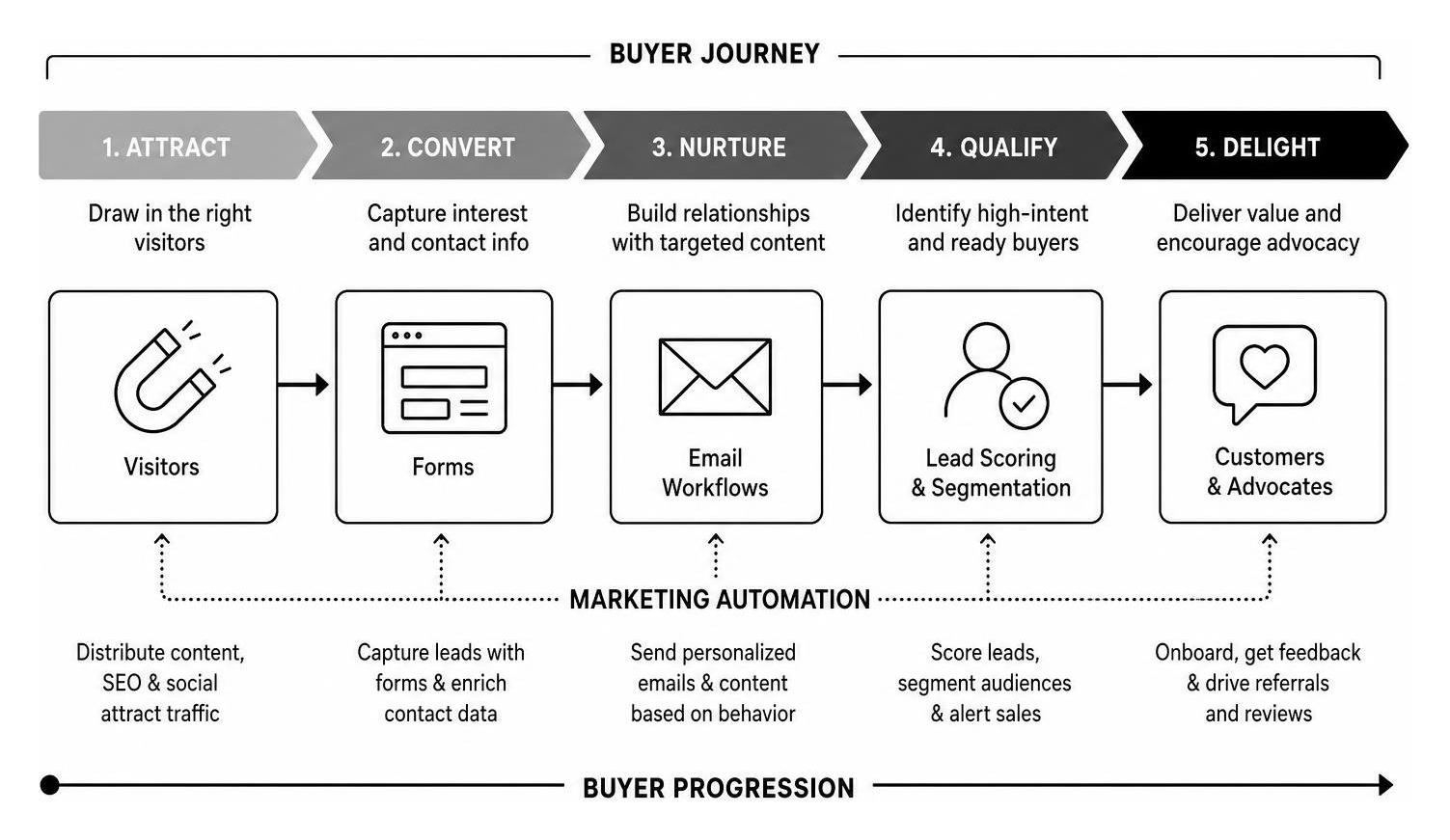
To understand marketing automation inbound, you first have to separate the vehicle from the engine. Inbound marketing is the magnet—it pulls prospects toward your business by offering valuable, SEO-optimized content, educational guides, and interactive tools that address specific customer pain points. Marketing automation is the engine—it processes that incoming traffic, sorts the high-value buyers from the casual browsers, and guides them along the buyer journey without requiring a human to manually type out every individual email.
In traditional digital strategies, teams often struggle to convert raw traffic into closed deals. That friction occurs at the conversion layer: the exact point where a prospect raises their hand to request information, a demo, or a quote. Marketing automation inbound acts as a dynamic bridge across this layer. Instead of leaving forms sitting in an inbox, the system automatically enriches contact profiles, calculates intent, and serves up tailored follow-up assets based on real-time behavior.
How Marketing Automation Inbound Transforms the Flywheel
The modern inbound methodology views customer growth as a flywheel rather than a linear pipeline. Instead of pushing leads through a pipe and dropping them at the end, the flywheel framework continuously builds momentum across three main phases: Attract, Engage, and Delight. Integrating marketing automation inbound principles accelerates this continuous cycle:
- Attract Stage: Automation tools schedule targeted content distribution across search and social channels, monitor Answer Engine Optimization (AEO) search trends, and capture visitor data via progressive, dynamic web forms.
- Engage Stage: Behavioral triggers deliver contextually relevant nurture sequences, register leads for webinars, and execute real-time lead scoring to hand off sales-ready prospects to reps within seconds.
- Delight Stage: Post-purchase automation orchestrates user onboarding, tracks platform usage, triggers automated satisfaction surveys (like NPS), and flags expansion opportunities for account managers.
By automating these routine touchpoints, your flywheel spins faster, converting happy customers into active brand advocates. To see how these stages connect visually across your acquisition channels, review our detailed guide on the Inbound Marketing Automation Funnel.
Traditional Marketing Automation vs. Inbound Strategy
It is easy to confuse general marketing automation with an inbound-driven approach, but the core strategy differs fundamentally:
| Dimension | Outbound Marketing Automation | Marketing Automation Inbound |
|---|---|---|
| Primary Mechanism | Push (cold emails, mass ads, broad lists) | Pull (valuable content, organic discovery, AEO) |
| Audience Relationship | Interruptive; relies on high volume | Permissive; builds trust over time |
| Data Usage | Third-party purchased lists and cold data | First-party behavioral and profile data |
| Primary Goal | Immediate, short-term lead volume | Long-term customer retention and high LTV |
When you blend inbound strategy with smart software automation, you stop screaming for attention and start building a self-sustaining organic growth engine.
Core Workflows to Capture, Qualify, and Route Inbound Leads
Setting up marketing automation inbound effectively requires establishing a dependable lead handling workflow. When a prospect lands on your site and submits a form, a modern automated pipeline executes a series of real-time actions to maximize lead conversion rates:
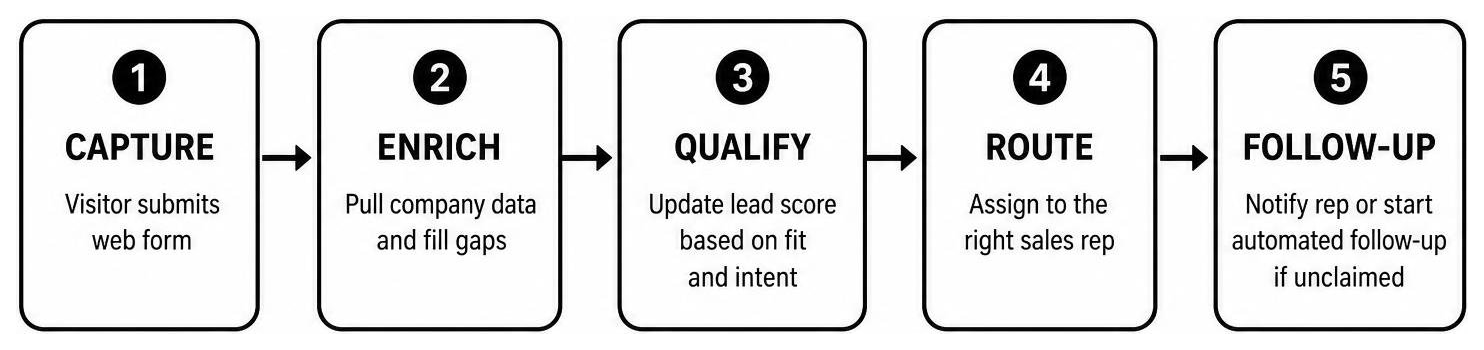
- Capture: The visitor submits a web form. Advanced systems also track partial form submissions, allowing you to recover lost contacts who start filling out fields but abandon the page before clicking submit.
- Real-Time Enrichment: Before routing the contact, automated enrichment tools pull background company data using the prospect's business domain, filling in missing details like industry, employee count, and estimated revenue.
- Qualify: The database updates the contact's dynamic lead score using both firmographic fit and explicit intent actions (such as viewing the pricing page multiple times).
- Route: The system evaluates your Service Level Agreement (SLA) routing logic and immediately passes the prospect to the appropriate account rep.
- Follow Up: If no sales rep claims the lead within a set SLA timeframe (e.g., 5 minutes), the platform reassigns the record or kicks off an automated multi-channel follow-up track.
For a complete breakdown of building custom visual triggers for your team, check out our Marketing Automation Workflow Guide 2026.
Speed-to-Lead, Lead Scoring, and Automated Routing
In B2B customer acquisition, speed is everything. Research demonstrates that 40% of demo requests go untouched for more than 24 hours, and half of those leads never respond when someone finally reaches out. Speed-to-lead is often the deciding factor in winning business.
Automated lead scoring ensures your team prioritizes high-value prospects over casual browsers. Scores update dynamically based on two core criteria:
- Explicit Fit (Firmographics): Job title, industry, company size, and geographic location.
- Implicit Intent (Behavior): Visiting pricing pages, downloading technical whitepapers, attending webinars, or opening key email sequences.
When a lead crosses a defined scoring threshold (e.g., 50 points), the marketing automation platform uses instant webhooks to push the contact straight to your sales CRM, triggering instant notifications in Slack or email for the assigned representative. Learn how to map these technical data handoffs seamlessly in our CRM Marketing Automation Integration Guide.
High-Impact Marketing Automation Inbound Workflows for Small Teams
You don't need a sprawling enterprise team to run high-performing automation sequences. Small businesses and lean teams can build momentum by deploying four high-impact core workflows:
- Content Download Sequence: Delivering a gated e-book triggers a 3-part educational email sequence, offering additional context and gently introducing a calendar link to book a discovery call.
- Instant Demo Routing: Directing inbound demo requests straight to specific sales representatives based on company size or location eliminates manual assignment delays.
- Form Abandonment Recovery: Capturing partial responses triggers a helpful follow-up email 30 minutes later, inviting the user to complete their inquiry or ask a quick question.
- Webinar Branching Workflow: Automatically split registrants post-event—live attendees receive direct sales calendar links and specific presentation slides, while non-attendees receive access to the on-demand replay recording.
Implementing these high-leverage assets helps smaller setups achieve enterprise-grade responsiveness. For advice on pairing these workflows with lightweight software solutions, view our recommendations on Simple CRM Small Business platforms.
The Role of AI and Personalization at Scale in 2026
The rapid rise of artificial intelligence has fundamentally transformed digital marketing execution. 61% of marketers believe marketing is experiencing its biggest disruption in 20 years due to AI, with 92% of marketers now using automation for data analysis and reporting.

Personalization has evolved far beyond simply inserting a {First_Name} tag into an email subject line. Modern marketing automation inbound architectures deploy AI to analyze user intent in real time, delivering tailored messaging across every digital touchpoint.
Answer Engine Optimization and AI Search Discovery
Buyer behavior has changed significantly. Today's prospective buyers increasingly turn to conversational AI models (such as ChatGPT, Perplexity, and Gemini) for software and partner recommendations before ever visiting a corporate website.
This shift makes Answer Engine Optimization (AEO) and Generative Engine Optimization (GEO) vital components of an effective inbound strategy. To maintain strong search discovery, businesses must structure their content libraries around conversational intent, clear semantic facts, and direct answers that generative models easily index. To learn more about modern search engine presence, read Visibility is Your Growth Engine: How to Become Unignorable Online.
Agentic AI and Dynamic Journey Orchestration
Beyond search optimization, AI is transforming how lead sequences function behind the scenes. Traditional static drip campaigns follow rigid, pre-programmed paths. Modern dynamic journey orchestration leverages specialized AI agents to adapt buyer paths in real time:
- Behavioral Triggers: If a prospect ignores three sequential emails about general industry trends but suddenly spends ten minutes reviewing an enterprise pricing page, AI automatically pauses the cold sequence and enrols them in a personalized solution campaign.
- Dynamic Adaptive Forms: Dynamic forms adapt fields based on known CRM history. Returning visitors see shorter, progressive questions rather than repeating information they previously provided.
- Agentic Sales Support: Autonomous AI agents can manage initial qualification conversations with long-tail inbound prospects across email or web chat, booking meetings directly onto sales reps' calendars while maintaining strict brand safety guardrails.
Overcoming Common Pitfalls and Measuring True Inbound ROI
Despite high adoption rates, many marketing automation initiatives stall due to common operational traps. 60-70% of content created by marketing departments sits unused, often because teams build materials without mapping them to clear buyer personas or real audience intent.
Key ROI Metrics and Performance Measurement
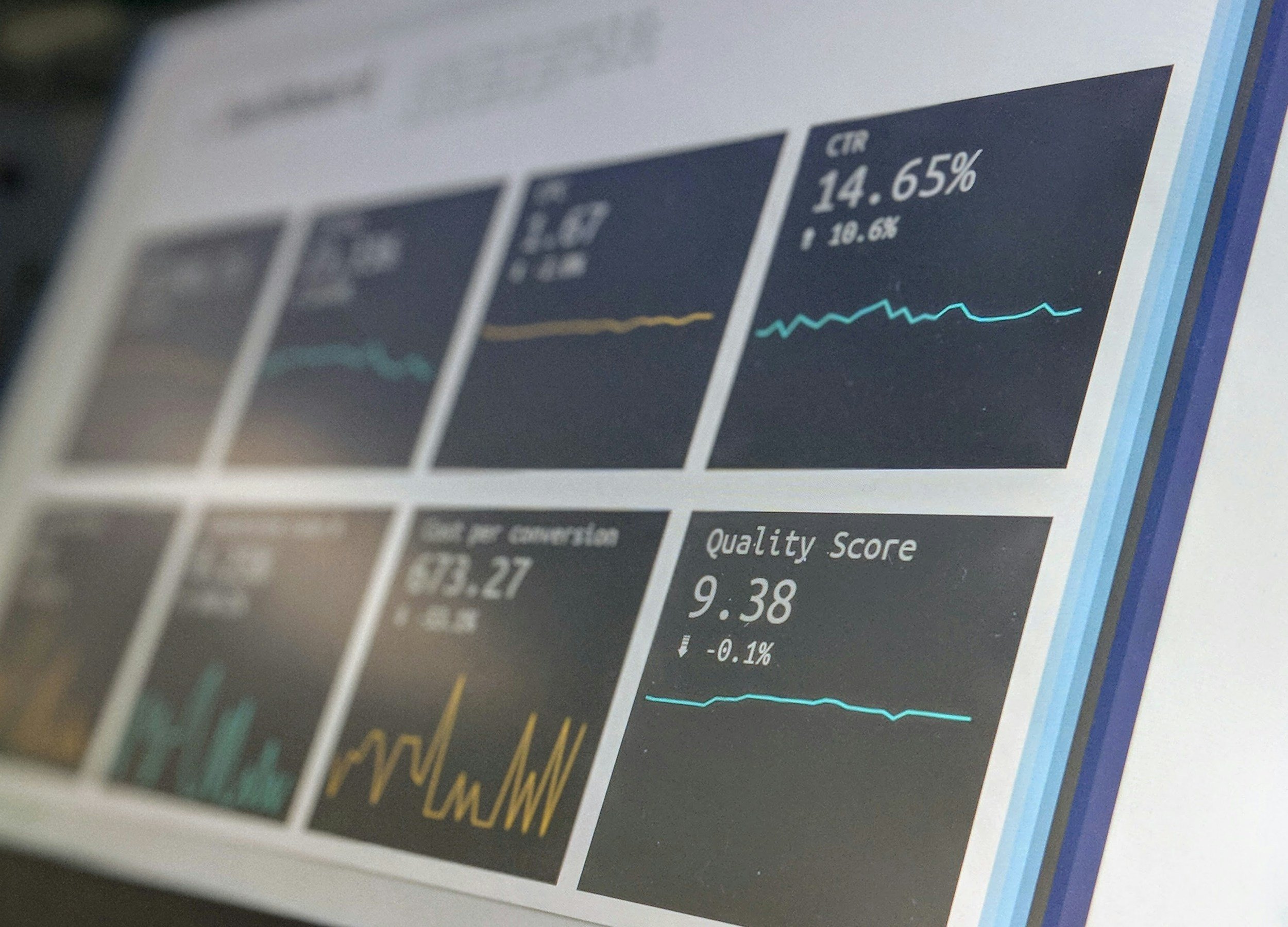
To justify martech investments and prove true marketing attribution, you must track a balanced blend of short-term leading indicators and long-term lagging revenue metrics:
| Metric Type | Key Performance Indicator | What It Measures | Strategic Value |
|---|---|---|---|
| Leading | Speed-to-Lead | Time taken to make first contact with an inbound lead | Identifies conversion friction and sales handoff delays |
| Leading | Form Conversion Rate | Percentage of visitors completing forms | Evaluates asset intent and landing page messaging |
| Leading | MQL-to-SQL Conversion Rate | Percentage of marketing leads accepted by sales | Measures lead scoring accuracy and prospect quality |
| Lagging | Customer Acquisition Cost (CAC) | Total marketing spend divided by new customers acquired | Measures overall acquisition efficiency |
| Lagging | Pipeline Velocity | Speed at which qualified opportunities move to closed-won | Evaluates nurture sequence effectiveness |
| Lagging | Customer Lifetime Value (LTV) | Total revenue generated over customer lifecycle | Highlights post-purchase retention and delight efforts |
Pitfalls to Avoid: Database Hygiene and Human Touch
Even the most sophisticated automated engine will underperform if fed poor data or configured without human oversight. Keep these common traps in mind:
- Database Decay: B2B contact records naturally decay over time as professionals change roles. Use continuous data cleaning applications to remove outdated emails, eliminate duplicates, and keep your list healthy.
- Over-Automation: Avoid automating every single customer touchpoint. Over-automated engagement creates a cold, mechanical user experience. Reserve automation for repetitive administrative routines, allowing human team members to step in for high-value strategic discussions.
- Lack of Sales Alignment: Building marketing workflows in isolation often results in rejected MQLs. Always define lead handoff criteria and scoring thresholds in close collaboration with your sales team.
To review the foundational operational processes required to support long-term growth, consult our breakdown on 5 Internal Systems That Drive Scalable Growth for Service-Based Businesses.
Implementing Inbound Marketing Automation on a Budget
A common misconception among small business owners is that modern marketing automation inbound strategies require enterprise-level budgets. In reality, lean operations often gain the highest relative efficiency boost from automation, as it frees small teams from manual tasks that would otherwise require extra headcount.
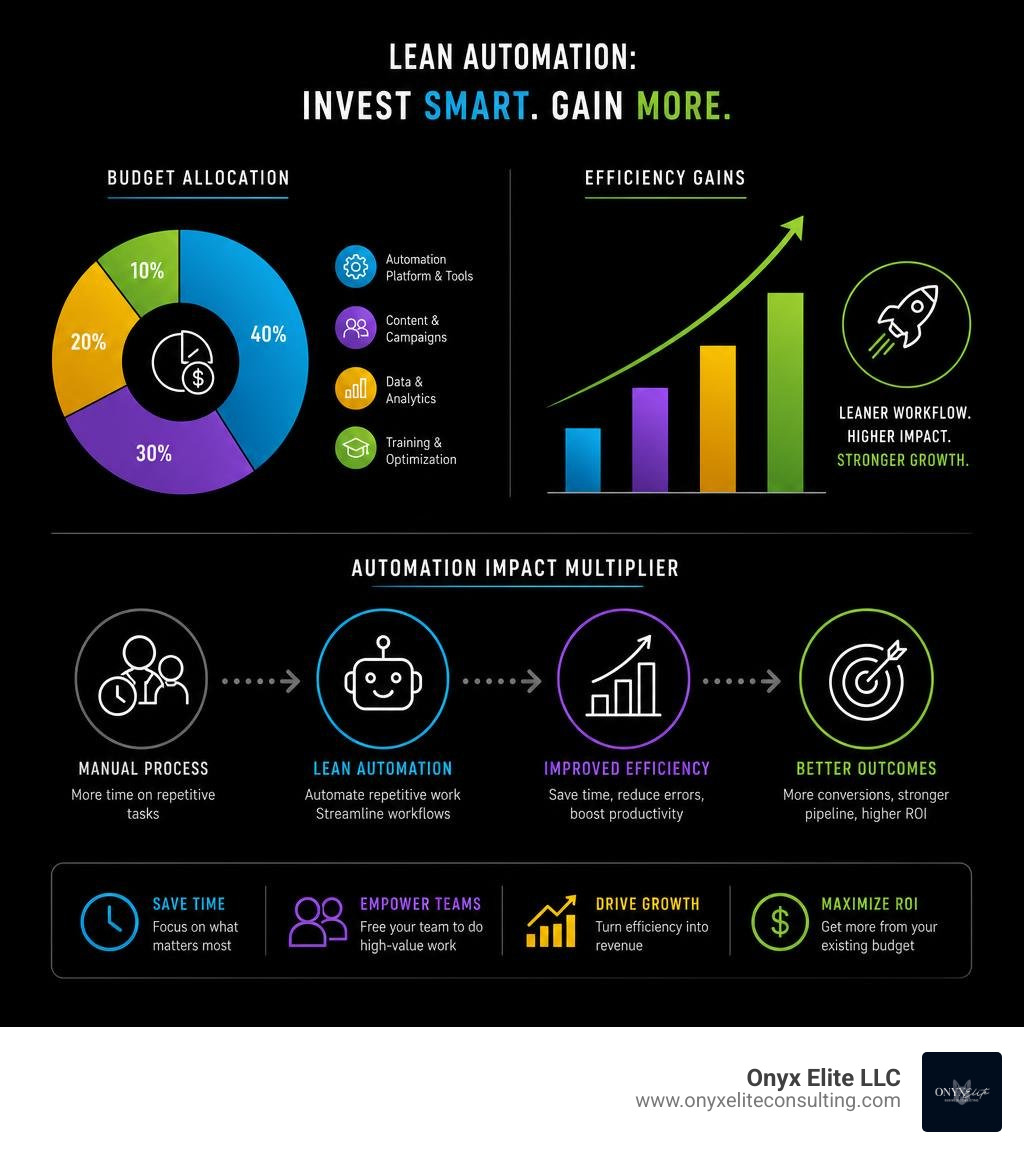
79% of marketing teams expect budget increases, but maximizing existing software resources remains the smartest way to scale profitably.
Selecting the Right Platform and CRM Ecosystem
When selecting tools for your growth stack, prioritize native API integration between your core CRM and marketing automation engines. Unifying customer data inside a central platform eliminates data silos, ensures accurate multi-touch attribution, and gives sales representatives clear context into a lead's behavioral history.
Start simple: choose an accessible CRM suite, establish 2 to 3 core capture workflows, and build out your automation rules as your inbound traffic expands. For expert assistance in configuring a lean, high-converting martech ecosystem, explore our specialized Consulting Services for Small Business and our guide on Marketing Automation Integration.
Frequently Asked Questions About Marketing Automation Inbound
How long does it take to implement inbound marketing automation?
A baseline implementation typically takes 2 to 4 weeks to configure core web forms, tracking scripts, CRM properties, and primary email workflows. Achieving full optimization—including AI search discovery adjustments, dynamic lead scoring model tuning, and closed-loop multi-touch revenue attribution—generally takes 60 to 90 days.
What is the difference between lead scoring and lead routing?
Lead scoring is an evaluative process that calculates a numerical score based on a contact's firmographic fit (e.g., job title, company size) and intent behaviors (e.g., pricing page views). Lead routing is an operational assignment process that uses logic rules to instantly assign scored, qualified contacts to the appropriate sales representative inside your CRM.
Can small businesses effectively automate inbound marketing without a huge budget?
Yes. Small businesses can launch an effective automation framework using accessible martech platforms and simple CRM setups. By focusing initially on fundamental high-converting workflows—such as instant demo routing, gated content downloads, and post-webinar follow-ups—lean teams can automate time-consuming routines without incurring massive software costs. For tailored strategies, read our Marketing Automation Services Guide 2026.
Strategic Growth with Onyx Elite LLC
Mastering marketing automation inbound isn't about setting up endless spam sequences or removing the human touch from your sales process. It's about designing an efficient digital framework that delivers the right message to high-intent buyers the moment they seek solutions—allowing your business to scale predictably without burning out your team.
At Onyx Elite LLC, we help growth-focused organizations streamline operational systems, implement high-converting martech ecosystems, and build sustainable revenue architectures. Based in West Hartford, CT, our consulting team partners with business leaders to turn complex acquisition challenges into smooth, scalable growth engines.
Ready to eliminate lead leakage and build an inbound automation engine that works around the clock? Explore Strategic Business Services with Onyx Elite LLC today, or browse our latest strategic playbooks on our Blogs & Insights hub.