

Marketing Automation Services 101
Why Marketing Automation Services Are a Game-Changer for Growing Businesses

Marketing automation services help businesses automatically send the right message to the right person at the right time — without doing it all by hand.
Here's a quick look at what they typically include:
| What You Get | What It Does |
|---|---|
| Email & SMS workflows | Send triggered messages based on customer behavior |
| Lead scoring | Rank prospects by how likely they are to buy |
| Audience segmentation | Group contacts by behavior, interests, or stage |
| CRM integration | Sync marketing data with your sales pipeline |
| Analytics & reporting | Track what's working and optimize in real time |
Businesses using marketing automation generate twice as many leads as those without it — and some report a 52% revenue increase within the first 30 days of implementation. The marketing automation industry is on track to reach $11 billion by 2030, which tells you just how fast this space is growing.
This isn't just a tool for enterprise companies. Founders and business leaders at every stage are using automation to scale faster, reduce manual work, and build more consistent customer experiences — without hiring a bigger team.
I'm Doru Angelo, Founder & CEO of Onyx Elite LLC, and with over a decade of experience in business consulting and brand strategy, I've helped organizations across industries implement marketing automation services that drive real, measurable growth. In this guide, I'll walk you through everything you need to know to choose the right solution for your business.
What Are Marketing Automation Services and How Do They Work?
At its core, marketing automation refers to software platforms and strategic services designed to streamline, automate, and measure repetitive marketing tasks. Instead of manually exporting contact lists, sending individual emails, or guessing which leads are ready to buy, we use technology to execute these processes based on predefined rules and behaviors.
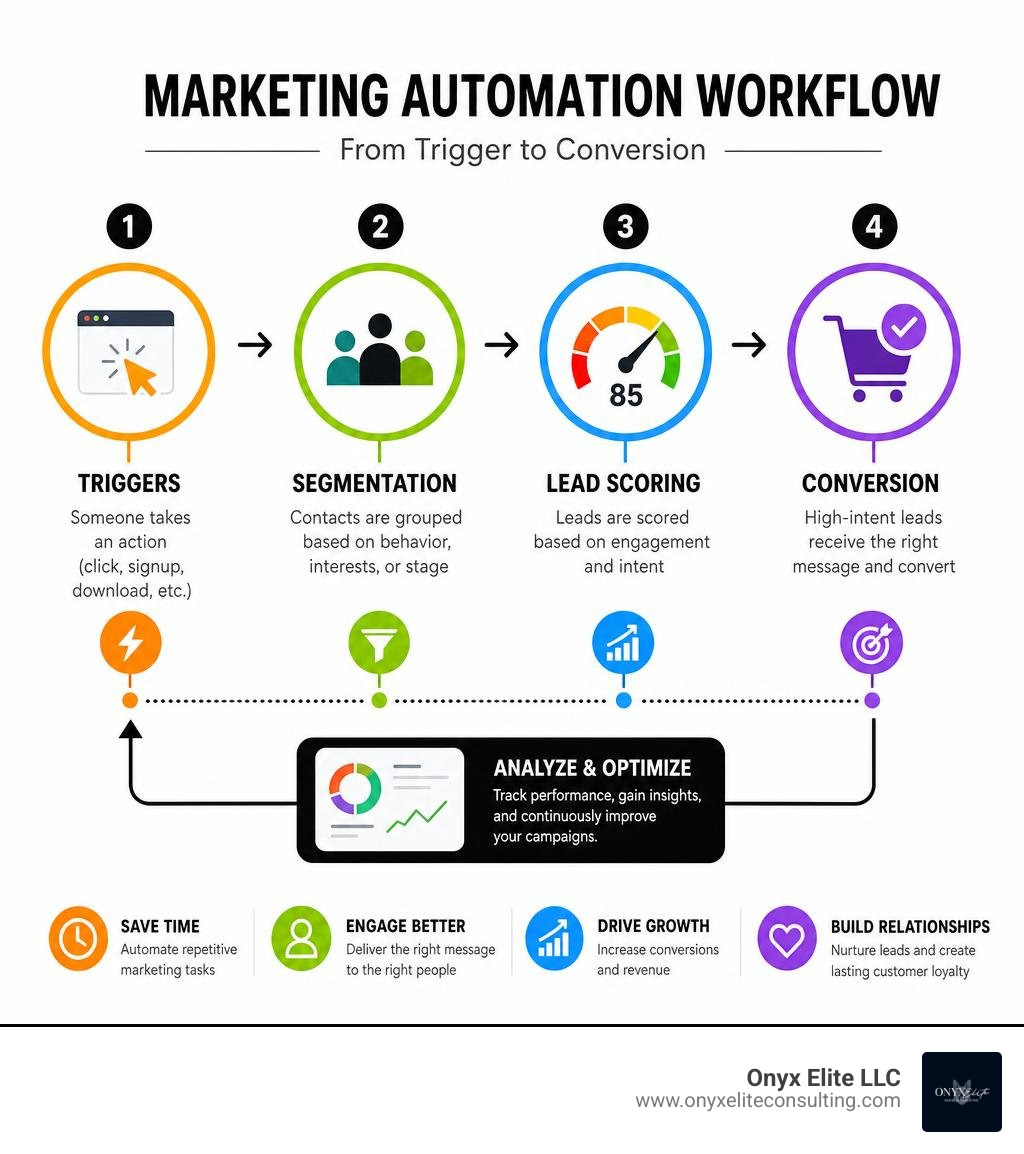
This setup functions through a continuous loop of data collection, behavioral tracking, and workflow triggers:
- Data Collection: The system tracks how users interact with your website, social media, and emails.
- Behavioral Triggers: An action, such as downloading a guide or abandoning a cart, acts as a trigger.
- Workflow Execution: The system automatically executes the next step, like sending a targeted SMS or assigning a follow-up task to a sales representative.
By establishing these automated systems, we help businesses in West Hartford, CT, build consistent, always-on campaigns that run in the background. If you are looking to design your own custom customer journeys, we highly recommend checking out our comprehensive Marketing Automation Workflow Guide 2026.
For local organizations looking to optimize their regional outreach, utilizing localized technical expertise is incredibly valuable. Aligning your digital campaigns with local consumer behavior ensures your automated touchpoints resonate with the community.
Core Features of Modern Marketing Automation Services
To make the most of your investment, it helps to understand the key capabilities that modern marketing automation services provide:
- Audience Segmentation: Automatically grouping contacts based on their demographics, purchase history, and real-time website behavior.
- Lead Scoring: Assigning numerical values to prospects based on their interactions (e.g., viewing a pricing page vs. reading a blog post) to identify sales-ready leads.
- Dynamic Personalization: Tailoring email copy, landing pages, and product recommendations in real time based on who is viewing them.
- Omnichannel Orchestration: Coordinating campaigns across email, SMS, push notifications, and social media from a single interface.
Connecting these features to your core sales pipeline is critical. To learn how to link these marketing triggers directly to your sales team, explore our guide on Marketing Automation Integration.
Marketing Automation vs. Traditional Email Marketing Tools
A common point of confusion for business owners is the difference between marketing automation and basic email marketing tools. While both send emails, their capabilities and underlying strategies are vastly different:
- Traditional Email Marketing: This is primarily built around static lists and batch-and-blast campaigns. You write one email, select a list, and send it to everyone at once. It is a one-way communication channel with minimal adaptation to individual behavior.
- Marketing Automation Services: This is a multi-channel, behavior-driven ecosystem. Instead of a single blast, it builds dynamic, multi-step customer journeys. If a user clicks a link in your email, they are tagged and routed to a different follow-up sequence than someone who did not open it.
Furthermore, marketing automation tracks anonymous website visitors, links their behavior to known profiles once they subscribe, and integrates deeply with your CRM. If you are a smaller business looking to establish a solid database foundation before launching complex campaigns, you can start by exploring our resources on Simple CRM Small Business.
Key Benefits of Implementing Marketing Automation Services
Investing in professional marketing automation services yields substantial, measurable returns. By replacing manual administrative work with automated workflows, we help teams focus on high-impact strategic growth.

The primary advantages of adopting these systems include:
- Significant ROI Improvements: By targeting customers with highly relevant messages at their exact moment of interest, conversion rates naturally climb.
- Efficient Lead Nurturing: Instead of letting cold leads drop off, automated drip sequences keep your brand top-of-mind over weeks or months.
- Reduced Human Error: Automated workflows ensure that welcome emails, discount codes, and follow-ups are sent instantly and accurately, every time.
- Enhanced Operational Efficiency: Teams can build campaigns once and let them run continuously, saving hours of manual labor each week.
Boosting Lead Generation and Sales Alignment
One of the greatest points of friction in any business is the handoff between marketing and sales. Marketing teams often complain that sales reps do not follow up on leads, while sales teams complain that the leads they receive are not qualified.
Marketing automation bridges this gap. By utilizing lead scoring models, we can define exactly what constitutes a Marketing Qualified Lead (MQL) based on real engagement data. Once a lead reaches a specific score threshold, the system automatically syncs their activity history and routes them to the sales team inside your CRM.
This ensures your sales reps spend their valuable time talking to prospects who are actively engaged and ready to buy. For businesses that operate in the service sector, aligning these pipelines is crucial. You can read more about setting up these connections in our detailed guide on CRM for Service Businesses.
Hyper-Personalization and Customer Segmentation at Scale
Today's consumers expect experiences that feel personally tailored to them. Standard personalization, like inserting a first name into an email subject line, is no longer enough.
Modern marketing automation platforms leverage first-party data and predictive analytics to achieve hyper-personalization at scale. By tracking real-time actions, systems can detect "lead temperature" and trigger immediate, highly relevant nudges.
For example, if a customer regularly browses a specific service category on your website, the system can automatically send them a personalized case study or a targeted promotion related to that exact service. To understand how artificial intelligence is accelerating these capabilities, you can explore the cutting-edge strategies detailed in AI Marketing Automation — Run Your Entire Marketing Stack with AI | Sprites .
Comparing Types of Marketing Automation Software
Choosing the right software depends heavily on your business size, industry, and technical resources. We can broadly categorize the leading platforms into three main tiers:
| Platform Category | Target Audience | Key Strengths | Popular Examples |
|---|---|---|---|
| Enterprise Suites | Large corporations & complex B2B | Deep CRM integration, advanced lead scoring, robust security | Salesforce Marketing Cloud, Oracle Eloqua |
| SMB & Mid-Market Platforms | Growing businesses & eCommerce | User-friendly visual builders, fast setup, strong email/SMS focus | Klaviyo, ActiveCampaign, HubSpot |
| AI-Native Tools | Tech-forward brands & lean teams | Autonomous agentic execution, conversational AI, rapid optimization | Sprites |
To explore these platforms in greater detail, you can visit their official resources:
- For enterprise B2B orchestration: Eloqua Marketing Automation | Oracle or Eloqua Marketing Automation | Oracle United Kingdom .
- For omnichannel eCommerce and SMB growth: The Marketing Automation Platform for Email, SMS, & WhatsApp - Klaviyo .
- For comprehensive enterprise marketing stack management: Marketing Automation Software | Salesforce .
Choosing the Right Marketing Automation Services for Your Business
Selecting a platform is a long-term commitment. To avoid costly migrations down the line, we recommend evaluating potential software through a 3-to-5-year growth lens. Key factors to consider include:
- Native Integrations: Does the software connect seamlessly with your existing CRM, website platform, and customer support tools without requiring complex custom development?
- Usability and Training: Is the interface intuitive enough for your current team to manage, or will it require extensive training and certified experts to operate?
- Deliverability Rates: Does the provider have a strong reputation and infrastructure for ensuring your emails actually reach the inbox?
- Onboarding and Implementation Support: What is the typical timeline to get the system fully operational?
For businesses planning to implement the market-leading inbound marketing platform, we have put together a step-by-step walkthrough in our guide on HubSpot Marketing Automation Setup. Additionally, ensuring your website is optimized to capture and track these automated leads is a vital prerequisite. Local businesses in Connecticut can leverage specialized local design resources to build high-converting, automation-ready landing pages.
Typical Costs and Pricing Models
Marketing automation pricing varies widely based on the scale of your operations. Most platforms use one of two primary pricing structures:
- Contact-Based Pricing: You are charged based on the total number of contacts stored in your marketing database. As your subscriber list grows, your monthly software costs scale.
- Volume-Based Pricing: You are charged based on the total number of emails, SMS messages, or push notifications you send each month.
While entry-level plans for small businesses can start as low as $9 to $50 per month, mid-market platforms typically range from $150 to $500 per month. Enterprise-grade solutions can scale to several thousand dollars monthly, often accompanied by upfront implementation and onboarding fees. It is essential to factor in these setup costs and potential consulting fees when calculating your total budget.
Best Practices and Common Mistakes to Avoid
While marketing automation is incredibly powerful, it is not a set-it-and-forget-it solution. Poorly configured systems can lead to disjointed customer experiences or, worse, damage your brand's sending reputation.

To ensure your campaigns succeed, keep these best practices in mind:
- Prioritize Data Hygiene: Regularly clean your database to remove inactive contacts, bounce backs, and unengaged subscribers. High bounce rates can harm your overall email deliverability.
- Avoid Over-Automation: Do not automate every single touchpoint. Customers still value human interaction, especially during complex sales cycles or customer support inquiries.
- Define Clear, Measurable Goals: Establish specific KPIs for every automated workflow (e.g., open rates, click-through rates, and conversion goals) so you can measure impact and optimize continuously.
- Test Early and Often: Always run A/B tests on subject lines, email copy, send times, and delay lengths to discover what resonates best with your audience.
Real-World Examples of Marketing Automation Services in Action
To understand how these concepts translate into daily business operations, let's look at three common, highly effective workflows:
- The Abandoned Cart Recovery Sequence: When an eCommerce shopper adds items to their cart but leaves without purchasing, a trigger is fired. Within an hour, they receive a friendly email reminder. If they do not buy, a second email is sent 24 hours later offering a limited-time discount or highlighting customer reviews.
- The New Subscriber Welcome Series: When a user signs up for your newsletter, they instantly receive a welcome email introducing your brand. Over the next week, the system automatically sends a series of educational emails, slowly nurturing them toward their first purchase.
- The High-Intent Lead Alert: When a B2B prospect visits your pricing page three times in 48 hours, their lead score spikes. The system instantly tags them as "hot" and sends a notification to your sales representative to reach out personally.
Future Trends: AI and Agentic Marketing Automation Services
The marketing automation landscape is evolving rapidly, driven by advancements in artificial intelligence. We are moving away from traditional, rigid rule-based workflows toward autonomous, "agentic" marketing systems.
Instead of a marketer having to manually map out every branch of a customer journey, AI agents can analyze real-time context, translate simple natural language prompts into precise audience segments, and automatically draft, deploy, and optimize campaigns.
These autonomous systems can monitor ad performance, pause underperforming creatives, and shift budgets to high-performing channels dynamically. To see how these cutting-edge capabilities are transforming the industry, check out the Agentic Marketing Platform: Marketing Cloud Next. | Salesforce .
Frequently Asked Questions about Marketing Automation Services
How do marketing automation services improve business ROI?
Marketing automation services directly improve ROI by converting more leads into paying customers through timely, highly targeted messaging. By automating repetitive tasks, they also lower operational costs, optimize marketing spend, and increase customer lifetime value through automated cross-selling and retention campaigns.
What is the difference between CRM and marketing automation?
While they are closely connected, CRM (Customer Relationship Management) software is primarily used by sales and customer service teams to manage direct relationships, sales pipelines, and contact histories. Marketing automation software, on the other hand, is used by marketing teams to automate top-of-funnel activities, lead nurturing, and multi-channel campaigns. Integrating the two ensures a seamless data flow from the first touchpoint to the final sale.
How can small businesses start with marketing automation on a budget?
Small businesses can start by using affordable, SMB-friendly platforms that offer robust free tiers or low-cost basic plans. Focus on setting up just one or two high-impact workflows first, such as a simple welcome email sequence or a basic lead capture form, and scale your automation complexity as your revenue and contact list grow.
Conclusion
Implementing professional marketing automation services is one of the most effective ways to scale your business, align your sales and marketing teams, and deliver exceptional, personalized customer experiences at scale.
At Onyx Elite LLC, we help companies achieve sustainable growth and operational excellence through strategic planning, brand development, and a comprehensive suite of tailored services. As an award-winning business consulting firm based in West Hartford, Connecticut, we go beyond traditional solutions to build automated marketing ecosystems that run like clockwork and drive measurable revenue.
If you are a business owner in Connecticut looking to work with top-tier marketing and strategy professionals, partnering with a local expert who understands the regional market is key to achieving sustainable growth.
Ready to eliminate manual campaign chaos and accelerate your business growth? Let us help you design and deploy a high-velocity marketing engine. Partner with Onyx Elite LLC for expert marketing automation services today.