

The Complete Guide to Payroll Funding Solutions
Understanding Business Payroll Funding

Business payroll funding is a short-term financing solution that helps companies cover employee wages when cash flow doesn't line up with payroll deadlines.
Here's a quick overview of your main options:
| Funding Type | Best For | Speed | Typical Cost |
|---|---|---|---|
| Invoice Factoring | Businesses with unpaid invoices | 24-48 hours | 0.75% - 3.5% per invoice |
| Business Line of Credit | Recurring payroll gaps | 1-3 days | Varies by lender |
| Short-Term Loan | One-time cash shortfalls | 24-72 hours | 3% - 50%+ APR |
| Revenue Advance | Fluctuating revenue cycles | 24-48 hours | 1.11 - 1.13 factor rate |
| Payroll-Specific Funding | Any industry, fast access | Same day to 48 hours | ~1.5% weekly |
Even profitable businesses run into this problem. A client payment arrives on Net-30 or Net-60 terms, but payroll is due this Friday. That gap — even a temporary one — can put real pressure on operations, employee morale, and your reputation as an employer.
Missing payroll isn't just stressful. It can expose a business to wage theft claims, IRS penalties, and civil liability under the Fair Labor Standards Act. The stakes are high, and the solution needs to be fast.
That's exactly where payroll funding comes in.
I'm Doru Angelo, Founder & CEO of Onyx Elite LLC, and with over a decade of experience in business consulting and capital markets — including facilitating funding across a portfolio totaling upward of $12.5 billion — business payroll funding is one of the most urgent and solvable cash flow challenges I help founders navigate. In this guide, I'll walk you through every option available so you can make a confident, informed decision for your business.
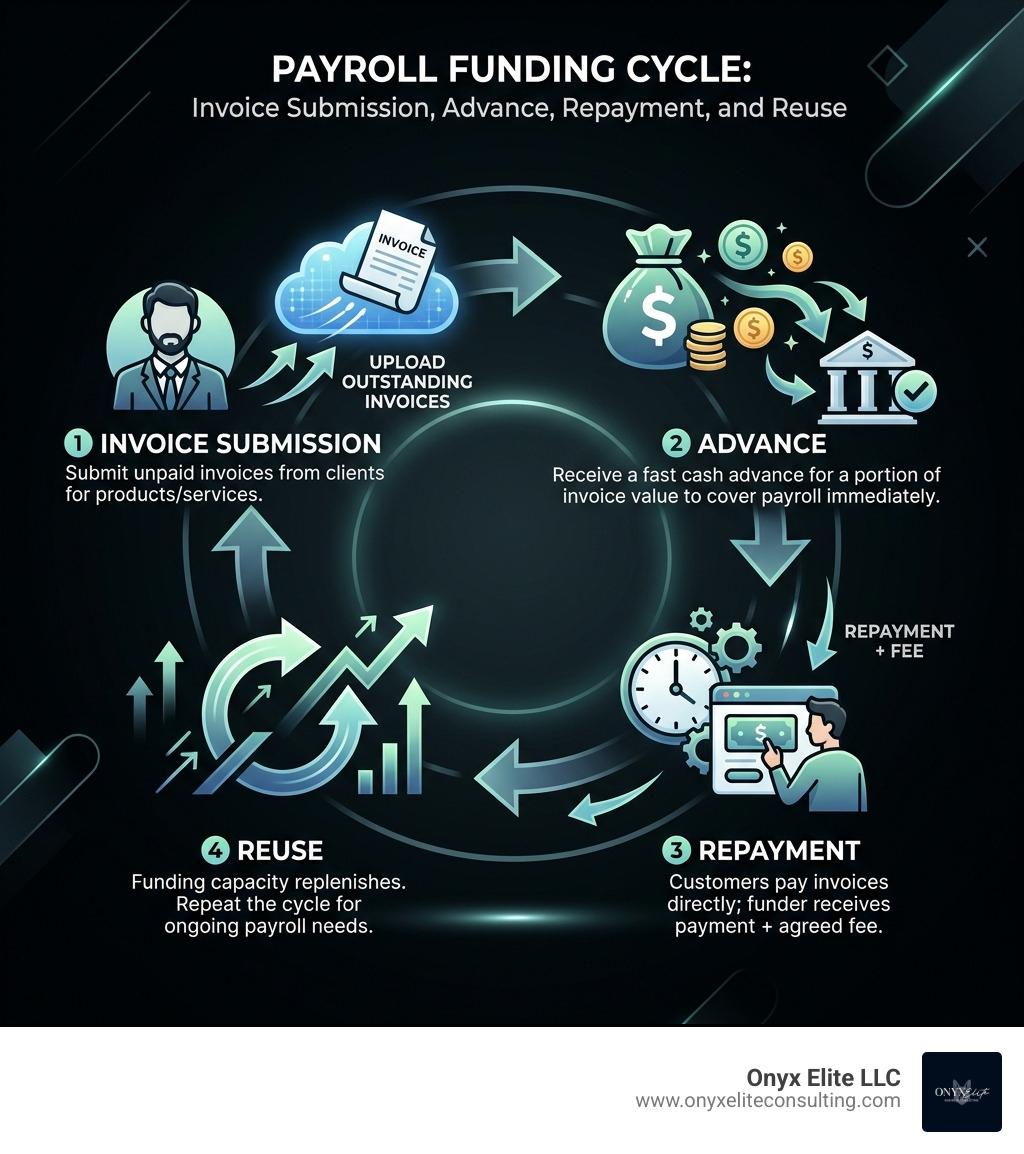

At its core, business payroll funding is a specialized form of working capital. It is designed to bridge the gap between when you owe your employees their hard-earned wages and when your customers actually pay you for the services or products those employees provided.
We often see businesses that are technically "profitable" on paper but "cash-poor" in the bank. This happens because most business-to-business (B2B) transactions happen on credit. You do the work today, but the check doesn't arrive for 30, 60, or even 90 days. Meanwhile, your staff needs to be paid every two weeks like clockwork.
According to research on What Is Payroll Funding and How Can I Find It in 2026? , this funding is essentially an advance on your own revenue. It allows you to unlock the value of your accounts receivable or your proven monthly revenue to meet your most immediate obligation: your team.
How it Differs from Traditional Business Loans
When you think of a "bank loan," you probably think of a long application process, mountains of paperwork, and a monthly payment that lasts for years. Business payroll funding is different in three major ways:
- Speed of Approval: While a traditional bank loan can take 60 days or longer to fund, payroll financing is built for speed. Many providers can approve you in 24 to 48 hours.
- Collateral Types: Banks usually want "hard" collateral like real estate or equipment. Payroll funders look at your "soft" assets—specifically your unpaid invoices or your consistent monthly bank deposits.
- Debt Structure: Traditional loans are long-term liabilities on your balance sheet. Many payroll funding options, like invoice factoring, are not considered "debt" in the traditional sense; they are a sale of an asset (your invoice) for immediate cash.
The Role of Payroll as a Revenue Driver
We always remind our clients at Onyx Elite LLC that payroll isn't just an expense; it’s a revenue-generating activity. Your employees are the ones delivering the services, building the products, and interacting with the customers that bring in money.
If you miss payroll, the cycle breaks. Top talent leaves, service delivery halts, and your growth scaling stops dead in its tracks. Using business payroll funding strategically ensures that your "revenue engine"—your people—remains fueled and running, even when your customers are slow to pay.
Primary Types of Payroll Financing

Not all funding is created equal. Depending on your business model, one of these Invoice Financing Solutions might be a better fit than the others.
| Feature | Invoice Factoring | Business Line of Credit | Short-Term Loan |
|---|---|---|---|
| Collateral | Unpaid Invoices | Business Assets/Revenue | General Business Credit |
| Repayment | When customer pays | Weekly/Monthly draws | Fixed daily/weekly/monthly |
| Flexibility | High (grows with sales) | High (reusable) | Low (fixed amount) |
| Best For | Staffing, B2B, Services | Seasonal dips, Backup | One-time emergencies |
Invoice Factoring for Immediate Liquidity
For businesses in industries like staffing or consulting, invoice factoring is often the "Gold Standard." Here is how it works: you sell your outstanding invoices to a funding company. They typically advance you 90% of the invoice’s face value immediately.
The remaining 10% is held in a "reserve." Once your customer pays the invoice in full, the funding company sends you that 10% reserve, minus a small fee (usually between 0.75% and 3.5%). The best part? The funding company cares more about your customer’s credit score than yours. If you work with reliable, large companies that pay late, you are an ideal candidate for this.
Business Lines of Credit and Revenue Advances
If you don't use invoices but still have consistent sales (like a retail shop or a restaurant), a line of credit or a revenue advance might be better.
A Business Line of Credit works like a credit card for your company. You are approved for a certain limit—say $100,000—and you only pay interest on what you actually draw. This is perfect for "standby" payroll protection.
A Revenue Advance (or Merchant Cash Advance) provides a lump sum based on your future sales. Repayment is often flexible, taking a small percentage of your daily sales. This means if you have a slow week, you pay back less. However, keep an eye on the "factor rate," which can make these more expensive than traditional lines of credit.
Eligibility and Requirements
While the requirements for business payroll funding are more relaxed than a bank's, you still need to meet certain benchmarks to show you are a viable business. In our local market, programs like the Connecticut Small Business Boost Fund are great resources, but private funders often have specific "speed-based" requirements.
Why Your Company Needs Business Payroll Funding
Most of our clients seeking these solutions fall into one of three buckets:
- Seasonal Dips: A landscaping company in West Hartford might have massive payroll in the spring but slow receivables in the winter.
- Rapid Hiring: You just landed a huge contract and need to hire 10 people today, but you won't get paid for their work for two months.
- Delayed Receivables: You have great customers, but they are stretching their payment terms from 30 days to 60 days to manage their own cash flow.
How to Qualify for Business Payroll Funding
While every lender varies, a typical "fast-track" qualification for payroll-specific funding includes:
- Monthly Revenue: Usually at least $25,000 in monthly sales.
- Time in Business: At least 2 years of operational history (though some specialized "startup" funders accept as little as 3-6 months).
- Employee Count: Often a minimum of 5 employees to qualify for payroll-specific products.
- Payroll System: You typically need to use a professional payroll service or software to provide clean summaries of what you owe.
The Step-by-Step Funding Process
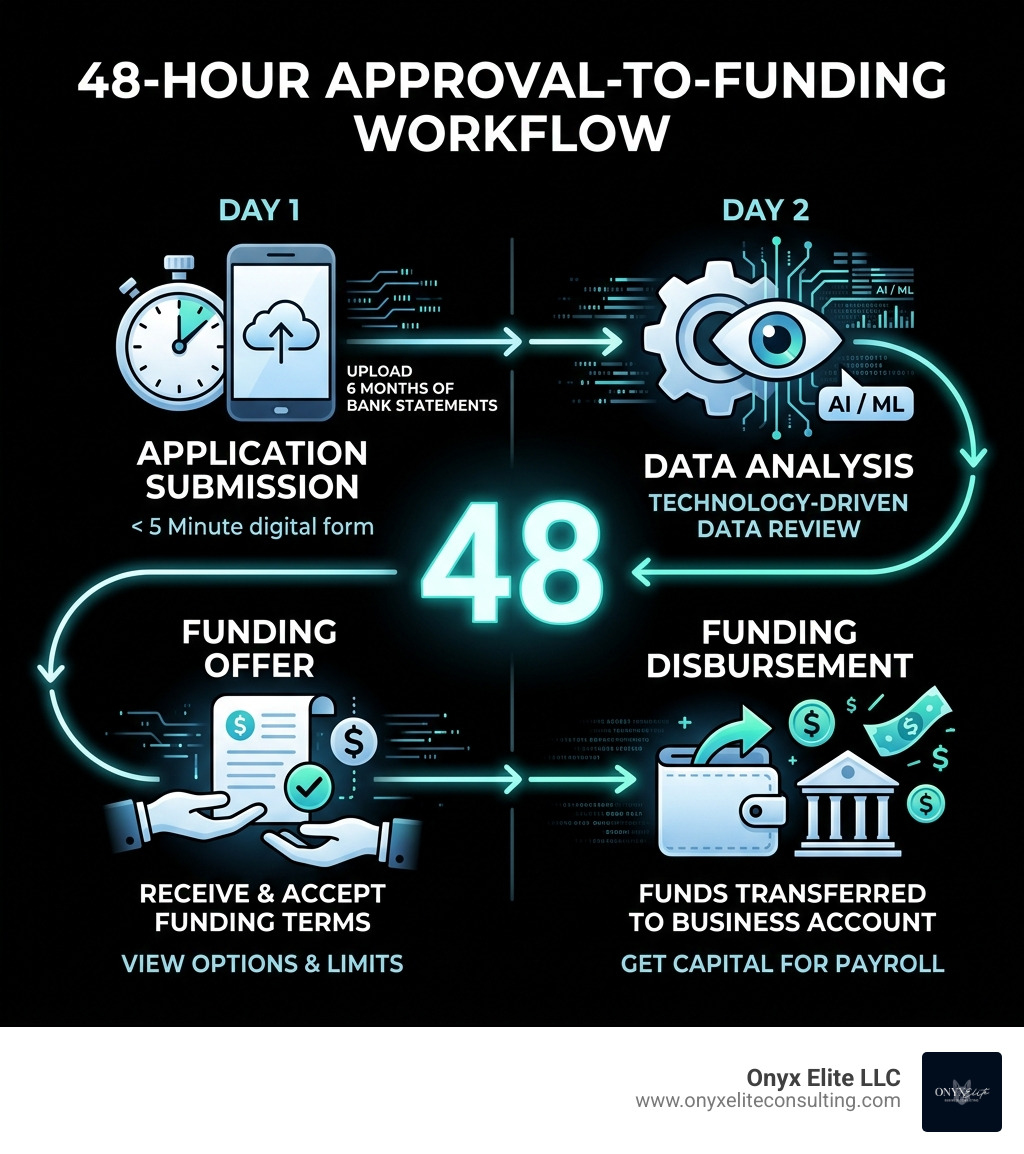
We know that when you're looking for business payroll funding, you don't have weeks to wait. The process is designed to be as frictionless as possible.
From Application to Approval
The modern application process is remarkably fast—often taking less than 5 minutes to complete. Because these lenders use technology to analyze your data, you don't need to mail in boxes of tax returns.
Typically, you will just need to upload:
- 6 months of bank statements (usually via a secure digital link).
- Your most recent payroll summary from your provider (like ADP, Gusto, or Paychex).
- Your Business Tax ID (EIN).
Most businesses receive an approval decision within 2 business days, though some same-day approvals are possible if you apply early in the morning.
Accessing and Repaying Funds
Once you are approved, you'll have a "credit limit" or a "funding facility" ready to use.
- Requesting Funds: This is often as simple as 4 clicks in an app. If you request funds before 1:00 PM EST, many providers can wire the money to your account the same day.
- The Cost: Rates can be as low as 1.5% weekly. For example, if you need $10,000 for one week to bridge a gap, your fee might be around $150.
- Repayment: To keep things simple, repayment is usually automatic. The funder will set up an ACH withdrawal from your business account on a pre-agreed date (often synchronized with when your customer invoices are due or when your next big revenue spike is expected).
Costs, Pros, and Industry Applications
At Onyx Elite LLC, we help businesses look at the "Total Cost of Capital." While business payroll funding has higher interest rates than a 10-year SBA loan, the "cost of missing payroll" is infinitely higher. You can find more about these trade-offs in our guide on US Business Funding Solutions.
Industries That Benefit Most
Certain business models are practically built on payroll funding:
- Staffing Agencies: You pay your temps weekly, but your clients pay you monthly. This creates a permanent cash gap that funding solves perfectly.
- Healthcare Providers: Insurance companies and Medicaid can take 8–10 months to pay out. Funding allows clinics to keep doctors and nurses paid while waiting on those "lagging" insurance checks.
- Construction Firms: You have to pay your crew every Friday, but you might only get "progress payments" from the developer once a month.
Weighing the Pros and Cons
The Pros:
- Improved Liquidity: You keep cash in the bank for other emergencies.
- Employee Morale: You never have to have the "awkward conversation" about a late paycheck.
- No Debt Burden: Many options don't require a personal guarantee or put a lien on your home.
- Speed: You can solve a crisis in 24 hours.
The Cons:
- Higher Fees: Weekly rates can add up if you don't pay the balance back quickly.
- Short-Term Only: This is a "bridge," not a long-term solution for a failing business model.
- Exclusivity: Some funders only allow the money to be used for payroll, not for buying new equipment or inventory.
Frequently Asked Questions about Payroll Financing
What documents are required for a business payroll funding application?
To keep the process moving at lightning speed, have your digital PDFs ready. You will generally need 6 months of business bank statements, your most recent payroll summary (showing the total amount due for wages and taxes), and your Business Tax ID. Unlike banks, most of these providers do not require years of personal tax returns or profit and loss statements.
How does payroll funding impact business credit scores?
In many cases, it doesn't impact your score at all. Most payroll-specific funders use a "soft inquiry" to check your background, which doesn't ding your credit score. Furthermore, because many of these solutions (like factoring) are considered the sale of an asset rather than a loan, they don't show up as "debt" on your credit report. This keeps your credit clean for when you want to apply for a traditional mortgage or a long-term expansion loan later.
When should a business consider alternatives to payroll funding?
Business payroll funding is a tactical tool for timing issues. If your business is consistently losing money every month, a loan won't fix the underlying problem—it will just make the eventual crash more expensive.
Consider alternatives like SBA loans or long-term traditional financing if you are looking to fund a major expansion. If you have deep cash reserves, it's always "cheapest" to pay yourself. However, for 90% of growing businesses, having a "standby" payroll line is just smart risk management.
Conclusion
Managing a business in 2026 requires more than just a good product; it requires masterful cash flow management. Business payroll funding is the safety net that allows you to focus on growth without the midnight anxiety of "how will I pay the team this Friday?"
At Onyx Elite LLC, we believe in sustainable growth. That means having the right financial tools in your belt before you need them. Whether you are a staffing firm in West Hartford or a healthcare startup in Connecticut, understanding these funding cycles is key to your operational excellence.
Ready to streamline your business operations and ensure your cash flow is as professional as your service? Get started with professional credit card processing today to speed up your incoming revenue and reduce the need for outside funding in the first place!