

Stop Waiting for Checks with These Invoice Financing Solutions
Why Businesses Are Turning to Invoice Financing Solutions to Fix Cash Flow

Invoice financing solutions are ways for B2B businesses to unlock cash from unpaid invoices — without waiting 30, 60, or even 90 days for customers to pay.
Here is a quick comparison of the most common options:
| Solution | How It Works | Best For |
|---|---|---|
| Invoice Factoring | Sell invoices to a lender; they collect payment | Businesses that want fast cash and don't mind lender contact with customers |
| Invoice Discounting | Borrow against invoices; you collect payment | Businesses that want funding confidentially |
| Selective/Spot Factoring | Finance specific invoices only | Businesses with occasional cash flow gaps |
| Receivables Line of Credit | Revolving credit backed by invoices | Established businesses with steady invoice volume |
Most providers advance up to 90% of invoice value within 24 to 48 hours, giving you working capital without taking on long-term debt.
You work hard to deliver your product or service. Then you wait. Net-30 becomes net-60. Net-60 becomes net-90. Meanwhile, payroll is due, suppliers need payment, and growth opportunities don't pause for your customers' payment schedules.
This is the cash flow gap that quietly strangles otherwise healthy businesses. In fact, bank loan approval rates for small businesses dropped from 62% in 2019 to just 53% in 2023, making traditional lending harder to count on. Invoice financing fills exactly that gap — turning your accounts receivable into immediate working capital.
I'm Doru Angelo, Founder & CEO of Onyx Elite LLC, and with over a decade of experience in business consulting and capital markets — including facilitating funding across a portfolio valued at over $12.5 billion — I've helped businesses at every stage evaluate and implement the right invoice financing solutions for sustainable growth. Below, I'll walk you through everything you need to know to make the right call for your business.
Understanding Invoice Financing Solutions for Business Growth
When we talk about invoice financing solutions, we are essentially discussing asset-based lending where your accounts receivable serve as the primary collateral. For many businesses in West Hartford and throughout Connecticut, the "working capital gap" isn't just a buzzword; it’s the difference between taking on a new contract or having to turn it down because you can't afford the upfront supplies.

Invoice finance allows you to unlock cash tied in invoices immediately. Instead of waiting for a check to clear, you use the value of your completed work to fuel your next project. This is particularly effective when paired with other operational efficiencies, such as optimized credit card processing, to ensure money is moving into your business from every possible angle.
Comparing Factoring vs. Lines of Credit
A common question we hear is: "Why not just get a bank line of credit?" While a line of credit is often cheaper, it is significantly harder to secure. According to the Small Business Credit Survey, full approval rates for traditional loans and lines of credit have been on a downward trend.
The primary difference lies in the underwriting. A bank looks at your business's credit history, tax returns, and profitability. In contrast, invoice factoring focuses on the creditworthiness of your customers. If you are a small startup doing business with a massive, credit-stable corporation, a factoring company is often happy to advance funds because they trust that the large corporation will eventually pay the bill.
Selecting the Best invoice financing solutions for Your Industry
Not every business is a fit for these solutions. Generally, invoice financing solutions work best for B2B (business-to-business) or B2G (business-to-government) models. If you sell directly to consumers (B2C), this isn't the right path for you.
However, if you operate in the following sectors, these solutions can be a game-changer:
- Manufacturing: Cover the cost of raw materials for a large order before the customer pays 60 days later.
- Staffing Agencies: Ensure you can meet weekly payroll for your contractors even if your clients pay monthly.
- Wholesale & Logistics: Manage the high overhead of fuel and shipping while waiting for retailers to settle their accounts.
- Construction: Bridge the gap between project milestones and final disbursements.
- Consulting: Maintain steady operations during long-term projects with delayed billing cycles.
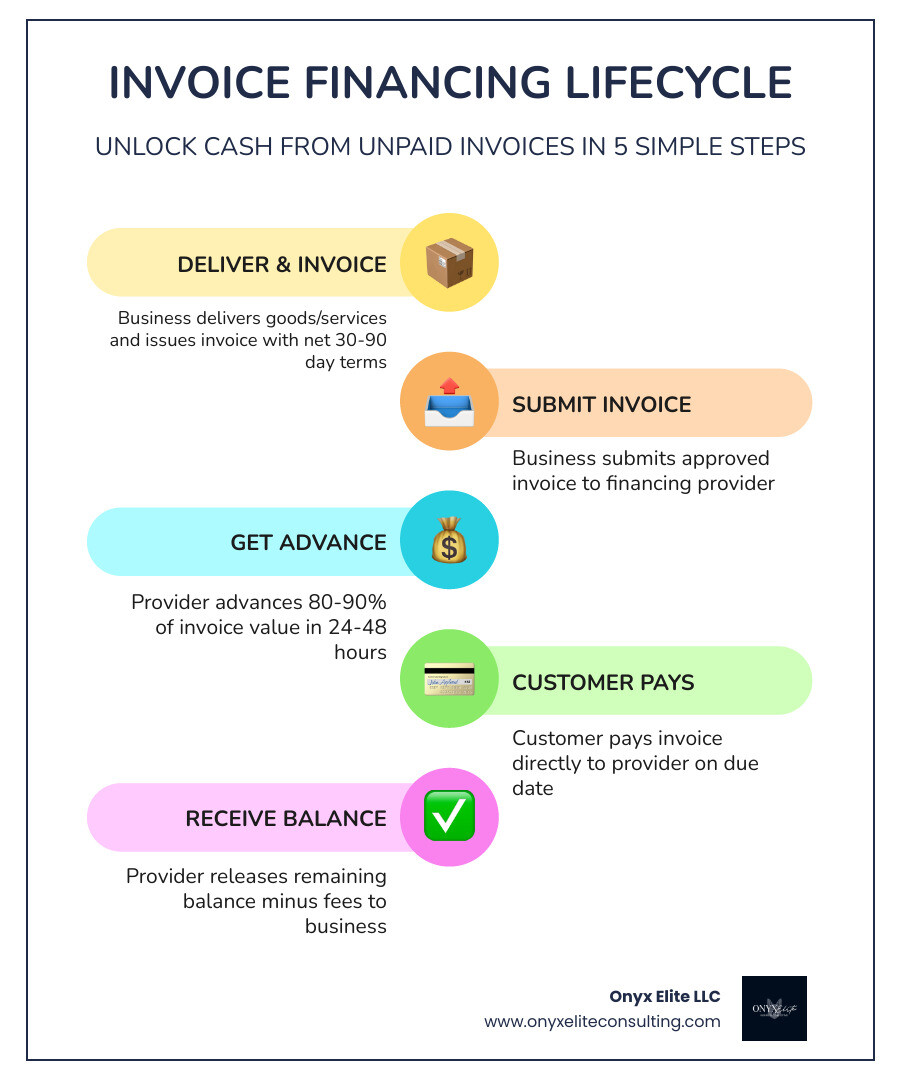
How Invoice Financing Works: A Step-by-Step Guide
The process is designed to be much faster than traditional banking. Here is how a typical engagement unfolds:
- Invoice Generation: You provide goods or services to your customer and issue an invoice as usual.
- Submission: You upload the invoice to your financing provider's digital dashboard.
- Verification: The provider may quickly verify that the goods were received or the work was completed.
- The Advance: The provider sends you an "advance rate," typically 80% to 90% of the invoice value, often within 24 hours.
- Customer Payment: Your customer pays the invoice on their normal schedule (e.g., in 45 days).
- The Rebate: The provider sends you the remaining 10% to 20% (the "reserve"), minus their service fees.
The Role of Advance Rates and Reserve Accounts
The advance rate is the percentage of the invoice the lender gives you upfront. If you have a $10,000 invoice and a 90% advance rate, you get $9,000 immediately. The remaining $1,000 goes into a reserve account. Once the customer pays the full $10,000 to the lender, the lender takes their fee (let’s say 3%, or $300) out of that reserve and sends you the remaining $700.
Integrating Financing into Your Order-to-Cash (O2C) Process
To truly maximize the benefits, you should integrate these solutions into your Order-to-Cash (O2C) cycle. Research shows that companies deploying O2C platforms can boost revenues by 1% to 3% annually by reducing "limbo" orders and speeding up processing.
By automating the flow of data between your accounting software and your financing provider, you can reduce your Days Sales Outstanding (DSO) and ensure a constant stream of liquidity. For businesses looking to refine this further, credit card processing consulting can help align your payment collection strategies with your financing needs.
Comparing the Main Types of Invoice Financing
There isn't a "one size fits all" approach here. The industry for invoice financing and asset-based lending supported nearly €2.5 trillion in turnover across Europe in 2023, and the variety of products reflects that scale.
| Feature | Invoice Factoring | Invoice Discounting | Selective Factoring |
|---|---|---|---|
| Collections | Handled by the provider | Handled by your business | Case-by-case |
| Confidentiality | Customer usually knows | Usually confidential | Varies |
| Best For | Small businesses/Startups | Established firms | Occasional needs |
Invoice Factoring vs. Invoice Discounting
The biggest distinction is who manages the "sales ledger." In factoring, the provider usually takes over the collections process. They might call your customers to remind them of payment dates. In invoice discounting, you maintain control over your collections. Your customers may not even know you are using a financing service, which is a major plus for businesses that want to maintain a specific brand image.
Many providers are members of trade bodies like UK Finance, which helps ensure they adhere to professional standards.
Recourse vs. Non-Recourse invoice financing solutions
This is a critical legal distinction:
- Recourse Financing: If your customer fails to pay the invoice (for example, they go out of business), you are responsible for paying the lender back. This is the most common and least expensive option.
- Non-Recourse Financing: The lender assumes the credit risk. If the customer doesn't pay due to insolvency, the lender takes the loss. Because the lender is taking more risk, the fees for non-recourse options are significantly higher.
The Financial Impact: Costs, Benefits, and Risks
Let's talk numbers. Invoice financing solutions are generally more expensive than bank loans but cheaper than Merchant Cash Advances (MCAs). Typical effective APRs range from 15% to 35% or more.
Understanding Fees and Interest Rates
Providers usually charge in one of two ways:
- A Flat Service Fee: A percentage of the total invoice value (e.g., 2% to 5%).
- A Discount Rate: A weekly or monthly interest charge (e.g., 0.5% per week) based on how long the invoice remains unpaid.
For example, if you finance a $10,000 invoice with a 3% monthly fee and the customer pays in 30 days, you pay $300. If they take 60 days, you might pay $600. This makes understanding how invoice financing works essential so you can accurately forecast your margins.
Managing the Risks of Customer Non-Payment
The biggest risk is customer default. Even with non-recourse factoring, there are often "dispute" clauses. If a customer refuses to pay because your product was defective, the lender will likely still come to you for repayment. To mitigate these risks, it is vital to maintain high-quality B2B relationships and perhaps look into chargeback management services to protect your revenue streams from other types of payment reversals.
Qualification and Application: Is Your Business Ready?
The beauty of these solutions is the speed of approval. While a bank might take weeks, an invoice financier can often approve you in 24 to 48 hours.
Essential Documents for a Successful Application
To get started, you’ll typically need:
- Accounts Receivable (A/R) Aging Report: A list of who owes you money and for how long.
- Bank Statements: Usually the last 3 to 6 months.
- Tax Returns: To verify business identity and basic standing.
- Customer List: The names and contact info of the businesses you are invoicing.
When to Choose Financing Over Traditional Loans
Choose invoice financing when:
- You need cash now (within 48 hours).
- Your business is too new for a bank loan.
- Your personal credit is less than perfect, but your customers are creditworthy.
- You want to avoid taking on "hard" debt that appears as a liability on your balance sheet (factoring is often treated as an asset sale).
Frequently Asked Questions about Invoice Financing
How does invoice financing differ from a merchant cash advance?
A Merchant Cash Advance (MCA) is based on your future projected credit card sales and often carries extremely high interest rates (up to 100% APR). Invoice financing is based on work you have already completed and is generally much more affordable.
Will my customers know that I am using a financing service?
If you use invoice factoring, yes; the customer usually pays the factoring company directly. If you use invoice discounting, no; the process is confidential, and you continue to collect payments in your own name.
Can startups with limited credit history qualify for these solutions?
Yes! This is one of the best funding options for startups. Because the lender cares more about your customer's ability to pay than your company's age, even a brand-new business can get funded as long as they have a valid invoice to a reputable client.
Conclusion
At Onyx Elite LLC, we believe that cash flow should never be the ceiling that limits your business's potential. Whether you are navigating a period of rapid growth or simply trying to smooth out the bumps of seasonal demand, invoice financing solutions offer a flexible, scalable way to keep your operations moving.
Based in West Hartford, CT, our team is dedicated to helping Connecticut businesses achieve operational excellence and sustainable growth. By combining strategic planning with modern financial tools, we help you stop waiting for checks and start focused on what you do best: building your business.
Get started with professional credit card processing solutions today to see how we can help you optimize every dollar that flows through your company.