

The Art of Brand Perception Analysis: Understanding Your Audience
Why Brand Perception Analysis is the Foundation of Sustainable Growth

Brand perception analysis is the process of measuring and understanding how your target audience thinks, feels, and talks about your brand. It captures the "mental real estate" your brand occupies by translating attitudes, emotions, and associations into insights you can act on.
Quick Definition:
- What it is: A research approach that captures consumer thoughts, feelings, and experiences about your brand
- What it measures: Familiarity, liking, memorability, sentiment, and emotional connection
- Why it matters: 62% of customers feel emotionally connected to brands they buy from, and 88% of executives agree customer engagement significantly impacts the bottom line
- How to do it: Surveys, social listening, sentiment analysis, website analytics, and customer feedback across key touchpoints
Here's the reality: your brand is not what you say it is - it's what your customers believe it to be. Many organizations find a gap between intended positioning and market reality, which can stall launches, slow growth, and dilute differentiation.
Brand perception analysis closes that gap by turning vague brand "health" into measurable signals. Whether you're a startup building initial awareness or an established company seeking to reposition, you need a clear baseline before you invest in messaging, campaigns, or experience improvements.
I'm Doru Angelo, Founder & CEO of Onyx Elite LLC. Over the past decade, I've helped businesses use brand perception analysis to pinpoint misalignment and build data-driven brand strategy that supports sustainable growth.
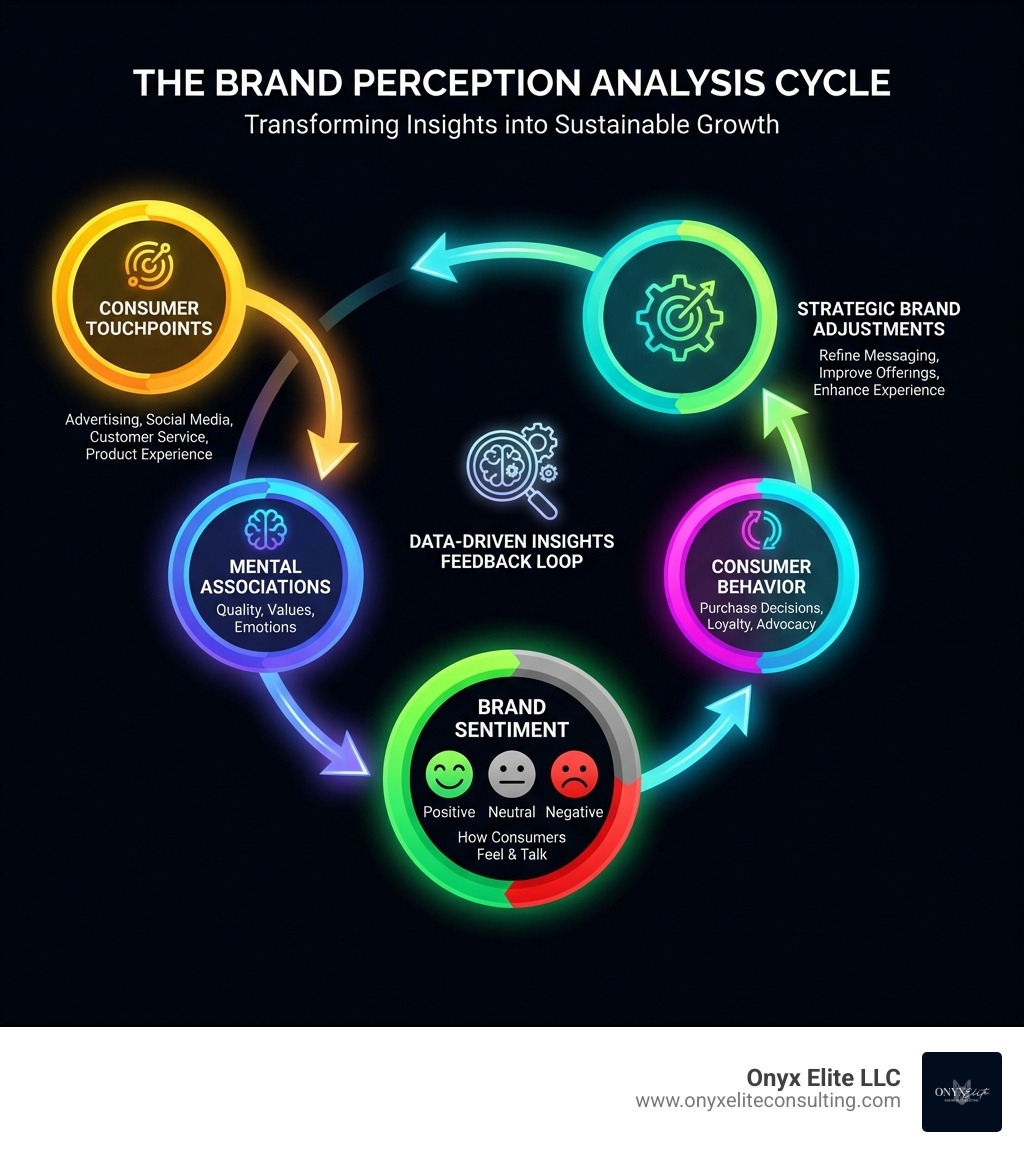
Defining Brand Perception and Its Impact on Business Growth
At its core, brand perception is the sum of feelings, experiences, and thoughts that consumers (and non-consumers alike) hold about your brand. It's not your mission statement or logo in isolation - it's what people believe your brand represents and how it makes them feel. As we noted, 62% of customers feel emotionally connected to brands they buy from, highlighting the deeply personal nature of the relationship.
Why does this matter for businesses, including those competing locally in West Hartford, CT and across Connecticut? Because positive brand perception correlates with purchase preference, recommendations, loyalty, and brand equity. Negative perception, on the other hand, makes growth more expensive and retention harder.
Brand perception is shaped by many inputs, including:
- Consumer feelings: Emotions your brand evokes (trust, excitement, comfort)
- Brand reputation: Opinions based on past actions, quality, and responsibility
- Word-of-mouth: What friends, peers, and online communities say
- Customer use and experience: Product usability, service quality, and support interactions
- Functionality and quality: Performance, reliability, and value delivered
- Advertising and marketing: The stories, claims, and visuals you put into the market
- Social engagement: How you interact with your audience in public channels
Each touchpoint contributes to a living, evolving perception. In an environment where people encounter thousands of brand messages a day, clarity and consistency matter. For a helpful overview of related concepts, see this Marketing Terms Cheat Sheet.
How Brand Perception Analysis Differs from Brand Equity
While closely related, brand perception analysis and brand equity are distinct. Think of brand perception as the inputs - the beliefs and associations in a customer's mind. Brand equity is the business value that accumulates from those perceptions over time.
Brand equity is often described as the "value premium" a brand earns compared to a generic alternative. It shows up as pricing power, preference, loyalty, and resilience against competitors. Common mindset-driven equity indicators include:
- Brand awareness: Recognition, recall, and salience
- Brand relevance: Fit with customer needs and category expectations
- Brand power: Overall strength of preference after repeated interactions
In other words, perception is what people think and feel; equity is the advantage you earn from it. Without measuring perception, building equity becomes guesswork. To explore how authority compounds these advantages, see More info about brand authority.
The Role of Consumer Experience in Shaping Identity
Consumer experience is where brand perception is confirmed or broken. Every step of the customer journey - findy, purchase, onboarding, product use, support, and renewal - reinforces what people believe about you. This is why 88% of executives agree customer engagement significantly impacts a business' bottom line.
The adage "your brand is not what you say it is, it's what they say it is" is practical guidance: if you promise innovation but deliver friction, the market will define you by the friction. Consistent experiences across touchpoints (digital, in-person, service, product, and community) create stronger mental availability and more durable associations. Over time, those experiences - not slogans - become the brand.
How to Effectively Measure Your Current Brand Perception
Measuring your current brand perception is a requirement for strategic growth. You can't improve what you don't measure - and for businesses in Connecticut, a clearer perception baseline can become a real competitive advantage.

At Onyx Elite Consulting, we recommend a blended approach that combines qualitative depth with quantitative tracking. Core methods include:
- Direct customer conversations: Structured interviews that explore expectations, hesitations, and language customers use.
- Brand perception surveys: Quantify cognitive (what comes to mind), emotional (how they feel), language (how they describe you), and experience factors. Use these Brand perception survey examples as a starting point.
- Online reviews and ratings: Monitor recurring themes in Google reviews and industry sites.
- Social media monitoring (social listening): Track brand mentions, comments, hashtags, forums, and news coverage.
- Website analytics: Review behavior signals like bounce rate, time on page, and conversion paths.
- NPS and CSAT: Track loyalty intent (NPS) and satisfaction (CSAT) as high-level sentiment indicators.
- Brand audits: Compare your perception, positioning, and messaging against competitors.
- Employee feedback: Internal perspective matters because employees deliver (or break) the promised experience.
Here's a comparison of qualitative vs. quantitative methods used in brand perception analysis:
| Method Type | Focus | Examples | Advantages | Disadvantages |
|---|---|---|---|---|
| Qualitative | Understanding why | Interviews, focus groups, open-ended questions, social comments | Rich insight; reveals motivations; flexible | Harder to generalize; time-consuming |
| Quantitative | Measuring what and how much | Surveys (NPS, CSAT, scales), analytics, sentiment scores | Comparable over time; easier trend tracking | Less context on why; depends on question quality |
Used together, these sources reveal not just what people think, but what to fix first.
Leveraging Brand Sentiment Analysis for Deeper Insights
Brand sentiment analysis focuses on the emotional tone behind mentions of your brand. It's not just what people say, but how they feel when they say it. Strong tools using Natural Language Understanding (NLU) can also isolate sentiment by topic (for example, positive on product quality but negative on price).
Positive sentiment often correlates with loyalty and advocacy, while a rise in negative sentiment can signal churn risk, product issues, or service breakdowns. The adoption of sentiment analysis has increased rapidly: in 2020, 54% of brands stated they had started using consumer sentiment analysis tools on reviews and social media.
For a more accurate picture, pull data from multiple channels: surveys, social posts, online reviews, forums, blogs, email, chat, and call transcripts. Social media alone rarely reflects the full customer base.
Quantitative Methods for Brand Perception Analysis
Beyond general sentiment, structured quantitative measures help you track perception consistently. Research such as the BRAND 2020 study highlights three useful components:
- Familiarity: How well-known and recognized your brand is
- Liking (attitude): Overall positive or negative evaluation of your brand
- Memorability (recognition memory): How easily people recognize your brand or logo
The study found that brand familiarity is a much stronger predictor of brand memory than brand liking. Consistent exposure (familiarity) is a primary driver of memorability and is also linked to brand value rankings. For the underlying research, see the Scientific research on brand familiarity and memory.
Key Steps to Improve and Shape Consumer Sentiment
Once you've analyzed your brand perception data, the next step is to act. Improving perception is not a one-time fix; it's an ongoing discipline that connects brand strategy, customer experience, and execution.
Here are the steps we typically recommend at Onyx Elite Consulting:
- Define or refine your brand: Clarify your values, positioning, and differentiation. If perception is misaligned, a refresh may be necessary.
- Focus on the customer: Make decisions with the customer journey in mind, not internal preferences.
- Commit to consistency: Align tone, visuals, messaging, and experience across channels. Even basics like a logo should support recognition; if helpful, explore tools to design your own logo.
- Tell an authentic brand story: Build a narrative that matches reality. Authenticity is what makes the story durable.
- Build relationships: Engage in real conversation, respond quickly, and create community where it makes sense.
- Lead with transparency: Let your actions confirm your claims.
- Involve leadership and employees: Perception shifts require internal alignment and consistent delivery.
- Adapt to future opportunities: Use perception data to spot emerging needs and adjust before competitors do.
For more guidance on earning attention in crowded markets, see Visibility is Your Growth Engine.
Building Stronger Relationships Through Feedback
A direct way to improve brand perception is to listen and act on customer feedback. This is also a major opportunity: 63% of consumers think that brands need to do a better job of listening to feedback.
Building stronger relationships involves:
- Active listening: Go beyond collecting comments; look for patterns and root causes.
- Two-way communication: Acknowledge feedback and share what will change.
- Personalization: Tailor experiences when appropriate based on preferences and history.
- Closing the loop: Follow up on issues to confirm resolution. Visible responsiveness can reduce reputational damage and build trust.
Case Studies: Successful Shifts in Brand Perception
Perception can change when strategy and execution stay aligned:
- Volvo: Shifted from "dull but safe" to "premium and safe" through design, technology, and updated messaging.
- Burberry: Rebuilt luxury perception through creative direction, tighter distribution, and digital marketing.
- McDonald's: Addressed health-related concerns with menu additions and greater transparency.
- Zoom: Moved from early-pandemic simplicity to broader connection messaging as "Zoom fatigue" became widely discussed, including coverage like the APA on digital fatigue, alongside positioning updates described in this Brand perception shift in digital communication platforms.
- Patagonia: Reinforced core values (durability and environmental activism) to counter the "Patagucci" fashion-only narrative.
The pattern is consistent: lasting perception shifts come from clear positioning plus consistent delivery across touchpoints.
Turning Data into Actionable Business Improvements
Collecting brand perception analysis data is only half the work. The value comes from turning it into decisions that improve performance. For businesses in the West Hartford, CT area and across Connecticut, these insights can help prioritize what to change first and what to protect.
At Onyx Elite Consulting, we guide clients through a practical interpretation process:
- Assess brand promise alignment: Does customer experience match what you claim? Identify gaps between promise and reality.
- Competitive benchmarking: Compare your perception to competitors to find differentiation and vulnerability.
- Evaluate brand image trends: Track recurring associations (positive and negative) over time to see what's sticking.
- Segment perception by audience: Different customer groups can perceive you differently; segmenting enables more targeted strategy.
- Spot trends and unserved needs: Social listening can reveal emerging expectations and language customers are adopting.
- Mitigate reputational risks: Detect negative patterns early and resolve the operational source, not just the message.
These insights inform marketing, product decisions, service design, and leadership priorities. Our Brand Development Consulting services are designed to help companies operationalize this work.
Refining Marketing and Product Strategy
The outputs of brand perception analysis should directly influence what you say (marketing) and what you deliver (product and service).
For marketing strategy:
- Targeted messaging: Adapt messaging by segment when perception differs across audiences.
- Channel optimization: Invest where your audience actually discusses and finds brands.
- Creative storytelling: Build campaigns around the emotional associations that already resonate.
- Competitive positioning: Emphasize differentiators the market can understand and remember.
For product strategy:
- Feature prioritization: Use recurring sentiment themes to decide what to improve next.
- Align experience with brand values: If you promise simplicity, remove friction that contradicts it.
- Innovation and diversification: Identify unmet needs and develop offers that fit your positioning.
To go deeper on extracting insight from public conversations, explore our social listening guide.
Frequently Asked Questions about Brand Perception Analysis
What is the most important KPI for brand perception?
While there isn't a single "most important" KPI, a combination often provides the best overview. However, if we had to choose one, Brand Familiarity consistently emerges as a critical indicator. Research shows that brand familiarity is a significant predictor of brand memory and is the strongest predictor of a brand's rank in external brand value lists. It's the foundation upon which positive attitudes and memorability are built. Other crucial KPIs include Net Promoter Score (NPS), Customer Satisfaction (CSAT), and overall Sentiment Score (positive vs. negative mentions).
How often should a company conduct a brand audit?
We recommend conducting comprehensive brand perception surveys or audits at least quarterly, or in conjunction with major advertising campaigns or product launches. This allows you to track shifts in perception over time, measure the impact of your initiatives, and quickly identify any emerging issues. Regular social listening and monitoring of online reviews should be an ongoing, daily activity to capture real-time sentiment.
Can small businesses perform brand perception analysis effectively?
Absolutely! While large corporations may have dedicated teams and sophisticated tools, the principles of brand perception analysis are scalable for businesses of all sizes, including those in West Hartford, CT. Small businesses can effectively:
- Talk to customers directly: Personal conversations are powerful.
- Use free or affordable survey tools: Platforms like Google Forms or SurveyMonkey make it easy to create and distribute surveys.
- Monitor social media manually or with basic tools: Set up Google Alerts for your brand name and actively check relevant hashtags and local forums.
- Focus on local reviews: Prioritize platforms like Google My Business and Yelp.
The key is to start somewhere, consistently gather feedback, and act on the insights, no matter how small the scale.
Conclusion
In today's dynamic marketplace, understanding your brand perception is not just an advantage—it's a necessity. Your brand is a living entity, shaped by every interaction and conversation, and its health directly impacts your bottom line. By systematically analyzing how your audience thinks, feels, and talks about your brand, you gain the clarity needed to make informed strategic decisions.
At Onyx Elite LLC, we specialize in guiding businesses like yours through comprehensive brand perception analysis. Our expertise in strategic planning and brand development helps uncover critical insights, identify misalignments, and craft actionable strategies that drive sustainable growth and operational excellence. We believe that by truly understanding your audience, you can build a brand that not only resonates but also thrives.
Ready to transform your brand perception into a powerful engine for growth? Explore our full suite of custom services and find how we can help you achieve unparalleled success. Visit our Services Overview to learn more.