Process Perfected: Your Ultimate Guide to Business Improvement Methods
Why Business Process Improvement Methods Matter for Sustainable Growth

Business process improvement methods are structured frameworks organizations use to identify inefficiencies, eliminate waste, and improve operational performance. These approaches help companies streamline workflows, reduce costs, and deliver better value to customers.
Most Common Business Process Improvement Methods:
- Lean Manufacturing - Focuses on eliminating waste and maximizing customer value
- Six Sigma - Uses data-driven analysis to reduce defects and variation
- Kaizen - Emphasizes continuous, incremental improvements involving all employees
- Total Quality Management (TQM) - Organization-wide approach centered on customer satisfaction
- PDCA Cycle - Iterative problem-solving through Plan-Do-Check-Act stages
- Business Process Management (BPM) - Systematic approach to analyzing, improving, and monitoring processes
- Business Process Reengineering (BPR) - Radical redesign of core processes for dramatic improvements
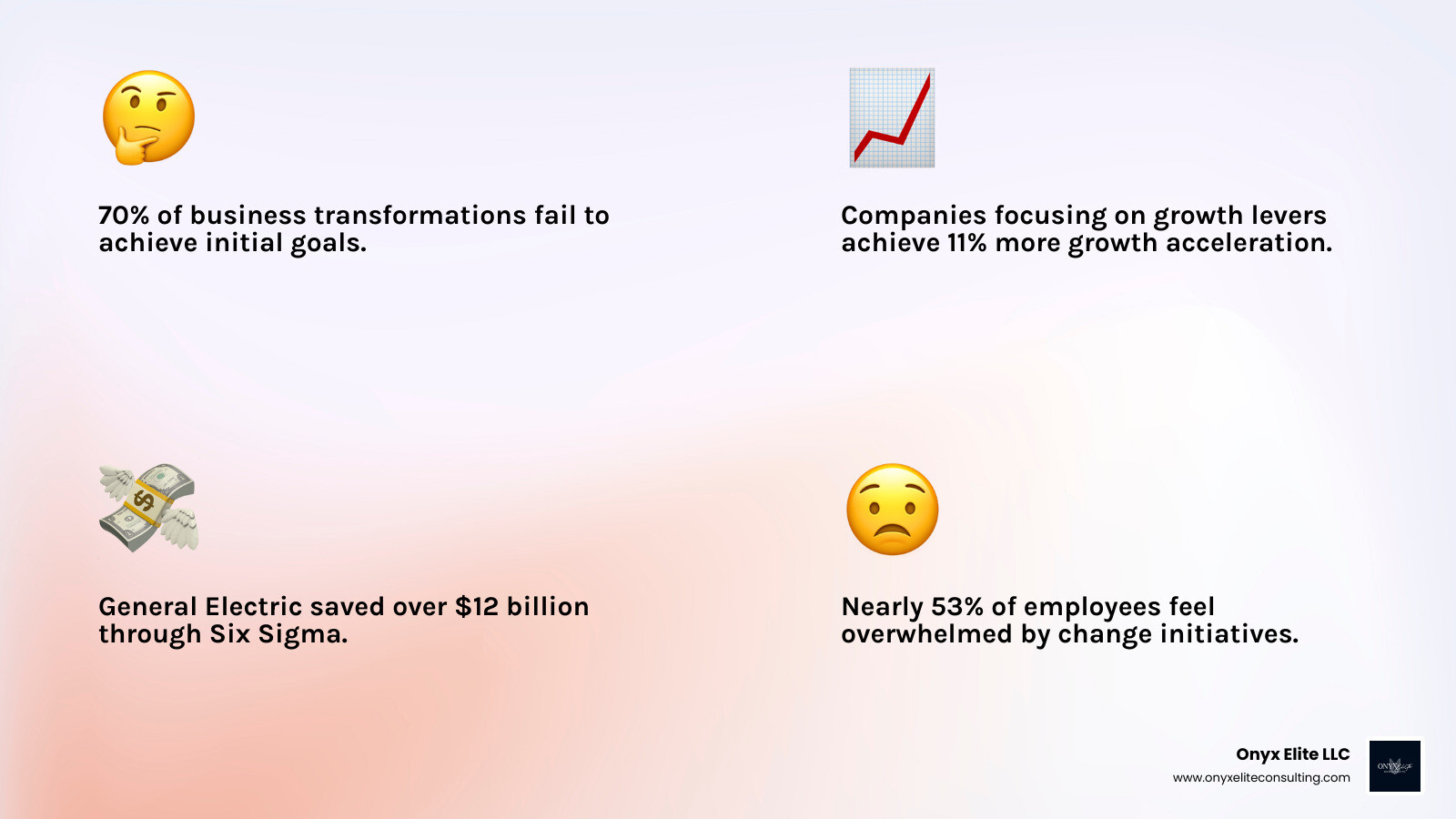
Despite successive technological revolutions, 70% of business changes fail to achieve their initial goals. The difference between success and failure often comes down to choosing and implementing the right improvement methodology for your specific situation.
Process improvement isn't just about cutting costs. Research shows that companies focusing on revenue growth levers during changes generate 11 percentage points more growth acceleration than those taking a traditional cost-reduction approach. General Electric reported savings of over $12 billion through Six Sigma implementation, while Ford reduced their accounts payable cycle time from 16 days to just four hours using Business Process Reengineering.
Yet many organizations struggle to translate these methodologies into lasting change. Nearly 53% of employees feel overwhelmed by change, highlighting the need for approaches that prioritize both process optimization and the human side of change.
As Founder & CEO of Onyx Elite LLC, I've spent over a decade helping organizations implement business process improvement methods that drive sustainable growth and operational excellence. Through working with clients managing portfolios exceeding $12.5 billion, I've seen how the right methodology—properly executed—transforms struggling operations into competitive advantages.
A Deep Dive into Common Business Process Improvement Methods
This section will explore the most effective frameworks organizations use to refine their operations.
Lean Principles: Eliminating Waste for Maximum Value
The Lean methodology, originating from the Toyota Production System, is all about maximizing customer value while minimizing waste. Think of it as decluttering your business: identify what adds value and eliminate everything else. Its core ideas apply to any organization, including service-based businesses in Connecticut.
The core principles of Lean are:
- Identify Value: Determine what the customer truly values and is willing to pay for.
- Value Stream Mapping: Document all steps from product inception to delivery, identifying value-added and non-value-added activities. This allows us to visualize the entire process from start to finish.
- Create Flow: Ensure a smooth, uninterrupted flow of work, eliminating bottlenecks and delays.
- Establish Pull: Only produce what is needed, when it is needed, driven by customer demand rather than forecasts. This helps reduce excess inventory.
- Continuous Improvement (Perfection): Strive for ongoing improvement, always looking for ways to improve value and eliminate waste.
Lean identifies eight types of waste (often called "Muda"): transportation, inventory, motion, waiting, overproduction, overprocessing, defects, and skills (underutilization of talent). By focusing on these, we can significantly cut costs and boost productivity.
Key tools we use in Lean include:
- Value Stream Maps: These are incredibly helpful Lean tools for visualizing the entire process, highlighting areas of waste.
- Kanban Boards: A visual workflow diagram to track progress, identify problems, eliminate bottlenecks, and improve efficiencies, often used in conjunction with Lean principles.
- 5S: A systematic approach to workplace organization and standardization – Sort, Set in Order, Shine, Standardize, Sustain. It's about creating clean, efficient, and safe work environments.
Real-world example: The Toyota Production System is a historical nod to how Lean manufacturing revolutionized the automotive industry, streamlining operations and fostering a productive culture. We've seen similar principles applied in service industries in West Hartford, where optimizing client onboarding or project delivery workflows can dramatically improve efficiency.

Data-Driven Process Improvement: Achieving Consistency and Quality
When it comes to achieving near-perfect processes and reducing defects, Six Sigma is our go-to methodology. Developed at Motorola and famously adopted by General Electric, Six Sigma is a data-driven approach that aims for extreme precision. Its goal is to minimize variation and eliminate defects in processes, striving for less than 3.4 defective features in every million opportunities.
Six Sigma employs two main process improvement cycles:
- DMAIC (Define, Measure, Analyze, Improve, Control): This structured approach is used for optimizing existing processes.
- Define: Clearly state the problem, project goals, and customer requirements.
- Measure: Collect data to establish current process performance and identify key metrics.
- Analyze: Examine data to identify root causes of defects or inefficiencies. Tools like the Ishikawa diagram (also known as a fishbone diagram) are invaluable here to visualize potential causes.
- Improve: Develop and implement solutions to address root causes, testing changes and optimizing processes.
- Control: Implement measures to sustain the improvements and prevent the process from reverting to its old ways, continuously monitoring performance.
- DMADV (Define, Measure, Analyze, Design, Verify): This cycle is used for creating new processes or products when existing ones don't meet customer needs. It focuses on designing quality from the ground up.
Key tools we use in Six Sigma include:
- Statistical Analysis: Heavy reliance on data and statistical methods to identify patterns, measure performance, and predict outcomes.
- Control Charts: Visual tools to monitor process behavior over time and determine if a process is in statistical control.
- Root Cause Analysis Diagrams: Beyond Ishikawa diagrams, we often use SIPOC analysis diagrams (Suppliers, Inputs, Process, Outputs, Customers) to define a process at a high level, and the 5 Whys analysis to dig deep into the underlying causes of problems.
Real-world example: General Electric's implementation of Six Sigma in the late 1990s led to reported savings of over $12 billion by 2005. This demonstrates how a data-driven approach can significantly improve service quality and financial returns across diverse operations.
Continuous Improvement Culture: The Philosophy of Ongoing Progress
Kaizen, a Japanese philosophy meaning "change for the better" or "continuous improvement," is about fostering a culture where everyone, from the CEO to the front-line employee, is actively engaged in making small, incremental improvements every day. It's not about radical overhauls, but rather a steady, consistent march towards perfection. This philosophy works hand-in-hand with Lean principles, actively seeking to eliminate waste.
Kaizen encourages us to identify and eliminate three types of waste, often referred to as "3M":
- Muda (Wastefulness): Activities that consume resources but create no value for the customer.
- Mura (Unevenness): Irregularities or fluctuations in workflow that lead to inefficiencies.
- Muri (Overburden): Overloading people or equipment, leading to stress, breakdowns, and defects.
By focusing on these, we empower our teams to find smarter, more efficient ways to work.
Key tools we leverage in a Kaizen approach include:
- Gemba Walks: Management physically goes to the "actual place" where work is done to observe processes, engage with employees, and identify improvement opportunities firsthand.
- A3 Reports: A one-page report that easily identifies and communicates crucial process information, helping workers solve problems quickly and guiding continuous improvements.
- PDCA Cycle: The Plan-Do-Check-Act cycle is an interactive form of problem-solving, which we'll discuss more below. It's a fundamental tool for testing ideas and implementing changes in a structured, iterative way.
Real-world example: Toyota is a well-known example of the Kaizen methodology in action. In the mid-1990s, the company implemented Kaizen in its production facilities to streamline operations and foster a more productive culture. This focus on small, positive improvements led to significant gains in efficiency and quality. We believe this philosophy is key to building adaptable and resilient businesses in Connecticut.
Total Quality Management (TQM): A Customer-Focused, Organization-Wide Effort
Total Quality Management (TQM) is a comprehensive, organization-wide approach that places customer satisfaction at its core. This managerial strategy aims for customer satisfaction through an integrated system of tools, techniques, and training, involving everyone in continuous improvement. TQM gained significant attention in the late 1980s and early 1990s, emphasizing quality in every aspect of the company.
The key principles of TQM include:
- Customer Focus: The customer defines quality, and all efforts are directed towards meeting and exceeding their expectations.
- Total Employee Involvement: Every employee, from every department, is empowered and responsible for quality improvement. This involves training, empowerment, and fostering a culture where everyone contributes.
- Process-Centered Thinking: Focus on improving processes rather than just inspecting outcomes. Quality is built into the process.
- Strategic and Systematic Approach: Quality management is an integral part of the organization's strategic plan and is implemented through a systematic approach.
- Data-Driven Decisions: Decisions are based on facts and data, not assumptions or hunches. Performance is measured and analyzed to drive improvements.
Key tools and techniques we often use in TQM initiatives include:
- Quality Circles: Groups of employees who meet regularly to identify, analyze, and solve work-related problems.
- Benchmarking: Comparing our processes and performance to industry best practices to identify areas for improvement.
- Ishikawa Diagrams: As mentioned with Six Sigma, these help us brainstorm and visualize potential causes of quality issues.
- Flowcharts and Check Sheets: Simple visual tools for mapping processes and collecting data on defects or issues.
- PDCA Cycles: Used for continual process improvement, as they facilitate testing and implementation of changes.
Real-world example: Ford Motor Company deployed TQM after setting up a joint venture with paint supplier ChemFil in the 1990s. Both organizations used a TQM approach to refine painting processes, avoiding previous friction points and creating a decisive lift in product quality. This shows how TQM can drive significant organizational change and improve collaboration across business units.
Other Notable Methodologies
While Lean, Six Sigma, Kaizen, and TQM are titans in business process improvement methods, several other powerful methodologies offer unique perspectives and tools for optimizing operations.
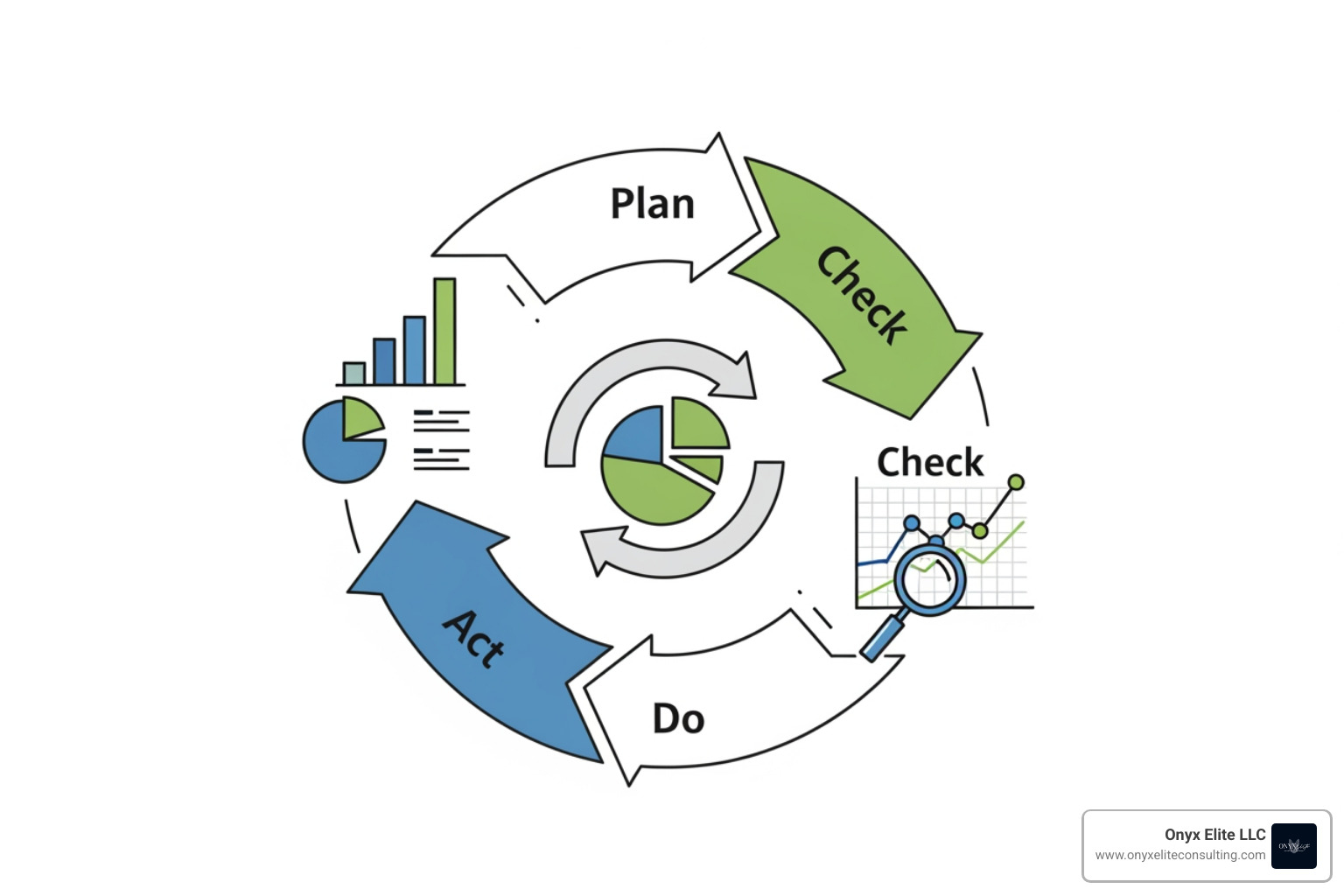
PDCA Cycle (Plan-Do-Check-Act): Also known as the Deming Cycle, this is an iterative four-step method for the control and continuous improvement of processes and products. It’s simple, yet profoundly effective for testing changes on a small scale before wider implementation.
- Plan: Identify an opportunity for change or improvement, define the problem, and develop a plan to address it.
- Do: Implement the change on a small scale, often as a pilot project, and collect data.
- Check: Analyze the results from the "Do" phase, compare them against expectations, and evaluate the effectiveness of the change.
- Act: If the change was successful, implement it on a larger scale and standardize the process. If not, refine the plan and repeat the cycle. Real-world example: NASA’s Space Shuttle Program applied PDCA to investigate the root cause of malfunctions, create and test solutions, and update protocols, showcasing its utility in high-stakes environments.
5 Whys Analysis: This is a straightforward, yet powerful, root cause analysis technique. It involves repeatedly asking "Why?" (typically five times) to peel back layers of symptoms until the underlying cause of a problem is uncovered. It's a great way to identify issues within a process, rather than mistakenly blaming human error.
Business Process Reengineering (BPR): This is a strategic approach that focuses on the radical redesign of core business processes. Unlike incremental improvements, BPR aims for dramatic improvements in areas like customer service, operational costs, and competitiveness by fundamentally rethinking how work is done. It often involves cross-functional integration and leveraging information technology. Real-world example: Ford Motor Company’s implementation of BPR in the 1990s led to significant improvements in their accounts payable process, reducing the cycle time from 16 days to just four hours. This was achieved by eliminating non-value-added steps and leveraging technology.
Theory of Constraints (TOC): TOC focuses on identifying and managing the limiting factor (the "constraint" or bottleneck) in a system that prevents it from achieving more of its goal. The five-step process is:
- Identify: Pinpoint the constraint.
- Exploit: Maximize the output of the constraint using existing resources.
- Subordinate: Align all other activities to support the constraint.
- Lift: If the constraint still exists, invest in breaking it (e.g., new equipment, more staff).
- Repeat: Once a constraint is broken, a new one will emerge, so the cycle continues. We often use Reality Tree Diagrams to analyze and identify these problems.
Business Process Management (BPM): BPM is a discipline that systematically manages, monitors, and improves business processes from end-to-end. It's a continuous practice aimed at optimizing all existing processes across the organization, ensuring greater transparency and adaptability. The lifecycle typically involves: Analyze, Model, Implement, Monitor, and Optimize.
Agile Methodology: While often associated with software development, Agile is a flexible, iterative approach to project management that can be applied to process improvement. It emphasizes adaptive planning, evolutionary development, early delivery, and flexible responses to change. Frameworks like Scrum and Kanban (which we discussed under Lean) are common Agile implementations.
Design Thinking: This is an innovation strategy centered around the human experience. It uses a five-stage process – Empathize, Define, Ideate, Prototype, Test – to tackle complex challenges and find appealing solutions by focusing on user needs and iterative problem-solving.
Here's a quick comparison of some of these methodologies:
| Methodology | Key Focus | Primary Goal | Iterative? | Radical? |
|---|---|---|---|---|
| PDCA Cycle | Iterative problem-solving, continuous learning | Small, incremental improvements | Yes | No |
| 5 Whys Analysis | Root cause identification | Uncover fundamental cause of a problem | N/A | No |
| BPM | End-to-end process management & optimization | Continuous efficiency, adaptability, transparency | Yes | No |
| BPR | Fundamental rethinking & redesign of processes | Dramatic performance improvements | No | Yes |
| TOC | Identifying and managing bottlenecks | Maximize system throughput by addressing constraints | Yes | No |
| Agile | Flexible, adaptive project management | Rapid delivery, responsiveness to change | Yes | No |
Implementing and Sustaining Your Process Improvement Initiative
A great methodology is only effective if implemented correctly and sustained over time. We often see businesses in Connecticut grasp the concepts but falter in execution. That's where a structured approach and a focus on change management come in.
A Step-by-Step Guide to Implementation
Implementing a process improvement initiative isn't a one-time event; it's a journey. Here's how we guide organizations through it:
Step 1: Identify & Map Processes Before we can improve something, we need to understand it. This involves identifying the specific process that needs attention, whether it's customer onboarding, product delivery, or internal administrative tasks. Then, we carefully map out the existing process, visualizing every step, role, and decision point. Tools like business process mapping are crucial here. This helps us see the "as-is" state, identify bottlenecks, redundancies, and areas of waste.
Step 2: Analyze & Set Goals Once mapped, we analyze the process data to pinpoint inefficiencies and their root causes. We then set clear, specific, measurable, achievable, relevant, and time-bound (SMART) goals for improvement. For example, instead of "improve customer service," we might aim to "reduce average customer support response time by 20% within three months." It's essential to ensure these goals are achievable with available resources and align with overall business priorities.
Step 3: Design & Develop Solutions With goals in hand, we brainstorm and design actionable improvement initiatives. This might involve running small experiments, changing existing process steps, or implementing new tools. We focus on high-impact initiatives, assigning clear ownership and ensuring necessary resources are available. The chosen business process improvement methods will heavily influence the types of solutions developed here.
Step 4: Implement & Monitor This is where the rubber meets the road. We implement the chosen solutions, often starting with pilot projects to test their effectiveness on a smaller scale. Crucially, we continuously monitor progress against our SMART goals using Key Performance Indicators (KPIs). If something isn't working as expected, we adjust our approach iteratively. This phase is about execution and learning.
Step 5: Control & Standardize (SOPs) Once improvements are successful, the final step is to embed them into the organization's DNA. This means standardizing the new processes by creating clear, concise Standard Operating Procedures (SOPs) and ensuring teams have easy access to them. This prevents backsliding into old habits and ensures consistency. We also continuously review and audit these processes, starting the improvement cycle over again to find new opportunities. This iterative approach is vital for scalable growth for service-based businesses.
The Critical Role of Change Management and Technology
Even the most brilliant process improvement plan can falter without effective change management. As we mentioned, 53% of employees feel overwhelmed by change, and nearly a fifth are discouraged by a lack of role clarity or disconnect with their company's mission. This isn't surprising – people are creatures of habit!
Here's why change management is critical:
- Overcoming Resistance to Change: Humans naturally resist change. Clear communication about why the change is happening, what the benefits are, and how it will impact them is essential. We need to address concerns and involve employees early in the process.
- Employee Engagement: When employees feel heard and involved, they become advocates for the change. Optimizing processes can erase disconnect, reduce frustration, and boost morale, directly addressing the statistic about discouraged workers.
- Leadership Buy-in: Strong leadership support is non-negotiable. Leaders must not only champion the change but also model the new behaviors. Their commitment ensures the initiative receives the necessary resources and organizational backing. This is a topic we dig into often, as effective leadership is the new currency for successful changes.
Technology as an Enabler: Technology isn't just a tool; it's a powerful accelerator for our process improvement journey.
- Business Process Management (BPM) Software: These platforms help us design, model, automate, execute, monitor, and optimize processes. They provide a centralized system for managing workflows and ensuring compliance.
- Automation Tools: Robotic Process Automation (RPA) and workflow management software can automate repetitive, rule-based tasks, freeing up employees for more strategic work. This reduces human error and speeds up processes.
- Real-time Dashboards: Features enabling easy integration and tracking of Key Performance Indicators (KPIs) provide real-time visualization of trends. This allows for better adjustment of objectives and greater responsiveness to improvement needs.
- Process Intelligence Tools: Advanced tools like process mining and task mining analyze event logs from IT systems to automatically find, monitor, and improve real processes. They provide deep insights into how processes are actually performing, revealing hidden bottlenecks.
Combining technology, proven business process improvement methods, and human involvement is key to long-term success.
Measuring Success and Ensuring Longevity
How do we know if our efforts are paying off? Measurement is key. We establish clear Key Performance Indicators (KPIs) that directly link to our improvement goals.
- Cycle Time: The time it takes to complete a process from start to finish. Reducing this often means greater efficiency.
- Defect Rates: For quality-focused initiatives, tracking defects (e.g., Six Sigma's target of fewer than 3.4 defects per million cycles) is crucial.
- Cost Savings: Quantifying the financial impact of improved processes, whether through reduced waste, labor, or rework.
- Customer Satisfaction Scores: Process improvements should lead to happier customers. Metrics like Net Promoter Score (NPS) can track this.
Ensuring longevity means creating a true culture of continuous improvement. This isn't a project with a finish line; it's an ongoing commitment. We help organizations embed improvement initiatives into their daily practice, making it a habit. Regular process audits and reviews ensure that the improvements stick and that we're always looking for the next opportunity to optimize.
Frequently Asked Questions about Business Process Improvement Methods
How do I choose the right process improvement methodology?
Choosing the right business process improvement method is like picking the right tool for a specific job – there’s no one-size-fits-all answer! It depends on several factors:
- Assess Organizational Goals: Are you aiming for radical change (BPR), incremental gains (Kaizen, PDCA), defect reduction (Six Sigma), or waste elimination (Lean)?
- Consider Company Culture: Is your organization ready for a data-intensive approach like Six Sigma, or would a more collaborative, iterative method like Kaizen or Agile be a better fit initially?
- Analyze Process Complexity: Simple, linear processes might benefit from PDCA, while complex, cross-functional processes could require BPM or Six Sigma.
- Scope of Improvement: Are you tackling a specific problem or aiming for organization-wide excellence?
- Resources Available: Some methodologies require significant training, data analysis capabilities, or dedicated personnel.
We recommend evaluating your specific needs and objectives. Sometimes, combining methodologies (a hybrid approach) can be the most effective strategy.
What are the most common challenges during implementation?
Even with the best intentions, implementing business process improvement methods can hit snags. The most common challenges we encounter include:
- Resistance to Change: As we've discussed, employees can feel overwhelmed or threatened by new processes.
- Lack of Leadership Support: Without clear, consistent backing from the top, initiatives can lose momentum.
- Inadequate Resources/Training: Insufficient time, budget, or training can derail even well-planned efforts.
- Poor Communication: A lack of transparency about the "why" and "how" of changes can breed mistrust and disengagement.
- Failure to Sustain Improvements: Without proper controls and a culture of continuous monitoring, old habits can creep back in.
Overcoming these challenges requires proactive change management, clear communication, robust training, and consistent leadership commitment. It's about empowering people and providing the support they need to adapt and thrive in the new environment.
Can different business process improvement methods be combined?
Absolutely! In fact, combining methodologies, often called a "hybrid approach," is common and highly effective. For example, Lean Six Sigma is a widely recognized combination that merges Lean's focus on waste elimination with Six Sigma's emphasis on defect reduction and statistical analysis.
We often find ourselves drawing tools and principles from various business process improvement methods to create a customized approach custom to a client's unique situation. You might use:
- Lean tools (like value stream mapping) to identify waste, then apply a Six Sigma DMAIC cycle to address a specific quality problem.
- Kaizen events to engage employees in small, continuous improvements, while using BPM software to manage and monitor the broader process.
- PDCA cycles to test small changes identified through 5 Whys analysis.
The key is to understand the strengths of each methodology and strategically combine them to best achieve your specific goals. It's about building a robust toolkit, not just relying on a single hammer for every problem.
Propel Your Business Forward with Process Excellence
We've explored a wide array of business process improvement methods, from the waste-slashing principles of Lean to the data-driven precision of Six Sigma, the continuous evolution of Kaizen, and the holistic quality focus of TQM. We've also touched on the iterative nature of PDCA, the radical potential of BPR, and the systemic management of BPM.
The journey to operational excellence is continuous, requiring dedication, adaptability, and the right tools. It's about creating a culture where improvement is not just an initiative, but an ingrained way of working. By embracing these methodologies, effectively managing change, and leveraging technology, organizations in Connecticut and beyond can not only overcome current challenges but also position themselves for sustainable growth and a competitive advantage in an changing market.
At Onyx Elite LLC, we specialize in helping businesses steer this complex landscape. Our award-winning consulting firm helps companies achieve sustainable growth and operational excellence through strategic planning, brand development, and a comprehensive suite of custom services that go beyond traditional solutions. We're here to help you perfect your processes.
Explore our full range of services to achieve sustainable growth