

Don't Go It Alone: Finding the Right Business Formation Consultant in Connecticut
Starting a Business in Connecticut? Here's What You Need to Know First

A business formation consultant in Connecticut can be the difference between launching with a solid legal and strategic foundation — and spending months untangling costly mistakes.
Quick Answer: What does a business formation consultant in Connecticut do?
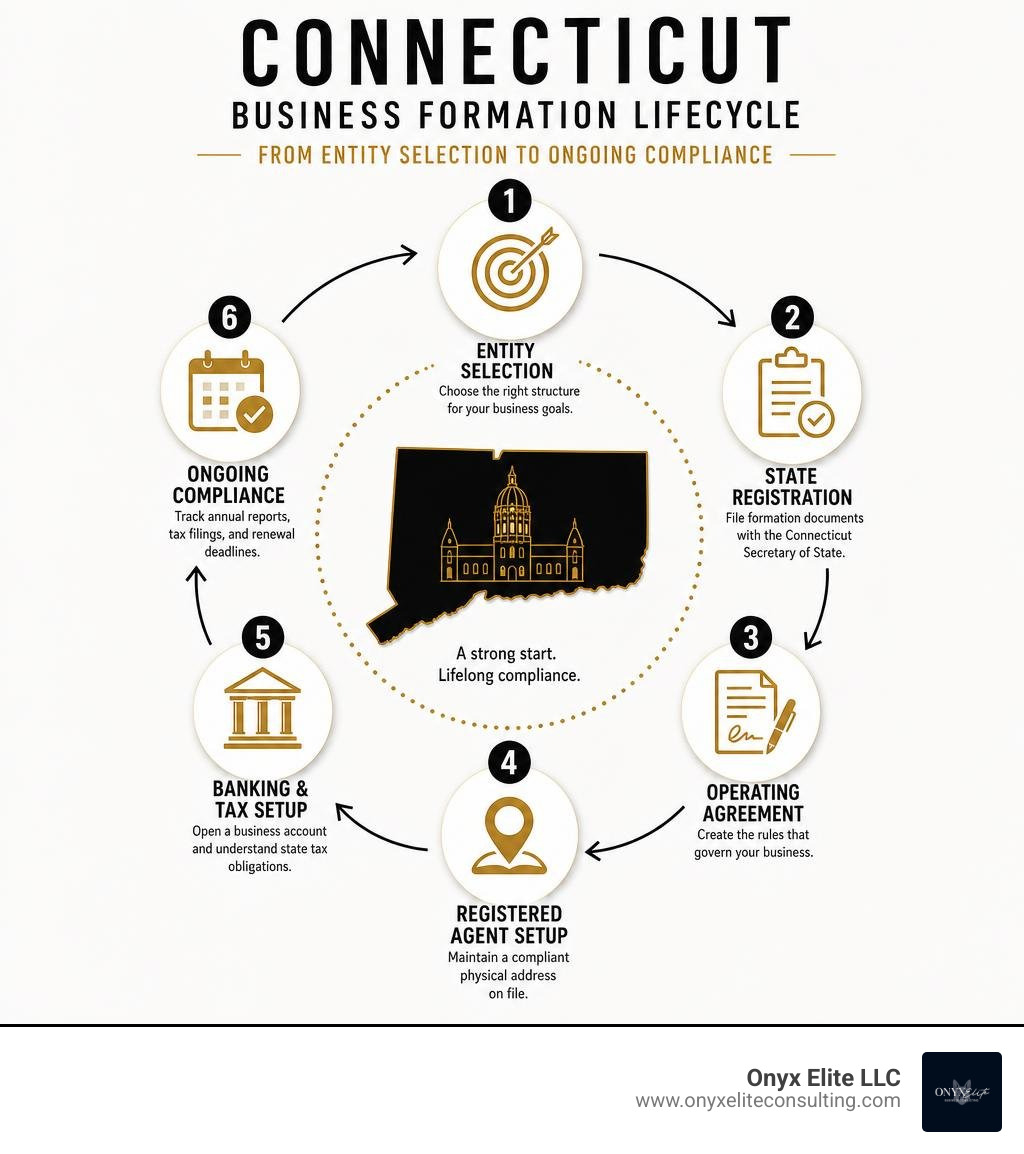
| Service | What It Means for You |
|---|---|
| Entity selection | Helps you choose LLC, S-Corp, or C-Corp based on your goals |
| State registration | Files your formation documents with the Connecticut Secretary of State |
| Operating agreement | Drafts the rules that govern your business |
| Registered agent setup | Ensures you have a compliant physical address on file |
| Ongoing compliance | Tracks annual reports, tax filings, and renewal deadlines |
| Banking and tax setup | Guides you through opening a business account and understanding state tax obligations |
Starting a business is exciting. But in Connecticut, the process comes with real legal requirements, filing deadlines, and compliance obligations that catch many new founders off guard.
The state requires every LLC and corporation to maintain a registered agent, file annual reports in their anniversary month, and meet state income tax obligations. Miss a step, and you risk penalties — or worse, losing your liability protection.
That's exactly the kind of problem a qualified formation consultant helps you avoid before it starts.
I'm Doru Angelo, Founder and CEO of Onyx Elite LLC, and with over a decade of experience in business consulting — including guiding clients through the full spectrum of what a business formation consultant in Connecticut does — I've seen how the right guidance at the start shapes everything that follows. In the sections ahead, I'll walk you through exactly what the formation process looks like, what to watch out for, and how to find the right partner to help you build something that lasts.
Why Hire a Business formation consultant Connecticut Expert?
When you decide to launch a business, it is easy to get swept up in the excitement of choosing logos, building websites, and dreaming of your first sale. However, the regulatory underpinnings of your business are what keep those dreams from turning into a legal nightmare. This is where a professional business advisory service steps in.

Selecting the right legal structure is one of the most critical decisions you will make. It dictates how you are taxed, how much administrative paperwork you must handle, and the extent of your personal liability protection. An expert business formation consultant in Connecticut acts as your strategic guide, helping you shield your personal savings, home, and assets from business-related debts or lawsuits.
For a comprehensive look at how strategic consulting shapes your business journey in the Constitution State, check out our Business Consultant Connecticut Guide.
What Does a Business formation consultant Connecticut Specialist Do?
A business formation consultant does far more than just fill out online forms. They provide a holistic, end-to-end service designed to transition your concept into a legally compliant, operational business. Their core responsibilities include:
- Corporate Structure Alignment: Analyzing your business model, funding requirements, and growth plans to recommend the ideal entity structure (LLC, S-Corporation, C-Corporation, or Partnership).
- Licensing and Permits: Identifying the specific state, municipal, and federal licenses required for your industry.
- State Registration: Preparing and submitting the Certificate of Organization or Articles of Incorporation to the Connecticut Secretary of State.
- Operational Setup: Helping you secure your Employer Identification Number (EIN), establishing corporate record-keeping practices, and setting up initial administrative frameworks.
- Strategic Business Planning: Aligning your legal structure with your long-term business and financial goals.
To explore how these foundational steps fit into a broader operational strategy, browse our comprehensive Consulting Services for Small Business.
The Strategic Value of Professional Guidance vs. DIY Filing
In the age of the internet, it is tempting to use the Connecticut Business One-Stop Portal to file your paperwork yourself. While the portal is a helpful resource, it cannot offer the tailored advice or strategic foresight that a human consultant provides.
DIY filings frequently suffer from common mistakes, such as:
- Filing under the wrong entity type, leading to higher tax bills.
- Using generic, downloaded operating agreements that do not comply with Connecticut-specific statutes.
- Failing to properly structure ownership percentages, which can lead to messy partner disputes down the road.
- Exposing your personal home address on public state registries.
By partnering with a professional, you gain absolute peace of mind, save valuable time that is better spent building your customer base, and ensure your entity is structured correctly from day one.
Key Steps and Legal Requirements for Connecticut Business Formation
Forming a business in Connecticut requires navigating specific administrative and legal channels. To establish a legally recognized entity, you must file formal paperwork with the Connecticut Secretary of State and build a robust corporate governance framework.

Choosing the Right Entity: LLC vs. Corporation
The two most common structures for new businesses are the Limited Liability Company (LLC) and the Corporation.
- Limited Liability Company (LLC): The LLC is highly favored by small business owners and startups due to its management flexibility and pass-through taxation. With pass-through taxation, the business's profits and losses flow directly to the owners' personal tax returns, avoiding the "double taxation" faced by traditional corporations.
- Corporation (C-Corp or S-Corp): A C-Corporation is a completely separate legal entity from its owners. It is ideal for businesses planning to raise venture capital or issue public stock. An S-Corporation is a tax status that qualifying corporations (and LLCs) can elect to avoid double taxation while maintaining a corporate governance structure.
Understanding how your entity type affects your business model is a key aspect of Business Model Innovation Consulting, where we align your structural choices with modern revenue and operational models.
Step-by-Step Connecticut Registration Process
Once you select your entity type, the registration process follows a structured timeline:
- Name Reservation: You must select a unique business name that is not already registered in Connecticut. You can run a search on the Secretary of State's database and reserve your chosen name if you are not ready to file immediately.
- Appoint a Registered Agent: Every Connecticut business must designate a registered agent with a physical address in the state to receive legal mail and service of process.
- File the Certificate of Organization (for LLCs) or Articles of Incorporation (for Corporations): This is the official document filed with the Connecticut Secretary of State.
- Pay State Filing Fees: As of June 2026, the standard state filing fee for a Connecticut LLC is $120.
- Processing Times: Standard online filing processing typically takes 5-7 business days. However, if you are in a rush to open a business bank account or sign a contract, the state offers 24-hour expedited options for an additional fee.
Operating Agreements and Corporate Governance
Many business owners mistakenly believe that if they are the sole owner of an LLC, they do not need an operating agreement. This is a critical error.
Under Connecticut General Statutes Section 34-243e, an operating agreement governs the relations among the members, the manager's duties, and the activities of the company. Even for single-member LLCs, having a formal operating agreement is vital because:
- It reinforces your limited liability status by proving your business is a separate entity from your personal life.
- Traditional banks and lenders often require it to open business accounts or secure loans.
- It outlines what happens in the event of disability, death, or partner exits, preventing state default laws from dictating your company’s future.
For corporations, this governance is established through formal bylaws and corporate resolutions drafted during the initial setup phase.
Navigating Costs, Compliance, and Ongoing Requirements
Forming your business is just the beginning. To keep your liability protection active and avoid state penalties, you must maintain ongoing compliance.
| Compliance Requirement | Limited Liability Company (LLC) | Corporation (C-Corp/S-Corp) |
|---|---|---|
| Filing Document | Annual Report | Annual Report |
| Due Date | Anniversary month of formation | Anniversary month of formation |
| State Filing Fee | $80 annually | $150 annually |
| Registered Agent | Required (Physical CT address) | Required (Physical CT address) |
| Corporate Formalities | High flexibility, no mandatory meetings | Mandatory annual shareholder meetings & minutes |
Understanding Connecticut Business Formation Costs
Budgeting for your business launch involves both state fees and professional consulting fees. While state filing fees are fixed, consultant pricing structures vary:
- Flat-Fee Packages: Many consultants bundle entity registration, EIN acquisition, operating agreement drafting, and registered agent services into a single flat-fee package. This provides cost predictability for startups.
- Hourly Rates: For complex structures involving multiple partners, custom joint ventures, or specialized licensing, consultants may charge an hourly rate.
To understand the financial dynamics of hiring professional guidance in the state, read our detailed guide on the Hourly Rate Business Consultants Connecticut.
Registered Agents and Annual Report Compliance
Every business registered in Connecticut must maintain a registered agent. Using your home address as your registered agent address is generally discouraged because it becomes part of the public record, exposing you to unsolicited junk mail and privacy concerns.
Professional registered agent services typically cost around $99 per year (often included in the first year of a consultant's formation package).
Additionally, Connecticut requires all LLCs and corporations to file an annual report during their anniversary month. Failing to file your annual report can result in the state administratively dissolving your company, which strips away your personal liability protection and leaves your personal assets exposed.
Tax Considerations and Business Banking Setup
Connecticut has its own state income tax structure, and businesses must register with the Connecticut Department of Revenue Services (DRS).
Once your business is formed, your consultant will help you secure an Employer Identification Number (EIN) from the IRS. Armed with your EIN and your approved Certificate of Organization, you can set up your business banking. Modern business banking platforms like Mercury or Relay make it easy to manage business finances digitally, keep business and personal funds completely separate, and streamline your tax preparation.
Transitioning from Formation to Long-Term Growth
A successful business launch is about more than just legal paperwork; it requires a clear path forward for scaling, marketing, and operational execution.
At Onyx Elite LLC, we believe that formation is simply step one. To build a highly profitable enterprise, you must transition your focus toward Corporate Strategy Development to secure market share and scale efficiently.
How to Choose the Best Business formation consultant Connecticut Partner
When looking for a business formation consultant or legal advisor in Connecticut, keep the following criteria in mind:
- Credentials and Experience: Ensure they possess a strong background in business administration, strategy, or corporate law.
- Local Expertise: They should have a deep understanding of Connecticut-specific tax structures and municipal requirements, particularly in business hubs like West Hartford.
- Client Reviews: Look for positive feedback on local directories. You can search resources like THE BEST 10 BUSINESS CONSULTING IN HARTFORD, CT - Yelp or check professional networks like Hire Top Business Consultants in West Hartford, CT LinkedIn to evaluate local reputations.
- Comprehensive Support: Choose a partner who can connect you with broader business development resources, such as the Home | Connecticut Small Business Development Center ..., or coordinate seamlessly with qualified legal specialists to address your specific corporate needs.
Support for International Founders and Non-US Residents
You do not need to be a US citizen or a Connecticut resident to form an LLC in the state. Connecticut is an attractive destination for global founders due to its proximity to major economic centers like New York City and Boston.
A professional consultant can assist international founders with:
- Forming a Connecticut LLC completely remotely.
- Obtaining an EIN without a Social Security Number (SSN).
- Setting up US-based business bank accounts remotely through partner digital banking platforms.
- Ensuring compliance with federal reporting mandates like the Corporate Transparency Act (CTA).
Strategic Planning and Brand Development
To grow your new business, you must move beyond administrative tasks and focus on your market presence. This involves creating a solid business plan, developing a clear brand identity, and establishing client acquisition systems.
Working with an expert to draft your initial business plan ensures you are prepared to pitch to investors or secure commercial loans. For a deep dive into crafting a roadmap for your business, consult our Business Plan Consultant Ultimate Guide 2026.
Frequently Asked Questions about Connecticut Business Formation
How long does it take to form an LLC in Connecticut?
Standard online filings submitted to the Connecticut Secretary of State are typically processed within 5-7 business days. If you need your business formed immediately, you can pay an additional state fee for 24-hour expedited processing.
Do I need an operating agreement if I am a single-member LLC?
Yes. While the state of Connecticut does not require you to file your operating agreement publicly, having one is essential. It legally separates your personal identity from your business entity, protects your limited liability status, and is almost always required by banks to open a business checking account.
What are the ongoing annual compliance requirements in Connecticut?
To keep your business in good standing, you must file an Annual Report with the Secretary of State during your anniversary month. You must also maintain a active registered agent within the state and file all required state and federal tax returns.
Conclusion
Launching a business in Connecticut is an exciting milestone, but navigating the administrative, legal, and operational steps alone can be overwhelming. From choosing the correct entity structure to maintaining annual compliance and setting up proper financial accounts, every decision you make today impacts your company’s growth tomorrow.
At Onyx Elite LLC, we go beyond simple filing services. We are dedicated to helping companies achieve sustainable growth and operational excellence through tailored strategic planning, brand development, and comprehensive business solutions. Based in West Hartford, Connecticut, we provide the local expertise and corporate-level insights you need to transition seamlessly from a brand-new startup to a thriving, scalable enterprise.
Ready to build your business on a rock-solid foundation? Explore our Services Overview or visit our About the Firm page to learn more about how we can support your entrepreneurial journey. Let's build something exceptional together.