
The Art of Business Model Innovation Consulting
Why Business Model Innovation Consulting Is the Growth Lever Most Companies Overlook
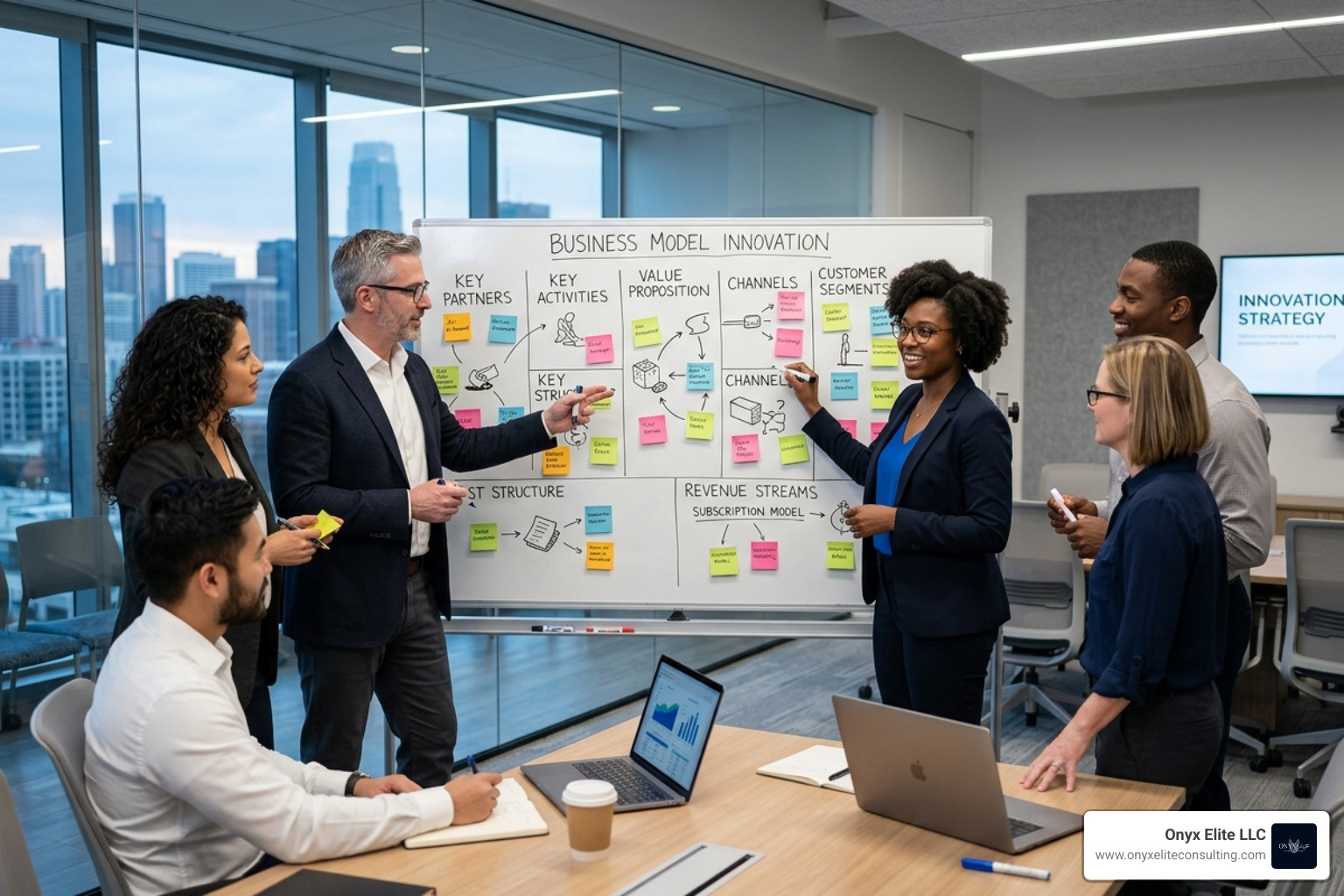
Business model innovation consulting is a strategic service that helps organizations fundamentally rethink how they create, deliver, and capture value — not just improve what they already do.
Here's a quick breakdown of what it involves:
- What it is: Redesigning the core logic of how your business makes money and serves customers
- Who it's for: Founders, executives, and business leaders facing disruption, stagnant growth, or competitive pressure
- What consultants do: Audit your current model, identify new revenue opportunities, prototype alternatives, and guide implementation
- Key benefit: Companies that go through business model redesigns have seen an average 29% uplift in contribution margins
- Why it matters now: The average lifespan of a business model has dropped from roughly 15 years to less than five over the past half century
The pressure to adapt is real. According to PwC's 2024 Annual Global CEO Survey, 45% of CEOs believe their organization won't be viable in ten years if it stays on its current path. Meanwhile, 84% of executives say keeping pace with market demands is a genuine challenge.
Yet most companies default to product tweaks or process improvements. Those moves matter — but they rarely change the competitive equation.
Business model innovation goes deeper. It asks harder questions: Who are we really serving? How do we get paid for the value we create? What would it look like to compete on completely different terms?
That's exactly where consulting expertise makes the difference.
I'm Doru Angelo, Founder & CEO of Onyx Elite LLC, and with over a decade of experience in business consulting across industries, business model innovation consulting is at the heart of the strategic transformation work we lead for our clients. In the sections ahead, I'll walk you through the frameworks, processes, and real-world strategies that separate thriving organizations from those being displaced.
Understanding Business Model Innovation Consulting
At its core, business model innovation consulting is about "value orchestration." While traditional consulting might focus on fixing a specific department, this discipline looks at the entire engine of the enterprise. We aren't just looking at what you sell; we are looking at the "why," the "how," and the "for whom."
A successful redesign focuses on three pillars: value creation (the benefit to the customer), value delivery (the operating model and channels), and value capture (the revenue streams and cost structures). When we partner with businesses in West Hartford and across Connecticut, we often find that companies are excellent at creating value but struggle to capture it effectively.
This is where Business Process Improvement intersects with innovation. By refining how assets are orchestrated—whether that’s your human talent, your data, or your physical infrastructure—we can unlock a 29% average uplift in contribution margins. It’s about moving from a "commodity" mindset to a "competitive advantage" mindset.
Why Companies Need Business Model Innovation Consulting Now
If you feel like the ground is shifting beneath your feet, you aren't imagining it. Market volatility is no longer a seasonal event; it is the baseline. Digital transformation has lowered the barrier to entry for new competitors, meaning a startup in a garage can suddenly threaten a century-old institution.
Furthermore, the average business model lifespan has plummeted. Fifty years ago, you could ride a single successful model for 15 years. Today, you’re lucky to get five. This "strategic decay" means that by the time you've perfected your current model, it might already be obsolete.
We see this clearly in the manufacturing sector. Research shows that 70% of manufacturers cite technology as their primary driver of change, yet only 30% are actually looking at new business models. This is a dangerous gap. "Thriving" companies (those with growing revenues) are 1.5x more likely to prioritize changing customer expectations than "survivors" who are just trying to keep the lights on. Business model innovation consulting acts as a defense against disruption by turning these market shifts into offensive opportunities.
The Strategic Difference Between Product and Model Innovation
Many leaders confuse product innovation with business model innovation. If you make a better, faster lightbulb, that’s product innovation. If you stop selling lightbulbs and start selling "lighting-as-a-service" where the customer pays for the illumination used, that is business model innovation.
Product innovation is often incremental and easily copied. Business model innovation, however, is systemic. It involves Corporate Strategy Development that changes the very rules of the game. It allows for:
- Value chain leadership: Instead of being a link in someone else's chain, you control the ecosystem.
- Margin protection: Moving away from price wars toward value-based pricing.
- Market creation: Finding "Blue Oceans" where competition is irrelevant.
Core Frameworks and Methodologies for Transformation
To move from a vague idea to a profitable reality, we use a set of battle-tested frameworks. These aren't just academic exercises; they are the blueprints for your future.
- The Business Model Canvas: This 9-block tool allows us to visualize every component of your business on a single page, from key partnerships to cost structures.
- Blue Ocean Strategy: We look for ways to "create and capture uncontested market space," making the competition secondary.
- Lean Startup Principles: We believe in "failing fast and cheap." Through Operational Excellence Consulting, we help you build Minimum Viable Models (MVMs) to test hypotheses before committing massive capital.
- Risk-Driven Audits: Instead of guessing, we use data to identify where your current model is most vulnerable to failure.
The Role of AI in Business Model Innovation Consulting
AI is no longer a "future" trend—it is the current engine of business model innovation consulting. We use AI not just for automation, but for generative strategy.
Imagine using predictive analytics to identify exactly when a customer segment is about to churn, or using machine learning to personalize pricing in real-time. AI allows for "rapid prototyping" at a scale previously impossible. We can simulate thousands of market scenarios to see how a new revenue stream might perform before you even launch a pilot.
In West Hartford and the surrounding areas, we see businesses leveraging AI to shift from reactive service to proactive, data-driven partnerships. This isn't just about efficiency; it's about using data-driven insights to create entirely new ways to play in the market.
Proven Processes: From Ideation to Implementation
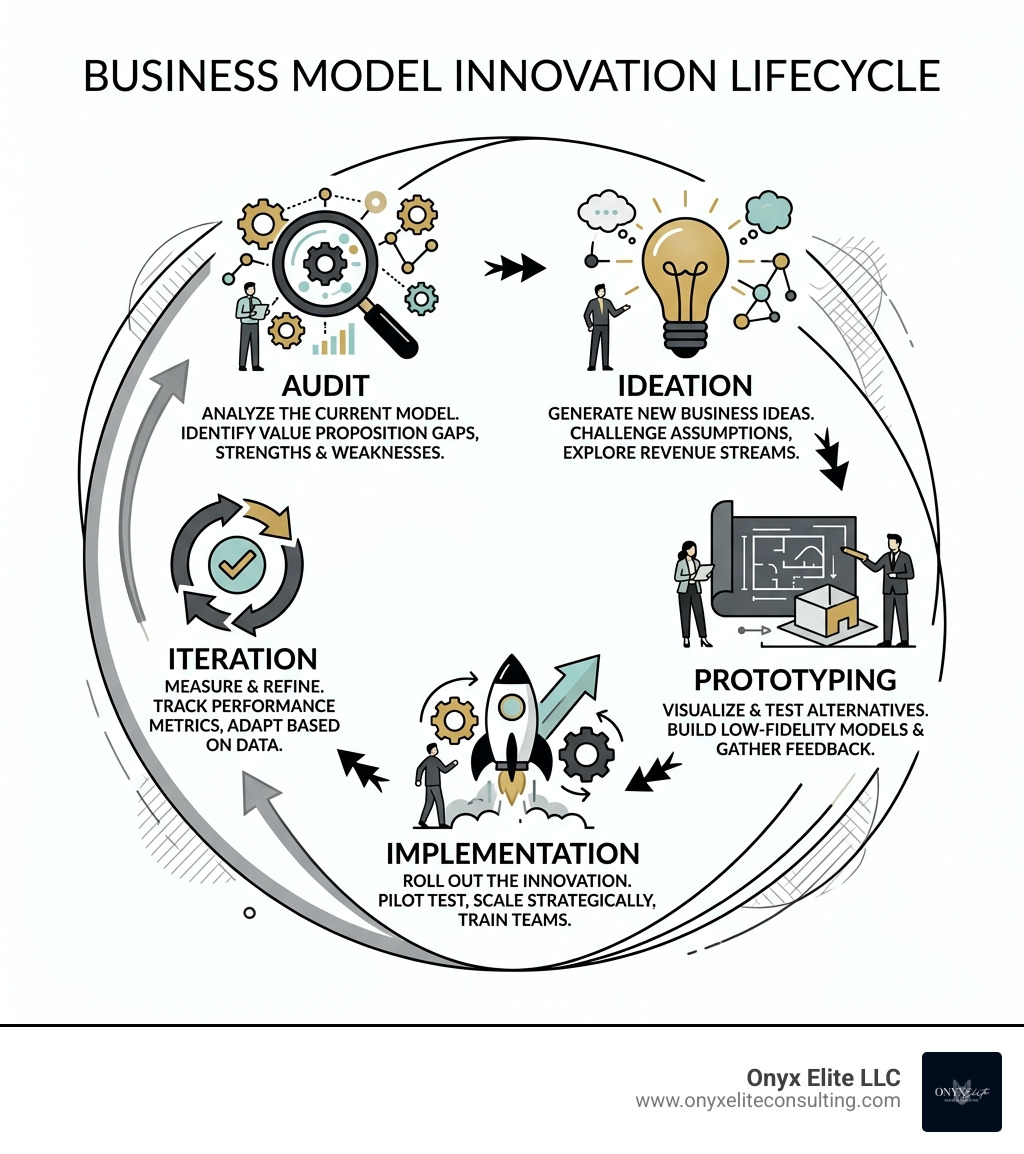
How do we actually do it? Our methodology is structured yet agile:
- Analysis: A deep dive into your current state and market trends. We look at your "Value Proposition Design" to see if it actually matches what your customers crave today.
- Ideation: This is the creative phase. We challenge ingrained assumptions and identify "blind spots."
- Prototyping: We develop small-scale versions of the new model. This is where the Operational Excellence Implementation Guide comes in, ensuring that the new model is grounded in reality.
- Implementation: A phased rollout that manages organizational risk.
- Iteration: We use continuous feedback loops to refine the model based on real-world performance.
Navigating the 2026 Innovation Landscape
As we look toward 2026, several "megatrends" are reshaping the business landscape. We are moving away from linear value chains toward platform economies.
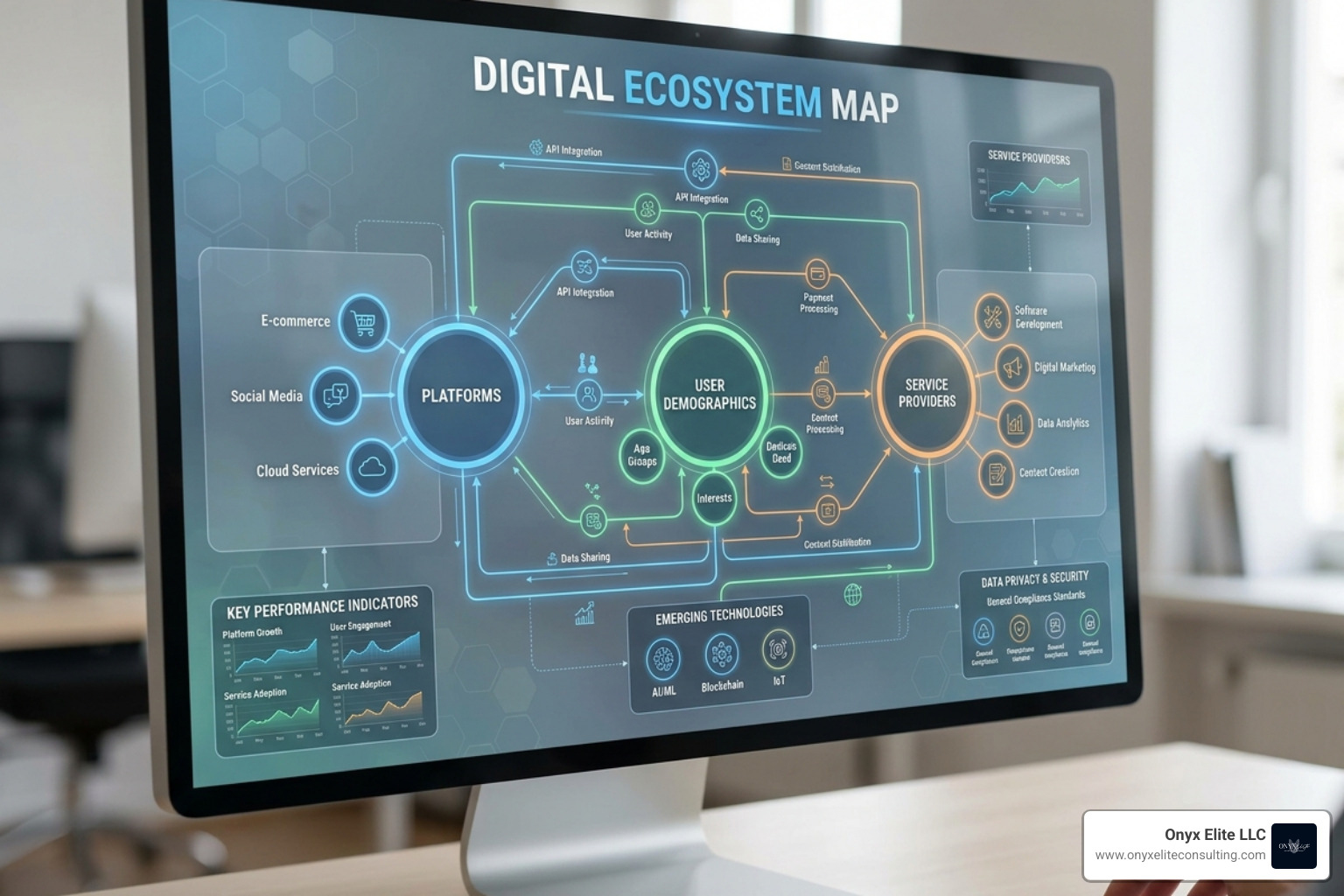
One of the most significant shifts is the rise of Subscription and XaaS (Anything-as-a-Service) models. Whether you are in industrial manufacturing or professional services, the move toward recurring revenue provides stability and deeper customer intimacy.
Furthermore, Automation and Process Improvement are enabling "Direct-to-Consumer" (DTC) shifts. Manufacturers who used to rely on wholesalers are now using digital platforms to build direct relationships with their end-users. We also see a massive push toward the circular economy, where waste is designed out of the system, creating new revenue streams from recycling and refurbishment.
Overcoming Organizational Barriers to Change
Let’s be honest: change is hard. The biggest hurdle to business model innovation isn't usually technology or capital—it's organizational resistance.
People are often tied to the "old way" because it’s what they know. To overcome this, we focus on:
- Leadership Buy-in: Innovation must be championed from the top.
- Cultural Agility: Building a "test-and-learn" mindset where failure is seen as data, not a disaster.
- Talent Investment: Upskilling your team to handle new technologies and processes.
- Lean Operational Excellence: Using Lean Operational Excellence principles to remove friction during the transition, ensuring the organization remains stable while it evolves.
Measuring Success in New Business Models
You cannot manage what you do not measure. Traditional KPIs like "quarterly sales" are often insufficient for tracking the success of a new business model. We help companies implement a more robust set of metrics.
| Traditional KPIs | Innovation KPIs |
|---|---|
| Quarterly Revenue | Customer Lifetime Value (CLV) |
| Net Profit | Contribution Margin Uplift |
| Market Share | Time-to-Market for New Iterations |
| Cost per Unit | Retention and Churn Rates |
By focusing on these metrics, you can Enhance Operational Efficiency while ensuring that your new model is actually driving long-term, sustainable growth.
Frequently Asked Questions about Business Model Innovation
How does business model innovation consulting mitigate financial risk?
Many leaders fear that changing their business model is a "bet the company" move. In reality, business model innovation consulting is designed to reduce risk. We use small-scale experimentation and validation before you ever scale.
By providing a fresh perspective, we identify blind spots that internal teams might miss. We also help you implement 5 Internal Systems That Drive Scalable Growth for Service-Based Businesses, ensuring that your "back office" can support the "front office" innovation without breaking.
What are the primary components of a successful business model redesign?
A successful redesign isn't just a new logo or a website. It requires a holistic look at:
- Value Proposition: What unique problem are you solving?
- Customer Segments: Who is your high-value audience?
- Revenue Architecture: How do you actually get paid? (Subscriptions, usage-based, freemium?)
- Key Partnerships: Who can help you scale faster?
- Cost Structures: How do you optimize for profitability?
Why is sustainability becoming a core pillar of business model consulting?
Sustainability is no longer just about "doing good"—it's about "doing well." ESG (Environmental, Social, and Governance) integration is a major driver of brand loyalty and regulatory compliance.
Top performers in sustainable business model innovation are 3x more likely to expand their value chain and 50% more likely to harness ecosystems. By designing for circularity and resource efficiency, you aren't just helping the planet; you are creating a more resilient, long-term viable business.
Conclusion
The "Art" of business model innovation is knowing when to hold onto your core strengths and when to boldly reinvent your path. When 45% of CEOs fear for their company's future, standing still is the riskiest move you can make.
At Onyx Elite LLC, we specialize in helping companies in West Hartford and throughout Connecticut navigate these complexities. Whether you are looking to defend against disruption, unlock new revenue streams, or achieve operational excellence, we are here to provide the strategic planning and fresh perspectives needed to thrive.
Don't let your business model become a relic of the past. Partner with experts to redefine your path to growth and build a future-proof organization today.