
How to Build a Corporate Brand Strategy That Actually Works
What Is a Corporate Brand Strategy (And Why It Determines Your Company's Future)

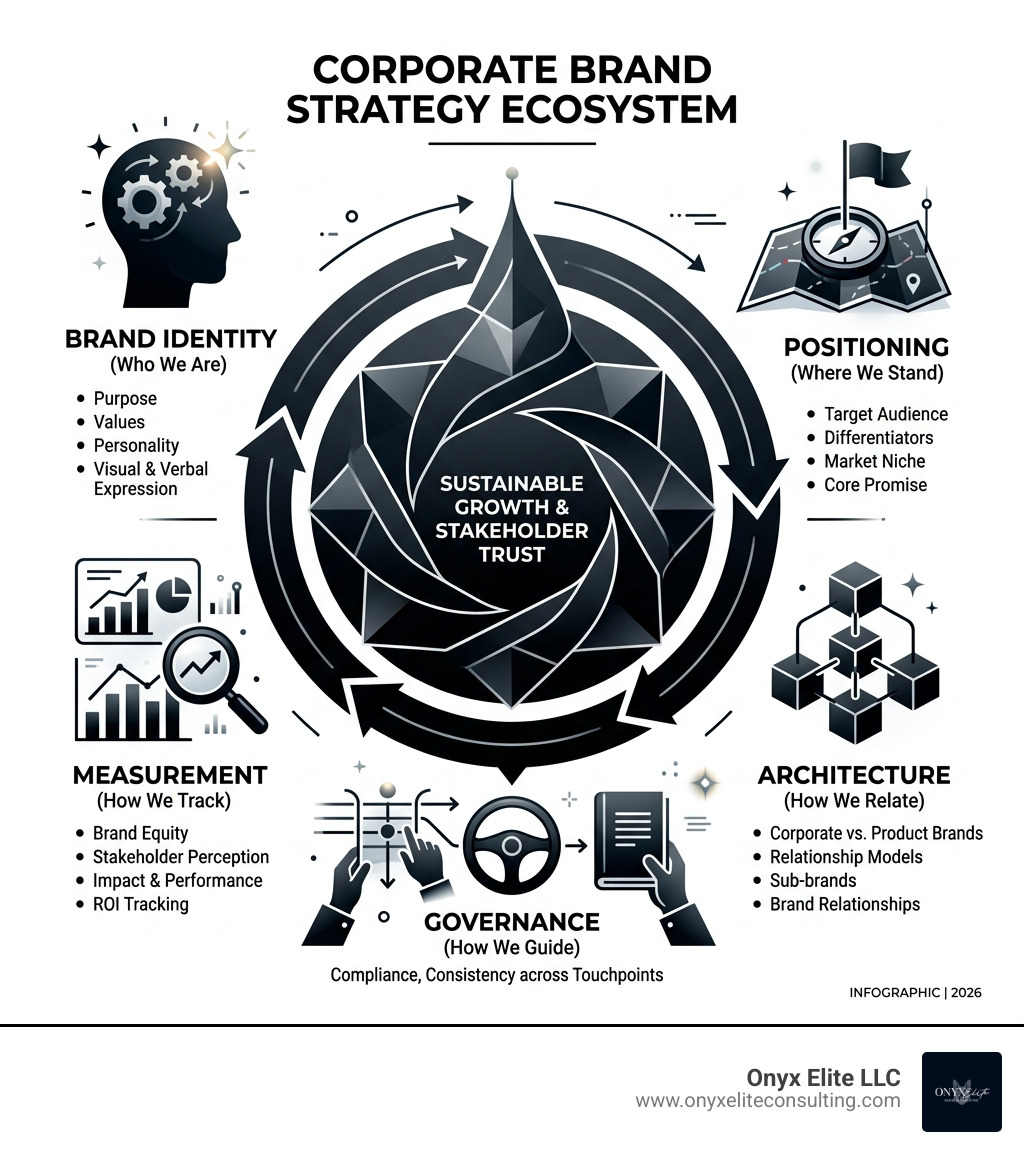
A corporate brand strategy is a long-term plan that defines how your company builds, expresses, and manages its identity — shaping how every stakeholder, from customers to investors to employees, perceives and trusts your organization.
Here's a quick breakdown of what it covers:
| Element | What It Means |
|---|---|
| Brand Identity | Who you are, what you stand for, and how you present yourself |
| Positioning | Where you sit in the market relative to competitors |
| Architecture | How your corporate brand relates to your products or sub-brands |
| Governance | How you keep your brand consistent across teams and channels |
| Measurement | How you track brand equity, trust, and business impact |
Think of it as the operating system behind everything your company communicates — not just your logo or tagline, but your values, behaviors, and the experience you deliver at every touchpoint.
And the stakes are high. Research from the Edelman Trust Barometer shows that over 80% of consumers need to trust a brand before they'll consider buying from it. Yet studies also reveal that consumers wouldn't care if 77% of brands simply disappeared. The gap between brands that matter and brands that don't comes down to strategy.
Most companies make the mistake of treating branding as a visual exercise — a new logo, a fresh color palette, a clever slogan. But leading organizations treat corporate brand strategy as a core business capability, one that sits in the boardroom, not just the marketing department.
I'm Doru Angelo, Founder and CEO of Onyx Elite LLC, and with over a decade of experience in business consulting and brand development, I've helped organizations across industries build and execute corporate brand strategies that drive real, measurable growth. In the sections ahead, I'll walk you through exactly how to do the same.
Defining Corporate Brand Strategy vs. Product Branding

To build a strategy that works, we must first distinguish between the "face" of a single product and the "soul" of the entire organization. While product branding focuses on the specific features, benefits, and target users of a single item (like a specific sneaker or a bottle of soda), a corporate brand strategy is much broader. It is a boardroom-level discipline that addresses the concerns of every stakeholder, including investors, employees, partners, and the community at large.
In the corporate realm, we aren't just selling a "thing"; we are selling the credibility of the entity that makes the thing. This shift from product to corporation moves the conversation from "Does this taste good?" to "Does this company act ethically? Is it innovative? Can I trust its long-term vision?"
| Feature | Product Branding | Corporate Brand Strategy |
|---|---|---|
| Primary Audience | Consumers/End-users | Customers, Investors, Employees, Partners |
| Scope | Single product or service line | The entire organization and its subsidiaries |
| Responsibility | Marketing/Product Managers | CEO, Board, and Senior Leadership |
| Time Horizon | Short to medium term (campaign-led) | Long-term (strategic vision) |
| Core Goal | Drive immediate sales | Build trust, equity, and enterprise value |
Why a Unified Corporate Brand Strategy Drives Enterprise Growth
A strong corporate brand strategy acts as a force multiplier for growth. When your corporate identity is clear and respected, it creates "brand equity" that lowers the cost of customer acquisition across all your products. If people trust the parent company, they are more likely to try its new offerings.
Furthermore, a unified strategy provides significant pricing power. Research published in the Harvard Business Review indicates that strong brands can often charge 20% to 30% more than their unbranded or poorly branded competitors. This isn't just about prestige; it's about the perceived reduction of risk. In the B2B world, where West Hartford businesses often deal with high-stakes contracts, a reputable corporate brand is the ultimate safety net for a buyer.
Operationally, a cohesive strategy eliminates the "fragmentation tax." When every department is on the same page, you spend less on redundant creative work and move faster in the market. To dive deeper into how this integrates with your broader goals, explore our insights on Corporate Strategy Development.
The Role of CEO Commitment in Brand Success
We often say that a corporate brand strategy lives or dies in the corner office. If the CEO views branding as a "marketing project," it will likely fail. True brand success requires leadership alignment at the highest level.
The CEO must be the primary brand ambassador, ensuring that the brand’s promise is reflected in capital allocation, hiring practices, and even crisis management. When leadership treats the brand as a strategic investment rather than a discretionary expense, the entire culture shifts. Employees become more engaged because they understand the "why" behind their work, which in turn leads to a more consistent customer experience.
The Essential Components of a High-Impact Strategy
At Onyx Elite LLC, we believe a strategy is only as strong as its foundation. To build a brand that stands the test of time, you need several core pillars working in harmony.
- Brand Purpose: Why do you exist beyond making money? (e.g., to democratize technology or to protect the environment).
- Core Values: The operational principles that guide your decisions. If your values don't influence who you hire or fire, they aren't values—they're just posters.
- Market Positioning: The unique space you occupy in the minds of your audience. Are you the premium innovator or the reliable, cost-effective partner?
For many enterprises, identifying these elements requires an outside perspective to bridge the gap between internal perception and market reality. This is where Brand Development Consulting becomes invaluable.
Designing Brand Architecture and Hierarchy
For large organizations, managing multiple sub-brands can become a logistical nightmare. Brand architecture is the system that organizes these relationships. There are four primary models we see in the market:
- Branded House (Monolithic): The corporate brand is the primary driver. Think of a major search engine company where every service (Maps, Mail, Drive) uses the main brand name. This builds massive equity quickly but carries a higher risk if the parent brand suffers a reputation hit.
- House of Brands (Pluralistic): The parent company remains invisible while individual product brands shine. A consumer goods giant owning hundreds of different detergent and snack brands is the classic example. This protects the parent but is very expensive to maintain because every brand needs its own marketing budget.
- Endorsed Model: Sub-brands have their own identity but are "brought to you by" the parent company. This offers a balance of individual personality and corporate "trust backing."
- Hybrid Structure: A mix of the above, often resulting from mergers and acquisitions.
Choosing the right structure is critical for Brand Elements Design because it dictates how logos, colors, and names interact across your portfolio.
Mastering Corporate Brand Strategy Messaging and Positioning
Once the architecture is set, you need a voice. Your messaging framework should translate your complex corporate strategy into simple, resonant narratives.
We start with Audience Personas. You cannot speak to an institutional investor the same way you speak to a frontline employee. We develop a Narrative Hierarchy that ensures the core value proposition remains consistent while the specific "proof points" change based on who is listening.
To ensure your message is actually landing, we often recommend a Brand Perception Analysis. This helps us see if the "innovative" image you think you're projecting is actually being received as "unreliable" by the market.
Implementing and Governing Your Visual Identity System
A corporate brand strategy is invisible until it is expressed through design. A visual identity system is more than just a logo; it’s a comprehensive design language including typography, color palettes, imagery styles, and even the "white space" in your layouts.
Consistency is the name of the game here. A brand has roughly seven seconds to make a first impression, and if your LinkedIn page looks different from your website, which looks different from your sales deck, you’ve already lost the trust of your prospect.
To manage this at scale, modern enterprises use Digital Asset Management (DAM) systems. These platforms serve as a "single source of truth" where every employee in Connecticut or across the globe can access approved logos, templates, and guidelines.
Brand Governance and Compliance Frameworks
Governance is the "policing" of the brand, but we prefer to think of it as "enablement." A good governance framework shouldn't just say "no"; it should empower teams to create on-brand content quickly.
- Ownership Roles: Who has the final say on brand changes? Usually, a Brand Council or a Chief Brand Officer.
- Approval Workflows: Clear paths for reviewing new creative assets.
- Global-Local Balance: Allowing regional offices to adapt messaging for local demographics while keeping the core visual identity intact.
- Training Programs: Educating employees on how to tell the brand story. Your employees are your most authentic ambassadors.
Leveraging Technology for Scalable Execution
In 2024 and beyond, technology is the backbone of brand management. AI is no longer a buzzword; it’s a tool for automated governance. AI can now scan thousands of social media posts or internal documents to ensure compliance with brand guidelines in seconds.
Real-time analytics allow us to track sentiment and see how the market is reacting to our brand in the moment. This data-driven approach allows for "brand evolution" rather than the disruptive and expensive "total rebrand" every five years.
Measuring Success and Avoiding Common Pitfalls
What gets measured gets managed. You cannot simply launch a corporate brand strategy and hope for the best. You need a dashboard of Key Performance Indicators (KPIs) that track both short-term health and long-term equity.
One of the biggest pitfalls we see is the "Visual Over-focus." A company spends $100k on a new logo but $0 on training their staff to live the brand values. This leads to Fragmentation, where the "pretty" marketing doesn't match the "ugly" customer service experience.
To understand the future of this landscape, read our guide on The New Era of Brand Authority: How Businesses Win in 2026 and Beyond.
Overcoming Internal Silos and Fragmentation
Fragmentation often happens because of internal silos. Sales, Marketing, and HR all think they own a different piece of the brand. To fix this, you need Cross-functional Alignment.
Internal branding is just as important as external marketing. If your employees don't buy into the brand, your customers won't either. We encourage "Employee Advocacy" programs where staff are given the tools and permission to share the brand story in their own voices.
Key Performance Indicators for Long-Term Equity
How do you know if your brand is actually worth more? We look at these metrics:
- Brand Awareness & Consideration: How many people know you, and would they buy from you?
- Net Promoter Score (NPS): A measure of customer loyalty and advocacy.
- Share of Voice: How much of the industry conversation do you own compared to competitors?
- Financial Valuation: Calculating the brand's specific contribution to the company's market cap.
Frequently Asked Questions about Corporate Branding
How long does it take to see results from a new strategy?
Developing and rolling out a corporate brand strategy typically takes six months to a year. While you might see a bump in "awareness metrics" and employee morale within the first 90 days, building true brand equity and trust usually takes 2 to 3 years of consistent execution. Branding is a marathon, not a sprint.
What is the biggest mistake in corporate branding?
The "Set and Forget" mentality. Many companies treat a brand strategy as a one-time campaign. In reality, a brand is a living system. If you don't have a governance framework and a plan for regular audits, your brand will inevitably drift into inconsistency and irrelevance. Another major error is ignoring the "Internal Brand"—if your culture doesn't match your marketing, the market will eventually sniff out the inauthenticity.
How does AI impact corporate brand management?
AI is a game-changer for predictive modeling and sentiment analysis. It allows us to process millions of data points to see where a brand is winning or losing in real-time. It also helps in scaling content creation while maintaining strict adherence to brand guidelines through AI-powered templates and "brand-aware" GenAI tools.
Conclusion
A successful corporate brand strategy is the difference between being a "commodity" that competes on price and a "leader" that commands loyalty. It requires strategic alignment from the boardroom to the front lines, a clear architectural structure, and a commitment to consistency that transcends mere aesthetics.
At Onyx Elite LLC, we specialize in helping organizations in West Hartford and beyond navigate this complexity to achieve sustainable growth and operational excellence. Your brand is your most valuable intangible asset—it's time to treat it like one.
If you're ready to make your business unignorable, start by understanding why Visibility is Your Growth Engine: How to Become Unignorable Online.
Ready to transform your organization? Achieve Operational Excellence with Onyx Elite today.