

The OpEx Playbook: Your Guide to Flawless Operational Excellence Implementation
Why Operational Excellence Implementation Is Your Competitive Advantage

Operational excellence implementation is how organizations build a systematic roadmap for continuous improvement in today's complex business environment. It goes beyond cutting costs or maximizing ROI—it gives companies the flexibility to adapt to changing markets, technologies, and customer demands while creating sustainable competitive advantage.
Quick Answer: To implement operational excellence successfully, you need to:
- Assess your current state - Evaluate processes, employee engagement, and operational maturity
- Define clear objectives - Set measurable goals aligned with your business strategy
- Engage your people - Build buy-in and empower employees at all levels
- Choose your methodologies - Select frameworks like Lean, Six Sigma, or Kaizen that fit your needs
- Implement in phases - Follow an 18-36 month roadmap with quick wins and continuous monitoring
- Measure and adapt - Track KPIs, celebrate progress, and refine your approach
The data tells a compelling story. More than half of employees believe they could save 240 hours annually through better processes and automation. The difference between high and low productivity growth could amount to nearly $50 trillion in wealth by 2030 in the US alone. Yet only 12 percent of change programs sustain their performance gains for more than three years.
Why do so many initiatives fail? Because operational excellence isn't just about tools and techniques—it's about culture. It requires every member of your organization to see the flow of value to the customer and solve problems before they become disruptions. It means working on your business, not just in it.
This requires a shift from viewing operational excellence as a cost-cutting exercise to seeing it as a strategic weapon for growth. The most successful organizations treat it as a continuous journey, not a destination. They integrate technology thoughtfully, empower their people consistently, and align every improvement effort with clear business objectives.
As Doru Angelo, Founder & CEO of Onyx Elite LLC with over a decade of experience in business consulting, I've guided organizations through operational excellence implementation by changing their vision into reality through strategic solutions and sustainable systems. My approach centers on understanding each client's unique business landscape to craft precise, actionable strategies that drive measurable results.
Throughout this guide, you'll find a proven playbook for implementing operational excellence that actually works—one that balances strategic thinking with practical execution, and technical excellence with human engagement.
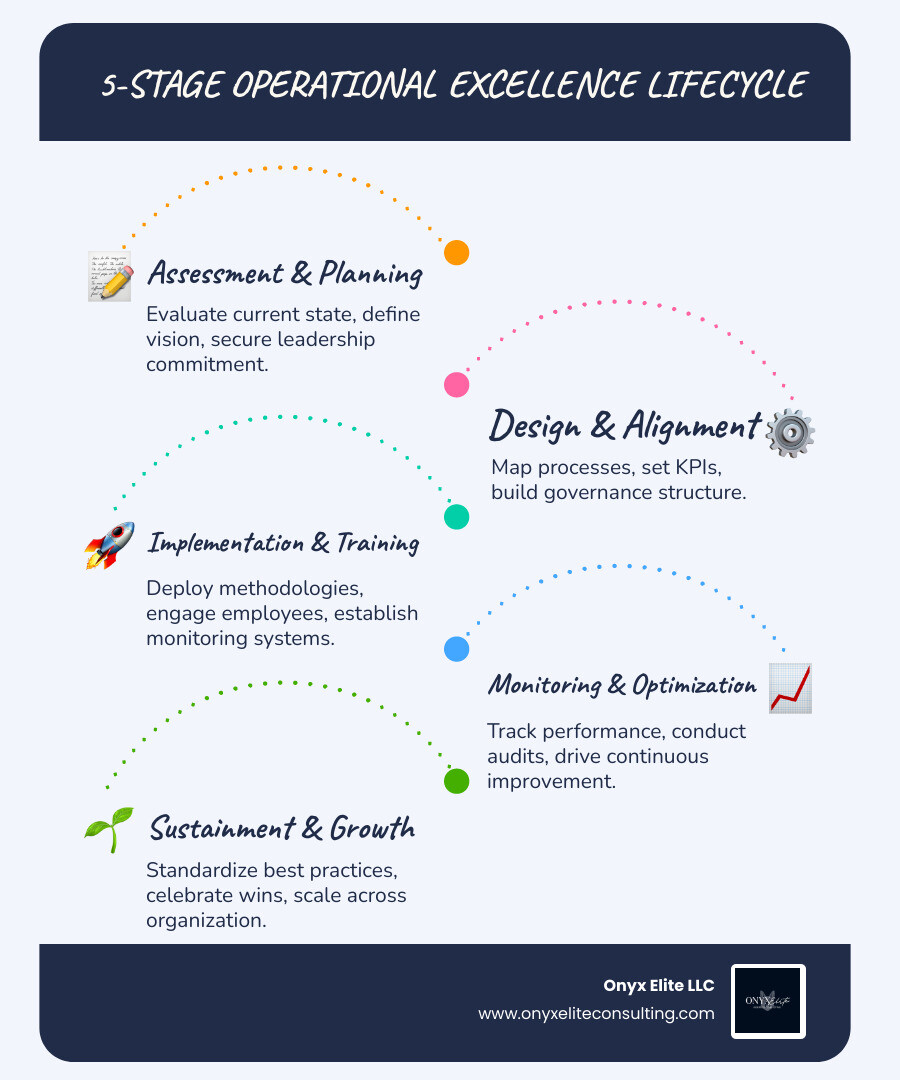
The Core Pillars of Operational Excellence Implementation
When we talk about operational excellence implementation, we aren't just talking about a new set of rules; we’re talking about a fundamental shift in how your business breathes. Successful strategies are built on the Shingo model, which identifies ten core principles that serve as pillars for world-class organizations.
At the heart of these pillars is Strategic Leadership. Leaders must do more than just sign off on budgets; they must lead with humility and embody the vision. This means being willing to learn from the frontline and ensuring that every person in the building understands how their work creates value for the customer.
Process Optimization is another critical pillar. In our experience, many businesses try to fix people when they should be fixing processes. By focusing on Business Process Improvement, you can identify the root causes of inefficiencies rather than just treating the symptoms. This involves:
- Scientific Thinking: Encouraging experimentation and data-driven cycles.
- Quality at the Source: Ensuring that work is done correctly the first time to prevent waste downstream.
- Systemic Thinking: Understanding that a change in one department (like sales) inevitably ripples through others (like fulfillment).
To support these pillars, modern organizations leverage Data analytics platforms to move away from "gut feeling" management. Data-driven decision making ensures that your OpEx journey is grounded in reality, not just optimism.
Clarifying the What, Why, and How
You can’t get where you’re going if you don’t have a map—and more importantly, a reason to go there. We find that the most successful operational excellence implementation efforts begin with radical clarity.
First, you must align your Vision. If your team doesn't understand the "Why" behind the change, they will view it as just another "flavor of the month" initiative. A purpose-driven strategy connects daily tasks to a higher mission, which is a massive motivator.
Next, we use Value Stream Mapping to visualize exactly how a product or service moves from a concept to the customer's hands. This highlights the seven principles of a winning strategy:
- Aligning senior leaders around business goals.
- Communicating the benefits of continuous improvement (CI) constantly.
- Empowering employees with tools and time.
- Dismantling departmental silos.
- Implementing small, incremental changes.
- Leading with purpose and compassion.
- Creating a fault-tolerant environment.
Without stakeholder buy-in at every level, even the most brilliant strategy will stall at the starting line.
Establishing Governance and Accountability
Who is steering the ship? To keep an OpEx initiative from drifting, we recommend establishing a dedicated Operational Excellence Task Force. This group isn't just there to attend meetings; they are the champions of standardized reporting and transparency.
Accountability starts with Leadership Humility. When leaders admit they don't have all the answers and invite feedback, it creates a culture where employees feel safe to report problems. A solid 5-step action plan for your framework should include:
- Building the business case.
- Understanding the drivers of change.
- Integrating sustainability into the vision.
- Managing risks proactively.
- Developing employee competencies through training.
A Step-by-Step Action Plan for Your OpEx Journey
Implementing excellence isn't a weekend project; it's a marathon. To help you choose the right gear for that marathon, here is a comparison of the heavy hitters in the OpEx world:
| Methodology | Primary Focus | Best Used For |
|---|---|---|
| Lean | Waste Elimination | Speed and efficiency; removing non-value-added steps. |
| Six Sigma | Variation Reduction | Quality and consistency; using DMAIC to solve complex defects. |
| Kaizen | Continuous Incremental Change | Cultural engagement; making small, daily improvements. |
Your journey begins with a Current State Assessment. You need an honest look in the mirror. Where are your bottlenecks? What is your cultural maturity? Most organizations use maturity models to plot an 18-36 month roadmap. This timeframe allows for the "rewiring of the organizational DNA" that true excellence requires.
Resource allocation is where many businesses trip up. You cannot expect your team to innovate if they are 100% used on daily tasks. We advocate for Lean Operational Excellence, which uses the PDCA (Plan-Do-Check-Act) cycle for rapid learning and the DMAIC (Define, Measure, Analyze, Improve, Control) framework for long-term problem solving.
Defining Measurable Objectives and KPIs
If you can't measure it, you can't improve it. But be careful—the wrong metrics can drive the wrong behaviors (like "creative accounting" to hit a target). We focus on a mix of leading and lagging indicators:
- OEE (Overall Equipment Effectiveness): A staple for manufacturing health.
- Cycle Time: How fast can you deliver value?
- Customer Satisfaction Scores: The ultimate "North Star" metric.
- Leading vs. Lagging: Don't just look at last month's profit (lagging); look at this month's employee training hours (leading).
Innovative firms are now using Digital twin technology for performance measurement, allowing them to simulate process changes in a virtual environment before touching the physical workspace. This reduces risk and provides a clear picture of potential financial impact.
Implementing Continuous Monitoring
Operational excellence isn't a "set it and forget it" system. It requires Real-time Dashboards and regular Process Audits to ensure that new standards are actually being followed.
Standard work is the foundation of all improvement. Without a standard, there can be no improvement because there is no baseline to compare against. We recommend focusing on 5 Internal Systems That Drive Scalable Growth to ensure that your "working on the business" efforts have a solid structure to stand on.
Fostering a Culture of Continuous Improvement

You can have the best software in the world, but if your people are disengaged, your operational excellence implementation will fail. In fact, research shows that only 12% of change programs sustain gains for more than three years—and the differentiator is almost always culture.
One of the most powerful tools in our arsenal is the Gemba Walk. Originating from Lean manufacturing, "Gemba" means "the real place."
How to Conduct a Gemba Walk:
- Go to where the work happens: Whether it's the shop floor or the software engineering pod.
- Observe the process: Don't look for people to blame; look for waste in the process.
- Ask "Why?": Engage employees with curiosity. They are the experts in their daily tasks.
- Respect the worker: Listen more than you talk.
This builds Compassionate Leadership. When employees feel that leadership cares about their safety and their input, they become active participants in the CI journey. This creates a Fault-Tolerant Environment where mistakes are viewed as data points for improvement rather than reasons for punishment. This psychological safety is the secret sauce for knowledge retention and skill development.
Leveraging Technology for Operational Excellence Implementation
Technology should never be implemented for its own sake; it should be an enabler of your OpEx goals. Digital transformation strategies today go beyond simple automation.
We are seeing massive Robotic process automation (RPA) benefits across industries. RPA can handle repetitive, rule-based tasks (like data entry or invoice processing), which WorkMarket’s 2020 In(Sight) Report suggests could save employees hundreds of hours a year.
Other tech trends include:
- Generative AI: Used by one-third of global organizations to summarize data or create initial drafts.
- Predictive Maintenance: Using sensors to fix machines before they break.
- Industrial Robotics: Projected to grow by 10% annually through 2030.
The goal is Smart Manufacturing (or smart services), where technology augments human capability rather than replacing it.
Future Trends Shaping the OpEx Landscape
The landscape of OpEx is shifting toward Sustainability Integration. Waste elimination isn't just about profit anymore; it's about environmental impact. We are also seeing the rise of Hyper-automation and Agile Operations, where businesses can pivot their entire production line or service offering in days, not months. Virtual simulations and AI-driven insights are making "trial and error" a thing of the past, allowing for more precise, low-risk operational excellence implementation.
Overcoming Challenges in Operational Excellence Implementation
Let's be real: this is hard. One of the biggest problems is Initiative Overload. We often see companies trying to do 5S, Six Sigma, and a new ERP implementation all at once. This leads to "change fatigue" and cultural inertia.
To Enhance Operational Efficiency, you must dismantle silos. If the marketing team doesn't talk to the operations team, you'll end up with a high-performing sales engine that the back office can't support. Leadership commitment gaps are the final "silent killer." If the CEO doesn't show up to the Gemba walks, the employees will quickly realize that OpEx isn't actually a priority.
Balancing Day-to-Day Operations with Improvement
This is the classic "working ON the business vs. working IN the business" dilemma. If you are too busy mopping the floor, you don't have time to fix the leak in the roof.
The WorkMarket’s 2020 In(Sight) Report highlights that automation is the key to freeing up this time. By automating the routine, you give your team the bandwidth for Rapid Deployment Strategies. Successful organizations often use Dual Organizational Structures: one team focuses on delivering today's results, while another (cross-functional) team focuses on tomorrow's improvements.
Sustaining Long-term Performance Gains
To avoid being part of the 88% of programs that fail, you need an Operational Excellence Index (OEI). This is a holistic score that tracks not just financial results, but organizational health and process maturity.
Sustaining gains requires:
- Continuous Training: Skills have a half-life; keep them fresh.
- Celebrating Quick Wins: High-fives are free. Use them to maintain momentum.
- Standardizing Best Practices: When one team finds a better way, it must become the standard for everyone.
Frequently Asked Questions about Operational Excellence
What is the significance of starting with small changes like 5S?
Starting with 5S (Sort, Set in order, Shine, Standardize, Sustain) is like cleaning your room before you try to write a novel. It establishes Workplace Discipline and provides Quick Wins that build psychological momentum. When employees see a cluttered, dangerous workspace transform into a clean, efficient one in just a few days, they start to believe that larger changes are possible. It’s the ultimate visual management tool.
How can organizations measure the success of OpEx initiatives?
Success should be viewed through a "Balanced Scorecard" lens. Look for Productivity Growth (output per hour), Cost-to-Income Ratios (efficiency), and Quality Cost Savings (less rework). However, don't ignore the "human" metrics. A drop in Employee Turnover and lower Customer Attrition Rates are often the first signs that your operational excellence implementation is taking root.
What role does leadership play in driving a fault-tolerant environment?
Leadership is the thermostat that sets the cultural temperature. By leading with Humility, managers shift the focus from "Who messed up?" to "What in our process allowed this to happen?" This Root Cause Analysis approach empowers frontline workers to make decisions without fear. When leaders role-model these behaviors, it creates a culture where problems are solved while they are still small, preventing catastrophic failures later.
Conclusion
At Onyx Elite LLC, we believe that operational excellence implementation is the bridge between having a good business and having a legendary one. Based in West Hartford, CT, our team understands that sustainable growth requires more than just a few new tools—it requires a holistic change in strategy and culture.
Whether you are looking to streamline your internal systems or undergo a full digital change, we are here to help you steer the complexities of modern business. We invite you to explore our Services Overview to see how we can help you turn these principles into a reality for your organization. Excellence isn't an act; it's a habit. Let's start building that habit together today.