Beyond the Budget: Smart Solutions for Cost Efficiency
Why Smart Cost Efficiency Solutions Matter More Than Ever

Cost efficiency solutions help businesses maximize output while minimizing waste—without sacrificing quality or long-term growth. Here's what you need to know:
Quick Answer: Top Cost Efficiency Solutions
- Strategic Resource Allocation - Match your best resources to high-value projects
- Process Automation - Eliminate repetitive tasks that drain time and money
- Zero-Based Budgeting - Justify every expense from scratch, not just incremental changes
- AI-Powered Analytics - Use data to predict costs and optimize decisions
- Supply Chain Optimization - Build resilience while reducing warehousing and distribution costs by 10-20%
- Change Control Systems - Prevent scope creep that kills project margins
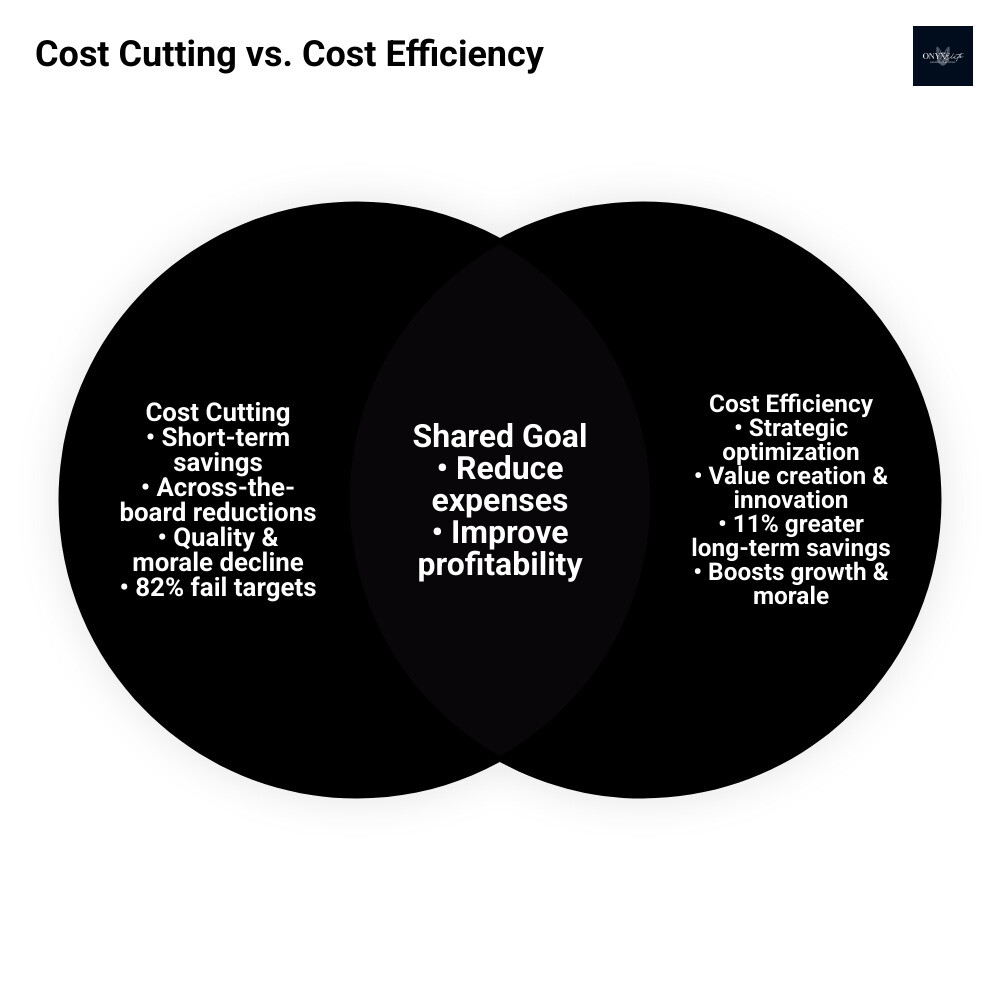
In today's volatile business environment, 82% of companies missed their annual cost reduction targets in 2023. The problem? Most businesses approach cost management as a "crash diet" of indiscriminate cuts, rather than a strategic discipline that fuels growth.
Traditional cost-cutting often backfires. You slash budgets across the board, lose critical talent, compromise quality, and watch customer satisfaction plummet. Meanwhile, your competitors who invested in smart cost efficiency are capturing market share with leaner operations and better margins.
The difference is profound: cost efficiency solutions don't just reduce expenses—they redefine how you create value. Companies that embed cost consciousness into their culture achieve up to 11% greater long-term cost reduction and actually improve employee morale in the process.
This isn't about doing less with less. It's about doing more with what you have—freeing up capital to invest in innovation, technology, and the capabilities that drive sustainable growth. From AI-powered supply chain optimization to zero-based organizational redesign, the most effective solutions combine immediate savings with long-term strategic advantage.
As Doru Angelo, Founder & CEO of Onyx Elite LLC, I've spent over a decade helping businesses implement cost efficiency solutions that transform operations while protecting their growth trajectory. Through our work facilitating funding and strategic consulting for clients across industries, we've seen how the right approach to cost management becomes a competitive advantage rather than a constraint.
Understanding Cost Efficiency Solutions: More Than Just Cutting Corners
When we talk about cost efficiency solutions, we aren't talking about "pinching pennies" until the quality of your service bleeds. True cost efficiency is the art of delivering products or services at the lowest possible price point while maintaining—or even improving—the quality expectations of your clients.

In the professional services and project-based sectors, this is where the "rubber meets the road." Many firms struggle to stay on track. According to the Pulse of the Profession 2021 report on project success rates, while 73% of projects met their initial goals, only 62% were completed within budget, and a mere 55% were on time. This gap represents a massive leak in profitability that smart cost efficiency solutions are designed to plug.
Defining Efficiency vs. Effectiveness
It is common to hear people use "efficient" and "effective" as synonyms, but in business strategy, they are distinct pillars. Management legend Peter Drucker said, "Efficiency is doing things right; effectiveness is doing the right things."
- Cost Effectiveness: This is about alignment. Are you spending money on the right projects that achieve your goals? You could be incredibly efficient at a task that shouldn't be done at all.
- Cost Efficiency: This is about process. Once you know you are doing the right thing, how can you do it with the least amount of waste?
A business can be effective without being efficient (it reaches its goals but wastes money getting there), but it is very difficult to remain profitable long-term if you aren't both. Our goal is to move your organization into that "optimal zone" where every dollar spent is directly tied to a high-value result.
Why Strategic Spending Beats Traditional Cost-Cutting
Traditional cost-cutting is reactive. It usually happens when a CFO sees a dip in the quarterly report and orders a 10% reduction across all departments. This "meat-cleaver" approach often kills innovation because it starves the very departments—like R&D or marketing—that drive future revenue.
Strategic cost efficiency solutions, on the other hand, treat spending as a source of competitive advantage. Instead of just cutting, we look at Business Process Improvement to identify "maverick spend" and non-value-add activities. By identifying these leaks, we can reallocate those funds toward growth-driving activities. It’s about being a "cost pioneer"—someone who embeds cost consciousness into the company DNA so that every employee, from the mailroom to the boardroom, is looking for ways to optimize.
Strategic Frameworks for Operational Excellence
Achieving operational excellence in Connecticut’s competitive market requires more than just good intentions; it requires a framework. We often work with businesses in West Hartford and beyond to implement structures that make efficiency a repeatable process rather than a one-time event.
The Budgeting Battle: ZBB vs. Traditional
| Feature | Traditional Budgeting | Zero-Based Budgeting (ZBB) |
|---|---|---|
| Starting Point | Last year's actual spend | Zero |
| Justification | Only new spending requires it | Every single expense must be justified |
| Focus | Incremental changes | Strategic alignment and necessity |
| Impact | Legacy waste stays hidden | Uncovers 10-25% in net savings |
Zero-Based Budgeting (ZBB) is a powerful tool. Instead of assuming last year's $50,000 marketing budget is the floor for this year, you start at zero and ask, "What do we need to achieve our goals this year, and what is the most efficient way to fund it?" This prevents "budget creep" and ensures resources are always flowing toward the highest ROI activities.
Beyond budgeting, we advocate for Lean Operational Excellence. This includes the 5S methodology (Sort, Straighten, Shine, Standardize, Sustain). While often associated with manufacturing, 5S is incredibly effective in service environments for reducing "digital waste"—cluttered file systems, redundant communication chains, and over-complicated approval processes.
Conducting a Robust Cost-Benefit Analysis
Before implementing any new solution, you must conduct a cost-benefit analysis (CBA). But don't just look at the invoice price. A robust CBA includes:
- Direct Costs: The actual price of the software or service.
- Intangible Effects: How will this impact employee morale or customer satisfaction? (Hint: A 10% cut that leads to 20% higher turnover is a net loss).
- Opportunity Costs: If we spend $100k on this efficiency tool, what can't we spend that money on?
- Risk Factors: What happens if the implementation fails or takes twice as long as expected?
Improving Resource Utilization and Lead Times
For service-based businesses in Connecticut, your biggest cost is people. Strategic resource utilization means matching the right talent to the right project without over- or under-resourcing.
We help firms Enhance Operational Efficiency by analyzing lead times—the time it takes from a client request to project delivery. By identifying bottlenecks (like a specific partner who is a "bottleneck" for approvals), you can increase throughput without hiring more staff. Hiring a new employee costs an average of $4,700; optimizing the ones you have is far more cost-efficient.
The Impact of Technology and Automation
We live in an era where technology is the primary driver of cost efficiency solutions. According to McKinsey research, 78% of companies now use AI for at least one business task.
Leveraging AI as Modern Cost Efficiency Solutions
AI isn't just a buzzword; it's a margin protector. By incorporating artificial intelligence (AI) and machine learning (ML), businesses can automate repetitive, low-value tasks.
- Generative AI: Can handle first-draft reporting, coding, and customer service inquiries, freeing up your team for strategic work.
- Demand Forecasting: AI can predict when your service demand will spike, allowing you to staff up strategically rather than paying overtime during a crisis.
- Error Reduction: Automated invoicing and "n-way matching" can reduce the time spent on accounts payable from hours to minutes, eliminating costly human errors.
Optimizing Supply Chain Resilience
For our clients involved in the movement of goods, the supply chain is often the largest expense. AI implementation in supply chains has been shown to reduce manufacturing, warehousing, and distribution costs by 10% to 20%.
Efficiency here isn't just about the lowest price; it's about resilience. We recommend "near-shoring" (sourcing closer to home in the Northeast or US) and dual sourcing to prevent the massive costs associated with stockouts or global shipping delays. Using real-time data allows you to move toward a "just-in-time" (JIT) inventory system, which prevents your cash from being tied up in dusty boxes on a warehouse shelf.
Avoiding Common Pitfalls in Project Management
Even the best cost efficiency solutions can be derailed by poor project management. If you don't have tight controls, your margins will evaporate before the project is halfway done.
Scope Creep and Gold-Plating
The Project Management Institute found that 34% of projects suffer from scope creep. This is when the project requirements grow without a corresponding increase in budget or time. Closely related is "gold-plating"—giving the client more than they asked for or need in an attempt to impress them. While it sounds nice, it’s a silent profit killer.
To combat this, you need 5 Internal Systems That Drive Scalable Growth for Service-Based Businesses, specifically a robust Change Control Process. If the client wants an extra feature, they need to see the extra invoice.
Choosing the Right Pricing Model
Your choice of pricing model drastically impacts your efficiency:
- Fixed-Price: Good for predictable projects, but you carry all the risk of inefficiency.
- Time & Materials (T&M): Often produces higher margins (38.7% for IT consultancies compared to 36.9% for fixed-price). T&M ensures you are paid for every hour worked, but it requires high transparency to keep the client happy.
Measuring the ROI of Your Cost Efficiency Solutions
You cannot manage what you do not measure. To ensure your efficiency efforts are working, track these Key Performance Indicators (KPIs):
- Operational Efficiency Ratio: (Operating Expenses + COGS) / Net Sales. A ratio of 50% or less is generally considered excellent.
- Net Promoter Score (NPS): Ensure your cost-cutting isn't hurting the customer experience.
- Employee Engagement: Engaged employees are more productive. If engagement drops, your "efficiency" is likely just burnout in disguise.
- Utilization Rate: Are your billable employees spending too much time on administrative tasks?
Frequently Asked Questions about Cost Efficiency
What is the main difference between cost efficiency and cost-cutting?
Cost-cutting is a reactive, often temporary reduction in spending (like a "crash diet"). Cost efficiency is a strategic, ongoing process of optimizing resources to get the best possible output for the least input (like a "healthy lifestyle"). Efficiency focuses on value, while cutting focuses solely on the price tag.
How does automation improve a company's bottom line?
Automation improves the bottom line by eliminating manual errors, reducing the time required for repetitive tasks (like data entry or invoicing), and allowing expensive human talent to focus on high-margin, strategic work. It essentially increases your "capacity" without increasing your "headcount."
Why do most cost reduction targets fail?
In 2023, 82% of businesses missed their targets because they lacked cultural buy-in and data transparency. Many companies chase "easy" cuts that don't stick or fail to account for "hidden costs" like decreased employee morale or lower product quality, which eventually drive expenses back up.
Conclusion
True cost efficiency solutions are not about scarcity; they are about abundance. By eliminating waste and optimizing your processes, you create the financial "breathing room" necessary for sustainable growth.
At Onyx Elite LLC, we believe that cost discipline should be embedded into your company’s DNA. Whether you are a growing firm in West Hartford or a settled enterprise in Connecticut looking to modernize, the path to operational excellence starts with a shift in mindset. It’s about moving from "How much can we cut?" to "How much more can we achieve with what we have?"
When you align your culture with your cost goals, you don't just save money—you build a more resilient, agile, and profitable organization. We are here to help you navigate that transformation through strategic planning and tailored consulting.
Ready to optimize your operations and fund your next phase of growth? Explore our full Services Overview to see how we can help your business achieve its full potential.