The Essentials of Integrated Risk Management for Modern Enterprises
Why Every Modern Business Needs an Integrated Risk Management Framework
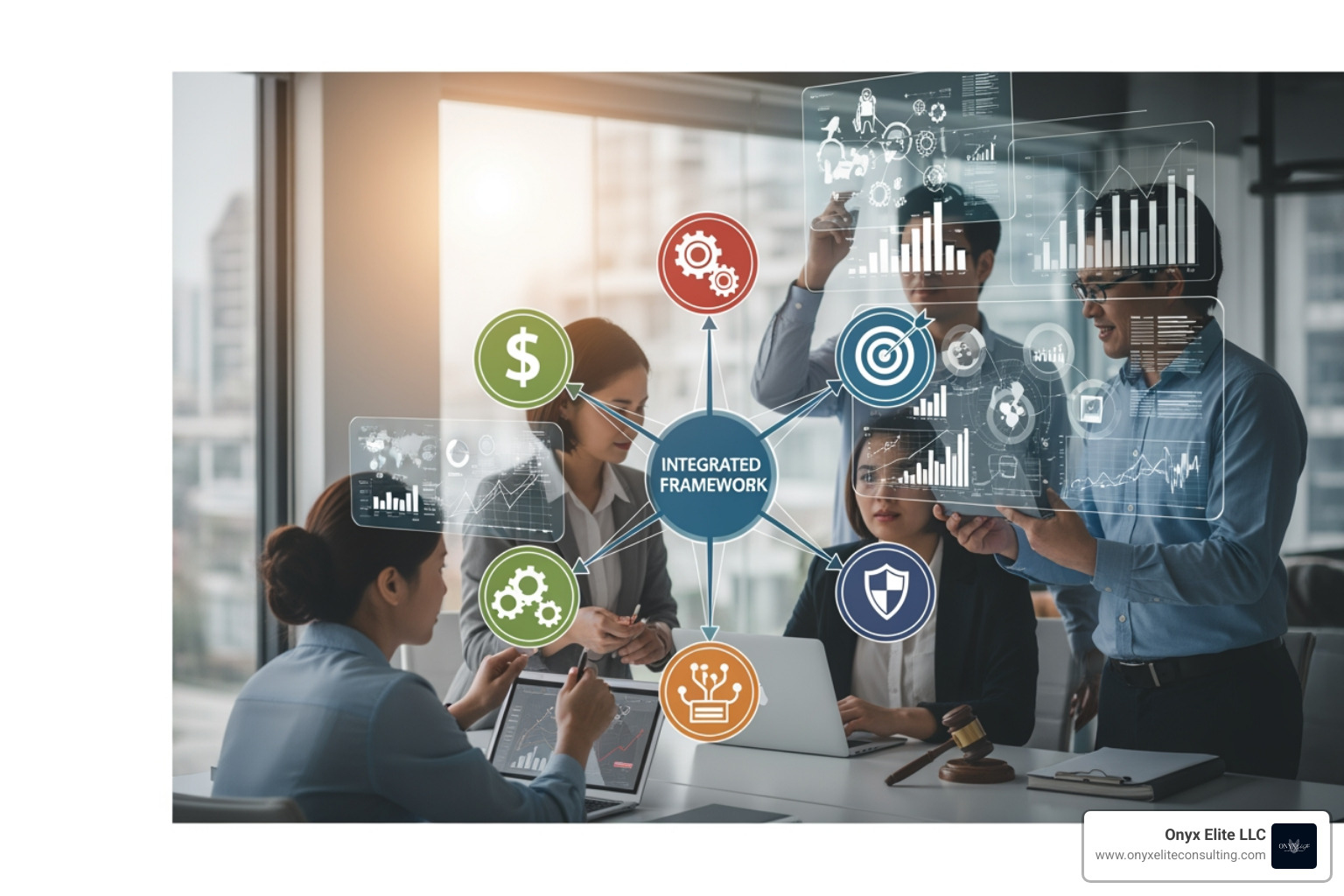
An integrated risk management framework is a structured, organization-wide system that unifies how a business identifies, assesses, and responds to risk — across every department, level, and function.
If you need a quick answer, here is what an integrated risk management framework covers:
| Component | What It Does |
|---|---|
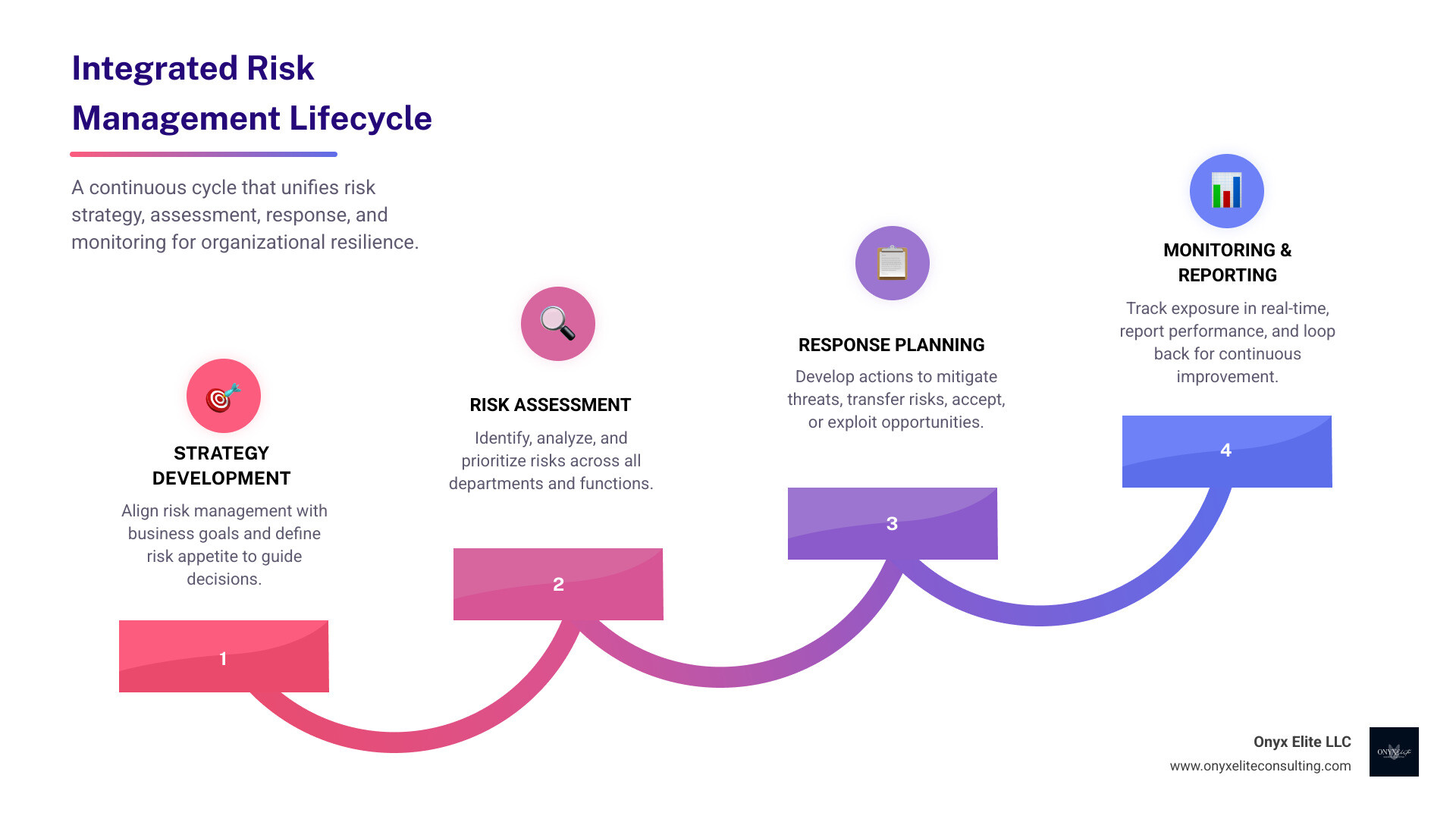
| Strategy Development | Aligns risk management with business goals and risk appetite |
| Risk Assessment | Identifies, analyzes, and prioritizes risks across the organization |
| Response Planning | Defines actions to mitigate, transfer, accept, or exploit risks |
| Monitoring and Reporting | Tracks risk exposure and performance in real time |
Unlike older, siloed approaches, an integrated framework connects these four components into one continuous cycle — giving leaders a clear, unified view of what could go wrong and what opportunities exist.
Risk is unavoidable. It shows up in operations, technology, compliance, strategy, and even in the spaces between departments. The problem is not risk itself — it is managing it in disconnected pieces. When teams handle risk separately, critical exposures get missed, costs rise, and decision-making slows down.
That disconnect between strategy and execution is where most businesses quietly lose ground.
I'm Doru Angelo, Founder and CEO of Onyx Elite LLC, and with over a decade of experience helping organizations build scalable systems and operational clarity, I've seen how a well-designed integrated risk management framework transforms both resilience and performance. The guidance in this article draws on that experience to give you a practical path forward.
Defining the integrated risk management framework: IRM vs. ERM vs. GRC
When we talk about risk, the alphabet soup of acronyms can get a bit overwhelming. You’ve likely heard of ERM (Enterprise Risk Management) and GRC (Governance, Risk, and Compliance). While they sound similar, they play different roles in the corporate sandbox.
Practically speaking, there are no massive walls between ERM and IRM; they are more like two sides of the same coin. ERM is the high-level, strategic view. It’s what the board of directors and executives look at when they want to see the "big picture" of compliance and corporate health.
IRM, on the other hand, is the hands-on, technical work that makes ERM possible. Effectively Integrated risk management is an organization-wide approach that involves input from every single team. It ties together three main areas: technology/cyber risk, operational risk, and enterprise/strategic risk.
Think of it this way: ERM is the architect’s blueprint for a house, while IRM is the actual plumbing, wiring, and structural support that keeps the house standing. You can't have one without the other.
| Feature | ERM (Enterprise Risk Management) | IRM (Integrated Risk Management) | GRC (Governance, Risk, Compliance) |
|---|---|---|---|
| Focus | Strategic, high-level, board-focused | Operational, technical, and tactical | Regulatory, legal, and procedural |
| Integration | Top-down strategy | Vertical and horizontal integration | Process and policy alignment |
| Key Driver | Business objectives | Risk-aware culture and technology | Compliance and audit requirements |
While GRC was the original vision for bringing these elements together, modern complexity has outpaced it. Today, an integrated risk management framework is required to manage the sheer scope of digital and operational threats.
How an integrated risk management framework bridges the strategy-tactics gap
One of the biggest frustrations we see in business is the "strategy-tactics gap." This is when a company has a beautiful five-year vision, but the day-to-day project delivery is a mess. Why? Because the risks aren't being managed in a way that supports the strategy.
Traditional risk management is often too narrow. It focuses only on "threats" (the bad stuff). But true IRM includes "upside opportunities." In Corporate Strategy Development, risk isn't just about avoiding a fire; it's about knowing when to take a calculated leap that could result in a massive payoff.
By using a common risk process framework, we ensure that the tactical teams are speaking the same language as the executives. This proactive management allows us to identify uncertainties that might affect our objectives and turn them into strategic advantages.
Vertical and horizontal integration in risk
To be truly "integrated," your framework needs to work in two directions:
- Vertical Integration: This connects the "boots on the ground" (IT controls, cybersecurity, floor operations) to the "top floor" (The Board and CEO). It ensures that a server vulnerability in the basement is understood as a business continuity risk in the boardroom.
- Horizontal Integration: This breaks down the silos. It connects Business Process Improvement with audit functions, HR, and finance.
When these functions talk to each other, you stop duplicating work. For example, your compliance team and your IT team might both be checking the same security controls. In a siloed world, they do it twice. In an IRM world, they share the data and move on to more important things.
Core Components and Strategic Advantages of IRM
Building a robust integrated risk management framework isn't just about buying a piece of software and calling it a day. It’s about building a culture.
Core elements of a modern integrated risk management framework
To get IRM right, we focus on four major components that act as the pillars of the program:
- Strategy Development: This is where we define the "risk appetite." How much uncertainty are we willing to live with to achieve our goals? This must be aligned with your overall mission.
- Risk Assessment and Identification: We don't just look for "risks"; we look for failure points. Using tools like Lean Operational Excellence helps us identify where processes are weak and where risks are likely to hide.
- Response Planning and Execution: Once we know the risks, what are we doing about them? We can avoid them, transfer them (like with insurance), mitigate them, or—if the opportunity is right—exploit them.
- Monitoring and Reporting: Risk isn't static. It changes every day. We need real-time visibility through centralized dashboards to make quick, informed decisions.
Strategic benefits of a unified approach
Why go through all this trouble? Because the "old way" of managing risk is expensive and slow. By adopting an integrated approach, we see:
- Better Decision-Making: When leaders have high-quality, real-time risk data, they don't have to guess. They can move with confidence.
- Cost Reduction: We find efficiencies by eliminating redundant controls and preventing expensive disasters before they happen.
- Increased Stakeholder Confidence: Investors, customers, and employees feel safer when they see a "risk-mature" organization that knows exactly where it stands.
- Scalable Growth: As we discuss in our guide on 5 Internal Systems That Drive Scalable Growth For Service-Based Businesses, having a system for risk allows you to scale without the wheels falling off.
Implementation Steps and Industry Applications
If you're sitting in West Hartford, CT, wondering how to actually start this, don't worry—you don't have to do it all at once. Implementation is a journey, not a sprint.
Practical steps for implementation
- Environmental Scanning: Look at your internal and external context. What are the regulations in Connecticut? What is the current market volatility?
- Establish Direction: Senior management needs to vocally support the IRM program. Without "top-down" buy-in, it will fail.
- Define the Process: Create a common language. What does "High Risk" actually mean for your company? Everyone needs to use the same dictionary.
- Technology Selection: Choose tools that support Automation and Process Improvement. Repetitive tasks should be handled by software so your team can focus on strategy.
- Continuous Learning: A "risk-smart" workforce is one that learns from mistakes. Document your findings and adjust the framework regularly.
Sector-specific IRM considerations
Different industries have different "danger zones." Here is how we apply IRM across various sectors:
- Healthcare: Here, the framework prioritizes patient safety and HIPAA compliance. We balance clinical risks with operational efficiency to ensure data protection doesn't slow down life-saving care.
- Financial Services: The focus shifts to market volatility, credit risks, and regulatory oversight. Banks use IRM to ensure they have enough capital to survive a downturn while still pursuing growth.
- Manufacturing: Safety is king. We use IRM to monitor Supply Chain Performance and production line reliability. If one vendor in the chain fails, the IRM framework should have already identified a backup.
- Technology: For tech firms in the CT area, cybersecurity and intellectual property protection are the top priorities. IRM helps these companies stay agile while protecting their most valuable digital assets.
The future of IRM and emerging technologies
The world of risk is changing fast. We are moving away from "looking in the rearview mirror" and toward predictive analytics.
Data analytics and artificial intelligence will reshape risk assessment capabilities. AI can scan millions of data points to find patterns that a human might miss, allowing us to predict a threat before it even manifests.
Furthermore, Environmental, Social, and Governance (ESG) factors are becoming a core part of the integrated risk management framework. Modern enterprises are now expected to manage risks related to climate change, social equity, and corporate ethics as part of their standard operations.
Overcoming Challenges and Measuring ROI
Let's be honest: implementing an IRM program isn't always sunshine and rainbows. There are hurdles to clear.
The most common challenge is cultural resistance. People often see risk management as "the department of 'No'." To overcome this, we have to flip the script. Risk management is actually the "department of 'Yes, but safely'." It's about enabling innovation, not stopping it.
Another hurdle is data quality. If you put bad data into your IRM system, you’ll get bad decisions out. This is why we emphasize the need to Enhance Operational Efficiency by cleaning up internal processes first.
Measuring success with key metrics
How do you know if your IRM program is actually working? You look at the numbers.
- Risk Maturity Scores: Use a standardized model to see how your organization's risk culture improves over time.
- Incident Rates: Are you seeing fewer "surprises" or project failures?
- Audit Outcomes: Are your internal and external audits becoming smoother and less expensive?
One of the most powerful statistics we use comes from Lean Six Sigma. Professionals with Lean Six Sigma Green Belt certification have been shown to reduce process risks by up to 40%. This is a massive return on investment for any organization.
Essential technologies and tools
To make IRM work in the modern era, you need the right "tech stack." We often help clients with Technology Consulting Connecticut to select the best platforms. Essential tools include:
- Risk Assessment Platforms: Centralized software to log and track risks.
- Advanced Analytics: Tools that use AI to predict emerging threats.
- Data Visualization: Dashboards that turn complex risk data into easy-to-read charts for the board.
- Automated Workflows: Systems that automatically alert the right person when a risk threshold is crossed.
Frequently Asked Questions about IRM
What is the main difference between IRM and ERM?
While they are closely related, ERM is high-level and strategic, focusing on board-level oversight. IRM is more operational and technical, focusing on the day-to-day controls and cross-departmental integration that make the overall strategy work.
How does IRM address both threats and opportunities?
Traditional risk management only looks at what could go wrong (threats). IRM uses a neutral definition of risk: "the effect of uncertainty on objectives." This means we also look for uncertainties that could have a positive effect, allowing us to exploit "upside risks" for competitive advantage.
What are the four major components of an IRM framework?
The four pillars are Strategy Development, Risk Assessment and Identification, Response Planning and Execution, and Monitoring and Reporting. These four elements work in a continuous cycle to keep the organization resilient.
Conclusion
In today's business environment, staying still is just as risky as moving too fast. An integrated risk management framework provides the balance you need to pursue sustainable growth and operational excellence without being blindsided by the unexpected.
At Onyx Elite LLC, we believe that risk management shouldn't be a burden—it should be a superpower. By breaking down silos, embracing technology, and fostering a risk-aware culture, your business can turn uncertainty into an asset.
If you are ready to transform how your organization handles risk and strategy, we invite you to explore our Services Overview. From our base in West Hartford, CT, we help modern enterprises build the frameworks they need to thrive in a complex world. Let’s build something resilient together.