Beyond the Logo: Your Complete Guide to Brand Building
Why Comprehensive Brand Development is the Foundation of Business Growth

Comprehensive brand development is the strategic process of creating a unified, memorable, and authentic identity that connects your business with your ideal customers across every touchpoint. It goes far beyond designing a logo—it encompasses your mission, values, voice, visual identity, customer experience, and the emotional associations people form with your company.
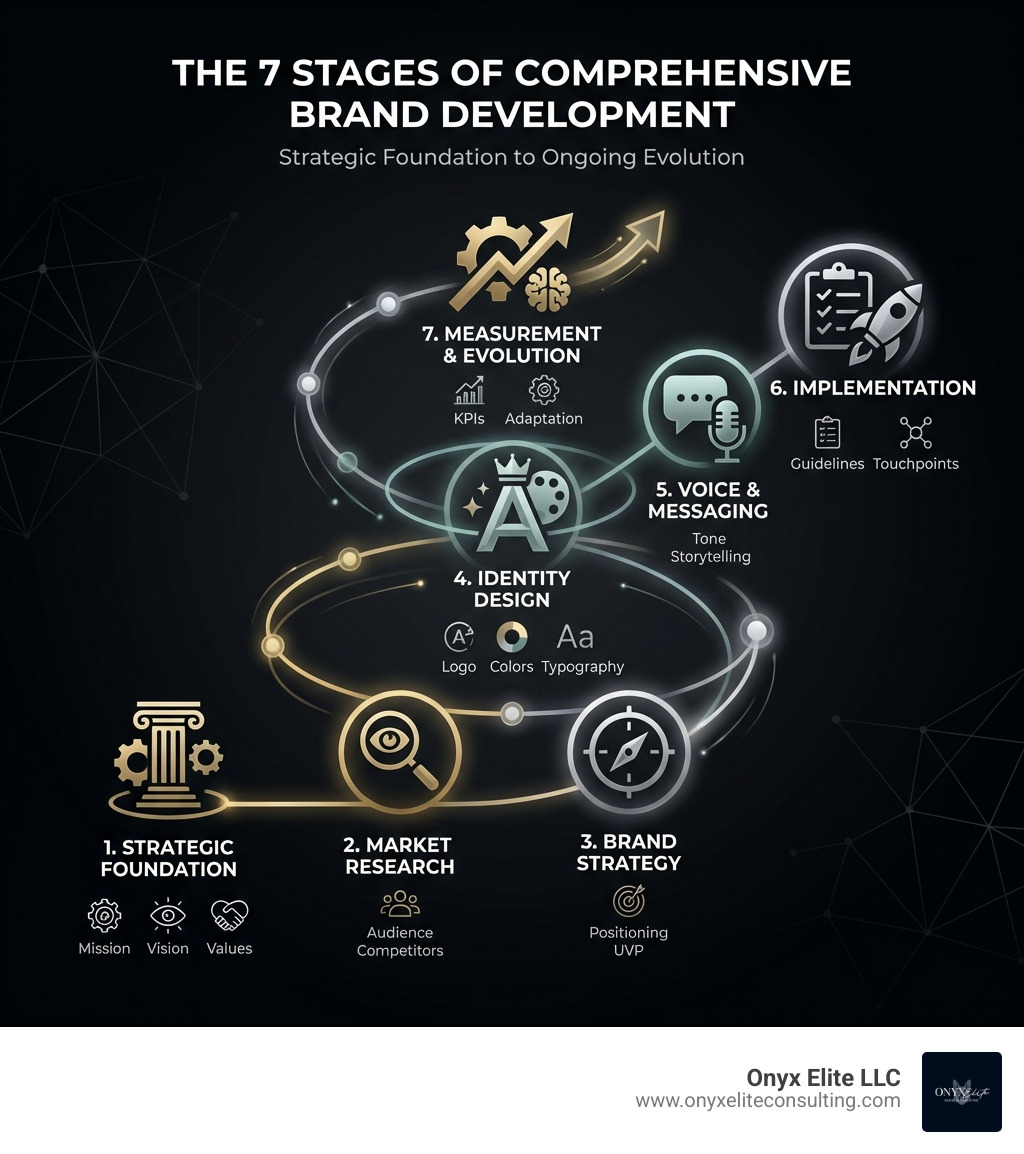
Quick Overview: What Comprehensive Brand Development Includes
- Strategic Foundation - Mission, vision, values, and positioning
- Audience Intelligence - Personas, psychographics, and pain points
- Competitive Analysis - Market gaps and differentiation
- Visual Identity - Logo, colors, typography, and imagery
- Brand Voice - Tone, messaging, and storytelling
- Implementation - Guidelines, training, and touchpoint execution
- Measurement & Evolution - KPIs, tracking, and adaptation
Here's the reality: companies with consistent branding can see up to 33% increases in revenue. Yet most businesses treat branding as a one-time project rather than an ongoing strategic investment. They jump straight to designing a logo without answering fundamental questions: Who are we? Who do we serve? What makes us different? How do we want people to feel when they interact with us?
Without a comprehensive approach, brands become fragmented. Your website says one thing, your social media another, and your sales team tells a third story. Customers feel this inconsistency—and it erodes trust before you even have a chance to earn it.
The good news? A well-executed brand strategy acts as your business's DNA—guiding every decision, from product development to customer service to marketing campaigns. It creates clarity internally and recognition externally. It helps you charge premium prices, attract top talent, and build genuine customer loyalty.
I'm Doru Angelo, Founder & CEO of Onyx Elite LLC, and I've spent over a decade helping businesses transform their operations and market positioning through comprehensive brand development. My work has helped clients secure funding, clarify their market positioning, and build brands that resonate authentically with their audiences.
What is Comprehensive Brand Development and Why It Matters
When most people hear the word "brand," they think of a logo. But at Onyx Elite LLC, we view the logo as just the tip of the iceberg. Beneath the surface lies the massive, essential bulk of your brand: your strategy, your culture, and your reputation. Comprehensive brand development is the holistic process of building that entire structure.
Think of your brand as a business blueprint. You wouldn’t start building a skyscraper in West Hartford by just picking out the paint colors for the lobby, right? You’d start with structural engineering. In the business world, brand strategy directly impacts your bottom line. A study found that consistent brand presentation across all platforms can increase revenue by up to 33%. This shows that a cohesive brand strategy isn’t just a nice-to-have; it’s a powerful driver of business growth.
Beyond revenue, this process is about Brand Development Consulting that creates trust equity. In a market where 9 out of 10 customers read reviews before buying, your brand is the promise that those reviews will be positive. It’s what differentiates you from a sea of "me-too" competitors and builds long-term value that survives market fluctuations.
The Power of Brand Perception
Your brand doesn't actually live on your business card or your website. It lives in the minds of your audience. As we discuss in The New Era of Brand Authority: How Businesses Win in 2026 and Beyond, brand strategy is about shaping emotions and associations.
Consumer psychology tells us that people make buying decisions based on feelings and then justify them with logic. If your brand feels innovative, sleek, and reliable, customers will gravitate toward you even if a competitor is slightly cheaper. It’s about creating an emotional connection that says, "We understand you, and we’re here to solve your specific problem."
Why Consistency is the Golden Rule
If your brand is the "personality" of your business, consistency is its "integrity." Imagine meeting a person who is professional and soft-spoken on Monday, but loud and rebellious on Tuesday. You’d find them hard to trust. The same applies to businesses.
A study by Demand Metric, in partnership with Lucidpress, explored the impact and value of brand consistency. They found that consistency across all touchpoints—from your email signature to your physical storefront—reduces friction in the customer journey. When a customer sees the same colors, hears the same voice, and experiences the same values everywhere, it reinforces recognition. This makes your marketing significantly more efficient because you aren't starting from scratch with every new ad or post.
The Strategic Pillars of Comprehensive Brand Development
Before we even touch a design program, we must establish the pillars of your brand. These are the "non-negotiables" that define who you are. This is often documented in what experts call a "brand bible" or brand strategy document. As Anat Baron, a brand building expert, notes, this document defines the strategy that lays the groundwork for all tactics.
At the core of this document are your Mission, Vision, and Values:
- Vision (The Why): The bold, aspirational future you are working toward.
- Mission (The How): Your current actions and the process of how you pursue that vision.
- Values (The Behavior): The principles that guide how you treat customers and employees alike.
To understand how this fits into your broader business, it’s helpful to distinguish between strategy and marketing:
| Feature | Brand Strategy | Marketing Strategy |
|---|---|---|
| Focus | Identity, values, and long-term perception | Tactics, channels, and short-term sales |
| Goal | Build trust and loyalty | Drive leads and conversions |
| Timeline | Long-term (years) | Short-term (months/weeks) |
| Outcome | Brand equity and authority | Revenue and market share |
Identifying Your Audience for Comprehensive Brand Development
You cannot be everything to everyone. In fact, trying to market to "everyone" is a fast track to marketing to "no one." Effective comprehensive brand development starts with deep audience intelligence.
We use user persona templates to capture critical insights. This goes beyond basic demographics like age or location in Connecticut. We dive into psychographics:
- What keeps them up at night?
- What are their secret aspirations?
- Where do they consume information?
- What frustrates them about current solutions in the market?
Once we know who they are, we use a customer journey map template to detail their emotional needs at every stage—from the first time they hear your name to the moment they become a loyal advocate.
Mapping the Competitive Landscape
To stand out, you have to know what you’re standing against. Competitor analysis isn't about copying what others are doing; it’s about finding the "white space" they’ve ignored.
By benchmarking your competitors' strengths and weaknesses, you can identify market gaps. This leads to the creation of your unique value proposition (UVP). Your UVP is a clear statement that explains how your product solves a customer’s problem better than anyone else. It’s the "reason to buy" that moves a prospect from "just looking" to "take my money."
Bringing the Brand to Life Through Identity and Voice
Now we get to the fun part—the visuals! But remember, these designs are informed by all the research we just did. If your brand is meant to be "authoritative and trustworthy," we aren't going to use neon pink and comic sans.
A successful visual identity includes:
- Logo Variations: A primary logo, a simplified version for social media, and a wordmark.
- Color Palette: Primary, secondary, and accent colors that trigger the right emotional response.
- Typography: Fonts that are readable and reflect your personality (e.g., a serif font for tradition, a sans-serif for modernity).
- Imagery Style: A mood board that defines the types of photos or illustrations you use.
To keep things organized, we recommend using a brand visual identity checklist template. This ensures that whether you’re printing a brochure or launching a website, the look remains identical.
Crafting a Human-Centric Brand Voice
How does your brand "sound"? Is it a helpful neighbor, a sassy disruptor, or a buttoned-up consultant? Defining this is crucial because it dictates how you write every email, social post, and product description.
We use a brand voice template to select adjectives that describe your tone. For example, if your voice is "playful," you might say "Yikes! That wasn't supposed to happen" when a link breaks. If you’re "formal," you’d say "Please accept our apologies for this technical error."
Establishing these editorial standards prevents your content from feeling like it was written by five different people. It makes your brand feel like one cohesive "person" that your customers can get to know.
Storytelling in Comprehensive Brand Development
Humans are hardwired for stories. A great brand story isn't just about your history; it’s about your customer’s future. We often use the Hero-Guide framework:
- The Hero: Your customer (not you!).
- The Conflict: The problem they are facing.
- The Guide: Your brand, showing up with a plan.
- The Resolution: The success they achieve after using your solution.
Using a brand story template, you can craft an authentic narrative that resonates emotionally. Whether it’s your origin story or a customer success story, authenticity is key. People can smell a "corporate" story a mile away—be real, be human, and be bold.
Implementation, Measurement, and Evolution
A strategy is only as good as its execution. This requires internal alignment. Your employees are your most important brand ambassadors. If they don’t believe in the mission, your customers won’t either.
Gallup research shows that engaged employees produce better business outcomes than other employees across industries. When your team embodies the brand strategy, every customer interaction becomes a "moment of truth" that reinforces your value. This internal buy-in is the secret sauce to making your brand unignorable, as we discuss in Visibility is Your Growth Engine: How to Become Unignorable Online.
Measuring Brand Strategy Success
How do you know if your comprehensive brand development is actually working? You track it like you track revenue. While "brand" can feel fluffy, the metrics are concrete.
Key Performance Indicators (KPIs) to watch include:
- Brand Awareness: Are more people searching for your name?
- Customer Loyalty: What is your repeat purchase rate?
- Net Promoter Score (NPS): How likely are customers to recommend you?
- Brand Perception: Use a brand perception survey to see if what people say about you matches what you want them to say.
Brand tracking tools and social media analytics can provide valuable insights into how your brand is perceived and performing. We often help clients set up a marketing dashboard template to visually report these metrics and catch shifts in sentiment before they become problems.
Evolving the Brand Over Time
The world changes, and your brand must change with it. Brand loyalty will decline 25%, but usage of loyalty programs will increase. This prediction for 2025 suggests that brands must work harder than ever to stay relevant.
Regular brand audits (we recommend once a year) help you determine if your messaging still hits the mark. Evolution doesn't mean changing your logo every six months; it means adapting your tactics while keeping your core values intact. If you’ve outgrown your original niche or the market has shifted, it might be time for a strategic pivot.
Frequently Asked Questions about Brand Development
Why should I finalize my logo before a website redesign?
Your logo is your visual anchor. It dictates the color palette, the typography, and the overall "vibe" of your digital presence. If you design a website first and then change your logo, you'll likely end up with a mismatched user experience or expensive redesign costs. Finalizing the brand elements first ensures that your website is a perfect reflection of your identity from day one.
How does a brand style guide prevent misuse?
A brand style guide acts as your brand’s rulebook. It ensures that whether a new intern is making an Instagram post or an external agency is designing a billboard, they use the correct fonts, colors, and tone. It prevents "brand dilution"—where your identity becomes messy and unrecognizable over time. You can start with a one-page brand strategy template to keep the essentials in one accessible spot.
What is the difference between a UVP and a positioning statement?
A Unique Value Proposition (UVP) is external. It’s a clear, punchy statement that tells the customer why they should choose you. A Positioning Statement is internal. It’s a more detailed roadmap for your marketing team that defines your target audience, the category you compete in, and the specific evidence that proves you are better than the competition.
Conclusion
At Onyx Elite LLC, we believe that comprehensive brand development is the most practical step any business can take to cultivate sustainable growth and operational excellence. It isn't just about "looking pretty"—it's about building a strategic foundation that makes every other part of your business easier to run.
When you have a clear identity, your marketing makes more sense, your sales team closes faster, and your customers stay longer. You stop competing on price and start competing on value.
Ready to move beyond just a logo and build a brand that actually drives your business forward? Start your journey with our services overview and let’s see how we can help you become unignorable in your market. Whether you're in West Hartford or scaling across Connecticut, your brand is your most valuable asset. Let's treat it that way.