

Beyond the Basics: A Merchant Account Options Deep Dive
Why Your Choice of Merchant Account Options Defines Your Business Growth

Merchant account options are the different types of payment processing arrangements available to businesses that want to accept credit cards, debit cards, and digital payments. Here's a quick breakdown:
| Account Type | Best For | Key Trait |
|---|---|---|
| Aggregator (PSP/PF) | Small/new businesses | Fast setup, no underwriting |
| ISO (Dedicated) | Established/high-volume | Custom rates, more control |
| Bank-Sponsored | Businesses wanting one relationship | Bundled banking + processing |
| Payment Facilitator | E-commerce startups | Plug-and-play simplicity |
Right now, only 9% of Americans use cash as their primary payment method, according to Pew Research Center data. The volume of non-cash transactions is expected to hit $1.65 trillion this year alone. If your business can't accept digital payments seamlessly, you're leaving revenue on the table.
The challenge? Not all merchant accounts are built the same. Fees vary wildly. Contracts can lock you in. And the wrong setup can freeze your funds or cap your growth.
This guide cuts through the complexity so you can make a smart, confident decision.
I'm Doru Angelo, Founder & CEO of Onyx Elite LLC, and with over a decade of business consulting experience — including helping clients navigate capital markets and funding portfolios exceeding $12.5 billion — I've seen how the right merchant account options can make or break a business's operational efficiency and scalability. Let's explore what you need to know.
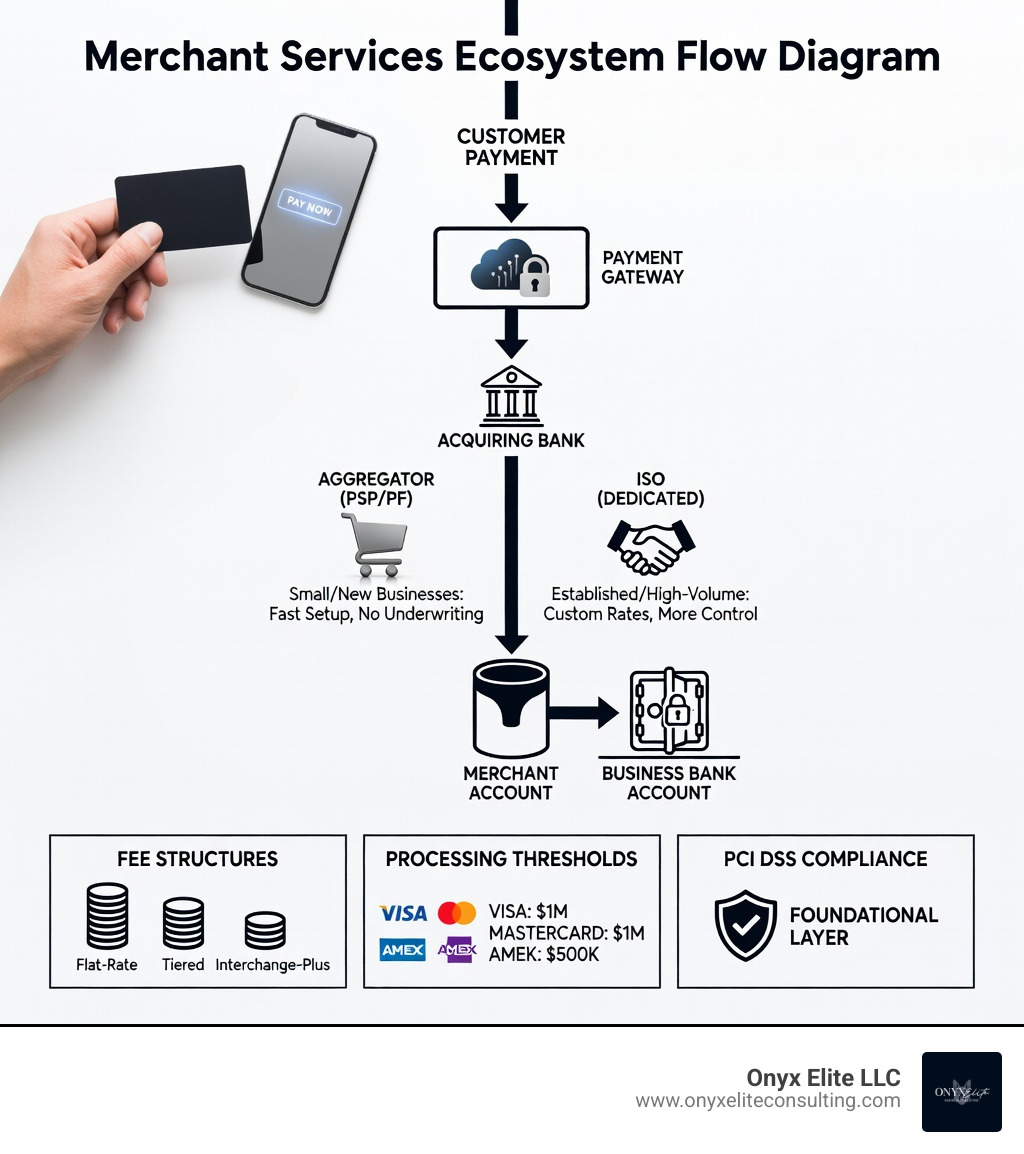
Navigating Modern Merchant Account Options
When we talk about merchant account options, we are looking at the engine that drives your business's cash flow. Many business owners confuse "merchant services" with "merchant accounts," but they aren't quite the same thing. Merchant services is the umbrella term for the entire suite of financial products that allow you to accept and authorize card payments. The merchant account is the specific "middleman" account where funds land after a customer pays but before they are deposited into your actual business bank account.
To make this work, you typically interact with three main components:
- The POS System: The hardware and software used at your physical West Hartford storefront or mobile location to dip, swipe, or tap cards.
- The Payment Gateway: The secure digital "tunnel" that transmits payment data from your website to the processor.
- The Merchant Account: The specialized holding account where settlement takes place.
Choosing between these components requires a strategic eye. For example, if you are a local retailer in Connecticut, you might prioritize a robust POS system. If you are a B2B firm, you might focus more on virtual terminals. For a deeper look at how these pieces fit together, check out our Credit Card Processing Consulting Guide.

Comparing Aggregator and ISO Merchant Account Options
One of the first forks in the road is deciding between an aggregator (often called a Payment Service Provider or PSP) and a dedicated ISO (Independent Sales Organization) account.
- Aggregator Accounts: These providers pool thousands of small businesses into one giant "master" merchant account. Think of it like living in an apartment complex; you share the "building" (the merchant account) with others. The benefit? You can get approved in minutes without intensive underwriting. It’s fantastic for startups or seasonal businesses.
- ISO Merchant Accounts: This is a dedicated account just for your business. It’s like owning your own house. You have your own unique merchant ID, more control over your funds, and often, lower long-term costs. Because these accounts involve individual underwriting (checking your credit and business history), they take longer to set up but offer much higher stability.
We often find that while aggregators are great for getting started, growing businesses eventually crave the stability and lower "per-transaction" costs of a dedicated ISO account.
Processing Thresholds and Migration
Why does the distinction between an aggregator and an ISO matter so much? It comes down to "growth ceilings." Card associations like Visa, MasterCard, and AMEX have strict rules about how much money can flow through an aggregator account before you are required to move to a dedicated one.
- Visa & MasterCard: Generally set a maximum processing threshold of $1,000,000 for aggregator accounts.
- American Express: Sets the bar even lower at $500,000.
If your West Hartford business starts booming and you cross these limits, your aggregator provider might freeze your account or force a sudden migration to a dedicated setup. This can cause massive headaches if you aren't prepared.
Furthermore, every business is assigned a Merchant Category Code (MCC). For example, if you run a veterinary clinic, your code might be 0742. Aggregators use these codes to group you into risk pools. If your industry is considered "high risk," you might find your funds held more frequently in an aggregator model than in a dedicated ISO account where the bank already knows and trusts your specific business operations.
Fee Structures and Pricing Models
Let's talk about the part everyone loves to hate: the fees. We believe pricing should be simple and honest, but the industry doesn't always make it easy. There are four main ways you'll be charged for your merchant account options:
- Flat-Rate Pricing: You pay a fixed percentage (and usually a small cent-per-transaction fee) regardless of the card type. For example, Stripe often charges 2.9% + $0.30 for online sales. It's predictable but can be expensive as you scale.
- Interchange-Plus Pricing: This is the gold standard for transparency. You pay the "Interchange" rate (the wholesale cost set by Visa/MasterCard) plus a small, fixed markup from your provider.
- Tiered Pricing: Transactions are grouped into "Qualified," "Mid-Qualified," and "Non-Qualified." This is often the least transparent model, as providers can shift transactions into higher-priced tiers without much warning.
- Subscription Pricing: You pay a flat monthly membership fee and then pay the wholesale interchange rate with 0% markup on the percentage. This is often the best deal for high-volume businesses.
For a detailed breakdown of how these rates impact your bottom line, visit our page on Credit Card Processing.
Understanding Interchange-Plus vs. Flat-Rate
If we were sitting down for a consultation in our West Hartford office, we’d likely tell you that Interchange-Plus is almost always the winner for established businesses. Why? Because you see exactly what the card networks are charging and exactly what your processor is taking as a "markup."
Flat-rate pricing is like a "convenience fee." You pay for the simplicity of not having to read a complex statement, but you usually pay a premium for it. If your annual sales exceed $5,000 to $10,000, the "convenience" of flat-rate pricing often starts costing you hundreds, if not thousands, of dollars in unnecessary margins.
Hidden Costs and Contractual Obligations
The "sticker price" isn't the only thing you need to watch. We’ve seen many Connecticut businesses get stung by "incidental" fees that weren't clearly explained upfront. Here are the big ones:
- Early Termination Fees (ETF): Some providers charge between $95 and $295 if you close your account before the contract ends.
- PCI Compliance Fees: You might see a monthly or annual fee just to "prove" you are following security standards.
- Monthly Minimums: If you don't process a certain dollar amount in a month, the provider might charge you a penalty fee to make up the difference.
- Chargeback Fees: When a customer disputes a charge, you’ll likely be hit with a fee ranging from $15 to $25 per instance, regardless of who wins the dispute.
Security and Compliance Standards
In an age where data breaches make headlines every week, security isn't just a "nice-to-have"—it's a legal and operational requirement. Every merchant account must adhere to the Payment Card Industry Data Security Standard (PCI DSS).
Compliance involves several layers of protection:
- Encryption: Scrambling data so it’s unreadable if intercepted.
- Tokenization: Replacing sensitive card numbers with a "token" that has no value to hackers.
- EMV Technology: The "chip" in the card that makes it nearly impossible to create counterfeit cards for in-person transactions.
If you find yourself dealing with frequent disputes or fraud, you may need specialized Chargeback Management Services to protect your revenue and your standing with the banks.
Fraud Prevention and Risk Management
Beyond standard PCI compliance, modern merchant account options offer advanced tools like 3D Secure (an extra layer of verification for online shoppers) and real-time risk scoring. These systems look at the "behavior" of a transaction—like where the IP address is located versus the shipping address—and flag suspicious activity before the sale is finalized.
For Connecticut businesses selling high-ticket items, these tools are invaluable. It’s much better to decline a suspicious $2,000 order today than to fight a $2,000 chargeback three weeks from now.
Evaluating Merchant Account Options for Scalability
As we help companies achieve sustainable growth, we always look at whether their payment setup can grow with them. Scalability in merchant accounts looks like:
- Multi-Currency Support: Can you accept Euros or Pounds if you expand globally?
- API Integrations: Does your payment processor "talk" to your accounting software (like QuickBooks) and your CRM?
- Unified Commerce: Can you see your in-person sales and your online sales in one single dashboard?
The goal is to eliminate "data silos." You shouldn't have to log into three different websites to figure out how much money your business made yesterday.
Strategic Integration and Promotional Offers
In 2025, many major banks are offering significant incentives to win your business. If you are setting up a new account in West Hartford or the surrounding area, you should look for "bundled" offers that combine business banking with merchant solutions.
Maximizing Bonuses and Incentives
For example, current 2025 promotions from major institutions often include tiered cash bonuses. Here is how you can maximize these:
- The Chequing Bonus: You can often earn up to $400 just for opening a new business chequing account and completing tasks like bill payments or direct deposits within the first 120 days.
- The Merchant Solutions Bonus: New accounts can sometimes earn $500 to $1,000 in cash. Usually, this requires a minimum three-year contract and processing at least one transaction within the first few months.
- The Savings Tier: If you have extra capital, maintaining a balance (e.g., $10,000 to $100,000) for 120 days can net you an additional $200 to $1,000.
- Credit Card Credits: Some offers include a $100 statement credit if you spend a certain amount (like $3,000) on a new business credit card within the first 90 days.
While these bonuses are enticing, always read the fine print. Most require a three-year commitment, and if you close the account early, you might have to pay the bonus back.
Industry-Specific Solutions
Not every business needs the same tools. A restaurant in West Hartford Center needs a POS that can handle "split checks" and "tip adjustments," while a local e-commerce warehouse needs a system that integrates with shipping carriers.
- High-Volume Processing: If you process over $250,000 annually, you should never accept "standard" rates. You have the leverage to negotiate custom pricing.
- Mobile Payments: For contractors or "field" services, look for providers that offer robust mobile apps and Bluetooth card readers.
- B2B Virtual Terminals: If you take payments over the phone or via invoice, a virtual terminal allows you to "key in" card data securely from your computer.
Frequently Asked Questions about Merchant Accounts
Do all businesses need a dedicated merchant account?
No. If you are just starting out or have low transaction volumes, an aggregator (like Square or PayPal) is often sufficient. However, once you cross the $500,000 to $1,000,000 annual threshold, the card networks (Visa/MasterCard) generally require you to move to a dedicated account.
What is the difference between a payment gateway and a merchant account?
Think of the payment gateway as the digital "courier" that carries the encrypted information from the customer to the bank. The merchant account is the "vault" where the money is held and verified before it is sent to your business bank account. You need both to accept online payments.
How long does it take to set up a new merchant account?
Aggregator accounts can be set up in minutes. Dedicated ISO accounts usually take 3 to 5 business days because they require a human underwriter to review your business's financial health and creditworthiness.
Conclusion
Choosing the right merchant account options is about more than just finding the lowest percentage. It's about finding a partner that supports your operational excellence and scales with your vision. Whether you are a small boutique in West Hartford or a high-volume enterprise expanding across Connecticut, the way you handle payments is the heartbeat of your customer experience.
At Onyx Elite LLC, we specialize in helping businesses navigate these complex financial landscapes. We believe in going beyond traditional solutions to ensure your growth is sustainable and your operations are seamless. If you're ready to optimize your payment processing and keep more of your hard-earned revenue, we're here to help.