

The Perception Playbook: Strategies for Brand Improvement
Why Brand Perception Is the Most Powerful Force in Your Business

Improving brand perception is one of the highest-leverage moves a business can make. Here's a quick breakdown of how to do it:
- Define a clear brand identity - Know what you stand for and show it consistently
- Deliver exceptional customer experiences - Every touchpoint shapes how people feel about you
- Listen to what customers are saying - Use social listening, reviews, and surveys
- Be authentic and transparent - Especially when things go wrong
- Leverage social proof - Reviews, testimonials, and influencer partnerships build trust fast
- Monitor and adapt - Track NPS, sentiment, and share of voice over time
Your brand isn't what you say it is. It's what your customers feel it is.
That gap between how you see your brand and how your customers experience it? That's brand perception — and it silently drives every buying decision your audience makes.
Think about it. When someone sees your logo, your website, or your social media post, they form an instant gut feeling. That feeling is built from every interaction they've had with you — or heard others have. It's emotional shorthand.
And the data backs this up. According to research, 76% of consumers will choose a brand they feel connected to over a competitor — even if the competitor offers a similar product. That connection isn't built through clever ads. It's built through consistent, trustworthy experiences over time.
The good news? Brand perception is not fixed. It can be shaped, shifted, and strengthened — with the right strategy.
I'm Doru Angelo, Founder and CEO of Onyx Elite LLC, and with over a decade of experience in business consulting and branding, I've helped organizations across industries improve brand perception and turn it into measurable revenue growth. This guide distills the strategies that actually work.
Understanding Brand Perception vs. Identity and Awareness
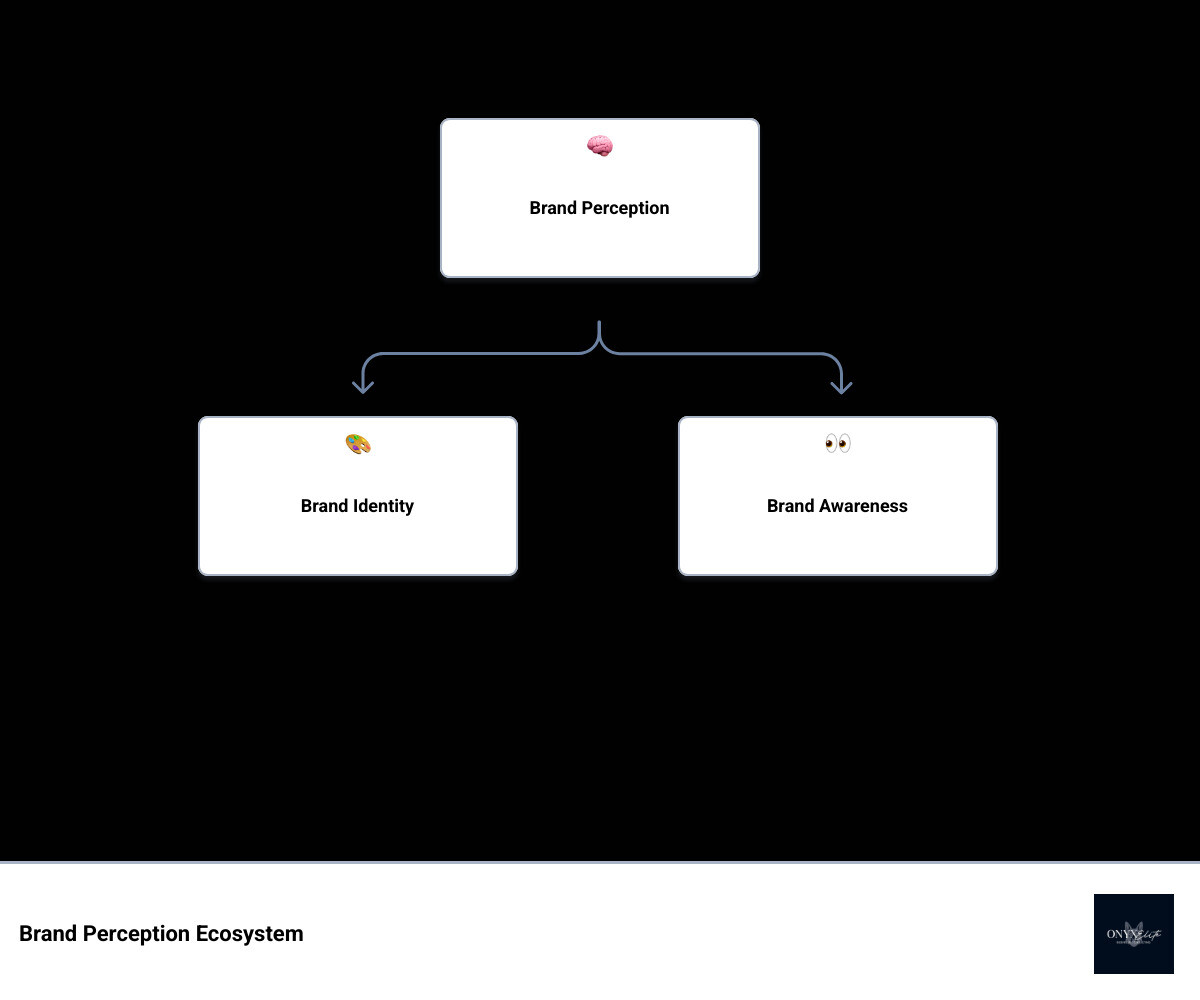
To improve brand perception, we must first understand what it isn't. Many businesses use the terms "awareness," "identity," and "perception" interchangeably, but they represent very different stages of the consumer's mind.
- Brand Awareness is simply the "who." Does the customer know you exist? It’s the first step, but it doesn't guarantee a sale.
- Brand Identity is the "what." This is what we project into the world—our logos, color schemes, and mission statements. It is the image we want to have.
- Brand Perception is the "how." It is the mental shorthand and emotional gut feeling a consumer has when they think of us. It is the result of their experiences, reviews they’ve read, and the quality of our service.
A common disconnect occurs when a company's internal culture doesn't match its external identity. Research on employee brand congruence shows that if employees don't believe in or understand the brand values, the customer will feel that friction. When your team's values align with management's vision, it creates a seamless experience that naturally elevates how the public sees you. At Onyx Elite, our Brand Development Consulting focuses on closing this gap so your internal reality matches your external promise.
Why You Must Improve Brand Perception to Drive Revenue
Why does this matter for your bottom line? Because perception dictates pricing power and loyalty. When people trust a brand, they are less price-sensitive. In fact, 61% of customers are willing to pay at least 5% more if they know they’ll get a superior customer experience.
Trust is the ultimate currency. When you improve brand perception, you move from being a "commodity" to being a "choice." Research shows that customers who feel an emotional connection to a brand are 52% more valuable on average than those who are just "highly satisfied." Satisfied customers buy; connected customers advocate.
The Difference Between Awareness and Emotional Connection
You can spend millions on ads to increase awareness (mental availability), but if that awareness is tied to a "meh" feeling, your ROI will suffer. Brand salience—how quickly your brand comes to mind in a buying situation—is important, but resonance is what closes the deal.
Think of it this way: Awareness is being invited to the party. Perception is being the person everyone wants to talk to at the party. To move from recognition to resonance, we must focus on the emotional drivers of purchase intent—trust, shared values, and consistent reliability.
Key Factors and Metrics to Measure and Improve Brand Perception
Every interaction is a data point. From the way your website loads to the tone of your support emails, these "touchpoints" form the mosaic of perception.
One fascinating piece of research on product variety and expertise suggests that brands offering a thoughtful variety of compatible options are perceived as having greater category expertise. This signals to the consumer that you aren't just selling a product; you are a master of the craft. This is why Brand Elements Design is so critical—every visual and functional choice must scream "expert."
To manage what we can't see, we need a mix of quantitative and qualitative data:
| Method | Type | What it Tells Us |
|---|---|---|
| NPS (Net Promoter Score) | Quantitative | How likely customers are to recommend us (Loyalty). |
| Sentiment Analysis | Qualitative | The emotional tone of online mentions (Feelings). |
| Brand Surveys | Both | Specific feedback on quality, value, and integrity. |
| Social Listening | Qualitative | Unfiltered "water cooler" talk about the brand. |
| Share of Search | Quantitative | How often people search for us vs. competitors. |
Essential Metrics to Improve Brand Perception Over Time
Don't just guess what people think. Use tools like Semrush Media Monitoring to track mentions across the web. This allows you to see if the conversation is trending positive or if a specific pain point is starting to boil over.
Regular Brand Perception Analysis is the only way to ensure your marketing spend is actually moving the needle. We look for the "Net Sentiment Score"—the balance of positive vs. negative talk—to determine if our brand health is improving or declining.
Using Social Media and Online Monitoring
Social media is the world's largest focus group. It offers real-time engagement that can either build or break your reputation in minutes. We recommend setting up Google alerts for your brand name and key executives.
The goal isn't just to broadcast; it's to build a community. This requires rapid response teams that handle untagged mentions and direct tags with the same level of care. When a customer complains on X (formerly Twitter) and a brand responds within minutes with a human, empathetic solution, that "negative" interaction often turns into a "positive" perception of the brand's accountability.
5 Proven Strategies to Improve Brand Perception

If you want to move the needle, you need a coordinated effort. Here are five strategies we use at Onyx Elite to help our clients become "unignorable."
- Prioritize Radical Consistency: If your Instagram looks like a luxury boutique but your website looks like a 90s garage sale, you are bleeding trust. Consistency in color, tone, and quality boosts brand recognition by up to 80%.
- Be Human and Authentic: People don't bond with corporations; they bond with people. Share your "why," show your team, and don't be afraid to have a personality.
- Personalize the Experience: Use data to make your customers feel seen. Whether it's a personalized recommendation or remembering their birthday, these small touches drive a 30-40% increase in conversion.
- Align with Values: Consumers—especially younger ones—want to buy from brands that stand for something. Whether it's sustainability or community support, your values should be visible.
- Optimize for Visibility: You cannot improve perception if you are invisible. Visibility is Your Growth Engine: How to Become Unignorable Online is a core philosophy we teach to help brands dominate their space.
One often overlooked factor is the "Country of Origin" effect. Research on country of origin effects shows that where your brand is perceived to be from can affect quality associations. If you’re operating in multiple markets, you may need to adapt your messaging to align with local perceptions of your home base.
Leveraging Customer Feedback to Improve Brand Perception
Your customers are your best copywriters. When you share user-generated content (UGC), you aren't just showing off a product; you’re showing proof of a promise kept.
Statistics show that 61% of customers are willing to pay more for a brand they know provides a great experience. Create feedback loops where you not only ask for reviews but actually act on them. When a customer sees that their suggestion led to a product improvement, they become a fan for life.
Building Authority Through Thought Leadership
To be perceived as a leader, you must lead the conversation. This involves:
- Educational Content: Solve your customers' problems before they even buy from you.
- Strategic Partnerships: Align with other respected brands or influencers who share your audience but aren't direct competitors.
- Influencer Collaboration: Don't just pick the person with the most followers. Pick the person whose audience trusts their word. Influencer posts often have 4.7 times greater engagement because the trust is already built-in.
Overcoming Negative Perception and Common Pitfalls
Even the best brands hit a snag. Whether it's a product recall or a social media blunder, the key to recovery is speed and transparency. Silence is the enemy of trust.
When facing a crisis, we follow a simple framework: Own it, Explain it, Fix it.
Leadership is the New Currency: The Mindset Shift Every CEO Needs in 2026 emphasizes that modern leaders must be visible and accountable. If a mistake happens, a public acknowledgment from the CEO often carries more weight than a polished PR statement.
Identifying the Source of Negative Brand Images
Before you can fix the problem, you have to find the root.
- Internal Audits: Are your employees unhappy? Disgruntled staff are often the first source of negative public perception.
- Social Listening: Is there a recurring complaint? If 20% of your reviews mention "slow shipping," you don't have a perception problem; you have a logistics problem that is causing a perception problem.
- Competitor Benchmarking: Are you being compared unfavorably to a rival on a specific feature?
Common Pitfalls to Avoid in Brand Management
- Over-Promising: Nothing kills perception faster than a "premium" price tag on a "budget" experience.
- Ignoring Feedback: If customers tell you something is broken and you don't fix it, you're telling them you don't care.
- Fragmented Messaging: Ensure your team in West Hartford, CT, is saying the same thing as your digital ads.
- Lack of Transparency: In the age of AI and instant information, secrets don't stay secret. Be honest about your sourcing, your pricing, and your mistakes.
Conclusion and Frequently Asked Questions
Improving brand perception is not a "one-and-done" project. it is a continuous commitment to excellence. It’s about building a legacy that survives market shifts and economic downturns.
At Onyx Elite Consulting, we believe that The New Era of Brand Authority: How Businesses Win in 2026 and Beyond is built on the foundation of trust and operational excellence. Whether you are a small business in Connecticut or a growing international firm, your reputation is your most valuable asset.
If you’re ready to take control of your narrative and Elevate your brand with Onyx Elite, we are here to help you navigate the complexities of modern branding.
What is the fastest way to change a negative brand image?
The fastest way is a combination of public acknowledgment and tangible action. You must admit the mistake transparently, explain how you will fix it, and then over-deliver on that promise. A humorous, self-deprecating response can also work well if it fits your brand voice, as it "humanizes" the corporation and de-escalates tension.
How does customer experience impact brand perception?
Customer experience (CX) is the primary "proof" of your brand promise. If your branding says "we care," but your customer service is a brick wall, the perception will be that you are dishonest. Positive CX builds emotional connections, which makes customers 52% more valuable and significantly more likely to provide word-of-mouth referrals.
Can small businesses improve brand perception without a large budget?
Absolutely. In fact, small businesses have an advantage: intimacy. You can provide a level of personalized service and community involvement that a giant corporation can't touch. By maintaining a consistent visual identity and engaging authentically on social media, you can build a "premium" perception through quality and care rather than expensive ad buys. Focus on your local West Hartford, CT community and let your satisfied customers be your marketing department.