
The Ultimate Guide to Business Funding Options
Choose Business Funding That Fits Your Growth Plan

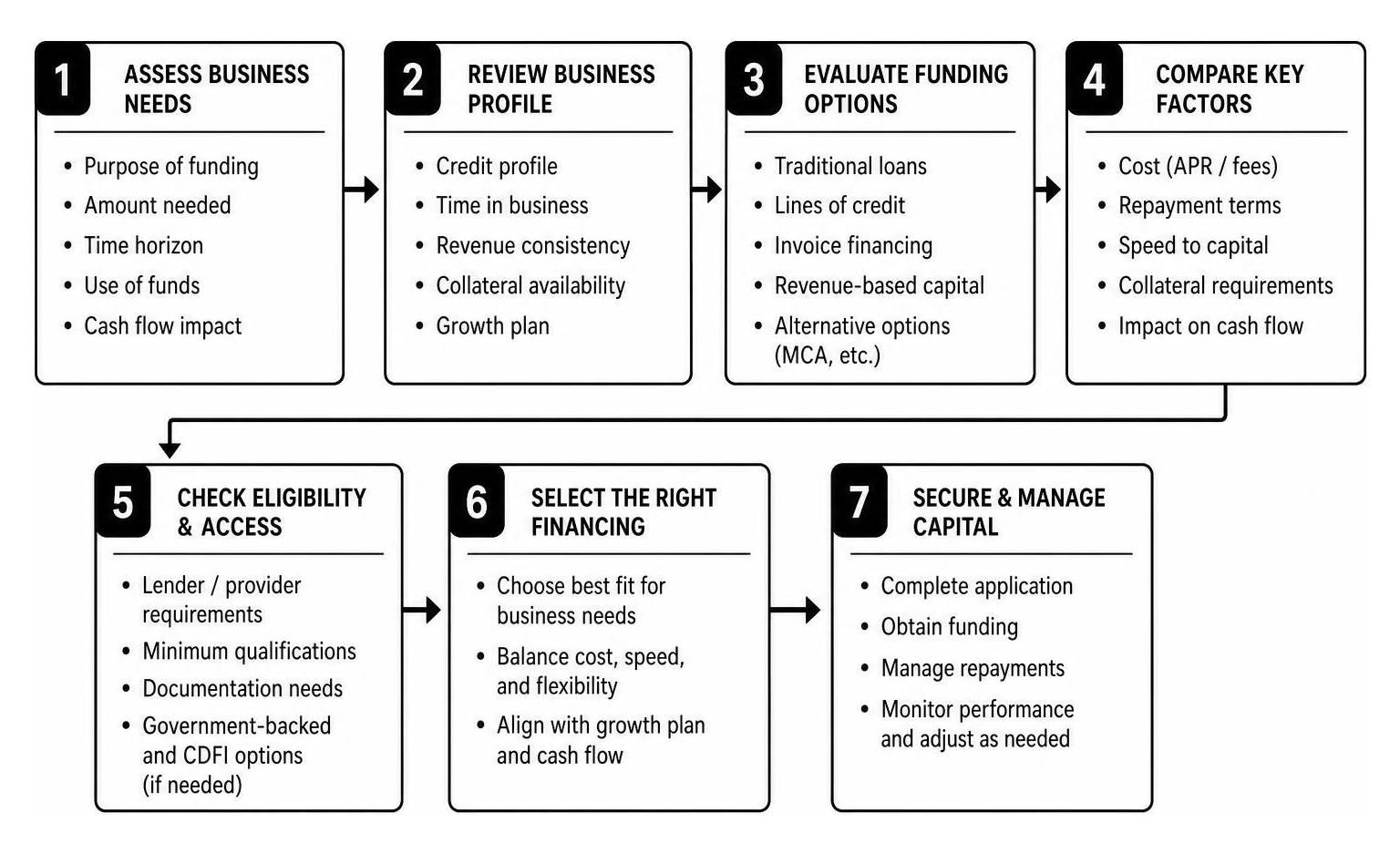
The best business funding option is the one whose cost, repayment schedule, and approval requirements fit the purpose of the money. Use lower-cost, longer-term options such as SBA-backed loans for major assets or expansion; use a line of credit for recurring cash-flow gaps; consider grants for eligible projects; and treat fast alternatives, such as merchant cash advances, with caution because they can put heavy pressure on daily revenue.
Start with three questions:
- What will the capital fund? Inventory, payroll, equipment, real estate, product development, or export orders each call for different financing.
- How quickly will the investment produce cash? Short repayment structures work best when the funded activity has a fast, predictable return.
- What can the business safely repay in a slow month? A funding offer is only useful if it protects cash flow rather than draining it.
Business funding can include loans, revolving credit, grants, equity investment, invoice financing, and revenue-based capital. The right choice depends on your business stage, revenue consistency, credit profile, time in business, collateral, and growth plan. Government-backed programs, Community Development Financial Institutions (CDFIs), and state funds can also help founders who do not meet traditional bank requirements.
I am Doru Angelo, Founder and CEO of Onyx Elite LLC, with more than a decade of experience in business consulting, hospitality, capital markets, and fundraising. My work in business funding focuses on helping organizations connect capital decisions to stronger operations, clearer market positioning, and sustainable growth.
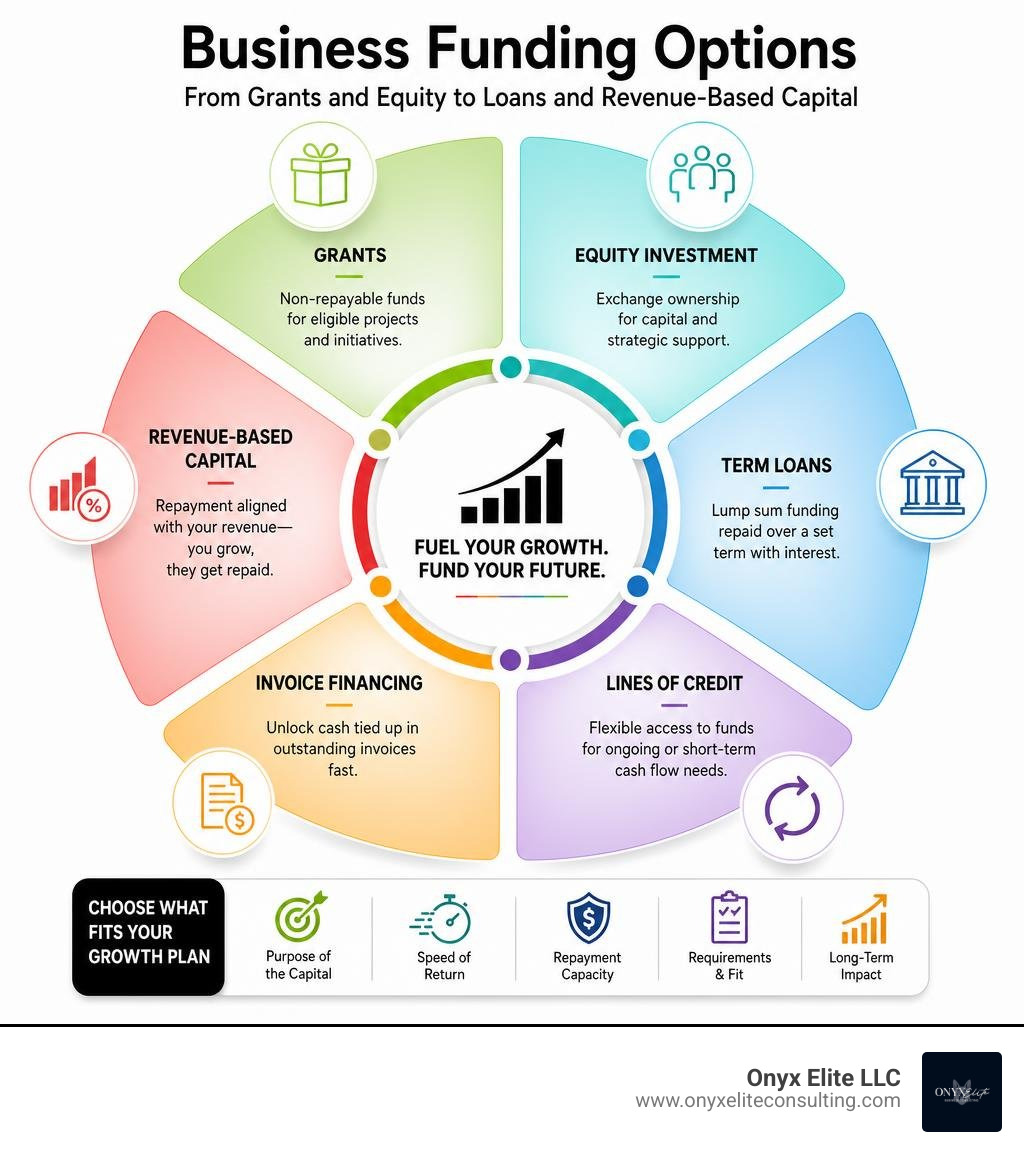
Evaluating Primary Business Funding Vehicles and Structures
Every company's capital stack requires a calculated balance between accessibility, speed, and long-term cost of capital. Selecting the wrong vehicle can restrict cash flow or lead to unsustainable debt service.
To evaluate your options, consider the standard small business financing landscape:
| Funding Mechanism | Typical APR / Cost Structure | Repayment Terms | Speed to Capital | Collateral Requirements |
|---|---|---|---|---|
| SBA 7(a) & 504 Loans | Prime + 2.25% to 4.75% | 7 to 25 Years | 30 to 60 Days | Commercial Real Estate, Equipment, or Blanket Liens |
| Bank Term Loans | 6.5% – 13% APR | 1 to 10 Years | 2 to 5 Business Days | Specific Assets, Receivables, or Personal Guarantees |
| Revolving Line of Credit | 8% – 24% APR | 12 to 36 Months (Revolving) | 1 to 3 Business Days | Unsecured or General Business Assets |
| Invoice Factoring | 1% – 4% Factor Fee per 30 Days | 30 to 90 Days (Invoice Due Date) | 24 to 48 Hours | The Outstanding Invoices (Accounts Receivable) |
| Merchant Cash Advance (MCA) | 1.15 to 1.45 Factor Rate (30%–90%+ APR equivalent) | 3 to 18 Months (Daily/Weekly) | Same Day to 24 Hours | Unsecured; Future Credit Card/Sales Receivables |
| Revenue-Based Financing | 6% to 15% Flat Fixed Fee | 6 to 24 Months (Dynamic) | 1 to 3 Business Days | Future Operating Gross Revenues |
Core Debt and Alternative Business Funding Models
Traditional commercial loans remain a staple for long-term growth. When you need predictable lump-sum disbursements to finance multi-year expansion projects, exploring structured US Business Funding Solutions allows you to secure fixed monthly installments with competitive interest rates.
However, companies experiencing rapid growth often face liquidity crunches caused by extended customer payment cycles. When capital is tied up in outstanding B2B accounts receivable, leveraging Invoice Financing Solutions lets you advance up to 85% to 90% of your invoice value immediately, eliminating 60-day or 90-day waiting periods.
Similarly, seasonal surges or sudden project rollouts can strain operational cash reserves. Deploying structured Business Payroll Funding ensures your team remains fully compensated while receivables clear.
For short-term emergencies, alternative options such as Merchant Cash Advances (MCAs) offer capital within 24 hours based on recent bank deposit volume. Rather than charging compounding APRs, MCAs utilize factor rates (such as 1.25 on a $100,000 advance, requiring $125,000 total repayment). Because remittances are debited daily or weekly from your sales, evaluate your margins carefully to prevent cash flow strain.
Revenue-Based Financing and Credit Facilities
Revenue-based financing (RBF) has emerged as a non-dilutive alternative to venture capital and strict commercial loans. Under an RBF agreement, a funder advances capital in exchange for a fixed percentage—typically 5% to 15%—of your gross daily or weekly revenue.

The primary advantage of revenue-based models is payment flexibility: if sales decline during a slow month, your dollar remittance drops proportionally. RBF providers often review real-time platform data rather than requiring personal guarantees or blanket asset liens.
Another flexible route for managing working capital is credit stacking. By coordinating several unsecured Business Credit Cards EIN Only, early-stage founders can access revolving 0% intro-APR lines for 12 to 18 months, effectively securing zero-cost short-term capital when managed carefully.
Matching Capital Structures to Business Stages and Growth Needs
Capital allocation must evolve alongside your enterprise lifecycle. Deploying high-cost short-term debt to fund long-term research is inefficient, just as surrendering equity for basic inventory needs dilutes ownership unnecessarily.
Applying strategic Cost Efficiency Solutions early helps preserve working capital, strengthen balance sheets, and improve debt-service coverage ratios (DSCR).
Selecting Business Funding for Startups vs. Scaling Enterprises
During early Business Formation, young businesses often lack the two-year operational track record and established balance sheets demanded by conventional institutional lenders.
At this stage, non-dilutive microloans (capped at $50,000 through federal and community channels), local grants, and technical assistance programs provide critical early runway. For a comprehensive breakdown of lifecycle-based strategies, review our Business Funding Guide 2026.
Once an enterprise surpasses $1 million to $2 million in consistent annual revenue, funding options expand toward institutional credit stacks:
- Mezzanine Financing & Venture Debt: Subordinated debt structures that bridge the gap between pure equity and senior secured bank loans, providing capital without requiring substantial equity dilution.
- Commercial Asset-Backed Lines: Securitized revolving facilities scaled to accounts receivable and inventory levels to support continuous scaling.
Purpose-Driven Allocations: Equipment, Payroll, and Exporting
Financing should match the useful life of the acquired asset:
- Equipment and Machinery Financing: Equipment loans use the purchased machinery as direct collateral, preserving cash reserves and qualifying for favorable depreciation deductions under tax codes.
- International Export Financing: Businesses expanding abroad can utilize the State Trade Expansion Program (STEP) and export working capital lines backed by the Export-Import Bank of the United States. These tools de-risk international trade through export credit insurance and specialized letters of credit.
Government-Backed Programs, CDFIs, and Regional Economic Grants
Public initiatives exist to expand access to capital for entrepreneurs who cannot secure traditional financing.

For organizations located in the region, portals such as Business Funding - Connecticut business - CT.gov and community programs like the Connecticut Small Business Boost Fund provide flexible, low-interest capital through participating community development lenders.
SBA 7(a), 504, and Microloan Frameworks
The U.S. Small Business Administration (SBA) mitigates risk for private lenders by guaranteeing portions of each issued loan:
- SBA 7(a) Loan Program: The flagship initiative providing up to $5 million for general working capital, debt refinancing, equipment, and business acquisitions. Maturities extend up to 10 years for working capital and 25 years for real estate.
- SBA 504 Loan Program: Delivered through Certified Development Companies (CDCs), this program offers long-term, fixed-rate financing up to $5.5 million for major fixed assets, land, and owner-occupied commercial real estate.
- SBA Microloan Program: Provides smaller loans up to $50,000 through mission-driven intermediary lenders. These microloans are available to early-stage startups, underserved business owners, and non-profit childcare centers.
Community Development Financial Institutions (CDFIs) and Public Grants
Community Development Financial Institutions (CDFIs) are specialized, mission-driven financial institutions certified to provide fair, transparent financing to underserved markets.
- Targeted Capital Solutions: CDFIs offer specialized micro-lending programs, revolving loan funds, and culturally aligned structures, such as Islamic-compliant murabaha financing.
- Federal Non-Dilutive Grants: Competitive federal programs, including the Small Business Innovation Research (SBIR) and Small Business Technology Transfer (STTR) initiatives, pool funding across 11 federal agencies to award non-dilutive research capital. All federal grant submissions require registration on Grants.gov and an active Unique Entity Identifier (UEI).
Navigating Underwriting Criteria, AI Lending, and Application Readiness
Securing capital on favorable terms requires clear financial presentation and transparent accounting.
Maintaining accurate financial statements through professional Bookkeeping Services helps ensure your balance sheets, income statements, and tax filings reflect a healthy Debt Service Coverage Ratio (DSCR)—ideally 1.25x or higher.
Preparing Financial Documentation and Technical Assistance
To position your company for institutional underwriting approval, prepare a complete financing package:
- Historical Tax Returns: Three consecutive years of business and personal federal tax filings.
- Current Financial Statements: Year-to-date Profit & Loss statements and balance sheets.
- Cash Flow Projections: A forward-looking 12-to-24-month cash flow forecast demonstrating reliable debt service capability.
- Strategic Business Plan: A structured roadmap outlining market demand, unit economics, and operational milestones. Working with an expert through our Business Plan Consultant Ultimate Guide 2026 helps refine your financial model before formal underwriting reviews.
Algorithmic Underwriting and Modern Fintech Shifts in 2026
Underwriting models have evolved through advanced API integrations and automated verification systems:
- Real-Time Cash Flow Underwriting: Lenders evaluate historical banking deposits and merchant transaction volume directly through secure integrations, frequently issuing credit decisions within minutes.
- Probabilistic Cash Flow Forecasting: Advanced algorithms evaluate seasonal sales trends, industry volatility, and platform payment performance to offer tailored capital products without relying entirely on traditional personal FICO scores.
Frequently Asked Questions About Business Funding
How does revenue-based financing handle periods of low or zero sales?
Because revenue-based financing calculates remittances as a fixed percentage of daily or weekly gross receipts, your dollar payment decreases automatically during slow revenue periods. On zero-revenue days, no percentage-based sales deduction is taken. However, borrowers should check whether their agreement includes periodic minimum payment thresholds or fixed maturity dates.
What is the primary difference between a business cash advance and a standard term loan?
A standard term loan is a debt instrument where you borrow a lump sum and repay it over a predetermined schedule with interest (APR). A business cash advance is legally a commercial purchase and sale of future receivables; it utilizes a fixed factor rate rather than an amortizing APR and is collected through automatic daily or weekly sales holdbacks.
What are the minimum requirements to qualify for an SBA 7(a) loan?
Standard eligibility for an SBA 7(a) loan typically requires:
- A personal credit score of 680 or higher.
- At least 24 months of verified operating history.
- A Debt Service Coverage Ratio (DSCR) of at least 1.15x to 1.25x based on historical tax returns.
- Demonstrated equity injection or collateral backing (for larger loan amounts).
- Certification that the business meets SBA small business size standards and operates as a for-profit entity.
Conclusion
Securing the right business funding is a strategic operational decision. By matching funding mechanisms directly to clear business objectives—whether modernizing technology, acquiring real estate, managing invoice delays, or scaling inventory—you protect your operating margins and support long-term stability.
At Onyx Elite LLC, we help business leaders evaluate capital structures, optimize internal operations, and implement resilient growth strategies. Explore our Services Overview to discover how our advisory team can assist your business in building sustainable value.