Ditch the Personal Guarantee: Top Small Business Credit Cards EIN Only
Why Most Business Owners Get Burned Searching for Small Business Credit Cards EIN Only
If you're comparing small business credit cards EIN only, here's the fast answer:
Top EIN-Only Business Credit Cards at a Glance (2026)
| Card | EIN Only? | Personal Guarantee? | Key Requirement |
|---|---|---|---|
| Ramp Corporate Card | Yes | No | $25,000+ bank balance |
| Brex Corporate Card | Yes | No | $50,000+ bank balance |
| BILL Divvy Corporate Card | Yes | No | $20,000+ bank balance |
| Capital on Tap | Partial | Yes | $2,500/month revenue |
| Secured Business Cards | Yes | Sometimes | Cash deposit ($1,000+) |
The bottom line: True EIN-only cards with no personal guarantee exist — but they are not standard small business cards. They are corporate cards that underwrite on your business's cash or revenue, not your personal credit.
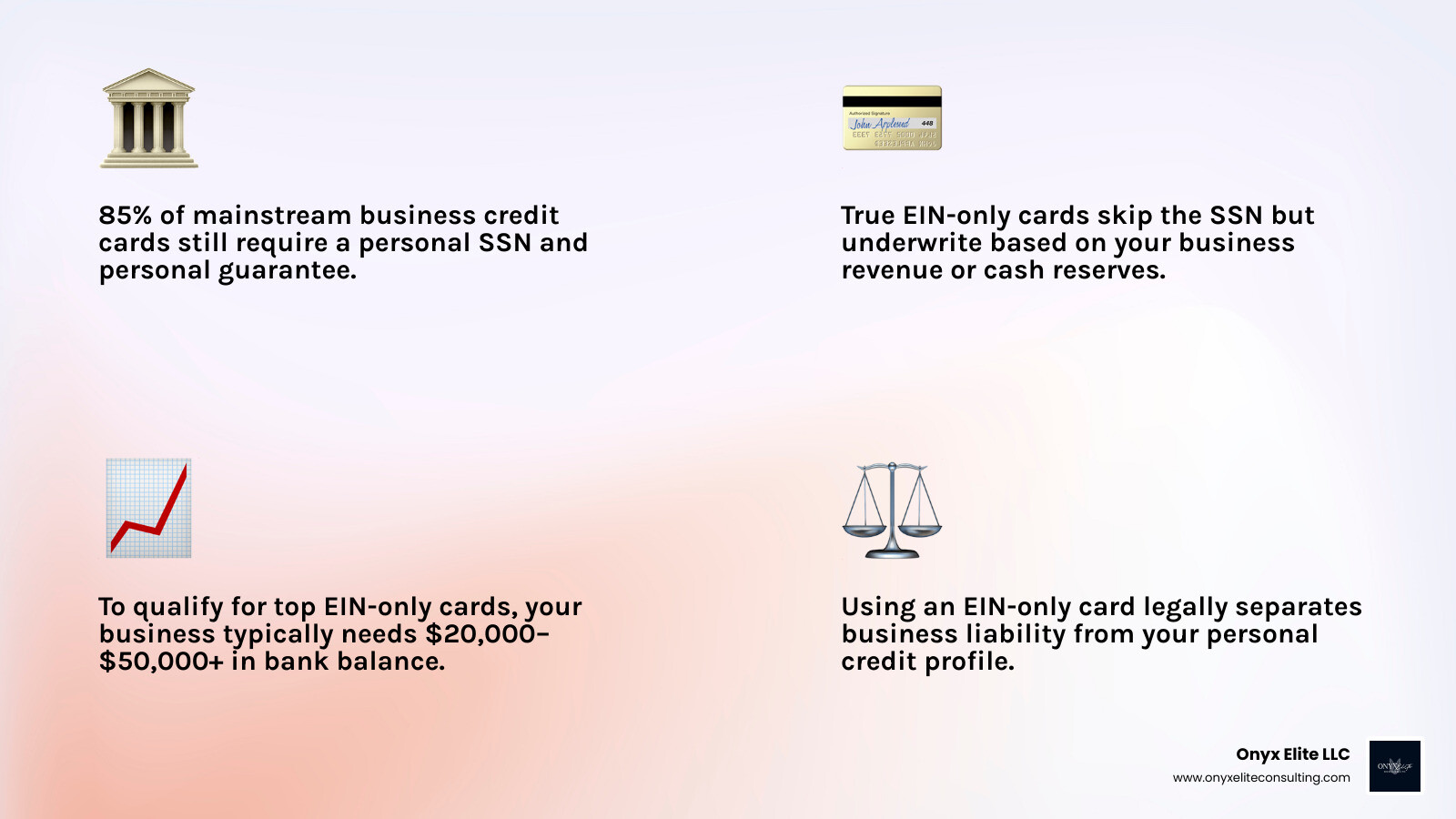
Most business owners searching for an EIN-only card hit the same wall: nearly every mainstream small business credit card still requires a Social Security Number and a personal guarantee. That means your personal credit is on the line if the business can't pay. For founders trying to separate personal and business liability, that's a serious problem.
The good news? A narrow but growing category of corporate and fintech-issued cards genuinely skip the SSN — if your business meets the right financial thresholds. Knowing which cards qualify, and what they actually require, saves you from wasted applications and unnecessary hard pulls on your personal credit.
I'm Doru Angelo, Founder & CEO of Onyx Elite LLC, a business consulting firm with over a decade of experience helping founders navigate funding, credit structure, and financial strategy — including guiding clients through the real landscape of small business credit cards EIN only. If you're building a scalable business and want to protect your personal credit while accessing real spending power, you're in the right place.
The Reality of Small Business Credit Cards EIN Only
Let's clear up the biggest myth in business credit: an Employer Identification Number (EIN) is not a magical shield that automatically hides your personal credit history.
An EIN is simply a nine-digit federal tax identification number issued for free by the IRS. It is used to identify your business entity for tax purposes. While it is true that business credit bureaus use your EIN to track your company’s payment history, major credit card issuers do not rely on it alone when you are a small business starting out.
Why? Because lending money to early-stage businesses is highly risky. Most small business credit cards do not require collateral, meaning the bank has no physical asset to seize if your business fails. To offset this risk, traditional lenders require a personal guarantee. This is a legally binding agreement making you personally liable for any unpaid business debt. To enforce this, they require your Social Security Number (SSN) to run a personal credit check.
If you apply for a standard business card using only an EIN, most major banks will simply reject the application. In fact, giants like Chase explicitly state in their educational materials that they do not offer business credit cards that only require an EIN. You can learn more about their perspective in this guide on How To Get a Business Credit Card With an EIN Only | Chase.
For a deeper dive into how traditional cards compare to alternative structures, check out our resource on Business Credit Cards EIN Only.
True small business credit cards EIN only do exist, but they are structured as corporate credit cards. Instead of looking at your personal FICO score, these card issuers shift the liability entirely to your business. They evaluate your company's real-time financial health, cash reserves, and monthly revenue.
However, this liability shift comes with a catch: sole proprietors are virtually always ineligible. To qualify for an EIN-only corporate card, your business must be legally structured as an LLC, S-Corporation, or C-Corporation.
How to Choose Small Business Credit Cards EIN Only
When you are looking to bypass the personal guarantee and secure an EIN-only card, you have to understand the structural differences in how these financial products operate.
First, most true EIN-only cards are charge cards, not traditional revolving credit cards. A revolving credit card allows you to carry a balance from month to month while paying interest. A charge card, however, must be paid in full at the end of every billing cycle. If you fail to pay, the account is frozen immediately. This structure significantly reduces the issuer's risk, which is why they are willing to waive the personal guarantee.
Second, the underwriting criteria are entirely different. Instead of a soft or hard pull on your personal credit report, issuers use secure digital connections (via platforms like Plaid) to analyze your business bank accounts. They look for:
- Consistent cash reserves: Many fintech corporate cards require you to maintain a minimum daily balance (often between $20,000 and $50,000).
- Monthly revenue: Lenders want to see steady deposits coming into your business bank account.
- Integrations: They evaluate your sales data directly from platforms like Stripe, Shopify, or Amazon.
If your business does not yet have these cash reserves, you may need to look at alternative pathways. For more details on navigating these options, read the breakdown on Get an EIN-Only Business Credit Card Without Using an SSN - Nav.
Who Qualifies for Small Business Credit Cards EIN Only?
Because EIN-only cards rely on corporate underwriting, the barrier to entry is higher than a standard small business card. To qualify, your business typically needs to meet the following baselines:
- Formal Business Structure: You must have an active, registered LLC, LLP, or Corporation. If you are operating as a sole proprietor, you cannot separate your personal liability from your business, making a personal guarantee unavoidable.
- Operational History: Most corporate card issuers want to see that your business has been active for at least 3 to 12 months.
- Strong Cash Balances: You will need to link a business bank account that consistently holds a healthy balance—typically a minimum of $25,000.
- Verified Revenue: If you do not have massive cash reserves, you must demonstrate consistent monthly revenue (usually at least $2,500 to $10,000 per month).
If your business is in the early startup phase and doesn't meet these thresholds, don't worry. There are alternative financing structures designed to help you bridge the gap. Explore your options in our comprehensive guide on US Business Funding Solutions.
Top EIN-Only Business Credit Cards to Compare in 2026
Finding the right card depends on your current cash reserves, your business structure, and your operational goals. Below, we compare the top tech-driven corporate cards and alternative EIN-only options available in 2026.
Tech-Driven Corporate Cards
Fintech companies have revolutionized the business credit space by offering corporate cards that bypass the personal guarantee entirely through real-time financial tracking.
- Ramp Corporate Card: Ramp is widely considered one of the best corporate cards for growing businesses. It requires no personal guarantee, no personal credit check, and offers a flat 1.5% cash back on all transactions. Underwriting is based on your cash balances—you must have at least $25,000 in a linked U.S. business bank account. Ramp also includes world-class expense management software that can help automate your accounting.
- Brex Corporate Card: Brex is a powerhouse for venture-backed startups and funded mid-sized companies. Following Capital One's acquisition of Brex in early 2026, its integration capabilities have expanded even further. Brex requires no personal guarantee but does require a minimum balance of $50,000 for startups to qualify, or $25,000 to maintain your credit limit. It offers high-yielding reward multipliers on software, travel, and advertising.
- BILL Divvy Corporate Card: If your cash reserves are slightly lower but you still have strong monthly revenue, BILL Divvy is an excellent option. It uses a flexible credit model and requires a minimum cash balance of around $20,000. It is highly praised for its budget-enforcement software, which allows you to set strict spending limits on employee cards.
- Intuit Business Credit Card: For businesses deeply embedded in the QuickBooks ecosystem, the Intuit Business Credit Card - 2% Cash Back & No Annual Fee is a game-changer. It offers 2% cash back on everyday purchases and 5% cash back on Intuit products. Underwriting is based on your overall business profile and QuickBooks history rather than a personal credit pull, and receipts upload and sync automatically.
Secured and Alternative Card Options
If your business is too new or doesn't keep $20,000+ in a bank account, you can still secure credit using your EIN through secured cards, store cards, or fleet cards.
- Secured Business Credit Cards: These cards require you to provide a cash deposit that acts as your credit collateral. For example, the Bank of America Business Advantage Unlimited Cash Rewards Secured Mastercard requires a minimum $1,000 deposit. While some secured cards still ask for an SSN to run a soft personal credit check, they are much easier to qualify for with poor or limited personal credit because the deposit mitigates the lender's risk.
- Corporate Gas and Fleet Cards: If your business operates vehicles in Connecticut, fleet cards like the Fuelman Mixed Fleet Card are highly accessible. Many of these cards allow EIN-only approval with no personal guarantee because their usage is strictly limited to fuel and vehicle maintenance.
- Store Credit Cards: Some major office supply or hardware retailers offer commercial store accounts using only your EIN. However, you must read the application carefully, as many retail store cards hide personal guarantee clauses in the fine print.
If you are looking for alternative ways to manage cash flow without relying on personal credit, you might also consider leveraging outstanding customer invoices. You can read about how this works in our guide on Invoice Financing Solutions.
How to Build Business Credit Using an EIN
If you cannot qualify for a top-tier corporate card today, your primary goal should be building an independent business credit profile. Just like personal credit, building business credit takes time—typically 6 to 18 months of consistent, reported financial activity.
Unlike personal credit, which is tracked via your SSN by Equifax, Experian, and TransUnion, business credit is tracked via your EIN by Dun & Bradstreet, Experian Business, and Equifax Business. Interestingly, business credit bureaus do not actually use the EIN itself to generate your credit score; instead, they use proprietary tracking identifiers, such as Dun & Bradstreet's D-U-N-S Number.
To build a strong business credit profile from scratch, follow these actionable steps:
- Establish Your Entity: Register your business as an LLC or Corporation in Connecticut. Set up a physical business address (not a P.O. Box) and a dedicated business phone number listed in national directories.
- Get Your EIN: Apply for your EIN for free directly on the IRS website.
- Open a Business Bank Account: Never mix personal and business funds. Open a business checking account in West Hartford, CT, using your legal business documents and EIN.
- Register for a D-U-N-S Number: Visit the Dun & Bradstreet website to request your free D-U-N-S Number, which is required to establish a business credit file.
- Open Net-30 Vendor Accounts: Apply for net-30 terms with suppliers (like Uline, Quill, or Grainger) that approve accounts using only an EIN and report your payment history to the business credit bureaus.
- Pay Early: Business credit scores (like the D&B PAYDEX score, which ranges from 0 to 100) heavily reward early payments. A score of 80 or above is considered excellent and requires paying your bills on or before the due date.
For a step-by-step roadmap on scaling your business's financial footprint, check out our Get Business Credit Cards Complete Guide.
Frequently Asked Questions about EIN-Only Credit Cards
Navigating the rules of business credit can be confusing. Here are the clear answers to the most common questions business owners ask.
Do EIN-only business credit cards require a personal guarantee?
True EIN-only corporate cards (like Ramp or Brex) do not require a personal guarantee. The business entity itself is solely liable for the debt. However, standard small business credit cards—even if they allow you to apply with an EIN—almost always require a personal guarantee in the fine print. Always read the cardholder agreement carefully before signing.
Can startups get a business credit card with just an EIN?
Yes, but it depends on the startup's financial situation. If your startup is venture-backed or has significant capital (e.g., $50,000+ sitting in a business bank account), you can easily qualify for an EIN-only corporate card. If your startup has no revenue and low cash reserves, you will likely need to start with a secured business credit card or net-30 vendor accounts to build credit first.
Do EIN-only cards affect my personal credit score?
Generally, no. Because true EIN-only cards do not require your Social Security Number during the application process, the issuer cannot perform a hard inquiry on your personal credit file. Furthermore, because there is no personal guarantee, your ongoing spending habits and balances will not be reported to consumer credit bureaus, protecting your personal FICO score.
Conclusion
Securing small business credit cards EIN only is entirely possible, but it requires moving away from traditional banking models and embracing modern, tech-driven corporate cards or dedicated credit-building strategies. By separating your personal assets from your business liabilities, you protect your financial future while giving your company the independent spending power it needs to scale.
At Onyx Elite LLC, we believe in helping companies achieve sustainable growth and operational excellence. Based in West Hartford, CT, our award-winning consulting firm goes beyond traditional solutions. We specialize in strategic planning, brand development, and tailored financial consulting to help Connecticut businesses structure their operations for long-term success.
Ready to unlock real spending power for your company? Dive into our comprehensive blueprint, the Get Business Credit Cards Complete Guide, or contact us today to build a tailored financial strategy for your business.