
The Complete Guide to Business Funding Solutions
Why Finding the Right Business Funding Solutions Can Make or Break Your Growth

Business funding solutions are the financial tools and programs that give companies the capital they need to start, operate, and grow.
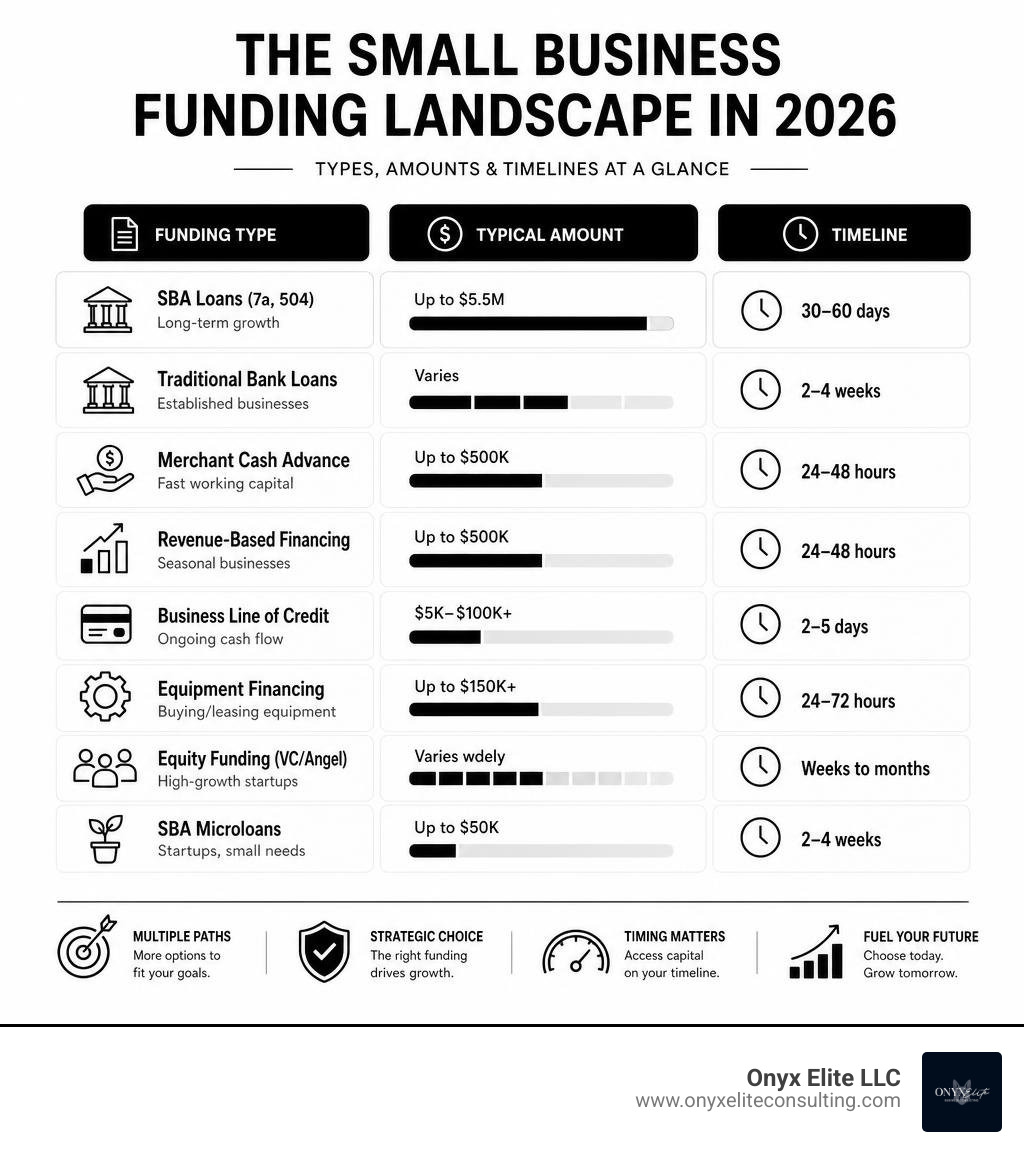
Here are the most common options available to small businesses in 2026:
| Funding Type | Best For | Speed | Typical Amount |
|---|---|---|---|
| SBA Loans (7a, 504) | Long-term growth | 30-60 days | Up to $5.5M |
| Traditional Bank Loans | Established businesses | 2-4 weeks | Varies |
| Merchant Cash Advance | Fast working capital | 24-48 hours | Up to $500K |
| Revenue-Based Financing | Seasonal businesses | 24-48 hours | Up to $500K |
| Business Line of Credit | Ongoing cash flow | 2-5 days | $5K-$100K+ |
| Equipment Financing | Buying/leasing equipment | 24-72 hours | Up to $150K+ |
| Equity Funding (VC/Angel) | High-growth startups | Weeks to months | Varies widely |
| SBA Microloans | Startups, small needs | 2-4 weeks | Up to $50K |
Access to capital is one of the most pressing challenges facing small businesses today. Nearly 50% of small businesses in the United States do not receive all the financing they seek. Yet small businesses collectively drive roughly 40% of U.S. GDP — making the funding gap not just a business problem, but an economic one.
The gap between what small businesses need and what they can actually get is estimated at anywhere from $350 billion to $750 billion in the U.S. alone. That's a staggering number — and it means millions of founders are leaving growth on the table, not because their ideas aren't good, but because they can't find the right funding path.
The problem isn't just access. It's confusion. The landscape has changed dramatically. Traditional banks are no longer the only option — or even the best one for many businesses. Alternative lenders, SBA-backed programs, revenue-based advances, and equity platforms have all expanded the menu. But more options also means more complexity, more fine print, and more risk of making a costly mistake.
This guide cuts through that noise.
I'm Doru Angelo, Founder & CEO of Onyx Elite LLC, with over a decade of experience in business consulting and capital markets — including facilitating business funding solutions for a client portfolio with cumulative funding needs exceeding $12.5 billion. My goal with this guide is to give you a clear, honest map of your options so you can make the right call for your business.
Understanding the Main Types of Business Funding Solutions
To navigate the complex world of business capitalization, we must first understand the fundamental structures of capital. Broadly speaking, business funding is divided into three primary categories: debt financing, equity financing, and working capital solutions.

- Debt Financing: This is money you borrow and must pay back over time, usually with interest. The primary advantage of debt is that you maintain complete ownership and control of your company. The downside is the monthly financial obligation, which can strain cash flow during lean times.
- Equity Financing: This involves selling a portion of your business to investors (such as angel investors or venture capitalists) in exchange for capital. You do not have to pay this money back, but you do give up a share of your profits and, often, a say in how your company is run.
- Working Capital Solutions: These are short-term financing options designed to cover day-to-day operational expenses, inventory purchases, or temporary cash flow gaps. Examples include accounts receivable financing, merchant cash advances, and Invoice Financing Solutions.
By selecting the right category, you align your funding structure with your operational goals. Let's look closely at how these play out across traditional, government-backed, and alternative markets.
Traditional Bank Loans and Lines of Credit
For generations, the local bank was the first and only stop for a business owner seeking capital. Traditional bank loans remain a highly desirable option because they offer some of the lowest interest rates and most stable terms on the market.
Traditional bank products generally fall into two categories:
- Term Loans: A lump sum of cash paid back over a set period (usually 1 to 10 years) with a fixed or variable interest rate. These are ideal for major, one-time investments like purchasing real estate or expanding a facility.
- Lines of Credit: A revolving pool of funds that you can draw from as needed. You only pay interest on the money you actually use, making this the perfect safety net for managing seasonal cash flow dips or unexpected expenses.
However, traditional banks are notoriously conservative. Because they are highly regulated, they look for ways to minimize risk. This means they typically require an exceptional personal and business FICO score (often 680 or higher), several years of profitable business tax returns, and physical collateral (such as property or equipment) to secure the loan. For startups or businesses recovering from a challenging year, qualifying for these products can feel nearly impossible.
SBA-Backed Loans for Long-Term Growth
To bridge the gap between conservative banks and ambitious small businesses, the U.S. Small Business Administration (SBA) offers government-backed loan programs. The SBA does not actually lend money directly to businesses (except in the case of disaster recovery). Instead, it guarantees a portion of the loan—up to 85%—which reduces the risk for partner lenders and encourages them to approve businesses they might otherwise reject.
The most popular SBA programs include:
- SBA 7(a) Loans: The flagship program, offering up to $5.5 million for working capital, debt refinancing, or purchasing equipment. These loans feature highly competitive rates (often around Prime + 2.75%) and long repayment terms.
- SBA 504 Loans: Designed specifically for major fixed asset purchases, such as commercial real estate or heavy machinery.
- SBA Microloans: Smaller loans of up to $50,000, administered through local non-profit community lenders, which are excellent for startups and early-stage businesses.
If you are operating in our home state of Connecticut, you can explore specialized state-level resources and SBA-backed loan options in Connecticut to see how local initiatives can supplement federal programs.
While SBA loans offer incredible terms, they are famous for their extensive paperwork and slow processing times. It is common for an SBA loan to take 30 to 60 days to close, meaning they are not a viable option if you need emergency cash next week.
Alternative Business Funding Solutions for Rapid Capital
When speed is your top priority, alternative business funding solutions step into the spotlight. Over the last decade, fintech platforms and private lenders have revolutionized the industry by shifting the focus from rigid credit scores to real-time cash flow analysis.
Two of the most common alternative products are:
- Merchant Cash Advances (MCAs): An advance of capital based on your future credit card sales. Instead of a fixed monthly payment, the lender automatically takes a percentage of your daily or weekly credit card transactions. If your sales slow down, your payment drops, which helps protect your cash flow.
- Revenue-Based Financing: Similar to an MCA, but repayments are tied to your total monthly deposits rather than just credit card sales.
Alternative financing is incredibly fast. Platforms like Globo Fund and Fora Financial can deliver approval decisions in hours and deposit funds into your account within 24 to 48 hours.
However, this speed and convenience come at a price. Alternative funding often carries significantly higher costs than traditional bank loans, frequently structured as "factor rates" rather than standard APRs. Before moving forward, it is crucial to read the fine print on US Business Funding Solutions to understand the true cost of alternative capital.
Comparing Traditional Bank Loans vs. Alternative Financing
To help you evaluate your choices, let's look at a direct head-to-head comparison of traditional bank products versus alternative lending solutions:
| Feature | Traditional Bank Loans | Alternative Financing |
|---|---|---|
| Speed of Funding | Slow (2 to 6 weeks) | Rapid (24 to 48 hours) |
| Cost of Capital | Low (typically 6% to 12% APR) | High (factor rates equivalent to 20% to 80%+ APR) |
| Approval Rates | Low (highly selective) | High (accessible to most operating businesses) |
| Underwriting Focus | Credit score, collateral, historical tax returns | Daily/monthly cash flow, bank deposit volume |
| Repayment Structure | Fixed monthly payments | Daily or weekly automated clearing house (ACH) drafts |
Understanding these trade-offs allows you to make strategic decisions. If you have time on your side and pristine financials, traditional bank or SBA loans are almost always the superior choice. If you are facing an urgent inventory purchase or a time-sensitive growth opportunity, alternative financing can provide the necessary bridge.
Debt-Based vs. Equity-Based Funding
Another critical decision is choosing between debt and equity.
If you choose equity-based funding, you will likely pitch to venture capital firms or angel investors. This path is common for high-growth tech startups or ecommerce brands looking to scale rapidly. Platforms like Clearco offer an interesting middle ground with non-dilutive capital models, allowing DTC brands to secure cash for inventory or marketing without giving up equity or personal guarantees.
The trade-off is clear:
- Debt-Based: You keep 100% of your company, but you carry the risk of monthly repayment obligations that must be met regardless of business performance.
- Equity-Based: You gain a partner with deep pockets and valuable industry connections, and you face no repayment stress if the business fails. However, you give up a portion of your future profits and ultimate decision-making control.
The Role of Business Credit Cards in Modern Funding
For many small business owners, business credit cards are the unsung heroes of working capital. When managed strategically, they can serve as a highly flexible, low-cost funding solution.
A particularly effective strategy is "credit stacking"—combining multiple business credit cards that offer 0% introductory APR periods. This allows you to access tens of thousands of dollars in interest-free working capital for 12 to 21 months, giving you a runway to launch a new product line or bridge a seasonal gap without paying a dime in interest.
To execute this safely, you must understand the rules of the game. We recommend reading our Guide to getting business credit cards to learn how to build a strong profile, as well as exploring options for Business Credit Cards EIN Only if you want to keep your personal credit completely separate from your business liabilities.
Eligibility Requirements and How to Qualify
Qualifying for business funding is not a guessing game; it is a matching process. Lenders look at specific metrics to determine your risk level.

Generally, lenders evaluate four key pillars:
- Credit Score: Your personal and business FICO scores tell lenders how reliably you pay back your debts.
- Time in Business: Startups are statistically risky (20% fail in year one, 50% within five years). Lenders usually require at least 6 months of operating history for alternative products and 2+ years for traditional bank loans.
- Monthly Revenue: Lenders want to see consistent cash flowing through your accounts to support repayment.
- Bank Statements: Usually, 3 to 6 months of business bank statements are required to verify your deposit history and check for negative balances or overdrafts.
Navigating Funding with Bad Credit or Limited History
If your credit score is less than stellar, do not despair. The rise of alternative underwriting means that a low credit score is no longer an automatic rejection.
Modern fintech platforms focus heavily on cash flow analysis. If your business is consistently generating $15,000 to $20,000 in monthly revenue, lenders like Motus Funding or Mach Funding are often willing to look past a low credit score. They will utilize a soft credit pull to evaluate your profile—which does not hurt your score—and structure an offer based on your real-time cash flow.
For business owners in our local area, working with regional partners like Hartford CT small business loans can open doors to community-focused lending programs designed specifically to support local economic development.
Essential Documentation for Your Application
To ensure a smooth and rapid application process, we recommend gathering your documentation ahead of time. Being organized can mean the difference between getting funded in 24 hours or waiting weeks.
Your preparation checklist should include:
- Business Bank Statements: The last 3 to 6 months of consecutive statements.
- Tax Returns: Personal and business federal tax returns for the last two years.
- Financial Statements: Up-to-date Profit & Loss (P&L) statements and Balance Sheets.
- Business Plan: A comprehensive roadmap showing exactly how the funding will be used to generate revenue.
If you need help building a professional, lender-ready package, read our Guide to hiring a business plan consultant to see how expert guidance can drastically improve your approval odds.
Avoiding Pitfalls: Predatory Lending and Grant Scams
As the small business funding gap has widened, predatory lenders and fraudulent consultants have stepped into the void. Protecting your business from these bad actors is just as important as securing the capital itself.
Red Flags of Deceptive Funding Consultants
The most common scams targeting small business owners involve "guaranteed" government or private grants. Let's be completely clear: no legitimate consultant can guarantee you will win a grant. Grants are highly competitive, merit-based programs with rigid eligibility criteria.
We have seen numerous complaints filed with the Better Business Bureau (BBB) against deceptive funding operations. For example, some predatory consulting firms charge business owners high upfront fees—ranging from $1,500 to $5,000—promising to secure grants, only to deliver generic business plan templates and broken links to outdated Google searches. Once the fee is paid, these operations often cease communication entirely.
Be on high alert for these warning signs:
- Guarantees of Funding: Any promise of a guaranteed grant or loan approval.
- High Upfront Fees: Legitimate lenders do not charge massive upfront application fees before reviewing your file.
- Vague Payment Structures: Lenders that refuse to disclose their fees, factor rates, or equivalent APRs in writing.
- Pressure Tactics: Consultants pushing you to sign paperwork immediately without allowing your attorney or accountant to review it.
How to Safely Evaluate Business Funding Solutions
Before signing any funding agreement, take a deep breath and conduct a rigorous contract review.
Always demand a full disclosure of the Annual Percentage Rate (APR) and the exact payment schedule. If you are using an alternative product like an MCA, calculate the total cost of capital. For instance, if a lender advances you $10,000 and requires you to pay back $13,000 over six months, your factor rate is 1.3, but your annualized interest rate is incredibly high. Make sure your business margins can support this cost without putting you in a "debt spiral" where you must take out a second loan to pay off the first.
Whenever possible, look for trusted state-backed initiatives. In Connecticut, the Connecticut Small Business Boost Fund is an excellent, safe, and highly supportive resource designed to offer fair, low-interest capital to local business owners without predatory terms.
Frequently Asked Questions about Business Funding
How quickly can I access funds through alternative lenders?
Alternative lenders are built for speed. The application process is typically fully digital, taking about 10 minutes to complete. By utilizing secure bank verification tools like Plaid, lenders can analyze your cash flow in real-time. You can often receive an approval decision in as little as 4 hours and have the funds deposited into your account via ACH within 24 to 48 hours.
What is the difference between a merchant cash advance and revenue-based financing?
While both are alternative funding options, the key difference lies in how repayments are structured:
- Merchant Cash Advances (MCAs) are tied directly to your credit card processing volume. The lender takes a fixed percentage of your daily credit card sales.
- Revenue-Based Financing looks at your total monthly deposits. Repayments are drafted automatically from your business bank account as a percentage of your overall monthly revenue, making it more suitable for businesses that do not rely heavily on credit card transactions.
Can I get business funding without a personal guarantee?
Yes, but it depends on the product. Equipment financing often does not require a personal guarantee because the equipment itself serves as collateral. Non-dilutive capital platforms like Clearco also offer funding without personal guarantees or blanket liens by tying repayments directly to business performance. However, for standard bank loans, SBA loans, and most alternative products, a personal guarantee is a standard requirement.
Conclusion
Securing the right business funding solutions is not just about getting cash into your bank account; it is about choosing a strategic capital partner that aligns with your long-term business goals.
At Onyx Elite Consulting, we believe that capital decisions should be strategic, not rushed. We go beyond traditional consulting to help West Hartford and Connecticut businesses navigate capital structures, optimize their cash flow, and build resilient financial safety nets for sustainable growth.
If you are ready to streamline your business operations and maximize your revenue, we invite you to take the next step. Optimize your cash flow with Onyx Elite credit card processing and let us help you build a solid foundation for your business's future.