

A Quick Start Guide to Business Credit Cards with EIN
Business Credit Cards with EIN: What Founders Need to Know
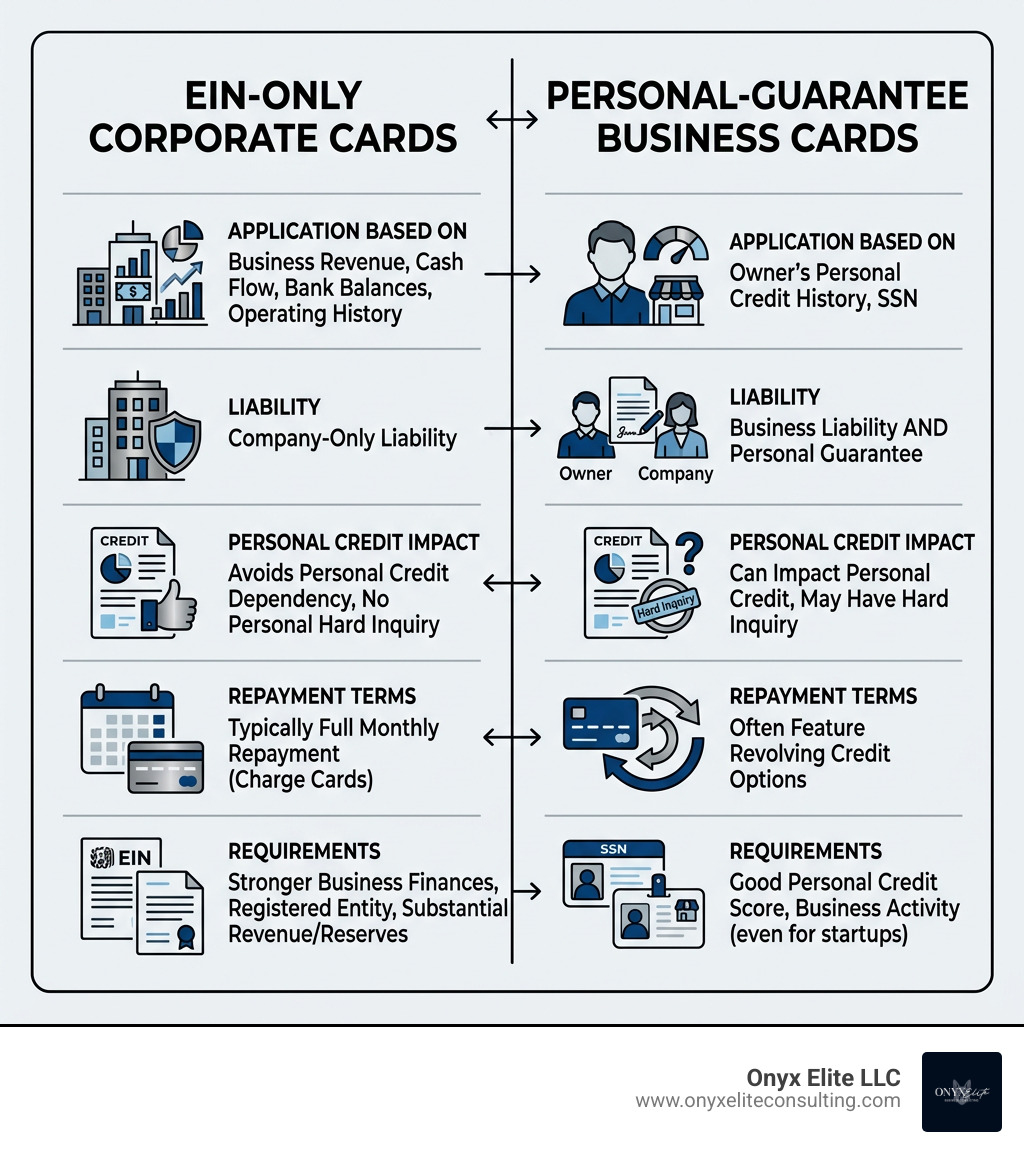
You can apply for business credit cards with EIN to separate company spending from personal spending, but an EIN alone is not enough for most small-business card applications. Traditional banks usually also ask for the owner's Social Security number and a personal guarantee. True EIN-only options are generally corporate or charge cards that review the company's revenue, cash flow, bank balances, and operating history instead of personal credit.
To get started:
- Formally register the business and get a free EIN from the IRS.
- Open and actively use a business bank account.
- Review corporate card options if your company has meaningful cash reserves or steady revenue.
- If you do not qualify yet, consider a secured business card or a standard business card with a personal guarantee while building commercial credit.
The tradeoff is simple: EIN-only cards can reduce direct reliance on your personal credit and may avoid a personal guarantee, but they often require stronger business finances and may require full monthly repayment. A card that uses your SSN can be easier to obtain, though the application may create a hard inquiry on your personal credit report and you can be personally liable if the company does not pay.
I am Doru Angelo, Founder and CEO of Onyx Elite LLC, with more than a decade of consulting, capital-markets, and business-growth experience. In this guide, I will help you evaluate business credit cards with EIN as part of a practical capital and cash-flow strategy.
Understanding Business Credit Cards with EIN: How They Work
An Employer Identification Number (EIN) is a unique nine-digit tax identifier issued by the IRS. It serves as your business entity’s federal tax fingerprint. When evaluating corporate cards, financial institutions review this tax identification number along with your formal entity structure, revenue, and cash reserves to underwrite credit directly to your business.

Unlike consumer credit applications that assess your personal debt-to-income ratio and FICO score, commercial credit underwriting evaluates the strength of your company. This separation safeguards personal assets, establishes a standalone commercial credit profile, and lets your business obtain purchasing power aligned with its actual operating revenue.
Why Companies Apply for Business Credit Cards with EIN
Securing commercial financing directly under your business tax ID offers structural, operational, and liability advantages:
- Shielding Personal Liability: Pure commercial cards underwrite the company, eliminating personal guarantee requirements and protecting your private assets if revenue fluctuates.
- Significantly Higher Purchasing Limits: Traditional consumer cards scale on personal income, while corporate cards often provide spending limits up to 10 to 30 times higher, reflecting your monthly cash flow and balance sheet.
- Streamlined Accounting and Tax Organization: Consolidating business operational spend onto dedicated corporate cards cleanly separates business and personal transactions, simplifying bookkeeping and year-end audits.
- Building Standalone Enterprise Credit: Consistently paying business card balances builds a solid corporate profile across major commercial credit bureaus.
Founders reviewing non-recourse funding options can explore our breakdown of business credit cards with EIN only for corporate credit strategies.
EIN Only vs SSN Required Credit Cards
Understanding the distinction between EIN-only corporate cards and traditional small business credit cards clarifies why underwriters ask for specific documentation during the application process.
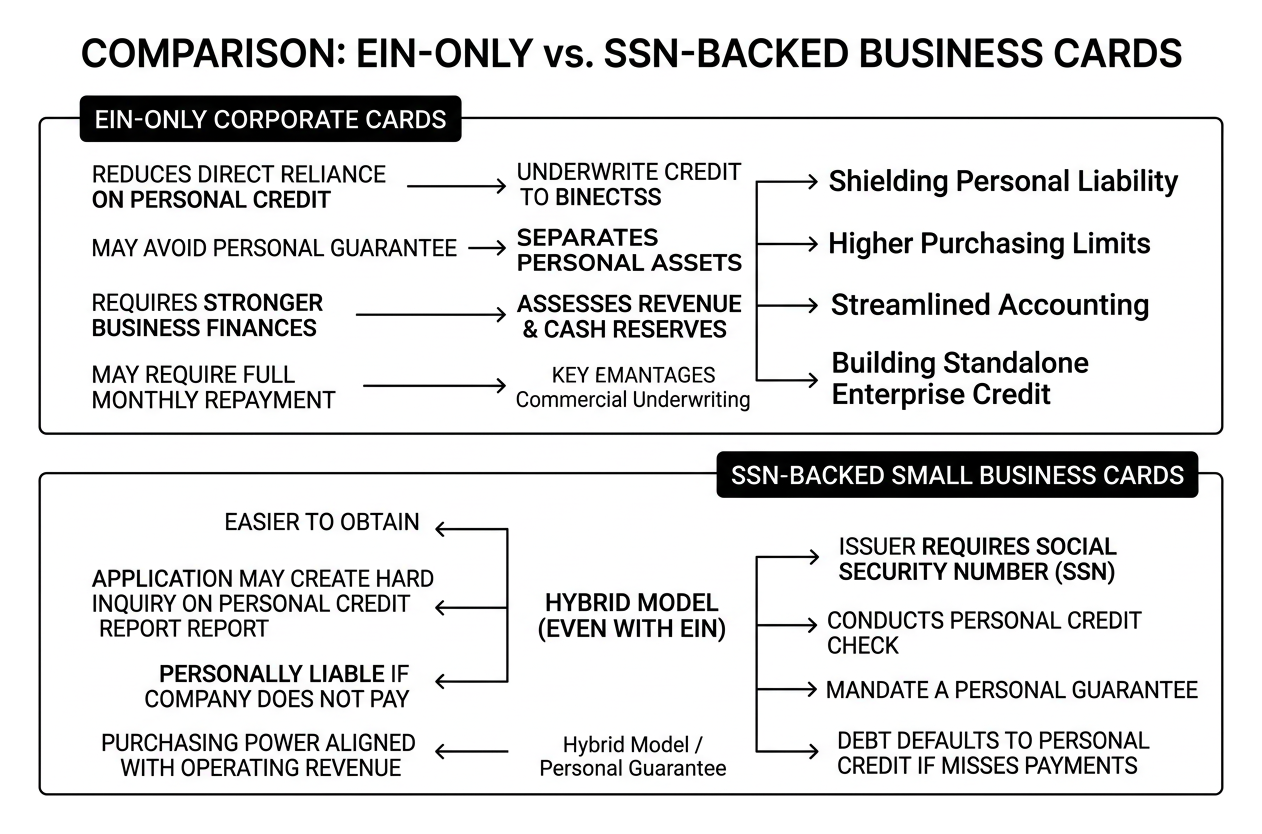
Traditional small business cards use a hybrid model. Even if you supply an EIN, the issuer requires your Social Security Number (SSN) to conduct a personal credit check and mandate a personal guarantee. If the business misses payments, the debt defaults to your personal credit.
True EIN-only corporate cards function on institutional commercial underwriting. The card issuer links to your corporate bank account, reviewing cash velocity, recurring revenues, and verified liquidity rather than evaluating personal consumer reports.
| Feature | EIN-Only Corporate Cards | SSN-Backed Business Cards |
|---|---|---|
| Primary Underwriting Focus | Corporate cash flow, revenue, liquid assets | Owner’s personal FICO score, debt-to-income |
| Personal Guarantee (PG) | Generally None (Non-recourse corporate liability) | Required (Owner assumes full personal liability) |
| Credit Check Impact | No personal hard inquiry | Hard inquiry on personal credit report |
| Repayment Terms | Pay-in-full monthly charge card structure | Revolving credit line (Carrying balances with APR) |
| Credit Reporting | Dun & Bradstreet, Experian Business, Equifax Commercial | Personal credit bureaus (on default) & commercial bureaus |
| Cash Reserves Required | $20,000 to $50,000+ in bank deposits | $0 (Underwritten primarily on personal score) |
Eligibility and Underwriting Criteria for Commercial Cards
Securing an EIN-based corporate card requires specific documentation to verify corporate liquidity and operational history. Issuers balance the absence of a personal guarantee by reviewing operational metrics and cash stability.
Reviewing a comprehensive small business cards EIN guide can help clarify the specific underwriting criteria needed before applying.
Qualifying for Business Credit Cards with EIN Without a Personal Guarantee
To qualify for corporate cards without supplying an SSN or personal guarantee, companies typically must meet these operational benchmarks:
- Formal Business Formation: You must operate as a registered corporate entity (LLC, C-Corp, S-Corp, or formal Partnership). Sole proprietorships rarely qualify for true corporate charge accounts.
- Verified Liquidity and Cash Reserves: Corporate card issuers typically require maintained minimum bank balances ranging from $20,000 to $50,000.
- Demonstrated Operating History: Most commercial card providers prefer businesses with at least 6 to 24 months of verifiable operational history and steady cash inflows.
- Integrated Bank Connectivity: Modern fintech platforms utilize read-only API bank integrations to track cash burn, recurring payroll, and operating revenues to establish dynamic, automated credit lines.
If your enterprise needs a versatile everyday business card, products like the Chase Ink Business Unlimited offer unlimited 1.5% cash back. For broader structured financing options, explore our guide on US business funding solutions to align your operations with the right capital options.
Building Business Credit Scores Using Your Tax ID
Commercial credit bureaus calculate scores using distinct scoring models. While personal credit uses the FICO framework (300–850), commercial credit uses scoring systems such as the Dun & Bradstreet PAYDEX score (0–100), Experian Intelliscore Plus, and the Equifax Business Credit Risk Score.
To establish and elevate your corporate credit rating:
- Establish Your Entity Structure: Properly register your business with your Secretary of State and secure your federal EIN. If your firm is expanding in the Northeast, reviewing proper business formation ensures your corporate veil and operational profile are established correctly.
- Obtain a D-U-N-S Number: Request a free Data Universal Numbering System identifier from Dun & Bradstreet to anchor your commercial credit file.
- Activate Net-30 Vendor Tradelines: Work with suppliers and corporate vendors that systematically report payment history to Dun & Bradstreet and Experian Commercial.
- Pay Invoices Ahead of Terms: A perfect PAYDEX score of 100 requires paying supplier invoices and commercial obligations before their contractual due dates.
Pros, Cons, and Key Alternatives for Small Business Owners
Selecting between an EIN-only corporate card and a traditional revolving business card involves balancing spending flexibility against liquidity and credit requirements.

Popular Commercial Card Structures and Cash Back Features
Corporate charge cards and commercial credit solutions offer tools tailored for growing operating teams:
- Automated Expense Controls: Managers can set dynamic, real-time spending limits, vendor categories, and budget constraints on digital and physical employee cards.
- Automated Accounting Integrations: Modern business cards sync transactions with accounting platforms, streamlining receipt uploads and month-end reconciliations. For instance, the Intuit Business Card syncs transactions directly into QuickBooks while delivering 2% cash back on everyday purchases and 5% on Intuit services.
- Cash Back and Strategic Rewards: Commercial cards offer rewards tailored to standard business spending categories, including digital advertising, logistics, cloud computing, and corporate travel.
For a deeper dive into optimizing your company's broader balance sheet, review our updated business funding guide.
Alternative Financing Options When You Do Not Meet Corporate Thresholds
If your company is in its early stages or does not yet meet institutional cash reserve requirements, alternative financing options can support operational cash flow:
- Secured Commercial Credit Cards: These cards use an upfront cash deposit as collateral, allowing new businesses to build a commercial credit history without requiring significant revenue history.
- Accounts Receivable Financing: Businesses managing long payment cycles can use invoice financing solutions to convert unpaid client invoices into working capital.
- Commercial Bank Working Capital Lines: Partnering with the best bank for a business loan can secure revolving working capital lines backed by enterprise cash flow.
Step-by-Step Guide to Applying for an EIN-Based Business Card
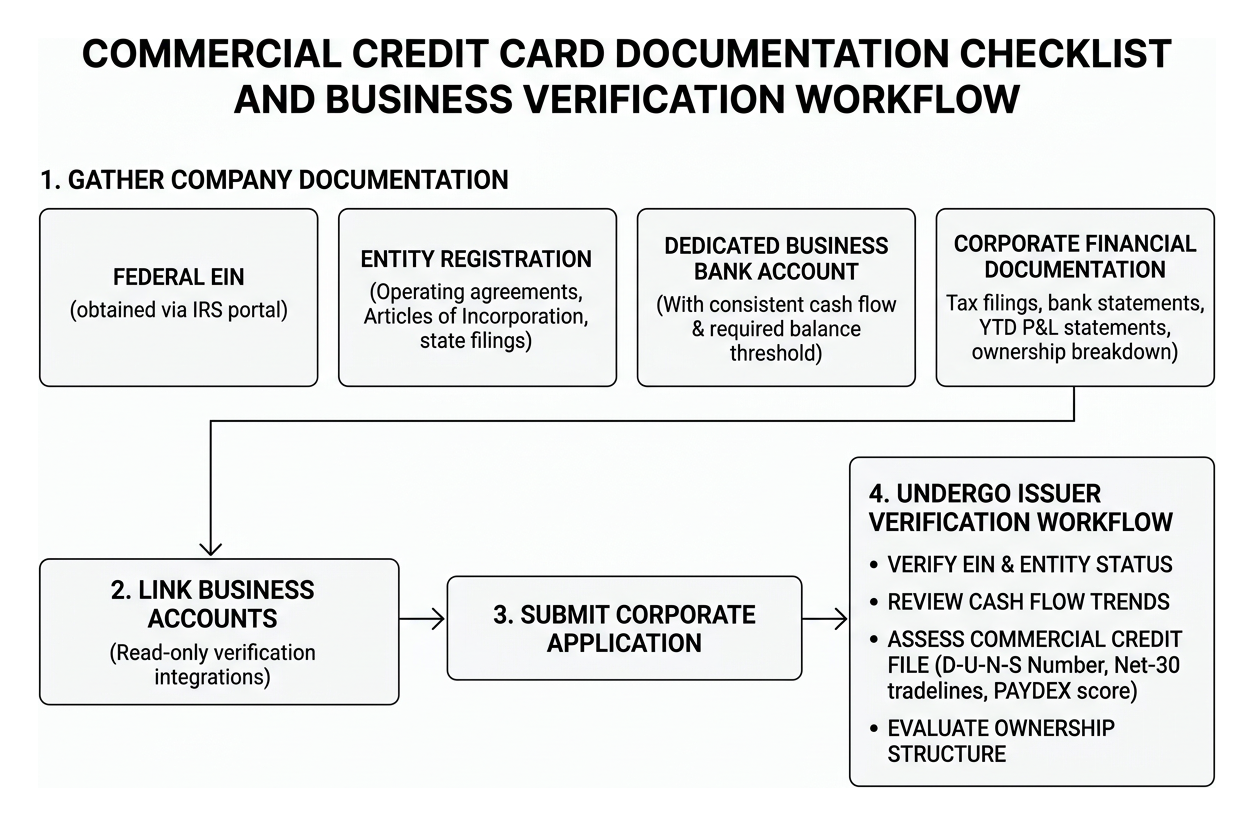
- Obtain Your Federal EIN: Secure your Employer Identification Number via the IRS portal.
- Confirm Entity Registration: Ensure your operating agreements, Articles of Incorporation, and state corporate filings are fully registered and up to date.
- Maintain Your Dedicated Business Bank Account: Build consistent cash flow and maintain the required cash balance threshold in your corporate checking account.
- Gather Corporate Financial Documentation: Prepare your corporate tax filings, recent bank statements, year-to-date profit-and-loss statements, and ownership breakdown records.
- Submit Your Application and Connect Financials: Complete the issuer's corporate application and link your primary business accounts using read-only verification integrations.
- Set Up Spend Controls and Expense Policies: After approval, issue virtual cards to team members, set vendor spending limits, and integrate transaction data with your accounting software.
Frequently Asked Questions About EIN Business Cards
Can a startup get a business credit card using only an EIN?
Startups can qualify for an EIN-only card if they maintain strong cash reserves (often $20,000 to $50,000 or more in liquid operating capital) or have verified venture funding. Startups without substantial deposits typically need a secured business card or a traditional small business card that uses a personal guarantee while building company revenues.
Does applying with an EIN affect my personal credit score?
Applying for a true EIN-only corporate charge card does not affect your personal credit score because underwriters use business financial statements and commercial credit files rather than pulling consumer credit reports. In contrast, standard small business cards that require an SSN typically trigger a personal credit inquiry during underwriting.
What is the minimum revenue required for EIN-only corporate cards?
Minimum revenue requirements depend on the card issuer. Modern corporate charge cards often require annual revenues between $100,000 and $250,000 or maintained minimum cash balances of $20,000 to $50,000. Traditional bank commercial corporate accounts often target larger mid-market enterprises generating upwards of $1,000,000 to $2,000,000 in annual revenue.
Conclusion
Securing business credit cards using an EIN is an effective way to separate business finances from personal credit, establish an independent commercial credit profile, and access higher spending limits. While qualifying without a personal guarantee requires steady operational revenue and cash reserves, building this corporate foundation provides long-term financial flexibility.
At Onyx Elite LLC, our advisory team helps business leaders in West Hartford, CT, and across the region optimize capital access, strengthen cash management systems, and implement scalable growth strategies. To continue refining your company's financing approach, review our complete guide to business credit cards to choose the right financial tools for your operational goals.