Laughing All the Way to the Best Bank to Get a Business Loan
Why Finding the Best Bank to Get a Business Loan Can Make or Break Your Growth

Finding the best bank to get a business loan comes down to matching your business profile — credit score, revenue, and time in operation — to the right lender. Here is a quick look at the top options:
| Bank | Best For | Min. Credit Score | Min. Time in Business | Min. Annual Revenue |
|---|---|---|---|---|
| Wells Fargo | Established credit | 680 FICO | 6 months | Not disclosed |
| Bank of America | Credit building | 700 FICO (unsecured) | 6 months (secured) | $50,000 (secured) |
| Chase | Relationship discounts | 660 FICO | 2 years | $100,000 |
| U.S. Bank | Loans under $250K | Not disclosed | Not disclosed | Under $2.5M |
| Huntington National Bank | SBA loans | Varies | Varies | Varies |
| Lendio | Fast funding / startups | Varies | Varies | Varies |
Most business owners assume any major bank will work for them. That is rarely true. Each lender has strict requirements — and applying to the wrong one wastes time, triggers hard credit pulls, and can hurt your score.
The good news: once you know what each bank actually looks for, the process gets a lot simpler.
I'm Doru Angelo, Founder and CEO of Onyx Elite LLC, with over a decade of experience in business consulting and capital markets — including facilitating funding across a portfolio totaling upwards of $12.5 billion — which means I have seen what separates a funded business from one that keeps getting rejected when searching for the best bank to get a business loan. In the sections below, I'll break down exactly which banks fit which business profiles so you can apply with confidence.
Key Factors in Choosing the Best Bank to Get a Business Loan
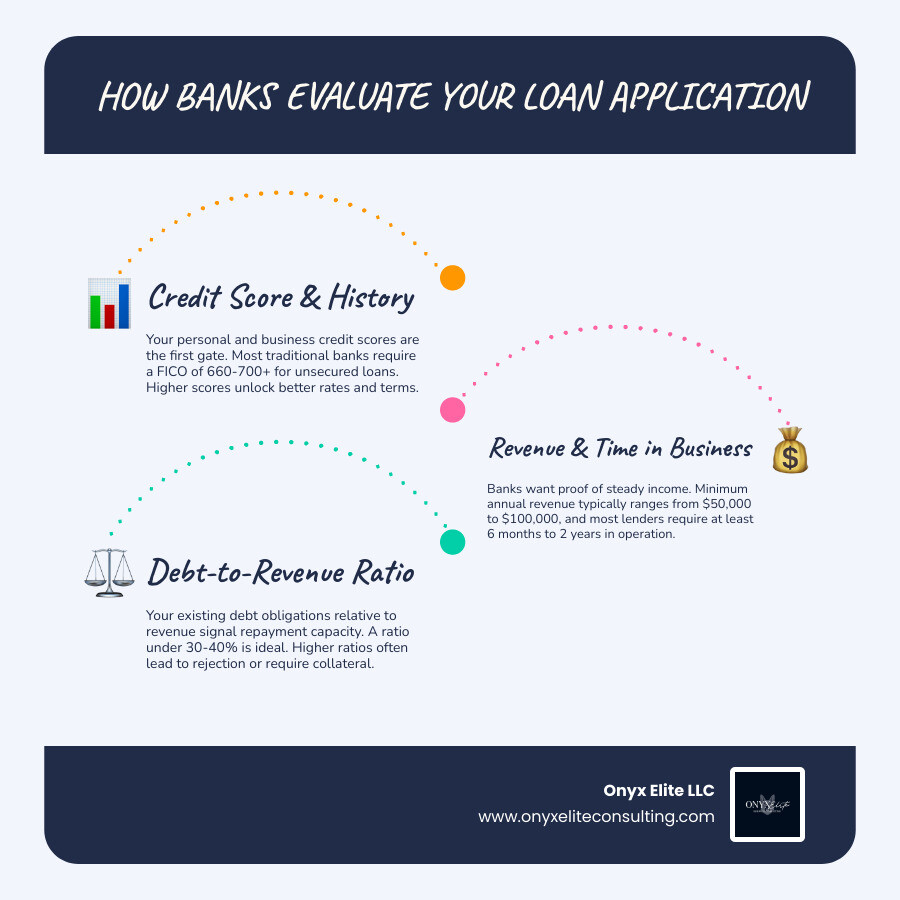
When we advise our clients in West Hartford and throughout Connecticut on securing capital, we emphasize that banks do not look at your business through a single lens. Instead, they evaluate a holistic matrix of risk indicators. Finding the best bank to get a business loan requires understanding these underwriting criteria before you walk through their doors or submit an online application.
1. Credit Score (Personal and Business)
Traditional banks rely heavily on your personal FICO score, even for established corporate entities. A score above 700 unlocks the most competitive interest rates, while scores between 660 and 680 represent the baseline threshold for most major institutions.
2. Time in Business
Startups face the steepest climb when seeking traditional bank financing. Most tier-one banks require a minimum of two years of operational history under existing ownership. However, select institutions offer specialized starter products for businesses with at least six months of track record.
3. Annual Revenue and Cash Flow
Lenders want to see a consistent flow of deposits that prove your capacity to handle monthly debt service. While some banks look for at least $100,000 in annual revenue, larger commercial loans or secured lines of credit may require $250,000 or more.
4. Debt-to-Revenue Ratio
A critical mathematical rule of thumb used by bank underwriters is keeping your total business debt payments under a 36% debt-to-revenue ratio. For example, if your business generates $650,000 a year, your total annual debt service should ideally not exceed $234,000 to remain in the bank's safe zone.
5. Collateral vs. Personal Guarantees
Secured loans require you to pledge business assets, real estate, or certificates of deposit (CDs) to mitigate the bank’s risk. Unsecured loans do not require physical collateral but almost always demand a personal guarantee from any owner holding 25% or more of the company.
Before committing to a traditional bank loan, it is vital to explore alternative capital structures. For instance, our guide on US Business Funding Solutions outlines how different financing vehicles fit distinct operational stages, while our breakdown of Invoice Financing Solutions highlights how to leverage your accounts receivable without taking on restrictive bank debt.
Top Traditional Banks for Small Business Financing
For businesses in Connecticut looking for stability, scale, and long-term relationship pricing, traditional banks remain the premier choice. Let's look closely at how the leading institutions stack up in 2026.
Wells Fargo: The Best Bank to Get a Business Loan for Established Credit
Wells Fargo is a powerhouse in small business lending, particularly for companies that have crossed the initial startup phase and possess solid credit profiles. Through Business Banking | Wells Fargo, companies can access a wide array of checking, savings, and specialized lending products.
Their standout product is the BusinessLine® line of credit, which offers revolving credit limits from $10,000 to $150,000.
- Interest Rates: Highly competitive, ranging from Prime + 1.75% to Prime + 9.75%.
- Fees: The annual fee is waived for the first year, after which it is $95 for lines up to $25,000 and $175 for lines over $25,000.
- Requirements: A minimum guarantor FICO score of 680 and at least 6 months in business.
- Guarantees: Personal guarantees are required from any owner with 25% or more ownership, with a minimum combined aggregate of 51% ownership.
For larger capital needs, the Wells Fargo Prime Line of Credit provides secured financing from $100,000 to $3,000,000, with rates starting as low as Prime + 0.50% (with a 5.00% minimum floor). To learn more about their revolving options, check out the BusinessLine Line of Credit | Wells Fargo.
Bank of America: The Best Bank to Get a Business Loan for Credit Building
Bank of America shines in its structured path to creditworthiness, making it an excellent partner for businesses looking to build their commercial credit profiles from the ground up.
For newer businesses (with at least 6 months of history) generating a modest $50,000 in annualized revenue, the Cash-Secured Line of Credit is a stellar option. It requires a minimum refundable security deposit of $1,000, allowing you to establish business credit safely.
For mature enterprises, Bank of America offers robust secured options. You can explore Secured Business Loans at Bank of America which start at $25,000. These feature distinct terms based on your collateral:
- Asset-Secured: Terms up to 4 years when secured by general business assets.
- CD-Secured: Terms up to 5 years when secured by Bank of America Certificates of Deposit.
To qualify for their unsecured Business Advantage Term Loan or Credit Line, you will need a personal FICO score above 700, at least 2 years in business, and $100,000 in annual revenue. Additionally, members of the Preferred Rewards for Business program can secure interest rate discounts ranging from 0.25% to 0.75%. If you are looking to complement your loan with strong credit options, review our Get Business Credit Cards Complete Guide.
Chase and U.S. Bank: Flexible Terms and Relationship Discounts
Chase for Business
Chase is highly favored by established business owners who value deep relationship discounts. For loans or lines of credit exceeding $500,000, Chase offers a Relationship Pricing Program that provides interest rate discounts between 0.4% and 1.2%.
- Key Requirements: A minimum FICO score of 660, at least 2 years in business, and a minimum of $100,000 in annual revenue.
- Fee Optimization: Chase's business line of credit carries an annual fee of $200 or 0.25% of the approved limit, but this fee is entirely waived if your 12-month average line utilization remains at 40% or higher.
If you are looking to separate your personal credit from your business operations, understanding how to obtain credit using only your Employer Identification Number is a crucial step. Read our guide on Business Credit Cards EIN Only for a complete roadmap.
U.S. Bank
U.S. Bank focuses heavily on streamlined, fast-tracked lending options under the $250,000 mark. Their Quick Loans offer unsecured funding up to $50,000 and secured options up to $250,000, ideal for rapid equipment purchases or vehicle financing (with terms extending up to 84 months). Their Cash Flow Manager line of credit charges a $0 annual fee for credit lines over $50,000 ($150 fee for lines under that threshold), making it highly cost-effective for mid-sized operations.
SBA Loans vs. Traditional Bank Loans
When searching for the best bank to get a business loan, you will inevitably face a choice: apply for a conventional bank loan or seek a government-backed loan through the Small Business Administration (SBA).
The SBA does not lend money directly to business owners (except in disaster recovery scenarios). Instead, it sets strict guidelines and guarantees a portion of the loan (up to 85% for smaller loans), dramatically reducing the risk for partner banks.
Here is how they compare structurally:
| Feature | SBA 7(a) Loans | Traditional Bank Loans |
|---|---|---|
| Max Loan Amount | Up to $5,000,000 | Varies (often higher for corporate) |
| Repayment Terms | Up to 10 years (working capital/equipment); Up to 25 years (real estate) | Typically 3 to 7 years |
| Down Payment | Often lower (10% to 20%) | Typically 20% to 30% |
| Approval Speed | Slow (can take several weeks/months) | Faster (especially with digital applications) |
| Eligibility | Must prove inability to obtain conventional credit elsewhere on reasonable terms | Strict internal bank criteria (FICO, revenue) |
The Value of Preferred Lenders
If you decide to pursue an SBA loan, working with an SBA Preferred Lender is critical. These banks have unilateral approval authority from the SBA, meaning they do not have to send your paperwork to the government for review, saving you weeks of waiting. For example, Huntington National Bank has been the largest originator of SBA 7(a) loans by volume for seven consecutive years.
For a detailed look at the primary SBA financing vehicle, you can explore the SBA 7(a) Loan - SBA Preferred Lender | WaFd Bank to understand how these flexible structures support working capital, partner buyouts, and equipment acquisition.
Fintech Partnerships and Online Marketplaces
The modern lending landscape is no longer confined to brick-and-mortar bank branches. Today, digital ecosystems and fintech partnerships play a massive role in how businesses access capital.
Online Marketplaces: The Power of Choice
If your business does not quite meet the strict 2-year history or 680 FICO score requirements of traditional banks, online lending marketplaces offer a highly accessible alternative.
Through platforms like Lendio: Apply For Small Business Loans Online, business owners can fill out a single, integrated application that matches them with a network of over 75 vetted lenders. Since its inception in 2011, Lendio has facilitated over $17 billion in funding for more than 520,000 businesses, frequently securing capital in as little as 24 hours. While interest margins can be higher than traditional bank loans, the speed, flexibility, and soft-credit-pull prequalification process make it an indispensable tool for fast-moving startups.
The Rise of Embedded Finance
Globally, the concept of the "best bank" is shifting toward embedded platforms. For example, digital-first institutions like GXS Business Banking show how seamlessly modern business banking can integrate into daily digital ecosystems. By partnering with massive consumer and merchant platforms (like Grab and Singtel in Southeast Asia), GXS enables micro-SMEs to secure standby credit lines up to S$1M with instant, paperwork-free approvals in under four minutes.
According to strategic industry reports from the Boston Consulting Group (BCG), tech-forward banks are shifting their budgets away from mere "run-the-bank" maintenance (which currently consumes over 60% of traditional bank IT spend) toward "change-the-bank" innovations. The banks that successfully build these digital ecosystems enjoy higher price-to-book ratios and double the shareholder returns of their slower competitors. For you, the business owner, this means the future of business lending is faster, highly automated, and increasingly integrated into the software platforms you already use every day.
Frequently Asked Questions About Business Loans
What are the minimum requirements for a traditional bank business loan?
While every bank maintains its own proprietary underwriting models, traditional lenders generally require:
- A personal FICO score of at least 660 to 680 (700+ for the best unsecured rates).
- At least 2 years of operational history under existing ownership (though some secured starter lines accept 6 months).
- Minimum annual revenues of $100,000, with a steady, verifiable deposit history.
- A debt-to-revenue ratio of 36% or lower to ensure your cash flow can comfortably support the new monthly payments.
What is the difference between secured and unsecured business loans?
- Secured Loans: Require you to pledge physical collateral, such as commercial real estate, equipment, inventory, or a Certificate of Deposit (CD). Because this reduces the bank's risk, secured loans offer higher borrowing limits, longer repayment terms (up to 5 years), and lower interest rates.
- Unsecured Loans: Do not require physical collateral. Instead, they rely on your creditworthiness and a personal guarantee. These loans are faster to process but carry lower borrowing limits, shorter repayment terms, and higher interest rates.
How can startups with limited history secure funding?
Startups with less than two years of history can secure capital through several strategic pathways:
- Cash-Secured Lines of Credit: Banks like Bank of America offer starter lines with a refundable cash deposit, helping you build business credit.
- SBA Microloans: These government-backed loans provide up to $50,000 specifically targeted at startups and underserved markets.
- Online Marketplaces: Fintech platforms can match you with alternative lenders who prioritize real-time cash flow and digital transaction history over years in business.
- Dedicated Business Consulting: Working with a professional advisory firm can help you draft a bulletproof business plan and financial projections that satisfy strict bank underwriters.
Conclusion
Securing capital is not just about finding a lender; it is about aligning your financing with a long-term strategic growth model. The best bank to get a business loan for your neighbor's retail shop might be completely wrong for your medical practice or logistics company.
At Onyx Elite Consulting, we pride ourselves on being an award-winning consulting firm. Based in West Hartford, Connecticut, we go far beyond traditional, cookie-cutter financial advice. We help business owners across the region achieve sustainable growth and operational excellence through meticulous strategic planning, brand development, and tailored capital-matching strategies.
Whether you need to polish your financial projections with a dedicated business plan consultant or require comprehensive small business consulting to scale your operations, our team is ready to guide you.
- To build a bank-ready business plan, explore our Business Plan Consultant Ultimate Guide 2026.
- To learn how we help local enterprises thrive, check out our Business Consultant Connecticut Guide.
- For a complete look at our hands-on advisory services, review our Consulting Services for Small Business.
Ready to take your business to the next level and secure the funding you deserve? Explore our complete suite of advisory services at the Onyx Elite Consulting Services Overview and let's build your financial future together.