

The Ultimate Guide to Content Marketing for Brand Awareness: From Nobody to Household Name
Why Content Marketing for Brand Awareness Is the Smartest Investment You Can Make

Content marketing for brand awareness is the practice of creating and sharing valuable, relevant content to make your brand recognizable, trusted, and top-of-mind for your ideal audience — before they ever need to buy.
Here is a quick summary of what it means and why it works:
| What It Is | What It Does | Why It Matters |
|---|---|---|
| Blog posts, videos, podcasts, social content | Attracts and educates your target audience | Builds recognition and trust over time |
| Consistent, value-first publishing | Keeps your brand visible in search and social | 87% of consumers research products online before buying |
| Strategic storytelling and thought leadership | Positions your brand as the go-to authority | 82% of consumers feel more positive about a brand after reading custom content |
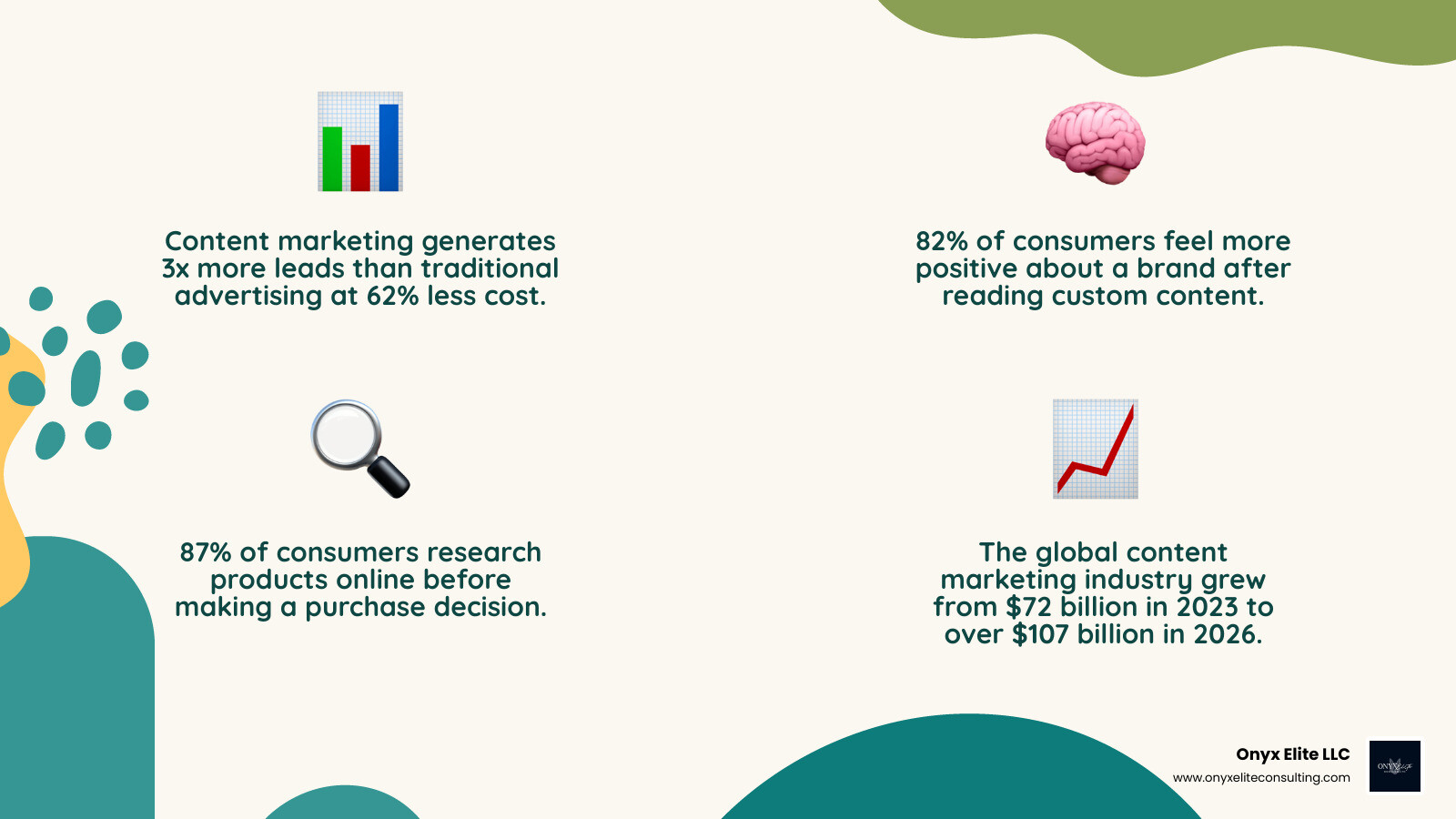
| Lower cost than traditional ads | Generates 3x more leads at 62% less cost | Compounds in value the longer you do it |
Most founders feel invisible online. They publish content, but nothing sticks. No one calls. No one remembers the brand name. That disconnect is not a creativity problem — it is a strategy problem.
The good news? A structured, consistent approach to content marketing does not just drive traffic. It builds the kind of brand recognition that makes people choose you over a competitor they have never heard of. Research shows that 60% of consumers prefer buying from a familiar brand rather than switching to a new one. Familiarity is not an accident — it is built.
I'm Doru Angelo, Founder & CEO of Onyx Elite LLC, and over a decade of working with founders and organizations across industries has shown me how a disciplined approach to content marketing for brand awareness can transform a business from overlooked to undeniable. This guide brings together everything I've learned — and the latest research — to help you build a brand people actually remember.
What is Content Marketing and How Does It Work in 2026?
In the digital landscape of July 2026, content marketing has evolved far beyond simply writing occasional blog posts or scheduling basic social media updates. Today, the global content marketing industry has ballooned from $72 billion in 2023 to over $107 billion in 2026. This massive growth highlights a fundamental shift in how businesses grow: audiences no longer tolerate being interrupted by traditional advertising.
Instead, content marketing operates as an inbound marketing strategy. It is designed to be an organic, welcome part of a user’s experience. By focusing on a value-first, long-term, and relationship-driven approach, we establish a line of communication that builds genuine trust.
When you publish content that answers questions, solves problems, and provides real utility, you are not chasing transactions. You are building equity. To understand the deep mechanics of this modern approach, you can Learn more about how content marketing works in 2026 to see how it acts as the foundation of sustainable digital growth.
The Key Stages of the Buyer Journey
To build a reliable system, we must understand how a stranger transforms into a loyal advocate. The buyer journey is not a straight line, but it can be mapped into three primary stages:
| Stage | Buyer's Psychological State | Best Content Formats | Goal of the Content |
|---|---|---|---|
| Awareness (TOFU) | "I have a problem or an opportunity, and I'm looking for information." | Educational blog posts, short videos, podcasts, infographics | Drive discovery, define the problem, introduce the brand |
| Consideration (MOFU) | "I understand my problem and I'm researching different types of solutions." | In-depth guides, comparison sheets, webinars, interactive quizzes | Demonstrate deep expertise, build trust, show product utility |
| Commitment (BOFU) | "I'm ready to select a partner or buy a product, but I need to validate my choice." | Case studies, product demos, detailed FAQs, client testimonials | Address sales objections, provide social proof, secure the decision |
By mapping your content directly to these stages, you ensure that no matter where a prospect interacts with your brand, they find a resource that matches their intent.
Content Marketing vs. Traditional Advertising
Traditional advertising relies on outbound marketing—interrupting someone's day with a billboard, a TV commercial, or a pop-up ad to scream, "Buy this now!" But in 2026, ad fatigue is at an all-time high; 96% of people report that they simply do not trust ads anymore.
Content marketing takes the opposite approach. Instead of chasing attention, it attracts it. This inbound method is highly cost-effective: content marketing costs 62% less than traditional outbound marketing while generating over three times as many leads.
By building organic search visibility, your content works for you 24/7. Long after an ad budget is spent and the campaign is turned off, your evergreen articles and videos continue to pull in qualified traffic, compounding in value over time.
Why Content Marketing for Brand Awareness is a Growth Engine
Brand awareness is often dismissed by skeptics as a "vanity metric." They argue that likes, impressions, and views do not pay the bills. But this view misses the point. True brand awareness is not just about reaching people; it is about building cognitive equity through three key layers:
- Recognition: Do they know who you are when they see your logo or visual assets?
- Recall: Do they think of your brand first when a specific category problem arises?
- Resonance: Do they feel that your brand's values, culture, and point of view align with their personal or professional identity?
When you build this level of deep awareness, you fundamentally change your downstream funnel economics.
A trusted brand lowers buyer resistance, makes sales conversations significantly easier, and allows you to command premium pricing. To explore how this works in practice, you can Discover how to build brand awareness with content marketing to turn passive viewers into active participants.
How Storytelling Enhances Content Marketing for Brand Awareness
Humans are biologically wired for stories. We do not remember raw statistics or generic product features; we remember narratives, challenges, and triumphs. Incorporating storytelling into your content marketing creates an emotional connection that positions your business as human and empathetic.
Your brand narrative should clearly communicate your core brand values. It should answer the "why" behind your business, showing your audience that you understand their struggles. If you are noticing that your current content is getting views but failing to build deep loyalty, it is time to look at how you present your identity. Learn How to improve brand perception by using authentic storytelling to bridge the gap between what you do and who you are.
The Power of Brand Authority and Trust
In 2026, trust is the ultimate differentiator. This is especially true in B2B markets, where 81% of buyers require demonstrable trust in a brand before they will even consider making a purchase.
Search engines have adapted to this reality by prioritizing E-E-A-T (Experience, Expertise, Authoritativeness, and Trustworthiness) signals. If your content is generic or clearly generated by AI without human oversight, it will struggle to rank.
True thought leadership requires original data, unique perspectives, and expert insights. By consistently publishing high-quality, authoritative content, you build a moat around your business. To understand how the rules of trust have changed, read about The New Era of Brand Authority to see how modern brands win and protect their market share.
The Best Content Marketing Strategies for Brand Awareness
To cut through the digital noise of 2026, you cannot rely on sporadic publishing. You need a structured, repeatable system. The most successful brands do not write random articles; they build integrated content engines using advanced structural frameworks.

To design a system that works, we recommend studying the step-by-step approach outlined in How to build a content system that drives results, which details how to align your content goals with real business outcomes.
Building Topic Clusters for Topical Authority
The "hub-and-spoke" model is the gold standard for modern search engine optimization (SEO). Instead of trying to rank individual, disconnected articles for highly competitive terms, you build topic clusters.
- Pillar Page (Hub): A comprehensive, high-level guide covering a broad topic in detail (e.g., "The Ultimate Guide to B2B Marketing").
- Supporting Articles (Spokes): Highly specific, long-tail articles that dive deep into subtopics (e.g., "How to Write a B2B Email Subject Line").
- Internal Linking: Linking all spoke articles back to the pillar page, and vice versa.
This structure tells search engines that your website is an authoritative resource on the entire subject, dramatically boosting your overall search visibility.
Optimizing for AI Search and Answer Engines
The search landscape has shifted dramatically. With the rise of Google's AI Overviews, ChatGPT, Perplexity, and Gemini, zero-click searches now account for roughly 58% of all queries. Users are getting direct answers without ever clicking through to a website.
To survive and thrive in this environment, you must optimize for AI search engines (AEO/GEO). This means:
- Structuring your content with clear, direct answers to common questions at the top of your pages.
- Writing in conversational, natural language that matches how people speak to voice assistants and AI tools.
- Using original research, quotes, and primary data that AI models will cite as authoritative sources.
Leveraging Branded Audio and Video Formats
While written content remains essential for search authority, audio and video formats are unmatched for building deep, emotional connections. Short-form video (such as YouTube Shorts, TikTok, and LinkedIn video carousels) owns the discovery phase, allowing you to reach massive new audiences quickly.
On the other end of the spectrum, branded podcasts build unparalleled trust. Audio creates an intimate, highly focused attention span that is less skimmable than social media and less transactional than search. In fact, research shows that branded podcasts can increase brand consideration by 57% and brand favorability by 24%.
For a deeper dive into using sound and motion to build your presence, Explore content marketing for brand awareness in audio to see how to design serialized programs that keep your audience listening.
How to Create a Content Marketing Strategy in 2026
Building a strategy starts with clarity. Before you write a single word, you must answer three fundamental questions: Why are we creating this content? For whom are we creating it? And how will we know it is working?
We begin by conducting deep audience research to construct detailed buyer personas. Do not guess what your audience cares about. Analyze sales calls, interview existing clients, look at industry forums like Reddit, and consult with your customer service teams to discover the exact challenges your prospects face. Once you have this data, build a structured editorial calendar with a consistent publishing cadence that your team can realistically maintain.
Mapping Formats to Awareness Jobs
Different content formats excel at different "jobs" within your brand awareness strategy. A balanced content mix in 2026 follows the 60-30-10 rule:
- 60% Evergreen & Educational Content: Deep, search-optimized articles and resources that build long-term traffic.
- 30% Conversion & Sales Enablement: Case studies, product comparisons, and landing pages that help buyers make decisions.
- 10% Thought Leadership & Experimental Content: Original research, opinion pieces, and bold formats like podcasts or short-form video series.
By structuring your content this way, you ensure you are educating your market while gently guiding them toward a solution.
Executing a 90-Day Content Rhythm
A common mistake is trying to do everything at once, leading to burnout. Instead, we recommend breaking your execution down into a highly manageable 90-day rhythm:
To ensure your content efforts align perfectly with your broader corporate goals, it is vital to integrate this rhythm into your overarching Corporate brand strategy to drive unified, scalable growth.
Measuring the ROI of Content Marketing for Brand Awareness
One of the biggest hurdles marketers face is proving the financial return of brand awareness campaigns. Because awareness-stage content sits at the top of the funnel, traditional single-touch attribution models often fail to capture its true impact. A prospect might read a blog post, leave, see a social post two weeks later, and finally convert via a direct Google search.
To measure this accurately, we must look at both brand equity (the qualitative value of your brand's reputation) and hard marketing analytics.
The basic ROI formula is:
$$\text{ROI} = \frac{\text{Revenue} - \text{Marketing Costs}}{\text{Marketing Costs}} \times 100$$
However, to get a true picture of how your content is performing, we must look at a blend of leading, lagging, and behavioral indicators.
Key Metrics Beyond Vanity Pageviews
If you are only tracking pageviews, likes, and shares, you are not seeing the full picture. To understand if your content is building real memory and recall, focus on these metrics:
- Branded Search Volume: Are more people typing your company's name directly into search engines?
- Direct Traffic: Is there a steady increase in users navigating straight to your URL?
- Share of Voice (SOV): How often is your brand mentioned in industry conversations compared to your competitors?
- Engaged Sessions & Scroll Depth: Are visitors actually reading your content, or are they bouncing immediately?
By tracking these numbers, you can run a continuous Brand perception analysis to see exactly how your audience views and interacts with your brand over time.
Proving the Value of Content Marketing for Brand Awareness to Stakeholders
When presenting results to executives or stakeholders, speak the language of business, not marketing jargon. They do not care about "viral reach." They care about pipeline health.
Frame your content marketing success around three core business metrics:
- Influenced Pipeline: How many closed-won deals touched a content asset before signing?
- Deal Velocity: Do prospects who consume your educational content move through the sales cycle faster than those who don't?
- Customer Acquisition Cost (CAC): Because content marketing generates compounding organic traffic, it naturally lowers your blended CAC over time compared to paid advertising.
Real-World Examples of Successful Content Marketing Campaigns
To see how these strategies work in action, let's look at a few classic and modern examples of brands that used content to become household names:
- The Viral Product Demo: A blender manufacturer wanted to prove the durability of its product. Instead of writing technical spec sheets, they created a simple, humorous video series called "Will It Blend?" where they blended unusual objects like smartphones, golf balls, and glow sticks. This creative approach generated over 300 million views and led to a massive spike in global sales.
- The Niche Educational Platform: A major CRM software provider built an interactive, free learning platform called "Trailhead." By offering structured courses and gamified certifications not just on their product, but on broader professional skills like sales, management, and marketing, they built an incredibly loyal community of advocates who carry the brand with them throughout their careers.
- The Narrative Diary: A B2B software company launched a highly transparent, narrative series called "Diary of a First-Time CMO." By documenting the raw struggles, failures, and successes of scaling a marketing department, they built immense trust with their target audience of marketing leaders, turning a simple blog series into a massive pipeline driver.
Frequently Asked Questions about Content Marketing for Brand Awareness
How long does it take for content marketing to build brand awareness?
Content marketing is a long-term compound investment. While you may see initial spikes in social engagement or search impressions within the first 3 months, most businesses see significant, compounding results (such as steady organic traffic growth and increased branded search) after 6 to 12 months of consistent publishing.
What type of content is best for brand awareness?
The best format depends entirely on where your audience hangs out. However, educational blog posts that solve highly specific user problems, short-form video clips that offer quick tips, and authoritative industry research reports are universally effective for capturing attention and building immediate credibility.
Is AI-generated content good for brand awareness?
Generative AI is an excellent creative partner for outlining, brainstorming, and summarizing information. However, relying entirely on AI-written content without human oversight is highly risky. AI tools often generate generic, copycat content that lacks your brand's unique voice, original data, and real-world experience—the very elements required to build true trust and rank on modern search engines.
Conclusion
Building a recognizable, trusted brand is not a matter of luck or massive advertising budgets. It is the result of a disciplined, value-first content system that consistently shows up for your audience. When you shift your focus from interrupting prospects to genuinely educating them, you stop chasing temporary traffic spikes and start building long-term equity.
At Onyx Elite LLC, we believe that visibility is the engine of your business growth. We work closely with organizations to design comprehensive brand strategies, optimize internal workflows, and build content engines that turn strangers into loyal clients. If you are ready to stand out in a crowded market and make your business truly unignorable, we invite you to take the next step.
Learn how to Become unignorable online to establish your digital footprint, and Explore Onyx Elite Consulting services to see how our West Hartford, CT-based team can help you build a sustainable growth engine.