Launch Your B2B Consulting Firm: A Step-by-Step Guide
Why B2B Brand Consulting Is the Growth Lever Most Companies Overlook

B2B brand consulting helps businesses define how they are understood, chosen, and remembered by the companies they sell to — and it is one of the most underleveraged drivers of sustainable growth available to founders and business leaders today.
What is B2B brand consulting? Here's a quick breakdown:
| Element | What It Means |
|---|---|
| What it is | Expert guidance on positioning, messaging, and brand strategy for companies that sell to other businesses |
| Who it's for | Founders, CMOs, and business leaders in B2B markets seeking clarity, differentiation, and growth |
| Core outcomes | Stronger market positioning, higher trust with buyers, better sales alignment, and measurable revenue impact |
| Why it matters | 81% of marketing decision-makers say brand is "very important" to revenue growth — yet nearly half of B2B companies allocate less than 30% of their marketing budget to brand |
| Key difference from B2C | B2B buyers are risk-averse, represent entire organizations, and require trust and expertise — not just emotional appeal |
Despite near-universal agreement that brand matters — 97% of marketing leaders say it plays an important role in awareness and consideration — most B2B companies still underinvest. The result? Inconsistent messaging, commoditized positioning, and a sales team working harder than they should.
This guide walks you through how to fix that.
I'm Doru Angelo, Founder and CEO of Onyx Elite LLC, and with over a decade of experience in business consulting, branding, and strategic growth, I've helped organizations across industries sharpen their positioning through B2B brand consulting that ties directly to measurable outcomes. The frameworks and insights in this guide draw on that hands-on experience — so whether you're building a brand from scratch or rethinking an existing one, you'll find clear, actionable direction ahead.
Understanding B2B Brand Consulting vs. B2C Branding
To build an effective B2B brand, we must first dismantle a common myth: that branding is just for consumer-facing companies. Many leaders assume that because they do not sell soft drinks or athletic shoes, branding is an expensive luxury.
In reality, b2b brand consulting is fundamentally different from B2C branding. While B2C brands often appeal to individual impulses, immediate desires, or personal lifestyle choices, B2B branding operates in a high-stakes, multi-layered environment.
In the B2B world, purchases are made by professional decision-makers who represent entire organizations. These buyers are highly risk-averse; a bad purchasing decision can cost millions of dollars, disrupt operations, or even cost someone their job. Consequently, B2B branding is not about creating a fleeting emotional buzz. It is about building long-term relationships, establishing credibility, and facilitating rational purchasing decisions.
By partnering with a brand development consulting firm, B2B organizations learn to transition from talking about what they sell to proving how they solve complex operational problems.
Why Expertise and Trust Dominate B2B Brand Consulting
In B2B transactions, trust is the ultimate currency. In fact, research shows that 81% of consumers (and an even higher percentage of business buyers) refuse to do business with brands they do not trust.
Trust is built by clearly demonstrating mastery and expertise at every stage of the buyer journey. While a catchy ad might work for a consumer product, B2B buyers actively seek deep, authoritative knowledge.
The single most influential source of knowledge for B2B customers remains their interaction with the sales force. However, digital outreach, webinars, and thought-leadership content serve as vital complements to these personal interactions. When a company uses strategic consulting to improve brand perception, they ensure that every touchpoint—from a downloadable white paper to a face-to-face sales pitch—consistently communicates operational excellence and mitigates buyer risk.
Key Differences in B2B Decision-Making
B2B purchasing decisions are rarely made by a single person. Instead, they are guided by complex buying committees and multiple stakeholders, each with their own priorities:
- The CFO wants to see a clear calculation of value, ROI, and cost reduction.
- The IT Director wants to ensure seamless integration, security, and technical compatibility.
- The End-User wants an intuitive interface and a lighter daily workload.
This multi-stakeholder environment leads to significantly longer sales cycles. To appeal to these diverse groups, successful B2B companies organize their platforms and offerings into customer-centric categories rather than product-centric ones. Instead of forcing a buyer to decode a list of technical features, a strong brand presents clear, tailored solutions that directly address the specific pain points of each stakeholder.
Core Components of a Successful B2B Brand Strategy
A robust corporate brand strategy acts as an anchor for all business activities. It ensures that your sales, marketing, and product development teams are all pulling in the same direction.
To achieve this, we focus on three core strategic pillars:
- Brand Positioning: Defining the specific space your company owns in the mind of the target audience relative to your competitors.
- Brand Salience: Ensuring your brand is not only recognized but is actively thought of at the exact moment a purchasing need arises.
- Category Entry Points (CEPs): The mental cues and situational needs that prompt a buyer to look for a solution (e.g., "We just got acquired and need to centralize our data").
By mapping your brand to these category entry points and deploying distinctive brand assets—such as unique visual codes, consistent messaging structures, and clear naming conventions—you build a highly recognizable market presence.
Building Brand Equity and Awareness
Brand equity is the commercial value that derives from consumer perception of the brand name of a particular product or service, rather than from the product or service itself.
To build brand equity, we must first establish deep stakeholder alignment. Surprisingly, 48% of B2B companies admit they collect insights from their own employees "occasionally, rarely, or never." This is a massive missed opportunity. Your employees are the ones delivering on your brand promise every day.
By conducting internal workshops and gathering employee insights, we can align internal culture with external marketing. This alignment is then translated into consistent brand codes and a unified brand elements design that makes your business instantly recognizable across all digital and physical channels.
The Role of B2B Brand Consulting in Positioning
Without clear positioning, B2B companies find themselves trapped in a race to the bottom, competing solely on price or feature lists.
This is where expert consulting provides immense value. Consultants help you analyze the market landscape to identify genuine whitespace—areas where customer needs are currently unmet by competitors.
Through comprehensive brand development, we help you craft a crystal-clear value proposition, a structured messaging framework, and highly targeted audience personas. This ensures your marketing spend is directed toward the accounts most likely to convert, rather than wasted on generic, broad-market campaigns.
Frameworks and Methodologies Used by Leading Consultancies
To turn creative ideas into predictable business outcomes, leading B2B brand consultancies rely on structured, repeatable frameworks.
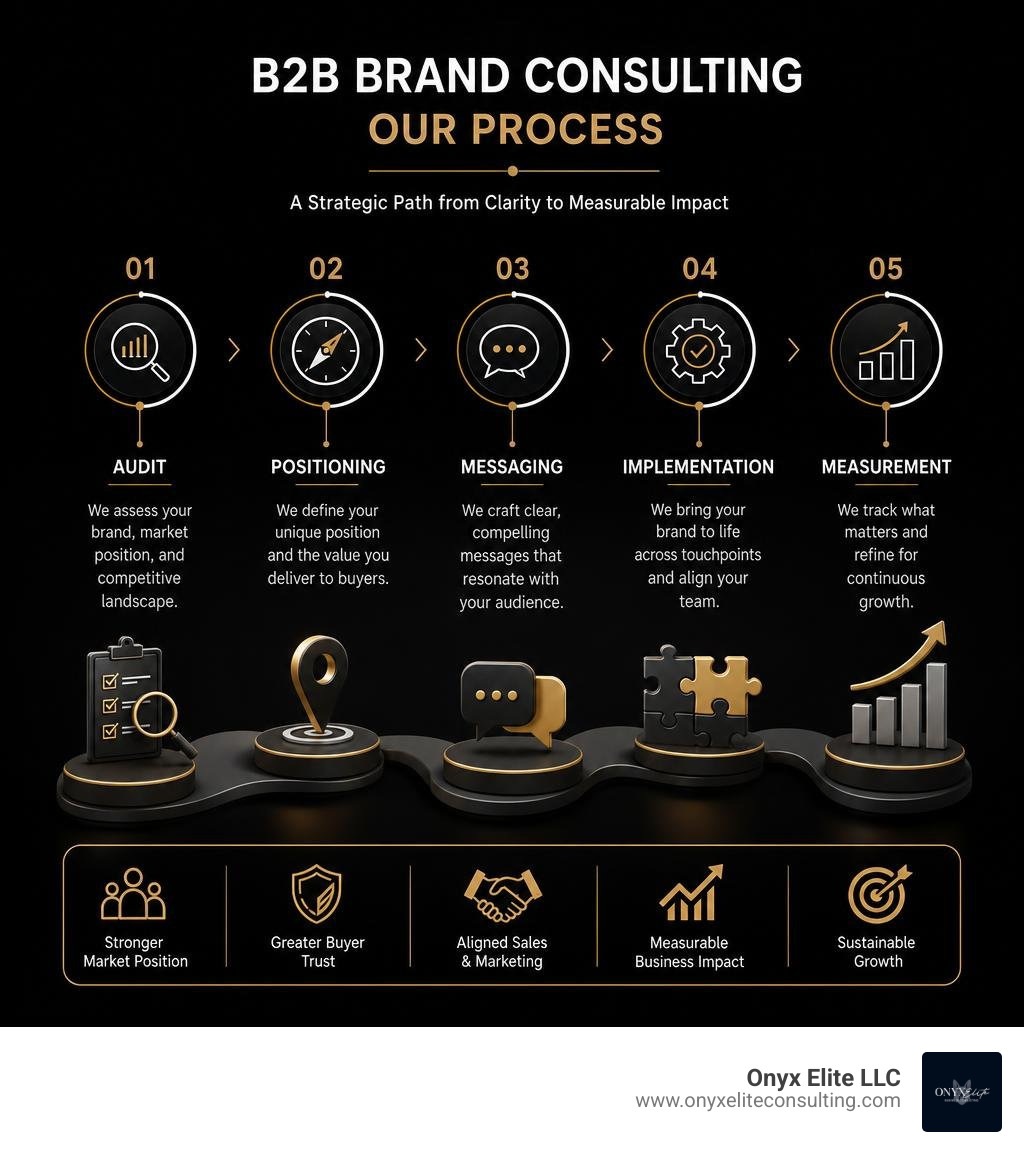
At Onyx Elite LLC, we believe that brand strategy should never be built on guesswork. We utilize a blend of proven strategic frameworks to guide our clients from initial analysis to market dominance:
- The Upstream Diagnostic: A focused, 4-to-6-week engagement designed to assess your current marketing strategy, identify operational bottlenecks, and map out high-impact decisions before execution begins.
- The Brand OS Framework: A structured methodology that aligns product, messaging, and acquisition systems to build a scalable foundation for growth.
- Jobs-to-be-Done (JTBD): A framework focused on understanding the exact "job" a customer is hiring your product or service to do, allowing for highly resonant positioning.
- The Multi-Stakeholder Positioning Matrix: A tool used to map and tailor core brand messages to the unique priorities of different members of a buying committee.
- The Trust Stack: A methodology that builds credibility in layers—starting with category relevance, moving to demonstrated competence, and reinforcing with social proof.
Rebranding vs. Brand Refresh Decisions
One of the most critical decisions a leadership team will face is determining whether to completely rebrand or simply refresh their existing brand.
A complete rebrand is a major undertaking that involves changing your core positioning, visual identity, and sometimes even your company name. This is typically necessary during major corporate milestones, such as a merger or acquisition, a massive shift in market dynamics, or when a highly complex brand portfolio is confusing buyers and hurting sales.
Conversely, a brand refresh or revitalization is a lighter, tactical update. It involves updating your visual assets, modernizing your logo, or refining your messaging without changing your core business values or target audience.
To make the right choice, we recommend starting with a thorough brand perception analysis. By surveying your customers, partners, and employees, you can pinpoint exactly where your current brand is succeeding and where it is falling short.
Measuring the ROI and Business Impact of Brand Investments
Historically, CMOs have struggled to justify brand marketing investments to skeptical CFOs who demand immediate, short-term proof of value. However, the data is clear: investing in brand maturity yields massive financial returns.
According to research, companies that advance their brand marketing maturity from an "emerging" level to a "differentiating" level experience an average increase of 25 percentage points in their Return on Marketing Investment (ROMI). Furthermore, top-performing "amplifying" brands generate returns that are 46 percentage points higher than those at a nascent level, and they hold an average of 46% larger market share than weaker competitors.
When you invest in professional consulting, you can expect to see a 10% to 20% typical improvement in sales productivity and a 5% to 10% typical increase in ROI per marketing dollar.
| Brand Maturity Level | Key Characteristics | Average ROMI Impact | Key Metrics Tracked |
|---|---|---|---|
| Nascent | Tactical, short-term focus; brand treated as an expense; minimal digital spend. | Baseline | Basic lead volume, click-through rates. |
| Emerging | Basic brand guidelines; brand and demand marketing operate in silos. | +10% to 15% | Cost per lead, aided brand awareness. |
| Differentiating | Clear value proposition; consistent brand codes across most channels. | +25% | Pipeline velocity, customer acquisition cost (CAC). |
| Amplifying | Fully integrated brand and demand; advanced analytics; >50% digital brand spend. | +46% | Customer lifetime value (LTV), brand salience, employee advocacy. |
Note: Amplifying companies typically assess about 50% more KPIs than nascent organizations, allowing them to make highly informed, data-driven decisions.
Integrating Brand with Demand Generation and Sales
A common mistake in B2B organizations is treating brand marketing and demand generation as opposing forces. In reality, they are two sides of the same coin.
Brand marketing builds the trust, awareness, and credibility required to make your demand generation campaigns effective. When a prospect recognizes and trusts your brand, they are far more likely to click on your ads, open your emails, and engage with your sales team.
By integrating brand strategy with demand gen, we shift the focus from chasing low-quality Marketing Qualified Leads (MQLs) to building a highly qualified, predictable pipeline. This integration ensures a seamless customer experience and provides your sales team with the high-impact enablement tools they need to close deals faster.
For a deeper look at how to position your business as an industry leader, read our insights on The New Era of Brand Authority: How Businesses Win in 2026 and Beyond and explore how to make your brand unignorable with Visibility is Your Growth Engine: How to Become Unignorable Online.
Overcoming Common B2B Branding Challenges
Building or refreshing a B2B brand is rarely a walk in the park. Organizations frequently grapple with internal hurdles that can stall progress:
- Budget Underinvestment: Nearly one-quarter of B2B companies allocate less than 20% of their marketing budget to brand, leading to slow growth and high customer acquisition costs.
- C-Suite Skepticism: CFOs and sales leaders often demand immediate, short-term metrics, making it difficult to secure long-term brand funding.
- Internal Silos: When marketing, sales, and product teams do not communicate, the customer experience becomes fragmented and confusing.
- Creative Talent Gaps: Many B2B companies lack the in-house creative capabilities required to tell compelling, emotionally resonant stories.

For businesses operating in West Hartford, CT and the broader Connecticut region, navigating these challenges often requires local expertise. Collaborating with local agencies and consulting firms can help bridge these gaps.
Whether you are exploring local options on Yelp's top marketing list for West Hartford, seeking specialized design through local West Hartford creative resources, or looking to partner with regional leaders listed among the top social media agencies in Hartford, local alignment is invaluable.
Additionally, working with specialized regional agencies like a Connecticut B2B ad agency or top-rated firms from the Semrush CT digital marketing directory can help align your brand strategy with local market nuances. For organizations seeking a comprehensive national approach, partnering with an established B2B marketing agency and consulting firm can provide the deep strategic rigor needed to scale.
Frequently Asked Questions about B2B Brand Consulting
What is the typical ROI of B2B brand consulting?
While brand building is a long-term play, the financial returns are highly measurable. On average, companies that invest in professional B2B brand consulting see a 10% to 20% improvement in sales productivity and a 5% to 10% increase in marketing ROI. Over the long term, strong brands generate up to 74% higher returns on their marketing investments and command significantly larger market shares than their unbranded competitors.
How long does a B2B brand strategy engagement take?
A comprehensive brand strategy engagement typically takes 4 to 6 weeks to complete. This timeline includes an initial discovery and diagnostic phase, stakeholder and customer research, a positioning workshop, and the delivery of a structured implementation roadmap.
When should a B2B company choose to rebrand?
A B2B company should consider a complete rebrand during major organizational transformations. This includes mergers and acquisitions, significant shifts in market dynamics, expansion into entirely new industries, or when a highly complex product portfolio is causing confusion among buyers and hindering sales.
Conclusion
In the business landscape of 2026, competing solely on product features or price is a losing strategy. To achieve sustainable growth and operational excellence, B2B companies must invest in a clear, authoritative brand strategy that builds lasting trust with buyers.
At Onyx Elite LLC, we go beyond traditional, cookie-cutter marketing solutions. We partner with leadership teams to design custom brand foundations that align your internal culture, streamline your sales process, and drive predictable revenue growth.
Ready to transform your brand into a powerful growth engine? Take a look at our branding portfolio to see our work in action, and explore our comprehensive services overview to learn how we can help your business win.