
Executive Coaching Services 101
Why Executive Coaching Services Are the Fastest Path to Leadership Growth

Executive coaching services give leaders the focused, one-on-one support they need to perform at their best — and drive real results for their organizations.
Here is a quick overview of what you need to know:
| Question | Quick Answer |
|---|---|
| What is it? | A confidential partnership between a leader and a certified coach to accelerate growth and performance |
| Who is it for? | Founders, CEOs, C-suite executives, and high-potential leaders |
| How long does it take? | Typically 6 to 12 months, with sessions every 1-2 weeks |
| What does it cost? | Roughly $20,000 to $35,000 for a six-month engagement |
| What are the key benefits? | Faster decisions, stronger influence, better team performance, and higher retention |
| Top credential to look for | ICF certification (PCC or MCC level) |
Running a business or leading a team is harder than it looks from the outside. You're expected to perform today while also transforming for tomorrow — often with less honest feedback the higher you climb.
Research shows that coaching senior leaders can increase the likelihood of a successful organizational transformation by more than 70%. And for leaders stepping into new roles, the right coaching can cut the typical 18-to-24-month ramp-up period down to just six months.
That kind of acceleration matters — whether you're scaling a company, navigating a pivot, or trying to build a team that actually executes.
I'm Doru Angelo, Founder and CEO of Onyx Elite LLC, and with over a decade of experience in business consulting and executive leadership, I've seen how the right executive coaching services can be the difference between a leader who survives pressure and one who defines their organization's future. In the sections below, I'll walk you through everything you need to know to find, evaluate, and get the most out of executive coaching.
What is Executive Coaching?
At its core, executive coaching is a collaborative, professional partnership designed to help leaders maximize their personal and professional potential. Unlike general business consulting, which focuses on solving specific operational problems, executive coaching focuses on developing the leader themselves.
Through structured, confidential conversations, a coach acts as a trusted sounding board. They help you build self-awareness, master the art of career transition, and drive sustainable behavioral change.
When leaders must constantly adapt to rapid changes in technology and market demands, the primary goal of coaching is to help you see your blind spots. It challenges your underlying assumptions, reframes your thinking, and gives you a safe space to experiment with new ways of working.
For a deeper dive into how this tailored development functions at the highest levels, explore our guide on Elite Executive Coaching.
Executive Coaching vs. Mentoring and Training
It is common to confuse coaching with other forms of leadership development like mentoring and training. However, they occupy very different spaces on the guidance spectrum.
- Training is structured and curriculum-driven. It focuses on broad skill acquisition (like learning how to read a balance sheet or use a new software system). It is a one-to-many approach where the trainer is the expert delivering information.
- Mentoring is typically an informal relationship where a more experienced colleague shares their personal career journey, giving advice based on "how they did it."
- Executive Coaching is highly customized, self-directed, and action-oriented. A professional coach does not simply hand you the answers. Instead, they use powerful questioning, active listening, and objective diagnostic tools to help you discover your own strategies and solutions.
| Feature | Executive Coaching | Mentoring | Training |
|---|---|---|---|
| Primary Focus | Behavioral change, self-awareness, and strategic leadership capability | Career guidance, networking, and long-term advice | Specific skill acquisition and knowledge transfer |
| Relationship | Equal partnership; coach is a facilitator of growth | Senior-to-junior dynamic; mentor is the expert advisor | Instructor-to-learner dynamic; structured curriculum |
| Customization | 100% tailored to the individual leader's goals | Informal and based on the mentor's personal experience | Standardized for a group or organization |
| Sponsor | Often corporate-sponsored with clear organizational alignment | Internal or organic; rarely structured around corporate goals | Programmatic; driven by HR or department budgets |
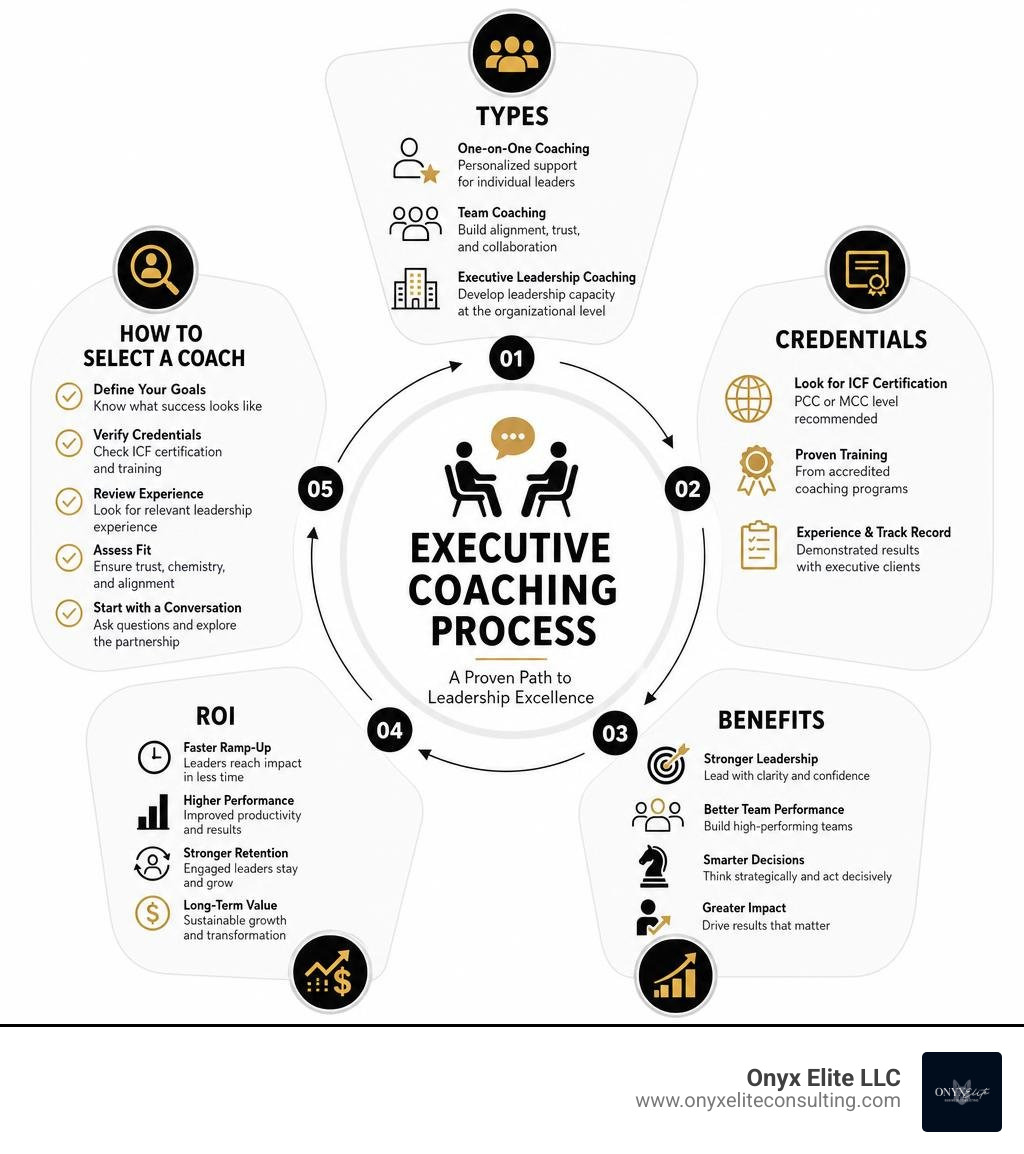
Core Types of Executive Coaching Services
Every leader faces unique hurdles depending on their organizational context. To address these varied needs, professional executive coaching services are categorized into distinct modalities. These focus on everything from alignment to organizational agility.
For a complete breakdown of how these services fit into a broader corporate strategy, see our insights on Leadership Coaching For Executives.
One-on-One Executive Coaching Services
This is the classic coaching format. It is a highly personalized engagement where a single executive works directly with a master coach.
One-on-one coaching is exceptionally effective at identifying personal blind spots—those behavioral patterns or communication habits that hold an otherwise brilliant leader back. Whether you are aiming to refine your executive presence, master strategic decision-making, or recover from burnout, this private container offers the psychological safety needed for deep, transformational work.
Transition and Onboarding Coaching
Stepping into a new C-suite role or transitioning from a functional leader (like a VP of Engineering) to an enterprise leader (like a Chief Technology Officer) is a notoriously high-risk period.
Transition coaching is designed to accelerate a leader's ramp-up time. Instead of the typical 18 to 24 months it takes a new executive to fully understand an organization and start driving value, structured onboarding coaching can reduce this period to just six months.
By focusing heavily on the "first 100 days," this service helps incoming executives align with key stakeholders, understand the unwritten cultural rules of the organization, and secure early wins without stepping on landmines.
Team and Leadership Group Coaching
Even the most talented individuals can struggle to perform as a cohesive unit. Team and leadership group coaching focuses on the collective dynamic of an executive team.
Rather than working in isolation, the team learns to align around a shared vision, improve collective decision-making, and build deep organizational trust. This type of coaching is particularly valuable during major corporate milestones such as mergers, acquisitions, or rapid scaling.
During these high-pressure periods, a skilled coach can facilitate constructive conflict resolution and ensure that the leadership team speaks with a unified voice.
The Measurable ROI and Benefits of Coaching
One of the most common questions boards and CFOs ask is: Is executive coaching actually worth the money?
The data points to a resounding yes. When done correctly, investing in leadership development yields significant, measurable organizational returns.

Key benefits that organizations routinely experience include:
- Increased Transformation Success: Aligning and coaching senior leaders around a unified strategy increases the likelihood of successful organizational change by over 70%.
- Accelerated Executive Productivity: Shortening transition periods saves organizations hundreds of thousands of dollars in lost momentum.
- Stronger Retention Rates: Leaders who receive investment in their development are far more likely to remain with their organizations, reducing costly executive search fees.
- Cultivating a Leadership Pipeline: Coaching helps prepare high-potential managers for future C-suite roles, minimizing succession risks.
How to Measure the ROI of Executive Coaching Services
While behavioral change can feel subjective, measuring its impact does not have to be. Leading organizations use a combination of quantitative and qualitative metrics to track the return on their coaching investment:
- 360-Degree Stakeholder Feedback: By collecting anonymous feedback from peers, direct reports, and board members before and after a coaching engagement, organizations can objectively measure improvements in communication, emotional intelligence, and collaboration.
- Goal Attainment Scaling (GAS): At the beginning of the engagement, the coach, the executive, and the corporate sponsor establish 3 to 5 highly specific business goals. Success is measured by the leader's progress toward these targets.
- Key Performance Indicators (KPIs): Linking coaching goals directly to business outcomes—such as team retention rates, department productivity, or project delivery timelines—provides a clear line of sight to the bottom line.
Who Benefits from Leadership Coaching?
While historically reserved strictly for the C-suite, modern organizations recognize that coaching is highly valuable across multiple career stages:
- C-Suite Executives and Founders: To navigate high-stakes decisions, manage board dynamics, and maintain strategic focus without burning out.
- Emerging and High-Potential Leaders: To prepare them for the leap from tactical management to strategic leadership.
- STEM and Technical Professionals: To help highly analytical minds (such as engineers, scientists, or financial analysts) develop the crucial emotional intelligence and communication skills needed to lead large, diverse teams.
Selecting the Right Executive Coach: Credentials and Criteria
The executive coaching market is highly unregulated. Anyone with a LinkedIn profile can call themselves a "coach." For organizations looking to protect their investment and ensure psychological safety for their leaders, having a strict selection process is essential.
If you are looking for local expertise in our home state of Connecticut, starting with trusted partners like West Hartford Leadership Consultants can help streamline your search.
Essential Credentials and Experience
When evaluating potential coaches or coaching firms, look for these baseline credentials:
- International Coaching Federation (ICF) Certification: The ICF is the gold standard for coaching credentials. Ensure your coach holds a Professional Certified Coach (PCC) or Master Certified Coach (MCC) designation.
- Advanced Academic Degrees: A background in organizational psychology, business administration, or human resources adds deep theoretical backing to practical coaching.
- Real-World Leadership Experience: The best coaches have sat in the hot seat themselves. Look for coaches who have prior experience as executives, founders, or senior corporate leaders.
Baseline Coach Selection Checklist:
- ICF Certified (PCC or MCC level)?
- Proven experience in your industry or leadership level?
- Certified in scientific assessment tools (Hogan, DiSC, 360s)?
- Offers a complimentary "chemistry call" before signing?
Key Qualities of an Effective Coach
Beyond credentials, the success of a coaching engagement hinges on the relationship between the coach and the executive. A great coach must balance two opposing roles: being a supportive confidant and a fierce challenger.
- Active Listening: They listen not just to what you say, but to what you leave unsaid.
- Constructive Challenge: They are bold enough to point out your inconsistencies and call out behavior that does not align with your stated goals.
- Trust and Confidentiality: You must feel entirely safe sharing your deepest professional anxieties without fear of it reaching your board or HR department.
Frequently Asked Questions About Leadership Development
How long does a typical coaching engagement last?
The majority of professional executive coaching engagements last between six and nine months. This timeframe provides enough room to conduct initial diagnostic assessments, set clear goals, implement behavioral changes, and gather feedback to ensure those changes are sustainable.
Sessions are typically held every two weeks for about 60 minutes, allowing the leader time to practice new behaviors between conversations.
What is the typical cost of executive coaching?
Executive coaching is a premium professional service. A standard six-month corporate-sponsored engagement for a senior executive typically ranges from $20,000 to $35,000.
The price varies based on the coach's experience, the inclusion of 360-degree diagnostic assessments, and whether the program includes stakeholder interviews. While the initial investment may seem high, the cost of an executive failing or leaving an organization prematurely is infinitely higher.
How is virtual coaching delivered compared to in-person?
In 2026, the vast majority of executive coaching is delivered via a hybrid or fully virtual model. Virtual coaching—conducted over secure video platforms—offers incredible flexibility for busy executives, allowing them to fit sessions into tight schedules without travel time.
Many organizations prefer a hybrid approach: starting with an in-person kickoff session to build trust and rapport, followed by bi-weekly virtual check-ins. Both formats are highly effective, provided the leader has a quiet, private space to speak openly.
Conclusion
At Onyx Elite LLC, we believe that great leadership is not a static trait—it is a continuous practice of self-discovery, strategic refinement, and deliberate growth. In an increasingly complex business environment, trying to navigate these challenges alone is no longer necessary or efficient.
Whether you are looking to accelerate your own career transition, build a high-performing leadership team, or drive operational excellence across your entire organization, our suite of tailored business consulting and executive development services is designed to help you succeed.
Ready to take your leadership to the next level?
- To learn more about our firm's philosophy, visit aboutthefirm.
- Get to know our leadership and approach at meetthefounder.
- Explore our complete range of growth and strategic planning solutions at our Services Overview.