How to Build an Enterprise Wide Compliance Strategy That Actually Works
Why Regulatory Change Management Services Are Critical in 2026

Regulatory change management services help organizations systematically identify, assess, and respond to new laws, rules, and guidance — before those changes create compliance gaps, penalties, or operational disruptions.
Here's a quick overview of what these services typically cover:
| RCM Service Component | What It Does |
|---|---|
| Regulatory Monitoring | Continuously scans for new rules across jurisdictions |
| Impact Assessment | Determines how changes affect your policies and controls |
| Triage & Prioritization | Filters what's material vs. what can wait |
| Implementation Planning | Assigns ownership and timelines for required changes |
| Verification & Closure | Confirms changes are embedded and documented |
| Audit Trail Management | Maintains records to demonstrate compliance readiness |
Every year, the regulatory landscape grows more complex. The SEC alone created 64 new rules between 2021 and 2024. Meanwhile, 92% of compliance professionals say their roles have gotten harder — and nearly half report they simply can't keep pace with the volume of changes coming at them.
The pressure is real. And for most organizations, the old way of handling it — manually tracking regulatory updates through email newsletters and spreadsheets — is no longer enough.
77% of compliance teams are still relying on manual processes. That's not just an efficiency problem. It's a risk problem.
For founders and business leaders, this isn't abstract. A missed regulation can derail a funding round, trigger a costly penalty, or expose governance gaps that shake stakeholder confidence. The stakes have never been higher — and the window to act proactively has never been narrower.
I'm Doru Angelo, Founder and CEO of Onyx Elite LLC, and through over a decade of business consulting and strategic advisory work across complex, high-stakes environments, I've helped organizations build the operational systems — including regulatory change management services — that turn compliance from a liability into a competitive advantage. In the sections ahead, I'll walk you through exactly how to build an enterprise-wide compliance strategy that actually holds up under pressure.
Defining Regulatory Change Management (RCM) in 2026
At its core, Regulatory Change Management (RCM) is the structured process of identifying, assessing, and implementing changes to an organization’s policies and controls in response to external shifts in the legal landscape. In 2026, this isn't just about reading the news; it’s about having a "system of intelligence" that captures updates from thousands of global authorities and translates them into actionable business tasks.
Unlike internal policy reviews, RCM is triggered by external forces—such as a new federal mandate or a state-level administrative code change in Connecticut. Because these triggers are outside our control, having an Integrated Risk Management Framework is essential. It ensures that when a regulator moves the goalposts, your entire team knows exactly which play to run.
Distinguishing RCM from Organizational Change Management
It’s easy to confuse RCM with general Organizational Change Management (OCM), but the distinction is vital for your strategy.
- Internal vs. External: OCM handles internal transitions like a company merger or a new software rollout. RCM responds to external laws that force your hand.
- The People Side: While RCM is technical and legal, it relies on OCM principles to succeed. We often use the Prosci ADKAR model (Awareness, Desire, Knowledge, Ability, Reinforcement) to ensure employees actually adopt the new compliance behaviors.
- Decision Boundaries: RCM requires strict "decision boundaries" to determine if a change is mandatory or discretionary. If a new rule from the Department of Labor drops, you don't "brainstorm" whether to follow it—you determine how to follow it to stay within the law.
The High Stakes of Modern Compliance Challenges
The numbers tell a sobering story. As of April 2026, 92% of compliance professionals report their roles have become significantly more difficult. The sheer volume of data is staggering: some estimates show over 40,000 regulatory items being vetted annually by top-tier firms.
The "bottleneck" is almost always manual labor. With 77% of teams still stuck using spreadsheets, the risk of a "miss" is high. This is particularly dangerous considering that cloud environment intrusions increased by 75% between 2022 and 2023. If your compliance process is manual, your defense against modern cyber-threats is likely outdated before the ink even dries on the report.
| Feature | Manual RCM | Automated RCM Services |
|---|---|---|
| Speed | Weeks of research | Real-time alerts |
| Accuracy | High human error risk | AI-driven mapping |
| Cost | High (labor-intensive) | Up to 90% reduction in long-term costs |
| Audit Readiness | Scrambling for files | Continuous, digital audit trail |
To survive this, businesses must look toward Business Process Improvement to strip away the friction that manual tracking creates.
The Strategic Value of Regulatory Change Management Services
Many leaders view compliance as a "cost center"—a necessary evil that drains the budget. However, in 2026, legal and compliance leaders rate business risk at a 7.9 out of 10, a 36% increase since just last year. In this environment, regulatory change management services become a strategic asset.
When we provide Operational Excellence Consulting, we focus on "transaction readiness." If you are looking to sell your company or raise a Series B, a documented, automated RCM process signals to investors that your governance is mature. It removes the "skeletons in the closet" that often derail big deals.
Core Capabilities of Regulatory Change Management Services
What should you actually look for in these services? A comprehensive solution isn't just a news feed. It needs:
- Standardized Taxonomy: This maps multiple regulatory providers into a single framework so you aren't comparing apples to oranges.
- Automated Triage: AI filters out the "noise" (like a regulation change in a country where you don't do business) and routes the "signal" to the right department head.
- Impact Assessment: Digital workflows that ask, "Which of our 50 policies does this new SEC rule actually touch?"
- Audit Trails: A permanent record of who saw the change, what they did about it, and when it was finished.
Best Practices for Implementing Regulatory Change Management Services
The secret to success isn't just the software; it's the leadership. Organizations with "excellent" change management practices meet their objectives seven times more often than those with poor practices.
We recommend:
- Early Stakeholder Engagement: Don't let compliance be a "legal-only" island. Get IT and Operations involved from day one.
- Proactive Horizon Scanning: Don't wait for the fine to arrive. Use services that monitor "proposed" rules so you have a six-month head start.
- Scalable Design: Ensure your process works whether you have 10 employees in West Hartford or 1,000 across the globe.
Leveraging AI and Automation for Compliance
AI has moved from a buzzword to a requirement. Modern regulatory change management services now use Machine Learning (ML) to perform "intelligent mapping." This means the AI can read a 300-page regulatory update and automatically suggest which internal controls need to be updated.
The results are transformative. Companies utilizing these advanced tools report a 90% reduction in compliance costs and a 60% faster response time to changes. By integrating Automation and Process Improvement, you shift your team from "data entry clerks" to "strategic risk advisors." Predictive analytics can even help you spot patterns in regulatory enforcement, allowing you to shore up defenses before the regulators even knock on your door.

A 6-Step Framework for Robust Compliance
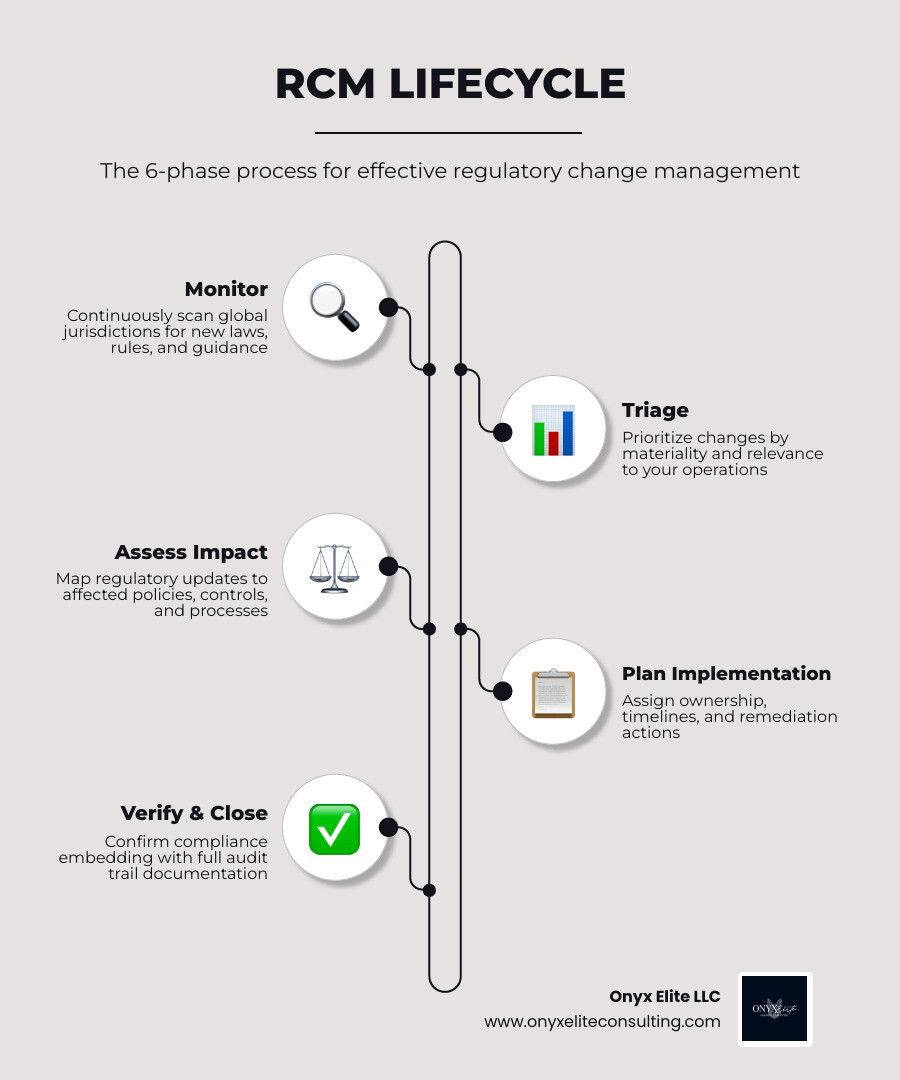
To build a strategy that actually works, we follow a repeatable, six-step lifecycle. This ensures nothing falls through the cracks and every action is defensible to an auditor.
- Monitoring & Intake: Use automated tools to scan sources like the Federal Register, agency websites (like CT.gov for our local Connecticut friends), and industry standards.
- Triage & Materiality: Not every update matters. Define "materiality thresholds" to separate minor guidance from major rule changes that require executive attention.
- Impact Analysis: Conduct a gap analysis. Where does our current state differ from the new requirement? What policies, training, or systems must change?
- Implementation Planning: Assign owners, set deadlines, and allocate resources. This is where you use our Operational Excellence Implementation Guide to keep the project on track.
- Execution & Testing: Update the documentation and, crucially, test the new control to make sure it actually works in the real world.
- Verification & Closure: An independent party (or a senior leader) verifies the change is complete. The "log" is closed and archived for audit purposes.
Frequently Asked Questions about Regulatory Change Management
What counts as a material regulatory change?
A material change is anything that introduces new legal obligations, modifies existing ones, changes the scope of who must comply, or alters reporting requirements. If it creates a new "enforcement risk" or requires you to change a business process, it’s material.
How does RCM differ from general policy management?
Policy management is about maintaining your internal "rulebook." RCM is the engine that tells you when that rulebook needs to be rewritten. Policy management is often static; RCM is dynamic and externally driven.
What is the role of AI in modern RCM services?
AI acts as a force multiplier. It performs the "grunt work" of reading thousands of pages of legal text, summarizing them into plain English, and recommending which parts of your business are impacted. It turns a month-long research project into a ten-minute review.
Conclusion
Building an enterprise-wide compliance strategy isn't about checking a box; it's about building a resilient organization that can thrive in a volatile world. By moving away from manual spreadsheets and embracing modern regulatory change management services, you protect your brand, your people, and your bottom line.
At Onyx Elite LLC, we specialize in helping companies in West Hartford and across Connecticut achieve sustainable growth through these exact types of operational excellence. Compliance shouldn't be a burden—it should be the foundation of your success.