Small Business, Big Tech: Why IT Consulting Isn't Just for the Giants
Technology Is No Longer Optional for Small Businesses

IT consulting services for small businesses are professional advisory services that help owners make smarter technology decisions — without needing a full-time tech team on payroll.
Here's what IT consulting actually covers:
- IT strategy and roadmapping — aligning your tech with your business goals
- Cybersecurity assessments — finding vulnerabilities before attackers do
- Compliance guidance — navigating HIPAA, PCI DSS, CMMC, and more
- Cloud migration — moving your systems to scalable, cost-efficient platforms
- Fractional CTO/vCIO services — executive-level tech leadership on a part-time budget
- Automation consulting — eliminating repetitive manual work that drains your team
Most small business owners assume IT consulting is something only large enterprises need. It isn't.
The reality is that small businesses face the same technology threats and pressures as big companies — but with far fewer resources to handle them. Downtime alone costs an average of $427 per minute. A single wrong software decision can create months of inefficiency and wasted budget.
Strategic IT consulting closes that gap. It gives founders and operators access to expert guidance, on demand, without the $77,000–$134,000 annual salary of a full-time IT hire.
I'm Doru Angelo, Founder and CEO of Onyx Elite LLC — an award-winning business consulting firm with over a decade of experience helping organizations build scalable, efficient operations, including navigating it consulting services small business decisions that align technology with long-term growth. The insights in this guide draw directly from that work, so you can make confident, informed choices for your business.
What is IT Consulting for Small Businesses?
To understand how it consulting services small business offerings can transform your operations, we first need to clear up some common industry confusion. Many business owners lump all "IT help" into a single bucket. However, there are major differences between having someone fix a broken printer, outsourcing your daily help desk, and hiring an IT consultant to design your long-term technology strategy.
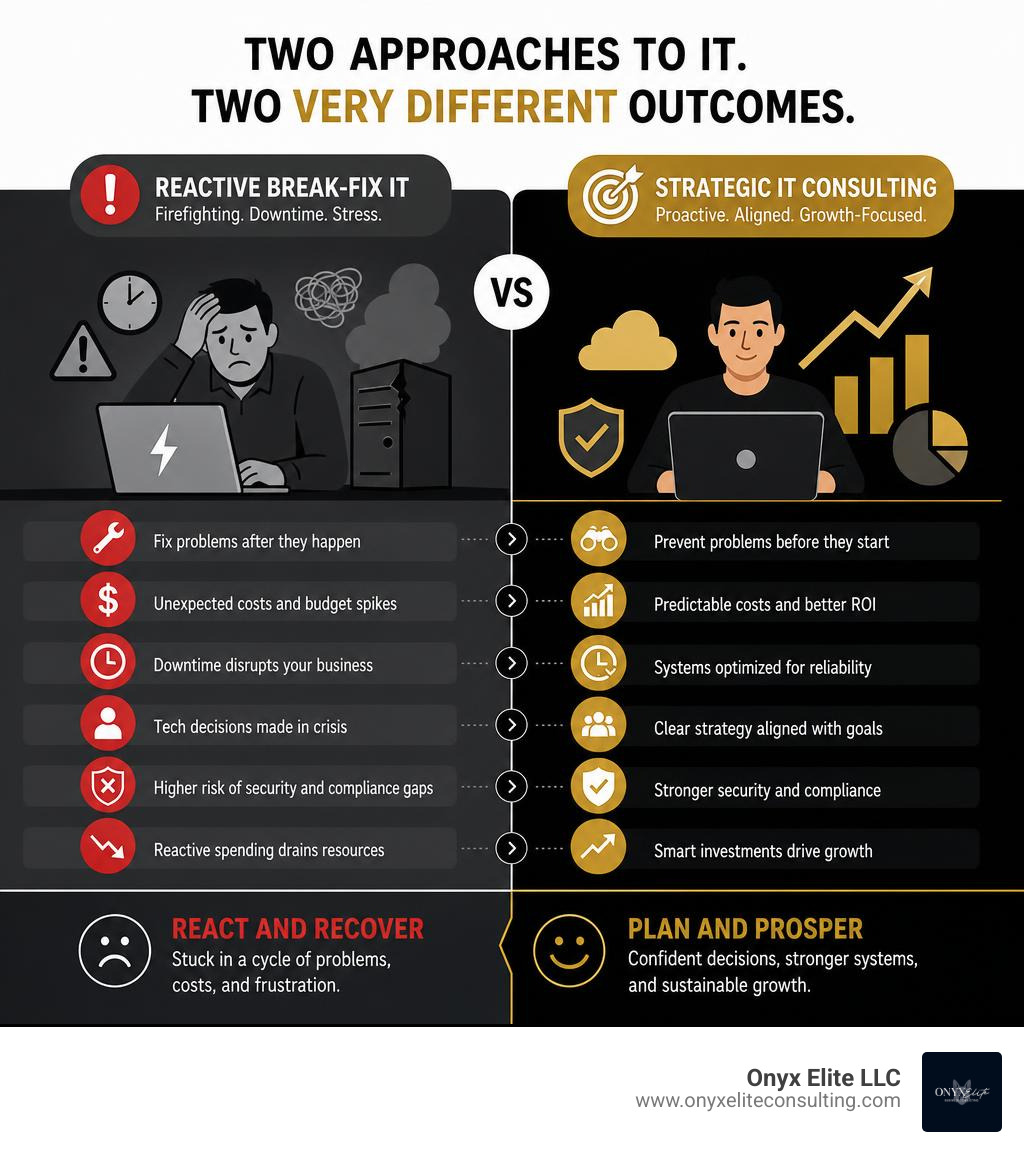
When you look at the broader landscape of Consulting Services for Small Business, IT consulting stands out as a proactive, strategic partnership. It is not about reacting to emergencies; it is about preventing them and building a tech infrastructure that actively drives revenue.
To make this distinction clear, let's look at the three primary ways small businesses handle technology:
| Feature / Service | Break-Fix Services | Managed IT Support (MSP) | IT Consulting |
|---|---|---|---|
| Primary Focus | Reactive repairs (fixing what is already broken) | Day-to-day operations, help desk, and monitoring | Strategy, alignment, compliance, and growth |
| Pricing Model | Hourly rate per incident | Flat monthly fee (typically per user/device) | Project-based, retainer, or hourly consulting fees |
| Strategic Planning | None | Limited to infrastructure maintenance | Exhaustive 3-to-5-year technology roadmaps |
| Ideal For | Micro-businesses with minimal tech needs | Businesses requiring outsourced day-to-day support | Companies scaling up, migrating systems, or facing compliance rules |
Defining IT Consulting Services Small Business
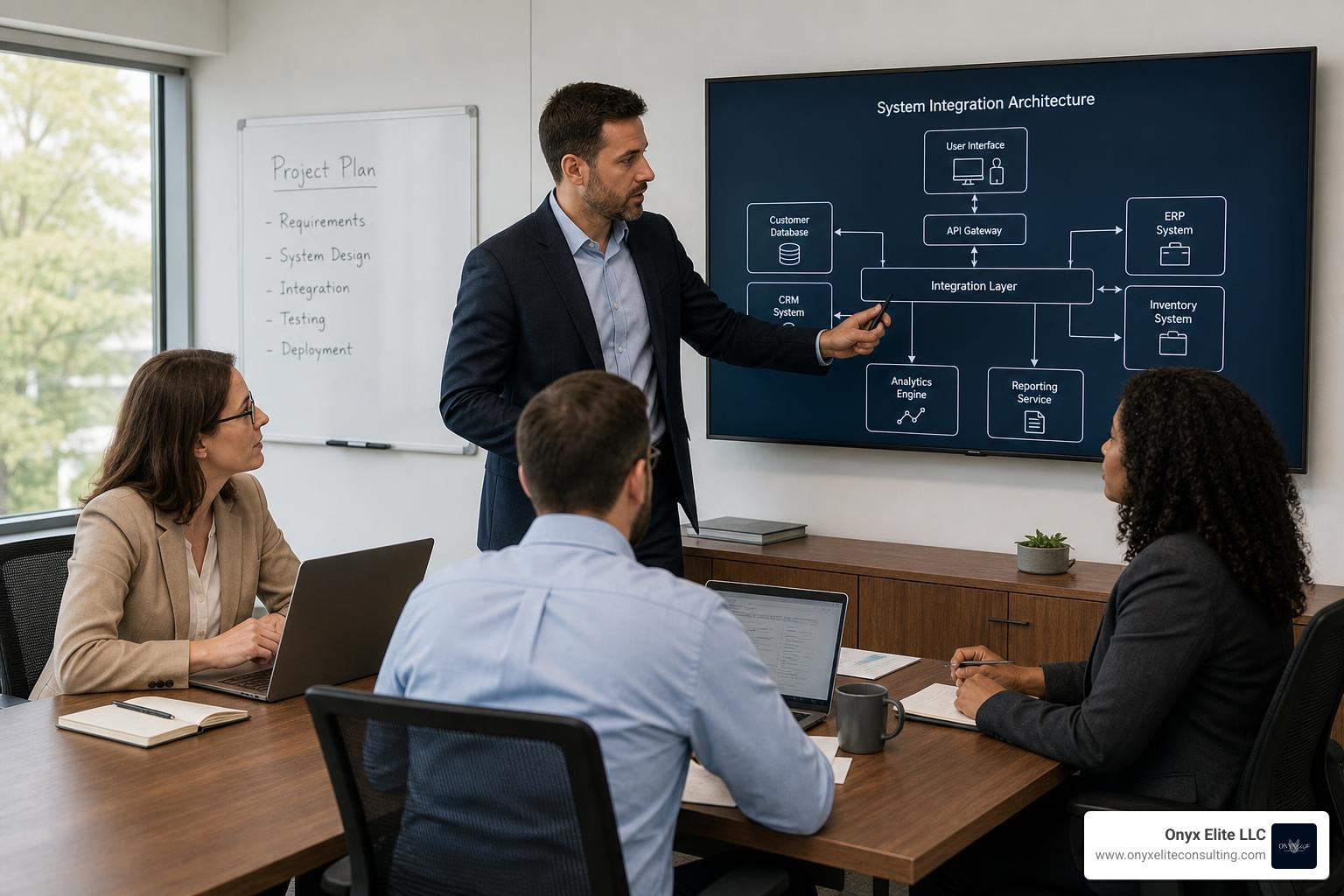
At its core, it consulting services small business models focus on big-picture technology planning. A true IT consultant doesn't just install software; they analyze your business goals, map out your current bottlenecks, and design a tailored technology roadmap.
For instance, if your goal is to double your headcount in West Hartford over the next two years, an IT consultant won't just tell you to buy more laptops. They will evaluate your network architecture, assess your cloud readiness, and implement single sign-on (SSO) systems so new employees can be onboarded securely and efficiently. This strategic planning ensures every dollar you spend on technology directly supports your bottom line.
How Consulting Integrates with Managed Services and In-House Teams
One of the greatest misconceptions is that hiring an IT consultant means replacing your existing tech team or your Managed Service Provider (MSP). In reality, strategic consulting works beautifully alongside them.
We call this co-managed IT. Your internal IT person or your MSP is likely buried in daily help desk tickets, password resets, and hardware setups. They rarely have the time to research emerging AI integrations, plan a massive cloud migration, or conduct a deep compliance audit.
An IT consultant steps in to provide the high-level strategy, working hand-in-hand with your existing team to execute complex upgrades without disrupting daily workflows. If you are curious about how these strategic layers fit together, you can Explore Onyx Elite's Services Overview to see how we align operational excellence with technical execution.
Why Small Businesses Need Strategic IT Guidance
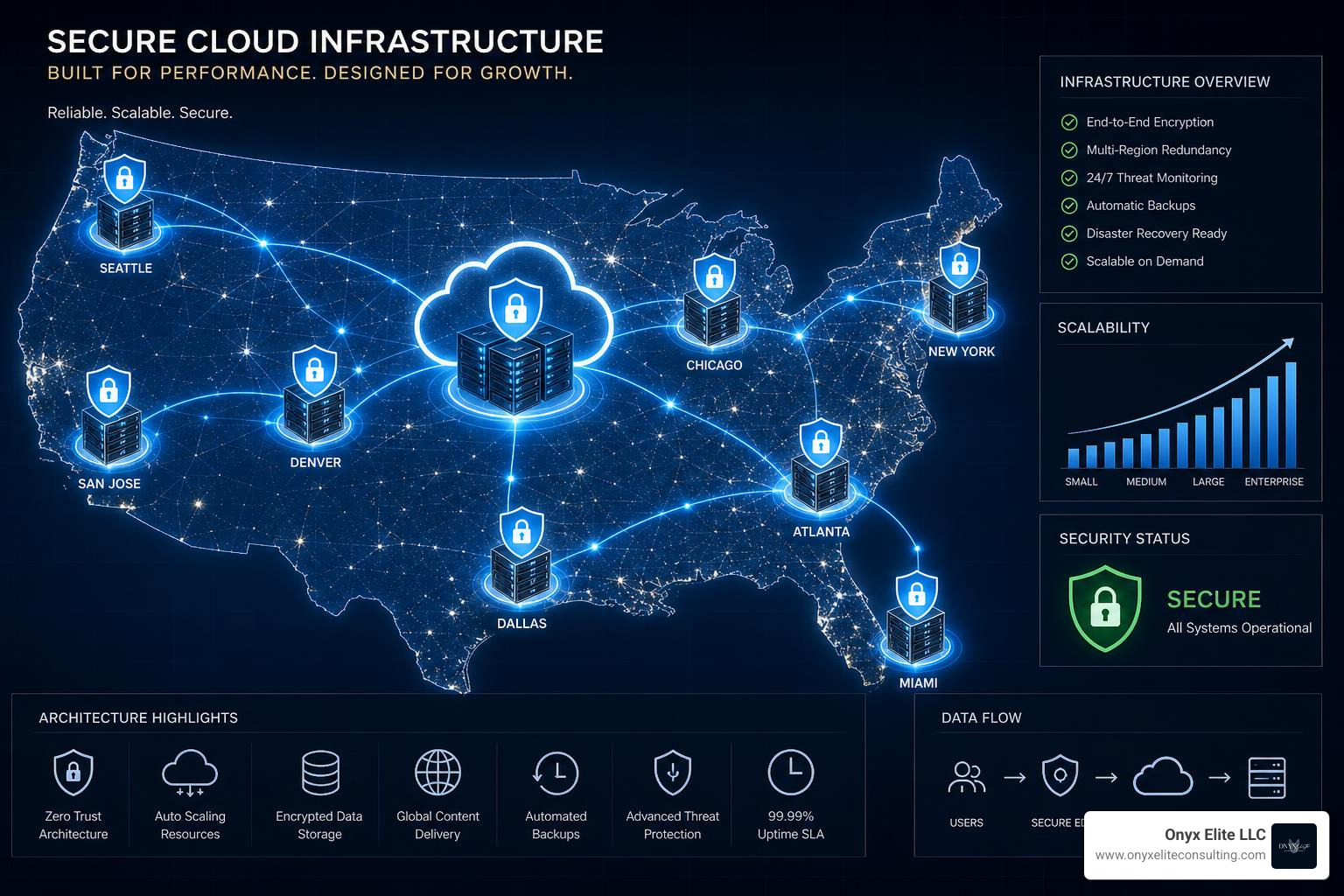
Many small businesses operate under a dangerous assumption: "We're too small to be targeted by hackers, and our basic systems work well enough."
Unfortunately, this "good enough" approach often leads to severe operational bottlenecks. Without a clear tech strategy, businesses end up with a messy, disconnected tech stack, slow processes, and major security gaps. To build a truly resilient company, you must understand how technology integrates into your broader operations. We explore these foundational requirements in our guide on 5 Internal Systems That Drive Scalable Growth for Service-Based Businesses.
Let's look at the specific risks of operating without strategic IT guidance, and the benefits of taking a proactive approach.
Overcoming Common Technology Challenges
Without expert guidance, small businesses quickly fall victim to several common technology traps:
- Tool Overload (SaaS Chaos): It is incredibly easy to sign up for dozens of software subscriptions, only to realize your team is using multiple tools that don't talk to each other. This creates data silos and wastes thousands of dollars a year on redundant licensing.
- Legacy System Bottlenecks: Relying on outdated hardware or legacy on-premise servers because "that's how we've always done it" slows down your team and increases your risk of hardware failure.
- The Cost of Downtime: As mentioned earlier, the average cost of downtime for small businesses is $427 per minute. Whether it is a local network crash, a ransomware attack, or a cloud service misconfiguration, unexpected downtime can quickly devastate your cash flow.
Key Benefits of Strategic IT Consulting Services Small Business
Partnering with an IT consultant turns technology from a constant headache into a competitive advantage. The primary benefits include:
- Significant Cost Savings: By auditing your software licenses, eliminating redundant platforms, and migrating to more efficient cloud architectures, consultants routinely save businesses thousands of dollars in waste.
- Unlocked Productivity Gains: Implementing automated workflows and clean system integrations allows your team to reclaim hours of repetitive manual work every single week.
- Robust Risk Reduction: Through layered cybersecurity defenses, automated backups, and strict access controls, consultants protect your business from reputation-damaging data breaches.
To achieve these outcomes, technology must be viewed as a core pillar of your business model. You can learn more about optimizing your entire operational structure through our Operational Excellence Consulting services.
Core IT Consulting Services Small Business Owners Should Consider
When searching for the right it consulting services small business partner, it helps to know exactly what specialized services are available. You don't have to implement everything at once; instead, focus on the areas that solve your most pressing operational challenges.
If you are looking to streamline your workflows, combining technology with Automation and Process Improvement is a fantastic place to start. Let's look at the core consulting services that drive the most value for growing businesses.
Fractional CTO and vCIO Services
For many small businesses, hiring a full-time Chief Technology Officer (CTO) or Chief Information Officer (CIO) is financially impossible. A seasoned tech executive easily commands a salary of $150,000 to over $200,000, which is outside the budget of most growing firms.
A Virtual CIO (vCIO) or Fractional CTO solves this problem by providing executive-level leadership on a part-time, retainer basis. Your vCIO will:
- Establish a clear 3-to-5-year technology roadmap.
- Create and manage your annual IT budget.
- Evaluate and negotiate contracts with software vendors.
- Ensure your technology infrastructure scales seamlessly alongside your business growth.
This approach gives you enterprise-grade strategic guidance without the enterprise-grade salary.
Cybersecurity Assessments and Regulatory Compliance
In 2026, basic antivirus software and a simple firewall are no longer enough to protect your business. Modern cyber threats require a sophisticated, layered defense strategy.
Furthermore, regulatory compliance is no longer just a concern for massive corporations. Small businesses in Connecticut must navigate strict rules depending on their industry:
- NIST CSF 2.0: The gold standard for mapping cybersecurity defenses, which now includes a heavy emphasis on governance and supply-chain risk.
- HIPAA: Essential for medical practices, clinics, and any business handling protected health information (PHI).
- CMMC (Cybersecurity Maturity Model Certification): Mandatory for any small defense contractors or manufacturers working with the Department of Defense. CMMC compliance consulting typically costs around $1,000 per month and includes dedicated weekly sessions with a registered practitioner to ensure you don't lose lucrative government contracts.
- PCI DSS v4.x: Crucial for any retail or e-commerce business accepting credit card payments.
- FTC Safeguards Rule: Highly relevant for accounting, tax, and financial services firms in the Hartford area, requiring a comprehensive Written Information Security Plan (WISP).
An IT consultant will conduct a thorough security audit, identify your compliance gaps, and implement the exact controls needed to keep your data safe and your business compliant. For businesses seeking a comprehensive operational overhaul, integrating these security standards is a key component of Business Process Improvement.
The Cost of IT Consulting Services for Small Business
Understanding how IT consulting is priced is essential for budgeting. Unlike standard IT support, which is often billed as a predictable flat rate per computer, strategic consulting costs depend heavily on the scope, complexity, and duration of your project.
To understand how these rates compare to other professional services in our region, check out our guide on the Hourly Rate Business Consultants Connecticut market.
Understanding Pricing Models: Hourly vs. Retainer vs. Project-Based
Most IT consulting firms offer three primary pricing models:
- Project-Based Fees: Best for clearly defined initiatives like migrating to Microsoft 365, setting up a new network, or conducting a compliance audit. Project-based labor is typically priced around $175 per hour (or packaged as a flat project fee based on estimated hours).
- Monthly Retainers: Ideal for ongoing strategic guidance, such as fractional CTO or vCIO services. These retainers typically range from $2,000 to $5,000 per month, depending on the size of your business and the frequency of strategic reviews.
- Hourly Consulting: Best for quick, ad-hoc technology advice or troubleshooting complex system integrations. Hourly rates generally range from $150 to $300 per hour depending on the consultant's specialization.
Comparing Outsourced Consulting to Full-Time In-House Hiring
When deciding whether to hire an in-house IT manager or partner with an external consulting firm, the financial comparison is clear:
- In-House IT Leader: A full-time strategic IT professional typically costs between $77,000 and $134,000 per year in base salary alone. When you add taxes, benefits, ongoing training, and specialized software tools, the true cost can easily exceed $150,000 annually.
- Outsourced IT Consulting: Partnering with a firm gives you access to an entire team of specialists (security experts, cloud architects, compliance officers) for a fraction of the cost of a single full-time hire.
This outsourced model allows you to scale your tech spending up or down based on your actual business needs, optimizing your resources for maximum efficiency.
How to Choose the Right IT Consulting Partner
Choosing an IT consulting partner is a major decision. The right partner will guide your business toward rapid, secure growth; the wrong one can lock you into expensive, overly complex systems that slow your team down.
If you are looking for a general framework on selecting professional advisors in our state, our Business Consultant Connecticut Guide provides excellent strategies for vetting local firms.
Key Qualities to Look For in a Consultant
When interviewing potential it consulting services small business partners, keep these essential qualities in mind:
- Vendor-Neutral Guidance: A great consultant shouldn't be locked into pushing a single software brand. They should recommend the absolute best tools for your unique goals, whether that means Microsoft Azure, Amazon Web Services (AWS), or specialized industry applications.
- Jargon-Free Communication: If a consultant cannot explain complex technical concepts in plain, simple business terms, walk away. You need a partner who speaks the language of business growth, not just code.
- Proven Industry Experience: Ask for case studies of businesses similar to yours in size and industry. A consultant who understands the specific regulatory pressures of a Connecticut accounting firm or medical practice is far more valuable than a generalist.
- Local Ecosystem Awareness: If your business operates in Connecticut, look for a consultant who understands the regional business environment, local compliance expectations, and the practical realities of supporting teams across West Hartford, Hartford, and surrounding communities. The right partner should also be able to coordinate smoothly with your existing internal IT staff, software vendors, or managed support provider without creating confusion or duplicated work.
The Typical Consulting Process and Timeline
A professional IT consulting engagement is highly structured. Most reputable firms follow a five-step framework based on proven consulting methodologies:
- Discover: We start by listening. We dive deep into your business goals, current workflows, and operational pain points.
- Assess: We conduct a thorough audit of your existing technology stack, network infrastructure, cybersecurity controls, and compliance gaps.
- Design: We build a custom, prioritized technology roadmap and budget aligned with your growth plans.
- Implement: We coordinate the rollout of new systems, migrate data to the cloud, and implement security protocols-minimizing disruption to your team.
- Optimize: We establish regular progress reviews to monitor system performance, train your staff, and adjust the strategy as your business scales.
A typical IT consulting engagement for a small business lasts between six and twelve months, depending on the size of your organization and the complexity of your systems.
Measuring ROI and Success Metrics
To ensure your investment is paying off, you should track both quantitative and qualitative success metrics:
- Quantitative Metrics: Look for a reduction in software licensing costs, a decrease in system downtime, faster project delivery times, and a measurable reduction in manual data entry errors.
- Qualitative Outcomes: These include improved employee satisfaction (fewer tech headaches), stronger security postures that satisfy insurance requirements, and the peace of mind that comes with knowing your business is fully compliant with industry regulations.
Frequently Asked Questions about IT Consulting Services Small Business
What is the difference between IT consulting and tech consulting?
While these terms are often used interchangeably, they have distinct focuses. IT consulting primarily covers business infrastructure, information management, cybersecurity, compliance, and aligning technology systems with business operations. Tech consulting is often narrower, focusing on specialized technical systems, custom software development, or hardware engineering.
Do I need IT consulting if I already have an internal IT person?
Yes! Your internal IT person is likely fully occupied with daily troubleshooting, user support, and basic maintenance. An IT consultant brings specialized expertise that your in-house team may lack, such as executing complex cloud migrations, designing advanced cybersecurity frameworks, or preparing your business for a rigorous regulatory compliance audit.
How often should a small business review its IT strategy?
We recommend reviewing your technology strategy at least annually. However, if your business is experiencing rapid growth, adding new locations, or adopting emerging technologies like AI-driven automation, you should review your strategy quarterly to ensure your systems are scaling efficiently and securely.
Conclusion: Partner with Onyx Elite for Sustainable Growth
At Onyx Elite LLC, we believe that technology should never be a source of stress or a bottleneck to your success. When implemented correctly, your IT infrastructure should be a powerful engine that drives efficiency, protects your hard-earned assets, and fuels sustainable growth.
Whether you are looking to secure your systems, migrate to a scalable cloud environment, or completely optimize your business processes, we are here to help. We combine strategic business planning with technical oversight to guide your organization toward operational excellence.
Ready to align your technology with your long-term business goals? Explore Onyx Elite's Services Overview to see our full suite of tailored consulting options, or connect with our team today through our Operational Excellence Consulting page to schedule your strategic assessment. Let's build a secure, scalable foundation for your business together.