

Don't Get Processed! Top Credit Card Processors for Small Businesses in 2025
Why Choosing the Right Credit Card Processor for Small Business Can Make or Break Your Margins

A credit card processor for small business is one of the most important - and most overlooked - financial decisions you'll make as a founder. Get it right, and you save thousands every year. Get it wrong, and hidden fees quietly drain your margins while you're focused on growing.
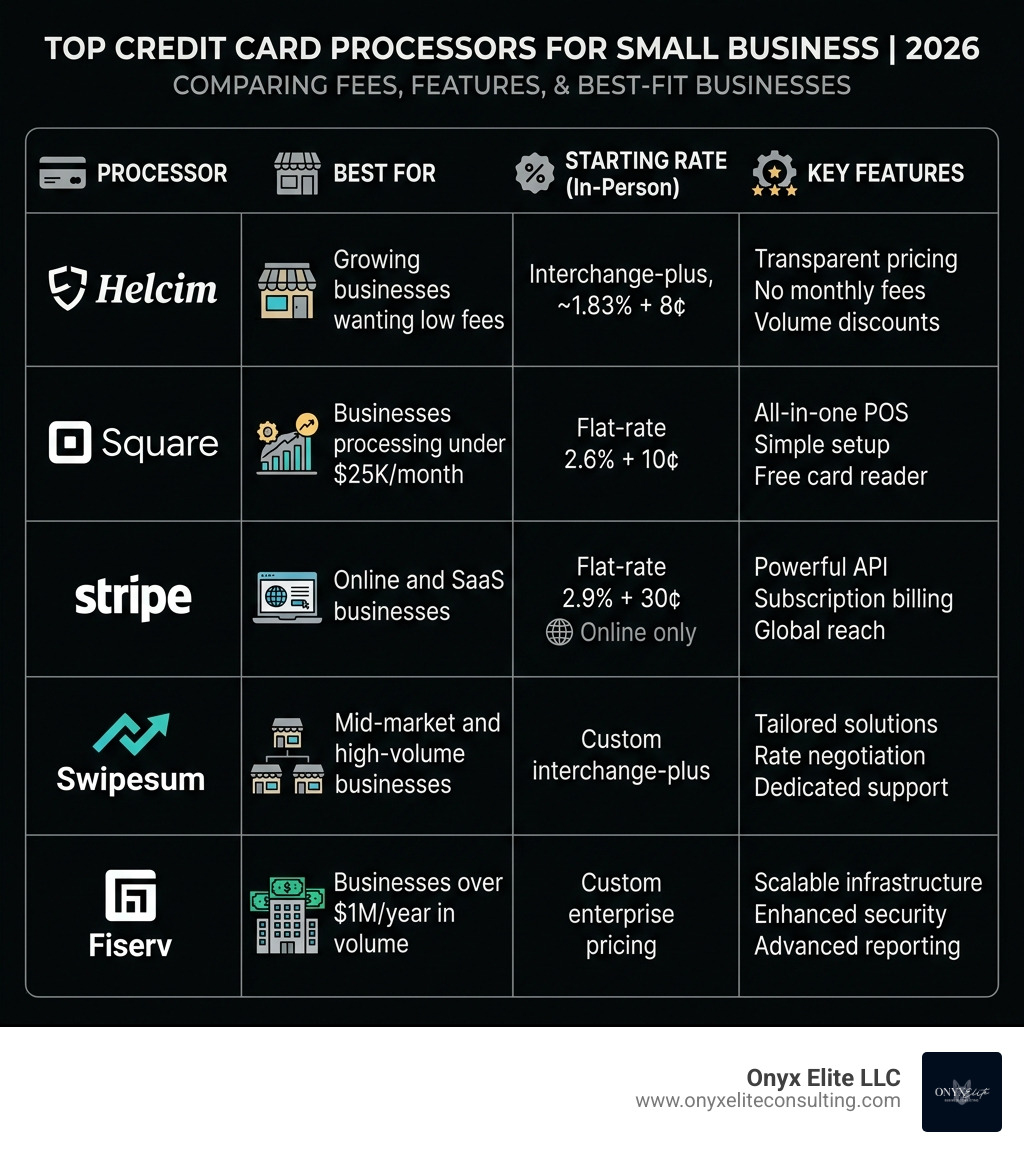
Here are the top credit card processors for small businesses in 2026:
| Processor Type | Best For | Typical Starting Rate |
|---|---|---|
| Interchange-plus providers | Growing businesses wanting low fees | Interchange-plus, often around 1.8% + 8c in-person before markup variations |
| Flat-rate all-in-one platforms | Businesses processing under $25K/month | Around 2.6% + 10c in-person |
| Online-focused payment platforms | Online and SaaS businesses | Around 2.9% + 30c online |
| Custom brokerage and optimization services | Mid-market and high-volume businesses | Custom interchange-plus |
| Enterprise payment providers | Businesses over $1M/year in volume | Custom enterprise pricing |
Most U.S. small businesses pay between 2.3% and 3.5% per transaction in total fees. That gap between the low and high end adds up fast. A retail shop processing $25,000 per month could save over $900 per year just by switching from a 2.9% to a 2.6% rate.
And the stakes are higher than most owners realize. With 41% of U.S. small businesses hit by a cyberattack in 2023, according to SBA cybersecurity reports, your processor choice isn't just about cost - it's about security, compliance, and protecting your customers.
The right processor should be transparent, scalable, and built for how your business actually operates.
I'm Doru Angelo, Founder & CEO of Onyx Elite LLC, and with over a decade of business consulting experience helping founders optimize their operations and financial systems - including navigating the often confusing world of choosing the right credit card processor for small business - I've seen how the wrong payment setup creates unnecessary drag on growth. In this guide, I'll cut through the noise so you can make a confident, informed decision.
Understanding the Role of a Credit Card Processor for Small Business
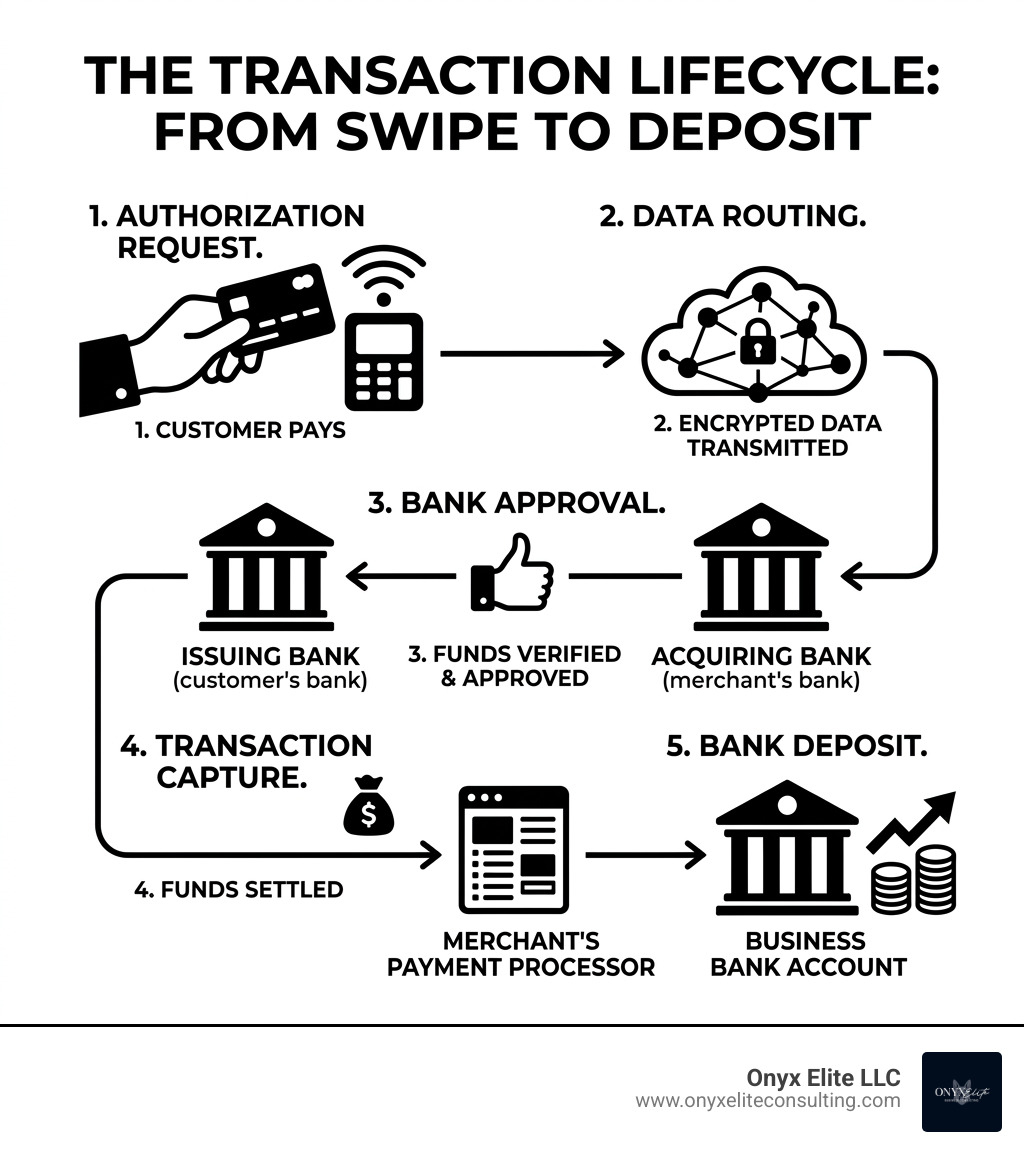
When a customer taps their card at your boutique in West Hartford or enters their digits on your website, a complex "handshake" happens in milliseconds. Understanding this lifecycle helps you spot where those pesky fees come from.
The Transaction Lifecycle
It starts with authorization. Your credit card processor sends the data to the card network (like Visa or Mastercard), which then asks the customer's bank if they have enough money. Once approved, the transaction is "captured." Finally, settlement occurs, usually 1-3 business days later, when the funds (minus fees) are deposited into your account.
Merchant Accounts vs. Payment Service Providers (PSPs)
In the past, every business needed a dedicated merchant account-essentially a special bank account for credit card funds. Today, many modern credit card processors for small business act as "aggregators" or PSPs. They lump thousands of small businesses into one giant merchant account.
- Pros of PSPs: Fast setup, no monthly fees, and simple flat-rate pricing.
- Cons of PSPs: Higher risk of account freezes and slightly higher per-transaction costs as you scale.

Payment Gateways
If you sell online, you need a payment gateway. Think of this as the digital version of a physical card reader. It encrypts the data and safely transports it from your website to the processor. Many providers now offer all-in-one solutions that handle both the hardware in your shop and the gateway on your site.
Comparing Pricing Models and Transaction Fees
Pricing is where things get "punny"—if you aren't careful, you’ll get processed! There are four main ways a credit card processor for small business will bill you:
- Flat-Rate Pricing: You pay a fixed percentage (e.g., 2.6% + 10¢) regardless of the card type. This is incredibly predictable and great for businesses processing under $10,000–$25,000 a month.
- Interchange-Plus: This is the most transparent model. You pay the "wholesale" cost set by the card networks (interchange) plus a small, fixed markup from the processor. For growing businesses, this is almost always the cheapest route.
- Subscription-Based: You pay a monthly membership fee in exchange for 0% markup on transaction rates. This is a win for high-volume businesses.
- Tiered Pricing: Avoid this if possible. Transactions are grouped into "qualified," "mid-qualified," and "non-qualified." It’s often designed to hide the true cost of rewards cards and business cards.
The Effective Rate Formula
To truly compare apples to apples, don't just look at the quoted percentage. Use the Effective Rate Formula:
(Total Monthly Fees ÷ Total Monthly Sales) x 100 = Your Effective Rate
If you processed $10,000 and paid $300 in fees, your effective rate is 3%. If another processor offers a lower "teaser rate" but adds PCI fees and statement fees that bring you to 3.2%, they aren't actually cheaper. Check out our Merchant Account Options guide for a deeper dive into these structures.
| Pricing Model | Best For | Transparency |
|---|---|---|
| Flat-Rate | New/Low Volume | High (Simple) |
| Interchange-Plus | Growing/Established | Very High (Detailed) |
| Subscription | High Volume ($50k+) | High |
| Tiered | Almost Nobody | Low (Opaque) |
Top-Rated Processing Solutions for 2026
The landscape in 2026 is dominated by contactless payments. In fact, NFC (Near Field Communication) adoption has surpassed 90% for in-person transactions. If your hardware doesn't accept Apple Pay or Google Pay, you're living in the stone age.
When we look at the best credit card processor for small business options, we see a clear divide:
- For the "Side Hustle" or Micro-Business: Flat-rate, easy-setup platforms remain popular because they usually have no monthly fees and a simple app-based experience.
- For the Growing Tech-Savvy Merchant: Interchange-plus providers are often a strong fit in 2026, especially for businesses that want more transparent pricing and opportunities to reduce costs on certain commercial card transactions.
- For the Online-First Brand: Online-focused processors typically offer robust developer tools and international support, making them a strong choice for e-commerce and SaaS.
For a customized roadmap on which tech stack fits your specific goals, see our Credit Card Processing Consulting Guide.
Key Features of a Credit Card Processor for Small Business
Don't just chase the lowest rate; look for these "sanity-saving" features:
- POS Integration: Does it talk to your inventory and accounting software?
- Real-Time Reporting: Can you see your sales trends from your phone while grabbing coffee in West Hartford?
- 24/7 Human Support: When your system goes down on a Saturday afternoon, a chatbot won't help you. You need a real person.
- Scalability: Can the processor handle you going from one location to five?
Evaluating a Credit Card Processor for Small Business by Industry
Every industry has its own "vibe"-and its own processing needs.
- Retail: Needs fast barcode scanning and robust inventory management.
- Restaurants: Requires "tableside ordering," tip management, and split-check capabilities.
- E-commerce: Needs a secure gateway and fraud tools like 3D Secure to prevent chargebacks.
- High-Risk: If you're in an industry like CBD or travel, you'll need a specialized processor that won't shut you down for "excessive risk."
For local insights, our Payment Processing Solutions Connecticut page covers regional trends and support.
Security Standards and Fraud Prevention
With the global credit card market exceeding $500 billion, hackers are working overtime. As a small business owner, you are legally responsible for protecting your customers' data.
PCI DSS Compliance
This is the gold standard, maintained by the PCI Security Standards Council. Most top processors now handle the bulk of this for you, but you still need to ensure you aren't storing raw card numbers on your local computer.
The "Security Shield" Stack
- End-to-End Encryption: Scrambles data the moment the card touches the reader.
- Tokenization: Replaces sensitive card data with a random string of characters (a "token") so that even if your system is hacked, there’s nothing for thieves to steal.
- EMV Chip Technology: This has been standard for years, but in 2026, using non-EMV readers is a massive liability. If you "swipe" a chip card and it’s fraudulent, you are responsible for the loss, not the bank.
Managing these risks is part of a healthy Chargeback Management Services strategy.
Frequently Asked Questions about Merchant Services
What is the average credit card processing fee in 2026?
Most businesses are seeing total effective rates between 2.3% and 3.5%. In-person "card-present" transactions are generally the cheapest (averaging 2.6%), while online or "keyed-in" payments are higher (averaging 2.9% to 3.5%) because the risk of fraud is greater.
How do I switch processors without paying high cancellation fees?
Many modern processors have a "merchant buyout" offer where they may cover some or all of your old processor's exit fees to win your business. Always ask a new provider if they offer a buyout before you sign.
Can I accept credit cards without a traditional merchant account?
Yes! Through Payment Service Providers (PSPs), you can start taking payments with just a standard business checking account. You don't need the lengthy underwriting process required by traditional banks.
Conclusion: Optimizing Your Payment Strategy
Choosing a credit card processor for small business isn't a "set it and forget it" task. As your volume grows, the flat-rate plan that was perfect on day one might start costing you thousands in unnecessary markups.
At Onyx Elite LLC, we believe in operational excellence. That means auditing your statements regularly and ensuring your payment technology supports your sustainable growth. Whether you’re a startup in West Hartford or an established Connecticut retailer, your margins deserve protection.
Ready to stop overpaying and start optimizing? Let’s build a Payment Strategy Consulting plan that puts money back in your pocket. Explore our full suite of Credit Card Processing services today.