

How to Master Nonprofit Bookkeeping Without Losing Your Mind
What Is Bookkeeping for Nonprofits (and Why It Matters)?

Bookkeeping for nonprofits is the process of systematically recording, organizing, and tracking every financial transaction your organization makes — from donations and grants to payroll and vendor payments.
Here's a quick snapshot of what it covers:
- Recording transactions — every dollar in and out, including in-kind gifts
- Fund accounting — separating restricted and unrestricted funds based on donor intent
- Bank reconciliations — matching your records to your bank statements monthly
- Financial reporting — producing statements your board, donors, and the IRS actually need
- Form 990 support — keeping books organized so your annual filing is accurate and complete
It's not the same as for-profit bookkeeping. Nonprofits don't track profit — they track accountability. Where the money came from, what it was restricted for, and whether it was spent according to donor intent.
That distinction matters more than most founders realize — especially as your organization grows.
Nonprofits make up America's third-largest workforce, yet many operate with financial systems that weren't built for their needs. A typical fraud case at a nonprofit goes undetected for 12 months and causes a median loss of $117,000. Organizations lose an estimated 5% of total revenue to fraud every year. Clean, consistent books are your first line of defense.
If your nonprofit is still running on spreadsheets or a general small-business accounting setup, the cracks may not be visible yet — but they will be.
I'm Doru Angelo, founder of Onyx Elite LLC and operator of a 501(c)(3) organization myself, which has given me insight into the real-world challenges of bookkeeping for nonprofits and why getting it right is foundational to long-term mission success. In the sections ahead, I'll walk you through everything you need to know to build a financial system that actually works for your organization.
The Importance of Bookkeeping for Nonprofits in 2026
In 2026, the regulatory and donor landscapes demand absolute transparency. For Connecticut-based organizations, staying on top of financial compliance is not just about keeping the IRS happy; it’s about preserving the hard-earned trust of your community. Whether you are operating in West Hartford, Danbury, or Old Saybrook, maintaining pristine financial records is your ticket to long-term sustainability.

When a nonprofit crosses $200,000 in gross receipts or $500,000 in total assets, it moves into full Form 990 filing territory. This transition changes bookkeeping from a basic administrative task into a crucial pillar of organizational governance. At this level, you must provide detailed disclosures, including a breakdown of your functional expenses. Without specialized bookkeeping for nonprofits, compiling this data at year-end becomes an absolute nightmare.
Furthermore, donor trust is highly fragile. Modern supporters and grantors want to see exactly how their contributions are being utilized. If you cannot quickly show that a restricted grant was spent on the designated program, you risk losing that funding entirely.
Implementing robust bookkeeping also acts as a shield against internal vulnerabilities. Research shows that while 47% of nonprofits put a large amount of effort into preventing fraud, and 89% make at least some effort, the sector remains highly vulnerable due to limited administrative capacity.
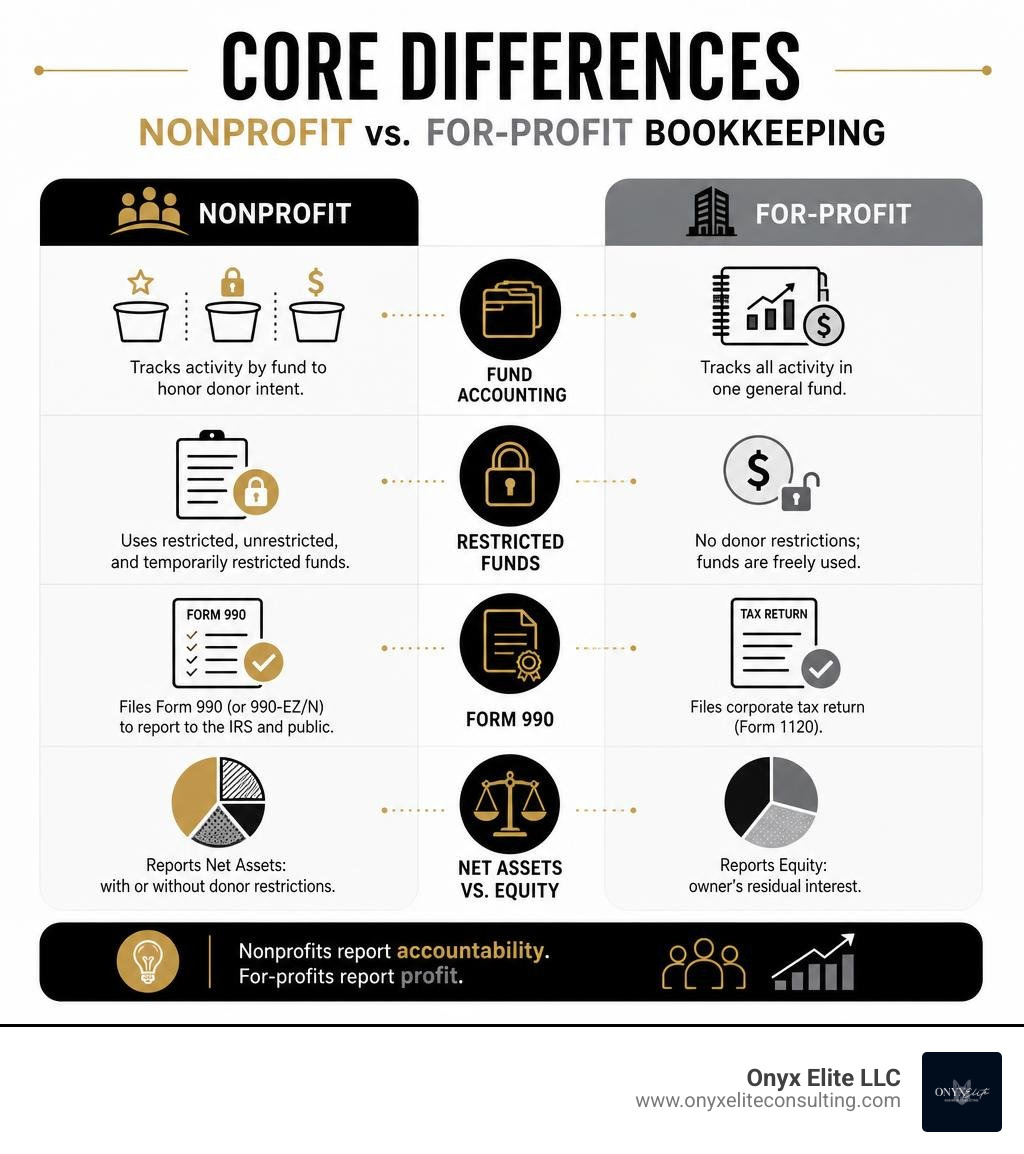
To help visualize how these demands differ from the commercial sector, let’s compare the core differences:
| Feature | For-Profit Bookkeeping | Nonprofit Bookkeeping |
|---|---|---|
| Primary Goal | Track profitability and return on investment | Demonstrate accountability and stewardship of funds |
| Accounting Method | Standard double-entry accounting | Fund accounting (restricted vs. unrestricted) |
| Equity Section | Retained Earnings / Owner's Equity | Net Assets (with or without donor restrictions) |
| Tax Filings | Corporate tax returns (Form 1120, etc.) | Annual information return (Form 990) |
| Financial Health Metric | Net profit margin and revenue growth | Program efficiency ratio and budget-to-actuals |
For local organizations trying to navigate these complexities, aligning with a professional Business Consultant Connecticut Guide can help establish the foundational structures needed to keep your mission on track.
Core Duties and the Pillars of Fund Accounting
A nonprofit bookkeeper does far more than just "keep the books." They manage the day-to-day financial pulse of your organization. The core duties of bookkeeping for nonprofits include:
- Transaction recording: Entering every donation, grant payout, invoice, and bill into your general ledger.
- Bank reconciliations: Cross-referencing bank and credit card statements monthly to catch errors, identify unauthorized transactions, and prevent overdraft fees.
- Payroll processing: Managing staff salaries, tax withholdings, and benefits while tracking allocations across different programs.
- Cost allocation: Splitting shared expenses (like rent and utilities) between programmatic, administrative, and fundraising functions.
- Financial reporting: Preparing clean draft statements for the executive director and the board of directors.
To maintain compliance and build a system that can scale, many organizations establish clear internal guidelines to ensure their daily transactions are categorized correctly from day one.
Tracking Restricted vs. Unrestricted Funds in Bookkeeping for Nonprofits
The absolute core of nonprofit financial management is fund accounting. Unlike commercial businesses that pool all revenue into a single pot, nonprofits must segregate funds based on their source and intended use.
- Unrestricted Funds (Net Assets Without Donor Restrictions): These are general operating funds. You can use them for rent, administrative salaries, marketing, or any general program expenses.
- Restricted Funds (Net Assets With Donor Restrictions): These are funds given by donors or grantors with explicit instructions on how and when they can be spent. For example, if a donor gives $10,000 specifically to purchase computers for an after-school program in Hartford, those funds cannot be spent on staff payroll or office rent.
- Board-Designated Reserves: Sometimes, your board will set aside a portion of unrestricted cash for a specific future project or emergency fund. It is vital to note that while board-designated funds are tracked separately, they can be redesignated by the board at any time. True donor-restricted funds, however, cannot be changed without written permission from the donor.
Structuring these categories correctly within your ledger is essential for maintaining clear financial boundaries and ensuring long-term compliance.
Streamlining Payroll and Cost Allocation in Bookkeeping for Nonprofits
Allocating personnel costs is often the most challenging aspect of nonprofit payroll. If an employee spends 60% of their time running your core community program, 20% writing grant proposals (fundraising), and 20% on general office administration, their salary and payroll taxes must be allocated across those exact functional categories.
To handle this efficiently, your bookkeeping system needs a robust time-tracking process. Employees should log their hours spent on specific programs or grants. At the end of each month, your bookkeeper will use these logs to post payroll allocations.
Using consistent, documented allocation methodologies is critical. If your nonprofit undergoes an audit, the auditors will look closely at how you divided these shared costs, making a standardized allocation process essential.
Key Financial Statements Every Nonprofit Must Produce
For-profit businesses rely on Balance Sheets and Income Statements. Nonprofits use a different set of reports designed to show stewardship rather than profit.

Under GAAP and FASB guidelines, your bookkeeping system must be capable of producing the following four core statements:
1. Statement of Financial Position (The Nonprofit "Balance Sheet")
This report provides a snapshot of your organization's financial health at a specific point in time. It lists your:
- Assets: Cash, grants receivable, equipment, and building values.
- Liabilities: Accounts payable, accrued payroll, and outstanding loans.
- Net Assets: Divided into "with donor restrictions" and "without donor restrictions."
The fundamental equation here is: Assets = Liabilities + Net Assets.
2. Statement of Activities (The Nonprofit "Income Statement")
This statement shows your revenues and expenses over a specific period (e.g., a month, quarter, or year). Instead of showing a "net profit," it reveals your Change in Net Assets. It tracks how funds move from "restricted" to "unrestricted" as donor-imposed conditions are met.
3. Statement of Functional Expenses
This is perhaps the most scrutinized report for nonprofits. It breaks down your expenses by their natural classification (salaries, rent, travel) and allocates them into three functional categories:
- Program Services: Direct costs associated with delivering your mission.
- Management and General: Administrative expenses, board meetings, and general bookkeeping.
- Fundraising: Costs associated with soliciting contributions, hosting galas, and writing grant proposals.
Donors and watchdog groups often look at the ratio of program expenses to total expenses to evaluate how efficiently you run your organization.
4. Statement of Cash Flows
This statement tracks the actual physical movement of cash in and out of your bank accounts across operating, investing, and financing activities. It ensures you have enough liquidity to meet your immediate liabilities, regardless of what your overall net assets look like on paper.
These reports must be compiled accurately and presented clearly to board members to ensure proper oversight and strategic decision-making.
Best Practices for Managing Donations, Grants, and In-Kind Gifts
Managing different revenue streams is a common stumbling block for growing nonprofits. Each type of funding requires unique bookkeeping treatment:
- Individual Donations: These should be recorded when received. If a donor makes a written pledge to give a certain amount in the future, it must be recorded as a pledge receivable (asset) and temporarily restricted revenue under accrual accounting.
- Grants: Government and private grants often operate on a reimbursement basis. You must track the exact expenses incurred under the grant program first, then record the corresponding grant revenue as those conditions are met.
- In-Kind Gifts: Non-monetary contributions (such as donated professional services, equipment, or supplies) must be recorded at their fair market value. For instance, if a local dealership donates a delivery vehicle, you must document its make, model, and market value, recording it as both an in-kind contribution and a fixed asset.
Maintaining clean records of these transactions is the cornerstone of audit readiness. For organizations in our local Connecticut community, establishing clear workflows is key. We highly recommend utilizing professional Bookkeeping Services West Hartford Ct to ensure your revenue recognition policies comply with FASB standards.
Building Internal Controls and Avoiding Common Pitfalls
Weak internal controls are the single biggest threat to a nonprofit’s financial health and reputation. When one person handles the entire cash cycle — opening mail, depositing checks, recording transactions, and reconciling the bank accounts — the risk of fraud or simple human error skyrockets.
To build a bulletproof bookkeeping system, implement these internal controls immediately:
- Segregation of Duties: Ensure the person who approves payments is not the same person who writes the checks or reconciles the bank statements.
- Documented Approval Workflows: Use digital tools like Bill.com or RAMP to route invoices through a formal approval process before they are paid.
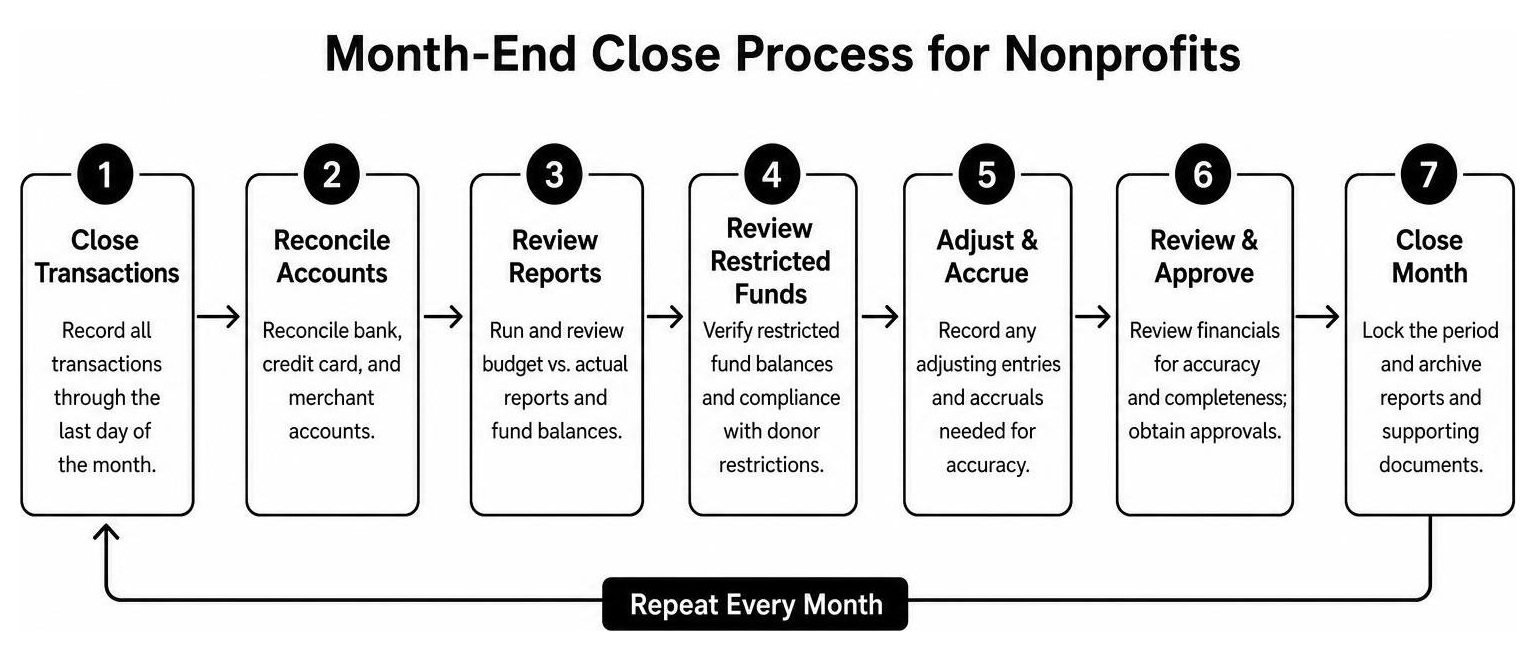
- Strict Month-End Close Rhythm: Reconcile all bank, credit card, and merchant accounts within 10 to 15 days of the month's end. Review restricted fund balances and investigate any significant budget variances.
- Ditch the Spreadsheets: Relying on manual spreadsheets for fund tracking is a recipe for disaster. It is incredibly easy to break formulas, overwrite historical data, or lose track of restricted balances.
If you are a smaller organization looking to secure your finances without breaking the bank, look into Affordable Bookkeeping West Hartford Ct to establish these controls early. Additionally, exploring Consulting Services For Small Business can provide the strategic oversight needed to protect your assets while keeping your operating costs lean.
Frequently Asked Questions about Nonprofit Bookkeeping
When should a nonprofit outsource its bookkeeping?
Many nonprofits start out using volunteers or administrative staff to handle basic data entry. However, as your transaction volume grows, or when you receive your first restricted grant, the complexity quickly exceeds general administrative skills.
You should consider outsourcing when:
- Your executive director is spending more time on spreadsheets than on running programs.
- Your board is questioning the accuracy of the financial reports.
- You are preparing for your first independent financial audit.
- You need specialized fund accounting expertise but cannot afford a full-time, in-house CFO or bookkeeper.
Outsourcing to specialized professionals provides access to expert oversight at a fraction of the cost of a full-time hire, allowing your team to focus on your core mission.
What software is best for nonprofit bookkeeping?
The right software depends entirely on your size and complexity. For small-to-mid-sized organizations, QuickBooks Online remains the industry standard because of its flexibility, vast integration options, and the abundance of bookkeepers who know how to use it.
For modern teams looking to automate manual tracking, modern cloud-based accounting platforms can automatically classify expenses to specific restricted funds and generate FASB-compliant reports in seconds. Larger organizations with complex multi-program structures may eventually need to transition to robust ERP systems like Sage Intacct or NetSuite.
How does bookkeeping support Form 990 preparation?
Your Form 990 is a public document. Donors, grantors, and watchdog agencies use it to evaluate your transparency and financial health.
If your day-to-day bookkeeping for nonprofits is handled correctly, preparing the Form 990 is a straightforward process. Your bookkeeper will provide your tax CPA with a clean, fully reconciled trial balance, a detailed Statement of Functional Expenses, and clear tracking of your restricted fund balances. This seamless handoff saves your organization thousands of dollars in CPA preparation fees and eliminates the risk of filing errors that could jeopardize your tax-exempt status.
Conclusion
Mastering bookkeeping for nonprofits doesn't mean you have to become a CPA overnight. It means building a structured, transparent, and accountable system that protects your resources and supports your mission. When your finances are organized, your board is confident, your donors are engaged, and you can focus entirely on making a difference in the community.
At Onyx Elite LLC, we believe that your financial systems should serve your mission, not distract from it. As an award-winning business consulting firm based in West Hartford, Connecticut, we help organizations achieve sustainable growth, operational excellence, and absolute compliance through tailored, strategic planning.
If you are ready to stop stressing over messy books and build a reliable, audit-ready financial foundation, let us handle the numbers so you can focus on your purpose. Contact us today to learn more about our Bookkeeping Services West Hartford Ct and take the first step toward complete financial clarity.