

The Complete Guide to POS Solutions
Why POS Solutions Matter for Growing Retail Businesses

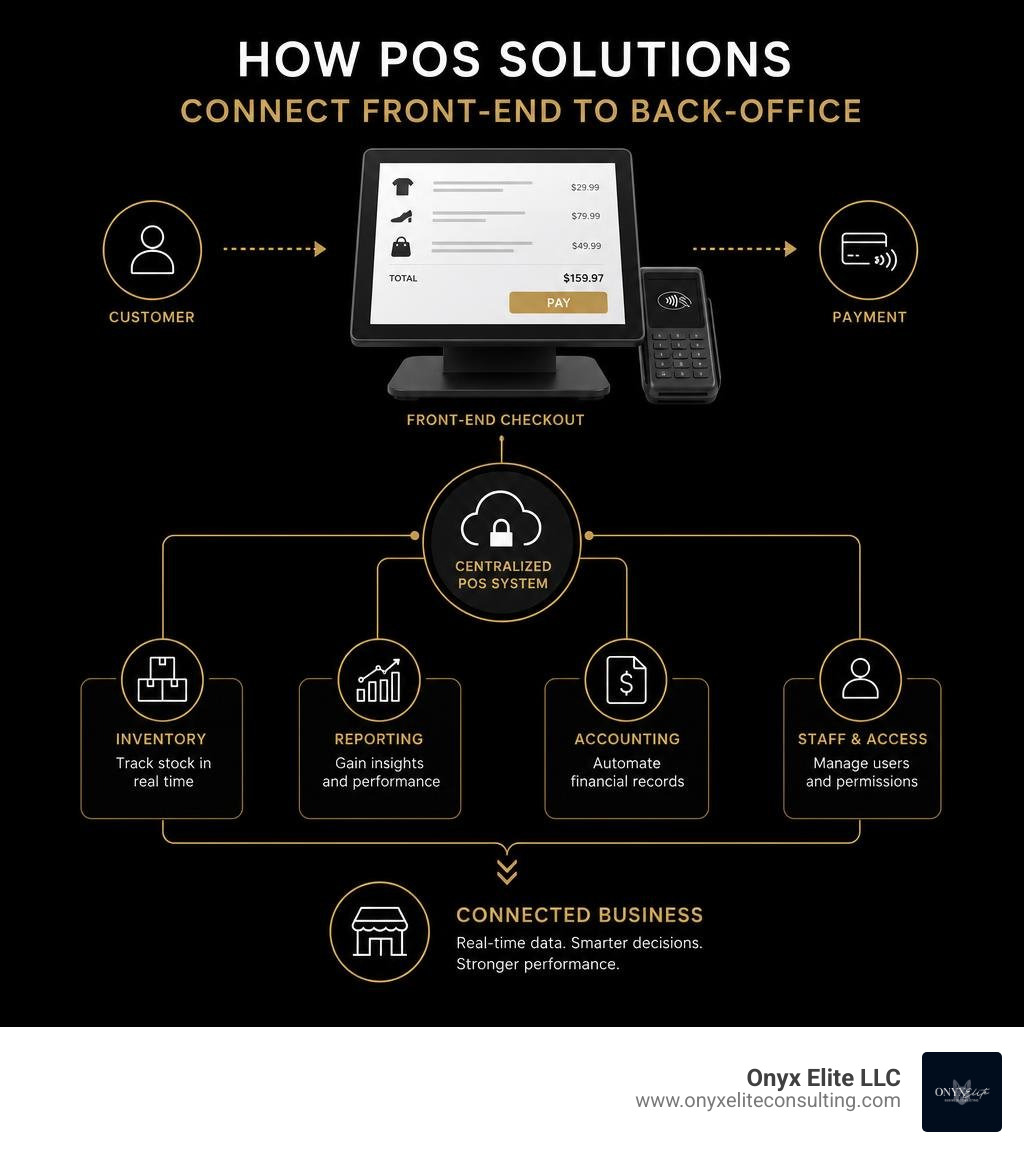
POS solutions are the backbone of modern retail operations — handling everything from payments and inventory to customer loyalty and reporting in one place.
Here's a quick overview of what a POS solution does:
| Function | What It Does |
|---|---|
| Payment Processing | Accepts cash, card, and contactless payments |
| Inventory Management | Tracks stock levels in real time |
| Sales Reporting | Generates insights on revenue and performance |
| Customer Loyalty | Manages VIP programs, rewards, and marketing |
| Staff Management | Controls access levels and tracks activity |
| E-commerce Integration | Connects your physical store to online sales |
Running a retail business without the right point of sale system is like trying to navigate without a map. You might get somewhere — but it takes longer, costs more, and leaves too much to chance.
Modern POS systems do far more than process transactions. They connect your front-of-house operations (checkout, payments, customer interaction) directly to your back office (inventory, accounting, analytics). For business owners juggling multiple locations, suppliers, and sales channels, that integration isn't a luxury — it's a necessity.
The right POS solution can be the difference between a business that reacts to problems and one that prevents them.
I'm Doru Angelo, Founder & CEO of Onyx Elite LLC, and with over a decade of experience in business consulting and operational strategy across retail and hospitality, I've helped leaders identify the right POS solutions to streamline their operations and drive sustainable growth. In this guide, I'll break down everything you need to know — from core features and integrations to choosing the right system for your business.
The Evolution and Profile of POS Solutions

To truly appreciate where retail technology stands in July 2026, we have to look back at how we got here. The journey from heavy, mechanical cash registers to cloud-based, multi-location pos solutions has been nothing short of a retail revolution.
In the early days, a cash register did one thing: it held cash and calculated basic change. Today, a unified point of sale system serves as the central nervous system of your entire business.
One of the true pioneers in this space is the Australian-based company, POS Solutions. Founded in 1983 and headquartered in Keysborough, Victoria, the company started with a small team and grew to become an industry powerhouse. By 2007, the company had grown to around 50 employees, establishing itself as a dominant market leader. With over 38 years in business, POS Solutions has served thousands of stores across Australia, making daily retail operations easier for millions of customers and business owners alike.
Their success was built on a simple philosophy: retail software shouldn't just record what you sold; it should help you understand why you sold it and how to sell more of it. As we look at the modern landscape, their flagship offerings continue to demonstrate how tailored software can transform niche retail markets. You can explore their specialized offerings directly on their Point of sale system for Australia | Point of Sale (POS) Software page.
At Onyx Elite Consulting, operating from our headquarters in West Hartford, Connecticut, we frequently work with retail and service businesses looking to upgrade their technical infrastructure. Whether you are a local boutique in West Hartford or a growing brand planning interstate expansion across Connecticut, understanding this evolution helps you choose a system built for longevity rather than a temporary fix.
Industry-Specific POS Solutions for Australian Retailers
One size rarely fits all in retail. A pet shop has vastly different operational needs compared to a pharmacy or a neighborhood newsagent. The strength of the POS Solutions platform lies in its deep, industry-specific customization.
For newsagencies, which have historically faced complex inventory challenges due to high-volume print media, sub-agents, and home delivery routes, the software provides specialized tools developed over 36 years. It manages delivery runs, processes complex supplier invoices automatically, and optimizes category management to ensure shelf space is always profitable.
In the pharmacy sector, integration is everything. The system connects directly with major dispensing platforms like Fred Dispense (which is installed in over 2,500 sites across Australia) and AMFAC. This allows scripts to be processed seamlessly at the register. Furthermore, automated Pharmx integration links the point of sale directly to the Pharmx Gateway, automating supplier ordering and stock control so pharmacists can focus on patient care instead of back-office paperwork.
Pet shops enjoy a completely different set of features. The software includes built-in tools to issue microchip certificates with serial numbers directly from the register. It also supports appointment bookings for grooming services, manages weight-and-measure records for animals, and tracks customer loyalty through highly targeted VIP programs.
To see how these specific workflows are structured, you can read more on their dedicated Point of sale software | Point of Sale (POS) Software details page.
Key Features of Modern POS Solutions

When evaluating modern pos solutions, it is easy to get distracted by flashy interfaces. However, the true value of any system lies in its core functionality. A robust system like PosBrowser is designed to make serious retail simple.
Let's look at the foundational features that make these platforms indispensable:
- Configurable Touch-Screen Interface: The checkout screen is entirely customizable. You can set up unique button layouts, color-code high-volume items, and build intuitive menus that minimize training time for new staff.
- Real-Time Stock Control: True stock control goes beyond counting items. It includes automatic reorder points, low-stock alerts, and direct electronic data interchange (EDI) with suppliers to streamline the replenishment process.
- Mobile Stock Management: Armed with a handheld android pos device, your staff can perform stocktakes, edit prices, and print labels directly on the shop floor without running back to a counter terminal.
To put this in perspective, let's compare how traditional cash registers stack up against modern, integrated software:
| Feature | Traditional Cash Register | Modern POS Software (e.g., PosBrowser) |
|---|---|---|
| Inventory Tracking | Manual pen-and-paper or basic department keys | Automated, real-time tracking with barcode scanning |
| Payment Processing | Standalone card terminal; manual keying required | Integrated credit card processing |
| Supplier Ordering | Manual phone calls or emails based on guesswork | Automatic reorder alerts and direct EDI supplier syncing |
| Customer Insights | None | Detailed VIP profiles, purchase history, and targeted SMS marketing |
| Staff Oversight | Basic shift totals | Detailed audit trails and function-level security permissions |
Advanced Reporting and Analytics
You cannot manage what you do not measure. Modern retail environments move too quickly for monthly or quarterly reviews; you need actionable data at your fingertips daily.
Advanced pos solutions leverage powerful reporting engines, such as Seagate Crystal Reports, to generate hundreds of highly customized reports. Rather than drowning in raw numbers, business owners can access a centralized Performance Dashboard that highlights key performance indicators (KPIs) like average basket size, peak transaction hours, and top-performing product categories.
By integrating with digital tools like Google Analytics, retailers can bridge the gap between their brick-and-mortar storefronts and their digital spaces. This allows you to track how an online marketing campaign translates to in-store foot traffic and physical sales.
Security, Staff Management, and Loss Prevention
Unfortunately, inventory shrinkage and internal theft remain significant challenges for physical retailers. A modern point of sale system acts as a silent partner in your loss prevention strategy.
With customizable function-level security, you can restrict sensitive actions—such as processing refunds, applying major discounts, or opening the cash drawer without a sale—to specific staff roles. If an employee needs to perform an action outside of their permission level, the system requires a manager override, creating a clear chain of accountability.
Every single keystroke is logged. Comprehensive audit trails allow you to review suspicious transactions step-by-step, helping you identify patterns of fraud before they impact your bottom line. Additionally, integrating these systems with specialized chargeback management services helps protect your business from external payment fraud and costly processing disputes.
Integrations and Multi-Location Management
In 2026, a retail store is rarely just a physical shop. Successful brands operate across multiple channels, which means your pos solutions must seamlessly communicate with your online store, accounting platform, and payment processors.
When it comes to e-commerce, systems like PosBrowser utilize integration tools like Webtail to connect your physical inventory directly to popular platforms such as Shopify, WooCommerce, WordPress, and Nop-Commerce. When a customer buys an item online, your physical store's inventory is updated instantly, preventing the nightmare of double-selling stock.
On the financial side, direct integration with accounting giants like Xero and MYOB eliminates hours of manual data entry. Your daily takings, tax liabilities, and cost of goods sold (COGS) are synced automatically, keeping your books clean and tax-ready.
Payment processing is another critical integration point. By linking your register directly with leading EFTPOS systems in Australia (such as Tyro, Zip, and Pc-Eftpos), the exact sale amount is pushed directly to the card terminal. This eliminates manual keying errors, speeds up checkout times, and keeps lines moving. If you are operating in Connecticut, evaluating your local merchant account options is a vital step to ensure your payment gateways are secure and cost-efficient.
Choosing the Right POS Solutions for Multi-Store Operations
Managing a single retail outlet is challenging; managing five, ten, or fifty locations across Connecticut or interstate can feel overwhelming without the right technology.
Multi-shop systems solve this by establishing centralized stock control. Rather than logging into separate databases for each location, managers can view inventory levels across the entire enterprise from a single dashboard. This enables:
- Seamless Stock Transfers: Easily transfer slow-moving stock from your West Hartford location to a high-demand store across the state.
- Franchise and Pricing Control: Update pricing, launch promotional campaigns, or add new products globally or by specific region in seconds.
- Data Warehousing: Keep your local registers running fast by offloading historical data to a secure, cloud-based data warehouse, ensuring that decades of sales history don't slow down daily transactions.
Overcoming Implementation Challenges and Regulatory Compliance
Upgrading or installing new pos solutions is a major operational milestone, and it is not without its hurdles. One of the most common mistakes business owners make is underestimating the implementation timeline. A successful rollout—from data migration to hardware configuration—typically requires a 6-to-9-month lead time.
During this period, you must ensure hardware compatibility (such as cash drawers, barcode scanners, and receipt printers) and invest heavily in comprehensive staff training. After all, even the most advanced software is only as good as the team operating it.
Furthermore, retailers must prepare for evolving environmental regulations. Across the globe, Deposit Return Schemes (DRS) are becoming standard practice. For example, Norway achieved an incredible 92% return rate for beverage containers by establishing a high density of over 15,000 return points (roughly one redemption point per 360 residents). Slovakia saw a 78% reduction in beverage container litter shortly after implementing their DRS.
These schemes require retailers to integrate Reverse Vending Machines (RVMs) and digital e-voucher systems directly into their POS software. In Ireland, retailers like SuperValu and Centra achieved return rates exceeding 95% through integrated POS systems. Aldi Ireland even drove over €30 million in voucher value in its first year by integrating e-voucher barcodes into its customer loyalty cards.
Whether you are navigating hardware costs—which can vary wildly depending on your industry, as detailed in this breakdown of How Much Do Restaurant POS Systems Cost? - Rezku —or aligning with regional compliance laws, having a clear roadmap is essential. Businesses looking to navigate these complex technical waters often benefit from professional payment strategy consulting and local payment processing solutions connecticut advice to ensure their investments are secure, compliant, and optimized for maximum return on investment.
Frequently Asked Questions about POS Systems
What is the difference between a POS system and billing software?
While both tools handle transactions, billing software is simple and transactional—it only records sales and generates invoices. A complete POS system serves as an all-in-one business management platform. It processes the transaction while simultaneously updating inventory levels, tracking vendor purchase orders, logging customer loyalty points, and feeding real-time data into your business analytics dashboard.
How does PosBrowser support pharmacy and pet shop operations?
PosBrowser includes built-in, industry-specific features that traditional POS systems lack. For pharmacies, it integrates directly with the Pharmx Gateway and dispensing software like Fred Dispense, allowing automatic script processing at checkout. For pet shops, it includes built-in tools to generate official animal microchip certificates with unique serial numbers, manage customer pet profiles, and schedule grooming appointments directly within the main retail calendar.
What integrations are essential for a modern retail POS?
To run an efficient omnichannel business, your POS system should feature three core integrations:
- EFTPOS / Payment Processing: To eliminate manual entry errors at checkout.
- Accounting Software (like Xero or MYOB): To automate your daily bookkeeping.
- E-commerce Platforms (like Shopify or WooCommerce): To sync your physical and digital storefronts in real time.
For a deeper dive into choosing the right merchant services and gateways for these integrations, check out our comprehensive credit card processing consulting guide.
Conclusion
Selecting and implementing the right pos solutions is one of the most critical decisions you will make for your retail business. It is not merely about buying a piece of hardware or subscribing to software; it is about building a scalable foundation that supports your long-term business goals.
At Onyx Elite Consulting, we help businesses in West Hartford, Connecticut, and beyond navigate these complex strategic transitions. We work closely with your team to deliver tailored strategic planning, brand development, and operational consulting that goes far beyond traditional, out-of-the-box software recommendations. Our mission is to help you achieve sustainable growth and operational excellence by aligning your technology with your business vision.
Ready to optimize your retail operations and elevate your payment strategy? Explore our full suite of customized services on our Onyx Elite Consulting Services page, and let's build a more efficient, profitable business together.